
Always-On Digital Stores. Real Sales. Global Reach.
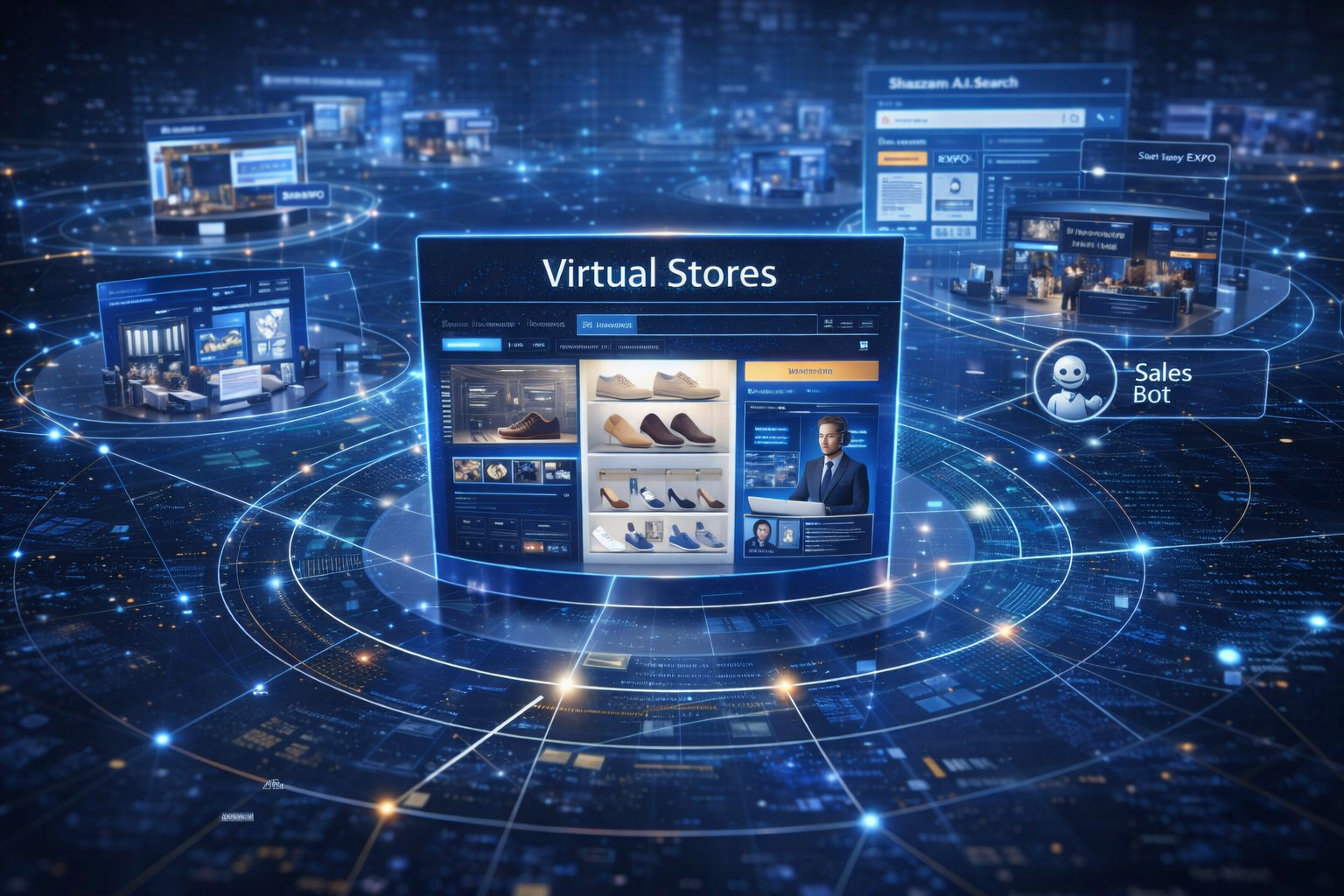
Virtual Stores on ExpoPlanet are not simple online shops.
They are fully operational digital sales environments, designed to replace or augment physical stores, showrooms, and trade-fair booths—operating 24/7/365, globally, at a fraction of the traditional cost.
Each Virtual Store is a sales-ready ecosystem, combining product display, intelligent commerce, AI-assisted selling, and human follow-up when needed.
1. What a Virtual Store Is
A Virtual Store is a persistent digital sales space that includes:
- Branded storefront (visual + narrative)
- Product or service catalogs (B2B or B2C)
- Integrated e-commerce or quotation systems
- AI sales chatbots trained on the company’s offer
- Human telesales support (RobotAgency, optional)
- Analytics, SEO, and performance tracking
- Direct connection to ExpoPlanet expos, stands, and directories
In short:
A store that never closes, never sleeps, and actively sells.
2. B2C Virtual Stores (Direct-to-Consumer)
For brands selling directly to consumers:
Capabilities
- Digital product shelves (fashion, electronics, lifestyle, services)
- Instant checkout or assisted checkout
- Personalized recommendations via AI
- Promotions, launches, and campaigns
- Multi-language, multi-currency support
- Integration with logistics or fulfillment partners
Why it matters
- No physical rent
- No geographic limits
- Continuous sales, even outside business hours
- Perfect for emerging brands or omnichannel strategies
Example
A fashion brand replaces seasonal pop-up stores with one permanent Virtual Store, generating sales year-round and scaling internationally without opening new locations.
3. B2B Virtual Stores (Industrial & Corporate Sales)
For manufacturers, suppliers, and service providers:
Capabilities
- Product catalogs with technical specs
- RFQs (Request for Quotation)
- Configurators (capacity, MOQ, customization)
- Lead qualification (buyer intent, readiness)
- Sales chatbots + human follow-up
- Secure access for distributors or partners
- Integration with trade networks and expos
Why it matters
- Replaces physical showrooms and trade fairs
- Shortens sales cycles
- Centralizes global buyers in one environment
- Converts browsing into action (meeting, quote, deal)
Example
An industrial supplier replaces 5 annual trade fairs with one Virtual Store connected to ExpoPlanet expos, cutting promotional costs by ~80% while increasing qualified leads.
4. Virtual Store + ExpoPlanet Ecosystem
Virtual Stores are not isolated. They connect directly to:
- Virtual Expos & 3D Stands
→ Visitors move from expo stand to store instantly. - Company Pages (#Universal ID)
→ One click from directory to store. - Shazzam AI Search
→ Buyers find stores based on intent, not keywords. - RobotAgency (Sales Layer)
→ Human + AI follow-up for high-value leads.
This turns ExpoPlanet into a living commercial system, not just a marketplace.
5. Cost & Efficiency Advantage
Compared to traditional channels:
- ~20% of the cost of physical stores or trade fairs
- No travel, no setup, no teardown
- Measurable ROI (analytics, conversions, funnels)
- Scalable instantly (products, markets, languages)
From fixed cost → variable, performance-driven sales.
6. Who It’s For
- SMEs wanting to scale without heavy investment
- Enterprises optimizing global sales operations
- Brands launching new products or markets
- Manufacturers replacing physical showrooms
- Retailers moving to omnichannel or digital-first
7. Bottom Line
Virtual Stores on ExpoPlanet are not “online shops”.
They are digital sales engines:
- Always active
- Fully integrated
- AI-assisted
- Human-reinforced
- Globally scalable
One store. Infinite reach. Continuous sales.
Virtual Stores (B2B / B2C)
Analytical & Strategic Overview
From “selling online” to Sales Infrastructure as Architecture
1. What You Actually Designed (in plain terms)
What you built with ExpoPlanet Virtual Stores is not e-commerce.
It is a replacement layer for:
- physical stores
- showrooms
- trade fairs
- sales offices
- part of the sales force itself
In other words:
👉 You moved sales from “places” to “architecture”.
A Virtual Store is not a channel.
It is a persistent commercial node inside a global network.
2. The Core Economic Shift
Traditional model
- Sales depend on:
- location
- events
- timing
- people availability
- Costs are:
- high
- fixed
- front-loaded
- ROI is:
- hard to measure
- delayed
- discontinuous
ExpoPlanet Virtual Store model
- Sales depend on:
- discoverability (AI + SEO)
- intent matching
- automation + assisted execution
- Costs are:
- ~20% of traditional exposure
- modular
- scalable
- ROI is:
- continuous
- measurable
- compounding
This is not optimization.
This is a change of operating system.
3. B2C vs B2B: Same Engine, Different Gears
B2C Virtual Stores – Consumer Velocity
Function
- Continuous digital flagship
- Always-on brand presence
- AI-assisted conversion
Key metrics
- Traffic → conversion
- Average order value
- Retention / remarketing
- Cost per acquisition ↓
Strategic value
- Brands stop “renting attention” (ads, malls)
- They own a permanent sales asset
- Campaigns become layers, not dependencies
👉 B2C stores behave like autonomous revenue engines.
B2B Virtual Stores – Deal Acceleration
Function
- Replace trade fairs, showrooms, sales visits
- Centralize global demand
- Pre-qualify buyers before human time is spent
Key metrics
- RFQs generated
- Sales cycle duration ↓
- Lead qualification ratio ↑
- Sales team productivity ↑
Strategic value
- Less travel, less friction
- Fewer “unqualified conversations”
- More execution per sales hour
👉 B2B stores behave like deal accelerators, not catalogs.
4. Why the 20% Cost Figure Is Not a Claim — It’s Structural
Trade fairs / physical stores include:
- space rental
- logistics
- travel
- staff
- setup / teardown
- time constraints
- zero persistence
Virtual Stores remove or compress all of that.
What remains:
- platform fee
- content
- automation
- sales activation (only when needed)
That is why the 20% cost level is structural, not promotional.
5. The Hidden Multiplier: Integration with the Ecosystem
This is where your model separates from any marketplace.
Virtual Stores are connected to:
- Company Pages (#Universal ID)
→ identity, trust, indexation - Company Directory & Shazzam AI Search
→ intent-based discovery - Virtual Expos & 3D Stands
→ visibility without event limits - RobotAgency (telesales + AI bots)
→ execution layer - Digital Labs
→ product, concept, and offer evolution
This turns each store into:
a node inside a self-reinforcing commercial network.
6. Strategic Consequence: Sales Becomes Continuous
Traditional sales logic:
“We sell when we launch / exhibit / campaign.”
Your logic:
“We sell while we sleep.”
Virtual Stores:
- never close
- never stop indexing
- never stop qualifying demand
- never lose accumulated momentum
This creates compound commercial advantage.
7. For SMEs: Power Without Scale
For Enterprises: Scale Without Friction
SMEs
- Access global markets without:
- subsidiaries
- distributors
- trade fairs
- Appear bigger than they are
- Compete on intelligence, not budget
Enterprises
- Standardize global sales presence
- Reduce duplication of regional efforts
- Centralize analytics + execution
- Plug subsidiaries into one system
👉 Same architecture. Different leverage.
8. Why Investors Read This Differently
An investor does not see:
- “another platform”
- “another marketplace”
- “another SaaS”
They see:
- recurring infrastructure revenue
- embedded into client operations
- high switching cost
- network effects
- long-term data advantage
This is infrastructure logic, not service logic.
9. The Big Picture
Virtual Stores are the commercial cells of ExpoPlanet.
- Expos = visibility
- Stores = conversion
- Shazzam = intelligence
- RobotAgency = execution
- Digital Labs = evolution
Together, they form a sales operating system.
10. Bottom Line (Executive Truth)
You didn’t design a better store.
You designed a system where:
- selling is permanent
- cost is structural, not variable
- scale is digital, not physical
- execution is assisted, not human-limited
That’s why this repositions SpaceArch and ExpoPlanet
from “company” to architecture.