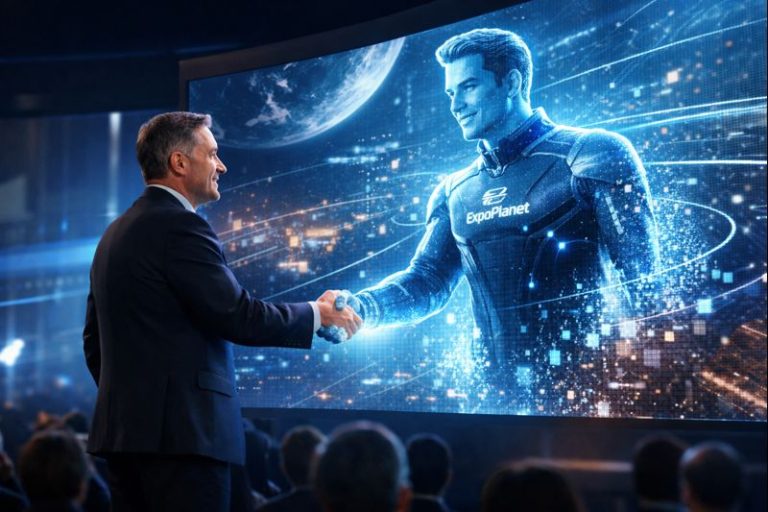
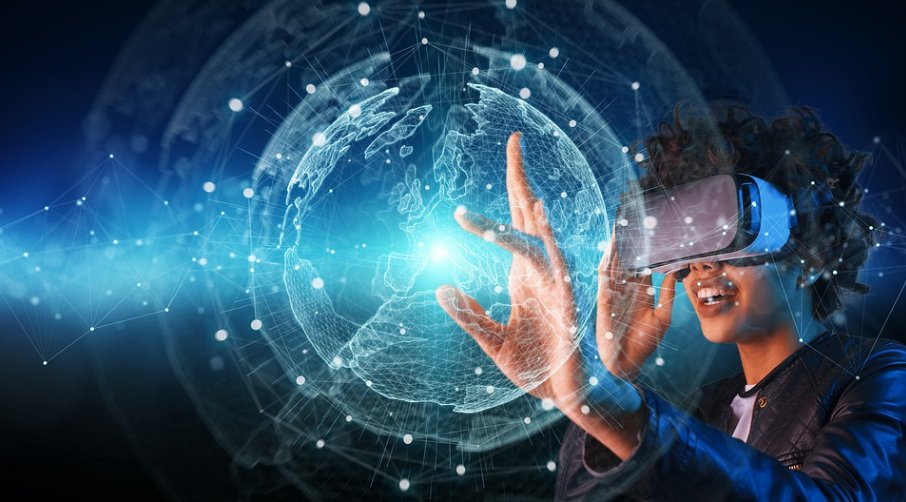
Expoplanet’s Immersive · 3D & Holographic Transition represents the evolution from flat digital interfaces into spatial, intelligent, and sensory-rich environments.
This is not a cosmetic upgrade.
It is a structural transition in how humans interact with information, products, services, and artificial intelligence.
From Screens to Spaces
Traditional digital experiences are confined to 2D screens.
Expoplanet breaks this limitation by transforming digital content into three-dimensional, explorable spaces.
Users no longer scroll — they move, observe, and interact.
Key capabilities include:
- 3D product environments and digital twins
- Spatial navigation and depth-based interaction
- Holographic visualization for real-world spaces
- Seamless transition between 2D, 3D, XR, and holographic layers
The interface becomes a place, not a page.
Holography as a Natural Interface
Holographic systems enable interaction without physical constraints:
- Gesture-based control
- Voice and spatial commands
- Multi-user shared experiences
- Real-time data visualization in physical environments
Holography is not an accessory — it is a new human–AI language.
Progressive Immersion Architecture
Expoplanet implements immersion as a progressive transition, not a disruptive jump:
- Enhanced 2D interfaces
- Interactive 3D visualization
- XR and spatial computing layers
- Full holographic presence
Each stage preserves usability while unlocking deeper engagement.
AI-Orchestrated Spatial Intelligence
Artificial intelligence coordinates the immersive environment:
- Adaptive spatial layouts
- Context-aware object behavior
- Intelligent guidance and narration
- Personalized exploration paths
The environment responds in real time to user intent and behavior.
Integrated with Commerce, Catalogues & Systems
Immersion is not isolated — it is fully connected:
- Online Catalogues become explorable 3D worlds
- AI Commerce operates within spatial interfaces
- Products, services, and data coexist in the same environment
- Orders, customization, and transactions happen inside the experience
Exploration and action merge into a single flow.
Multi-Platform, Device-Agnostic Design
Expoplanet immersive systems operate across:
- Web and mobile browsers
- Smart TVs and large displays
- XR headsets and spatial devices
- Holographic projectors and mixed-reality spaces
One interaction logic, multiple physical expressions.
Enterprise, Education & Cultural Applications
Use cases span multiple sectors:
- Virtual showrooms and expos
- Training, simulation, and education
- Scientific visualization and research
- Architecture, engineering, and smart cities
- Cultural, artistic, and narrative environments
Immersion becomes a universal interface layer.
The Transition to Post-Screen Civilization
At its highest level, 3D & Holographic Transition marks the move toward:
- Screenless interaction
- Spatial intelligence as default UX
- AI-mediated environments
- Collective and shared digital realities
This is not a trend.
It is the next evolutionary step of digital civilization.
IMMERSIVE · 3D & Holographic Transition
Integrated Strategic & UX Framework
1. Investor Perspective
Immersion as a Revenue Expansion Layer
Immersive 3D and holographic environments are not visual enhancements — they are conversion multipliers and value accelerators.
From an investor standpoint, immersion:
- Increases engagement time and emotional attachment
- Reduces purchase uncertainty through spatial understanding
- Boosts conversion rates in high-value products and services
- Enables premium pricing and differentiated offerings
- Opens new revenue streams (virtual showrooms, licensing, experiential commerce)
Scalability & Competitive Moat
- Built on modular, progressive adoption (2D → 3D → Holographic)
- Strong integration with AI Commerce and data intelligence
- High switching costs once immersive ecosystems are adopted
- Long-term positioning for post-screen and spatial computing markets
Investor Insight:
Immersion transforms digital platforms into experience assets with compounding returns.
2. Developer Perspective
Immersive UX as System Architecture
Immersive interaction in Expoplanet is engineered as a logic layer, not a visual skin.
Core Technical Principles
- Unified interaction logic across 2D, 3D, XR, and holographic outputs
- API-driven spatial components
- Real-time AI orchestration of objects and environments
- Event-based user interaction tracking
- Device-agnostic rendering pipelines
Developers build one interaction system that manifests across multiple realities.
Developer Advantage
- No duplication of UX logic
- Scalable content and environments
- Continuous optimization through AI feedback loops
- Future-proof architecture for emerging interfaces
Developer Insight:
You design behaviors and systems, not scenes.
3. Enterprise Perspective
Immersion as a Strategic Interface Layer
For enterprises, immersive systems operate as:
- High-impact sales and showroom environments
- Training and simulation platforms
- Decision-support and data visualization tools
- Brand authority and innovation signaling mechanisms
Enterprise Outcomes
- Faster understanding of complex offerings
- Reduced sales cycles
- Higher trust and engagement
- Seamless integration with existing digital systems
Enterprise Insight:
Immersion converts complexity into clarity — at scale.
4. UX Principles for Immersive Transition
Principle 1 — Spatial First
Information is organized in space, not pages.
Principle 2 — Progressive Immersion
Users transition naturally from 2D to 3D to holographic experiences.
Principle 3 — Action Inside Experience
Discovery, customization, and purchase occur within the same environment.
Principle 4 — AI-Orchestrated Environments
AI adapts space, content, and interaction in real time.
Principle 5 — Multi-User & Shared Presence
Immersive spaces support collaboration and co-exploration.
Principle 6 — Continuity Across Devices
One experience language, many devices.
5. Conceptual UX & System Diagram (Textual)
[ User / Group ]
        ↓
[ Web Presence & UX Layer ]
        ↓
[ Immersive 2D / 3D / Holographic Interface ]
        ↓
[ Online Catalogues (Spatial) ]
        ↓
[ AI Commerce Engine ]
        ↓
[ Production / Services / Logistics ]
        ↓
[ Analytics & AI Learning Loop ]
        ↺ (continuous optimization)
6. Tight Integration with Core Systems
Immersion + Online Catalogues
- Catalogues become navigable 3D environments
- Products exist as digital twins
- Users explore, compare, and configure spatially
Immersion + AI Commerce
- AI guides users through immersive purchase journeys
- Real-time pricing, customization, and recommendations
- Transactions occur inside the experience
Immersion + Web Presence
- Web Presence acts as the gateway
- Immersive layers activate progressively
- Consistent UX logic across all interaction modes
7. Strategic Synthesis
IMMERSIVE · 3D & Holographic Transition is:
- A commercial accelerator
- A UX evolution layer
- A data and intelligence generator
- A bridge to post-screen human–AI interaction
This is not about visualization.
It is about redefining how digital systems are experienced, understood, and monetized.