 Expoplanet Invest Brief

Immersive Fashion Spaces for the Hybrid World
FF Showrooms redefine the concept of a fashion store.
They are not physical locations replicated online.
They are intelligent, immersive, hybrid environments where fashion, AI, avatars, and commerce converge into a single experiential system.
A FF Showroom is simultaneously:
- A digital flagship
- A media space
- A personalization engine
- A commerce interface
- A brand universe
1. From Stores to Experience Systems
Traditional showrooms are:
- Static
- Inventory-dependent
- Limited by space and geography
FF Showrooms are:
- Dynamic
- Inventory-free by default
- Globally accessible
- Continuously reconfigurable
They operate as experience systems, not sales floors.
2. Hybrid Architecture (Physical + Digital)
FF Showrooms exist across multiple layers:
- Pure Digital Showrooms
Accessible via web, VR, large screens, and Expoplanet environments - Hybrid Physical-Digital Spaces
Minimal physical footprint
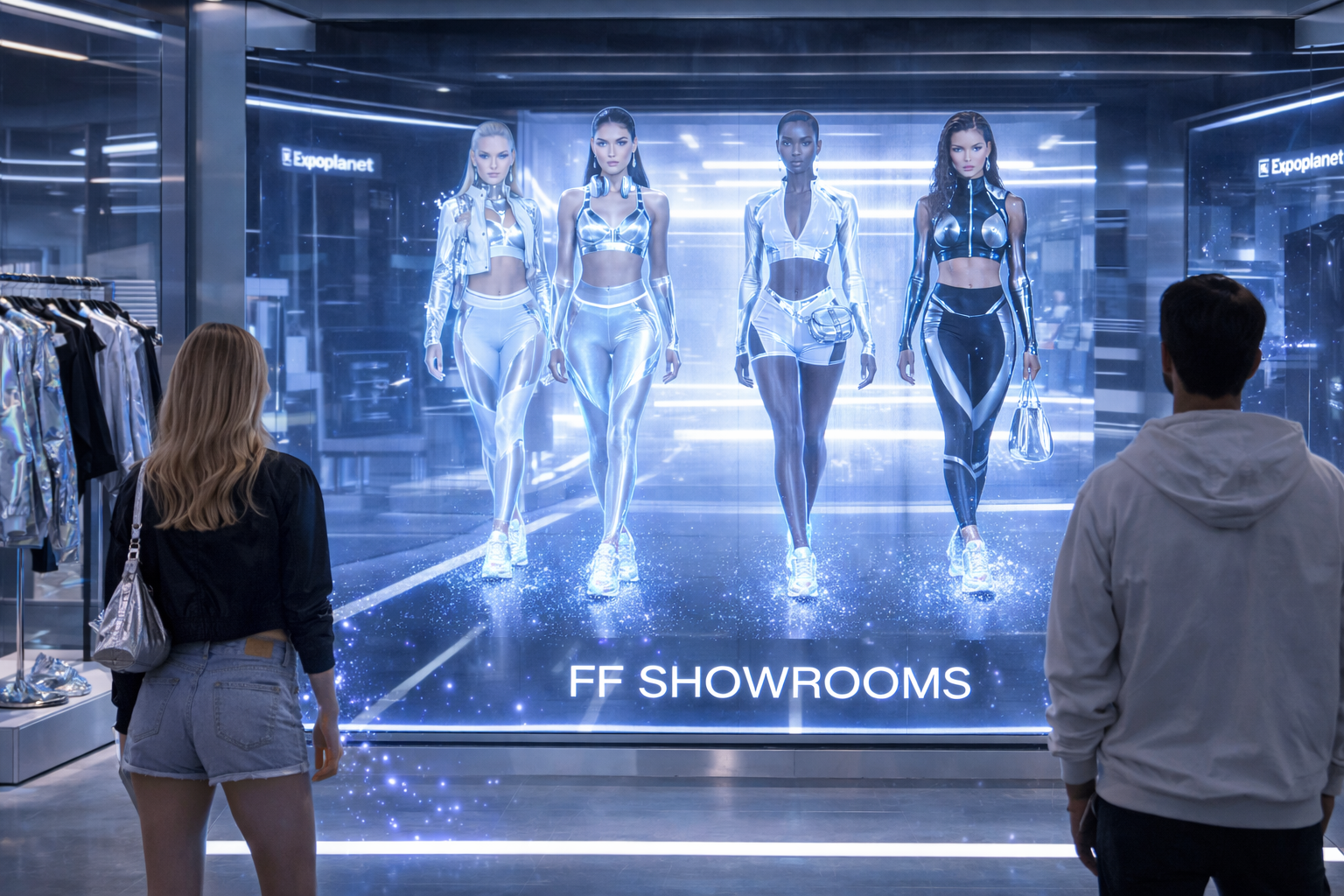
Large wall-scale displays
Digital mirrors
AI avatars as guides - Pop-Up & Event-Based Showrooms
Temporary, modular, fully digital-first
This allows global scalability with minimal capital expenditure.
3. Core Components of an FF Showroom
A. Immersive Visual Layer
- Wall-scale displays
- 3D environments
- Digital runways embedded in the space
- Cinematic lighting and motion
The showroom adapts visually to:
- Collections
- Time of day
- Events
- User profile
B. Digital Mirrors & Avatars
Users interact with:
- Their own avatar
- AI fashion models
- Brand avatars
Capabilities:
- Real-time try-on
- Body simulation
- Style variation
- Material and color changes
The mirror becomes a decision interface, not a reflection.
C. AI Styling & Guidance
AI avatars function as:
- Stylists
- Brand narrators
- Product guides
They:
- Understand user preferences
- Suggest outfits
- Explain design logic
- Assist purchasing decisions
Retail becomes conversational and personalized.
4. Inventory-Free Commerce Logic
FF Showrooms operate with:
- Digital-first presentation
- On-demand physical production
- Optional digital-only garments
Benefits:
- No dead stock
- No overproduction
- Reduced logistics
- Higher margins
The showroom sells validated demand, not speculative inventory.
5. Integration with Digital Runways
FF Showrooms are directly connected to:
- Digital Runways
- Fashion Weeks
- Collection launches
After a runway:
- Looks appear instantly in the showroom
- Users can explore, save, customize, or purchase
- Limited editions and drops are activated
Runways and showrooms form a single continuous experience loop.
6. Data & Intelligence Layer
Every FF Showroom generates real-time intelligence:
- Engagement heatmaps
- Try-on frequency
- Style preferences
- Conversion pathways
This data feeds:
- Designers
- Brands
- Production routing
- Future collections
The showroom becomes a strategic sensor, not just a display.
7. Sustainability by Design
FF Showrooms structurally reduce:
- Physical inventory
- Transportation
- Material waste
- Energy consumption
Sustainability is not a message —
it is a system outcome.
8. Strategic Value
For Designers & Brands
- Global presence without global stores
- Total control over narrative and aesthetics
- Direct relationship with the audience
For Consumers
- Personalized fashion experience
- No fitting rooms
- No pressure
- No compromise between digital and physical
For Investors
- Asset-light expansion
- High-margin experiential commerce
- Strong defensibility through integration
9. The Future of Retail
FF Showrooms are not stores of the future.
They are the end of stores as we know them.
Fashion becomes:
- Immersive
- Intelligent
- Personal
- Sustainable
- Scalable
FF Showrooms
Where fashion is experienced before it is produced.
FF SHOWROOMS
Layouts · Franchising · Training · Investor Thesis
I. FF Showroom Layouts
Modular, Asset-Light, Scalable by Design
FF Showrooms are not stores.
They are interfaces between users, AI, avatars, and fashion systems.
All layouts follow the same core principle:
Minimal physical footprint + maximal digital surface + AI intelligence
1. FF Showroom – SMALL
Micro Hub / Urban Node
Size:
- 20–40 m²
Target locations:
- Urban centers
- Galleries
- Malls
- Pop-up spaces
- Airports / transport hubs
Core Components:
- 1 wall-scale digital display (floor-to-ceiling)
- 1 interactive digital mirror
- 1 AI avatar stylist interface
- Minimal physical samples (optional)
- On-demand ordering terminal
Functions:
- Try-on via avatar
- Style discovery
- Digital-first purchasing
- Entry point to FF ecosystem
Staffing:
- 0–1 human facilitator
- AI handles styling, guidance, and sales
Use case:
- Rapid deployment
- Market testing
- Franchise entry-level
- High ROI / low CAPEX
2. FF Showroom – MEDIUM
City Flagship / Experience Hub
Size:
- 60–120 m²
Target locations:
- Prime urban retail areas
- Fashion districts
- High-footfall zones
Core Components:
- Multiple wall-scale displays
- 2–3 digital mirrors
- Dedicated Digital Runway zone
- Avatar-based concierge & stylists
- Event-capable configuration
Functions:
- Full collection immersion
- Digital runway screenings
- Capsule launches
- Community events
- Creator & designer presentations
Staffing:
- 1–2 human hosts
- AI handles most interactions
Use case:
- Brand presence
- Community building
- Events & drops
- Strong data generation
3. FF Showroom – FLAGSHIP
Iconic Experience Space
Size:
- 200–400+ m²
Target locations:
- Global capitals
- Fashion weeks cities
- Strategic brand hubs
Core Components:
- Immersive 360° digital environments
- Large-scale Digital Runway stage
- Multiple avatar interaction zones
- VIP / collector rooms
- Live-stream & recording infrastructure
Functions:
- Digital Fashion Weeks
- Couture & Avant-Garde launches
- Investor & media events
- Gen Academy showcases
Staffing:
- Curated human team + AI orchestration
Use case:
- Brand authority
- Media amplification
- Strategic partnerships
II. Pricing & Franchising Logic
Asset-Light Expansion Model
FF Showrooms operate under a franchise + platform hybrid model.
1. Franchise Entry Model
Initial Franchise Fee (indicative):
- Small: Low 5 figures USD
- Medium: Mid 5 figures USD
- Flagship: Negotiated / partnership-based
Includes:
- Brand license
- Software platform
- AI avatars access
- Showroom system integration
- Training via Gen Academy
2. Revenue Streams (Per Showroom)
- Product sales (physical + digital)
- Phygital drops
- Premium avatar sessions
- Events & launches
- Memberships
- Sponsorship activations
3. Revenue Split (Typical Model)
- Franchisee: 60–70% net
- FF Platform: 30–40%
FF share covers:
- Technology
- AI infrastructure
- Platform updates
- Global marketing
- Avatar IP access
4. Why This Model Works
- No inventory risk
- No seasonal dependency
- No heavy staffing
- No logistics complexity
Franchisees operate interfaces, not warehouses.
III. Alignment with Gen Academy
Training Operators, Not Clerks
FF Showrooms are directly integrated with Gen Academy.
1. Training Objectives
Gen Academy does not train retail staff.
It trains:
- Experience operators
- Digital fashion facilitators
- AI-assisted sales strategists
- Event & community hosts
2. Training Modules
Core Modules:
- FF System Overview
- AI Avatars & Styling Logic
- Digital Runways & Events
- UX & User Psychology
- Sustainability by Design
- Data Interpretation & Feedback
Advanced Modules:
- Showroom optimization
- Local market adaptation
- Creator & designer onboarding
- Event monetization
3. Strategic Advantage
- Operators are productive from day one
- Minimal onboarding friction
- System consistency globally
- Talent pipeline for FF expansion
Gen Academy becomes the human OS of the showroom network.
IV. Investor Retail Disruption Thesis
Why FF Showrooms Replace Traditional Retail
1. The Problem with Traditional Retail
- High fixed costs
- Inventory risk
- Low personalization
- Declining foot traffic
- Unsustainable overproduction
Retail is structurally broken.
2. FF Showrooms Change the Equation
| Traditional Retail | FF Showrooms |
|---|---|
| Inventory-based | Demand-based |
| Seasonal | Continuous |
| Static | Adaptive |
| Human-dependent | AI-orchestrated |
| Local reach | Global reach |
3. Economic Impact
- CAPEX ↓ dramatically
- OPEX ↓ significantly
- Margins ↑
- Scalability ↑
- Sustainability ↑
Retail becomes software-like.
4. Strategic Moat
FF Showrooms combine:
- AI Models & Avatars
- Digital Runways
- On-demand production
- Gen Academy talent
- Data & intelligence layer
Competitors can copy parts.
They cannot replicate the system.
5. Long-Term Vision
FF Showrooms are:
- Fashion interfaces
- Media nodes
- Data sensors
- Cultural spaces
They position Expoplanet & Future Fashion as:
The operating system of post-physical retail
Final Positioning
FF Showrooms
Not stores. Interfaces.
They scale globally,
train locally,
operate digitally,
and monetize intelligently.