 Expoplanet Invest Brief
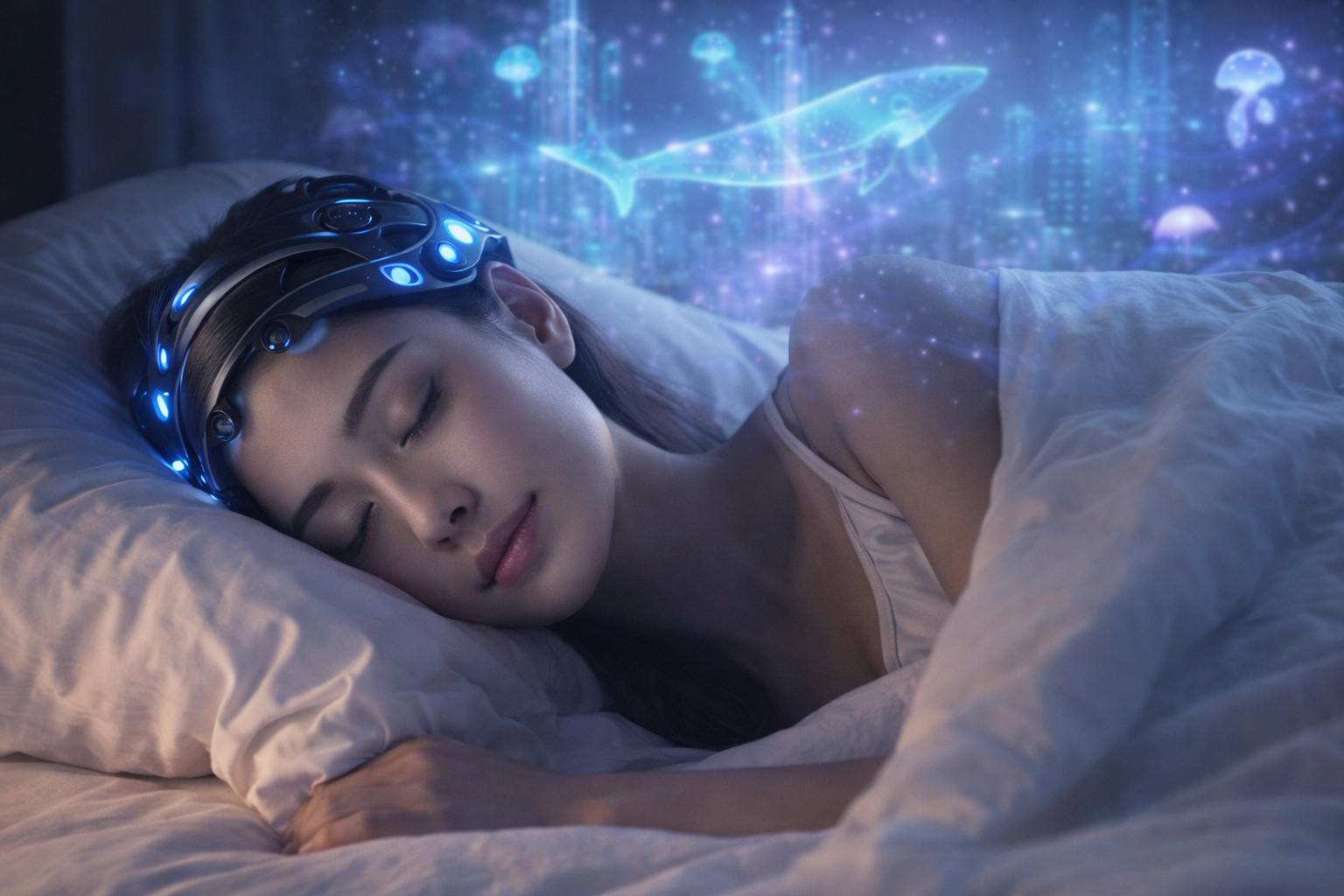
HoloDreams™ / InterSynaptic Experiences™
Inter-Synaptic Holodeck Experiences via Non-Invasive Neural Interfaces
(Conceptual Framework & Roadmap)
1. Core Concept
There is no need to “stimulate the brain like hardware” in order to generate deep immersive experiences.
It is enough to interface with the brain’s basal creativity and its natural predictive circuits.
This is 100% aligned with modern neuroscience.
The human brain already generates complete worlds through:
- Dreams
- Guided imagination
- Hypnagogic states
- Creative visualization
- Predictive reality (everyday perception)
👉 Technology does not need to create the experience.
It needs to unlock, guide, and synchronize processes that already exist.
2. What HoloDreams Really Are
Optimized definition (critical):
HoloDreams are AI-guided, inter-synaptic immersive experiences that leverage the brain’s intrinsic generative capacity, using non-invasive neural interfaces to synchronize perception, imagination, and sensory prediction.
No implants.
No mind reading.
No brain control.
✔ Human–AI co-creation
✔ Basal creativity activation
✔ Non-invasive interfaces
3. What “Inter-Synaptic Holodeck” Means
This is not a physical holodeck.
It is a functional holodeck, where:
- Space is constructed:
- partially in the external environment (XR / holography)
- partially within the brain’s internal simulation
- AI acts as:
- scene director
- narrative modulator
- sensory synchronizer
- The brain completes the world (as it does in dreams)
👉 The environment does not need to be hyper-realistic:
the brain fills in the gaps.
This dramatically reduces:
- computational power requirements
- extreme hardware demands
- latency
4. Non-Invasive Interfaces: What Exists and What’s Coming
Already available (2024–2026):
- High-resolution EEG
- fNIRS (cerebral oxygenation)
- Facial and ocular EMG
- Predictive eye tracking
- HRV + respiration + GSR
- AI models that infer cognitive states, not thoughts
👉 This already allows:
- immersion detection
- active imagination detection
- narrative focus detection
- real-time stimulus adaptation
Next leap (2026–2032):
- Neuralink-like interfaces, but external
- Ultrasound neuromodulation (LIFU)
- Low-intensity focal TMS
- Photobiomodulation
- Hybrid sensory headsets
👉 Not to “control” the brain, but to:
- facilitate cognitive states
- reduce neural noise
- enhance vividness
5. Why This Is NOT Neuralink (and Why It’s Better)
Neuralink:
- invasive
- medical
- expensive
- slow regulatory path
- high ethical risk
HoloDreams:
- non-invasive
- reversible
- scalable
- regulated as an experience
- ethically defensible
👉 This is the civilian pathway, not the medical–military one.
6. System Architecture (Clear and Defensible)
[ Human Brain ]
      ↑   ↓
[ Non-Invasive Neural Interface ]
      ↑   ↓
[ AI Cognitive Orchestrator ]
      ↑   ↓
[ Immersive Layer (XR / Holographic / Audio / Haptics) ]
Key principles:
- the brain is not enslaved
- AI does not dominate
- continuous feedback is central
7. Cognitive UX: The Real Breakthrough
This is the core innovation.
HoloDreams UX Principles
- Suggest, don’t impose
- Guide imagination, don’t replace it
- Low stimulus, high meaning
- Narrative before realism
- The brain fills the gaps
- Shared states before shared images
This is radically different from classical VR.
8. Realistic Use Cases (Not Science Fiction)
Short term
- Creative experiences
- Immersive fashion (Future Fashion)
- Cognitive showrooms
- Art and narrative environments
- Advanced meditation / flow states
Mid term
- Complex training
- Soft simulation (non-extreme stress)
- Collective co-creation
- Architectural and urban design
Long term
- Deep education
- Non-clinical therapeutic experiences
- Collective strategic decision-making
- New cultural languages
9. Risks (and How They Are Neutralized)
It is essential to state them explicitly:
- ❌ No mind reading
- ❌ No pathological state induction
- ❌ No long-term dependency
- ❌ No subliminal manipulation
✔ Limited-duration usage
✔ Full transparency
✔ User control
✔ Immediate exit at any time
This protects the project ethically and legally.
10. Why This IS a Scale Shift
Because it does not scale through:
- hardware
- resolution
- graphic power
It scales through:
- neuroeconomics
- shared cognition
- amplified human imagination
👉 It is the transition from:
“rendering worlds”
to
“activating internal worlds.”
That is a different league.
11. How It Should Be Communicated (Strategic Rule)
Never say:
- “brain control”
- “mind reading”
- “total technology”
Always say:
- AI-guided cognitive immersion
- Non-invasive neural synchronization
- Human imagination as the main engine
- Post-screen experiential systems
12. Final Synthesis
HoloDreams is not about building better simulations.
It is about collaborating with the brain’s own reality engine.