 Expoplanet Invest Brief


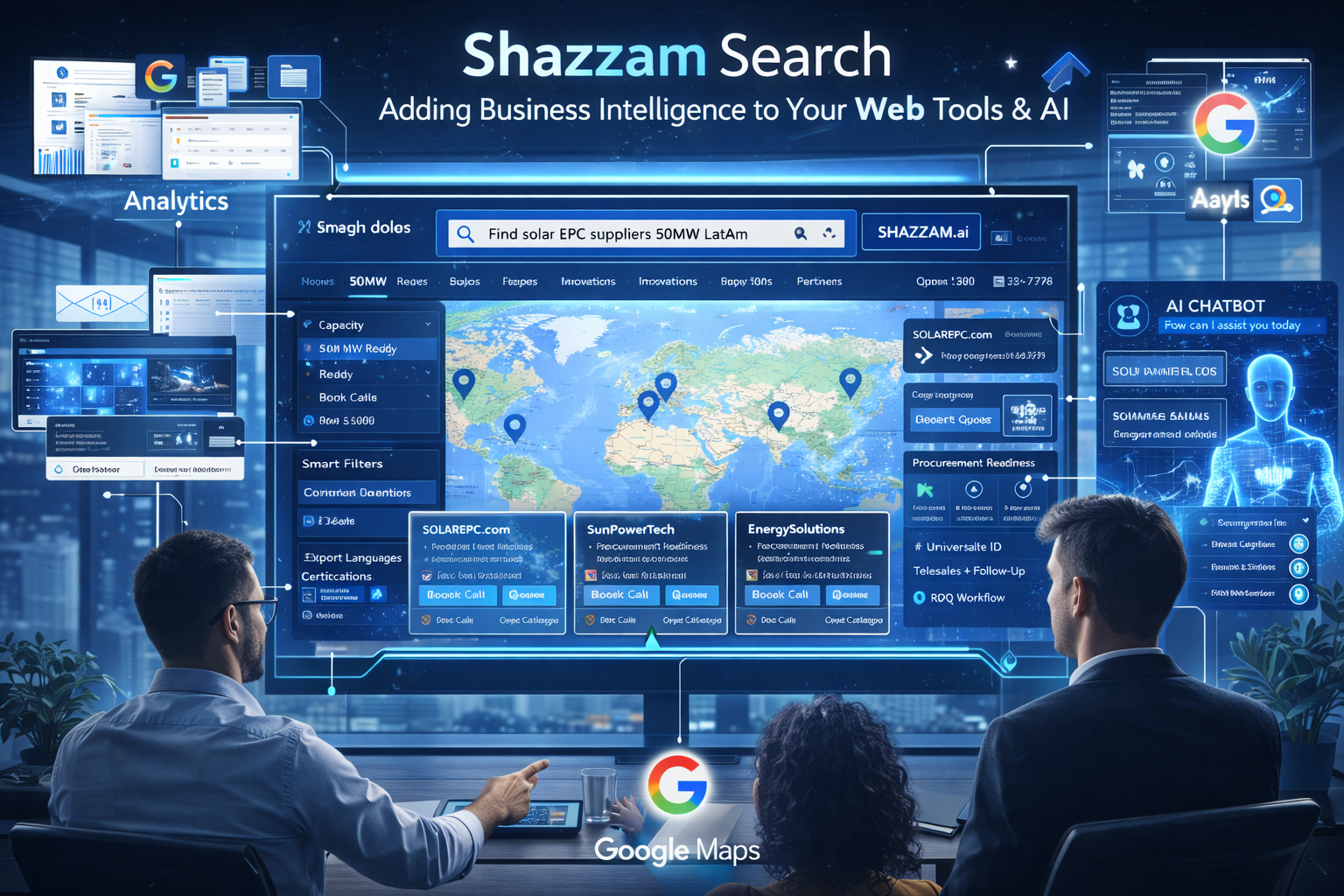
At its core, Shazzam MapSearch is a simple but powerful idea:
A map embedded inside a vertical business search engine
—or a search engine embedded inside a map.
Where:
- Google Maps provides the physical layer:
- cartography
- geocoding
- routes and distances
- POIs and base geographic data
- Shazzam (ExpoPlanet AI Search) adds the higher business layer:
- intent detection (buyer vs supplier vs investor)
- real industry classification
- demand–offer fit
- scoring (relevance, readiness, compliance, capacity)
- direct contact and commercial activation
In short:
Maps = the physical world.
Shazzam = economic and commercial logic.
Why This Is a Category Leap
Google Maps answers:
“Where is it?”
Shazzam MapSearch answers:
“Who is the right one for this deal, here and now?”
That creates three immediate effects:
- Less friction
Find + qualify + contact in a single interface. - Shorter sales cycles
From “search” to “action” (meeting, RFQ, catalog, chatbot). - Defensible advantage
Because this is not just UI — it’s data + ontology + scoring + execution.
What “Google Tools + a Higher Layer” Really Means
The idea is not to replace existing tools, but to use the best ones and add a superior operating layer.
Google provides the foundation:
- Maps + Places + routes + boundaries
- Street / satellite views (visual verification)
- Reviews and metadata (when relevant)
- Workspace (Docs, Sheets, Meet)
- Web analytics
ExpoPlanet / GlobalMarkets adds the operating system:
- Universal Company ID (#Universal ID)
- Company Pages (indexed micro-portals)
- Product catalogs and commerce links
- Demand signals (intent and need)
- Buyer–supplier matchmaking
- B2B workflows (RFQ, NDA, meetings, tenders, onboarding)
- RobotAgency (telesales + follow-up)
- AI sales chatbots trained by vertical and offer
- Trade networks (corridors, clusters, hubs)
Google becomes the infrastructure.
ExpoPlanet becomes the value layer.
And This Is the Key Insight
This concept is not limited to Google Maps.
If the model is correct, hybridization is unlimited.
The same logic can be applied to:
- any web platform
- any data source
- any AI tool
- any enterprise system
You take an existing tool that people already use,
and you add a higher semantic, commercial and execution layer on top.
If the logic is right, this can be replicated infinitely.
Two Valid Architectures
A) Map Inside Search (Search-First)
- User types: “solar EPC supplier 50MW LatAm”
- Shazzam understands intent and filters
- The map appears with pre-qualified pins
- On the side: ranking + cards + CTAs
(“Request Quote”, “Book Call”, “Open Catalog”)
Ideal for procurement and buyers.
B) Search Inside Map (Map-First)
- User explores by region, country, or city
- Search is contextual:
“Show me packaging suppliers within 150 km” - The map becomes a decision dashboard
(logistics cost, lead times, proximity to ports)
Ideal for supply chain, logistics and trade corridors.
High-Impact Features (Why This Becomes a Killer Tool)
1) Intent Modes
- Buyer Mode (source suppliers)
- Supplier Mode (find buyers/distributors)
- Investor Mode (discover companies + signals)
- Institutional Mode (clusters, programs, missions)
2) Smart Filters (Beyond Google)
- capacity / MOQ / lead time
- certifications (ISO, FDA, CE, etc.)
- export readiness
- price band (if applicable)
- languages / time zones
- “fast onboarding” (ready for calls now)
3) Shazzam Score (Visible Scoring)
- Fit score (to the query)
- Reliability score (data completeness + verification)
- Deal readiness (catalogs + response time + sales enablement)
- Sustainability / ESG (when relevant)
4) Action Layer (The Real Differentiator)
From a map pin, users can:
- open the Company Page (#Universal ID)
- view catalogs or connect e-commerce
- launch an AI sales chatbot
- request a quote or schedule a meeting
- send RFQs to multiple suppliers
- push leads to RobotAgency for follow-up
This is the moment where “maps” turn into sales.
The Bottom Line (Plain English)
This is not about maps.
It’s not about search.
It’s about adding a higher intelligence layer on top of tools people already trust, and turning them into real business execution systems.
Once you understand that, the model is:
- scalable
- repeatable
- extensible
- and potentially infinite
A Quick Note for Companies
We’re building something simple — and powerful.
Imagine Google Maps, but instead of just showing locations, it shows real companies you can actually do business with.
Now imagine that inside the map:
- every company is searchable by what it really does
- every pin opens a full digital company page
- you can see products, catalogs, capabilities
- and you can contact, quote, or book a meeting instantly
That’s what Shazzam Search inside ExpoPlanet does.
What’s Different From Google Maps?
Google Maps helps you answer:
“Where is this company?”
ExpoPlanet + Shazzam helps you answer:
“Who should I work with right now?”
We add a smart business layer on top of the map:
- buyer / supplier / investor intent
- industry and capability matching
- readiness and relevance scoring
- direct sales and onboarding tools
So the map doesn’t just show companies —
it activates business.
How You Use It
You can:
- search by industry, product, or need
- explore markets by country or region
- find suppliers near you or near your clients
- compare options visually and commercially
- open catalogs, chat with AI sales assistants, or book calls
All from one interface.
Why Companies Like It
- It works 24/7, all year, not just during events
- It replaces expensive fairs and scattered marketing
- It shortens sales cycles
- It puts you in front of real decision-makers
- And it costs a fraction of traditional exhibitions
In simple terms:
Your company becomes a permanent digital stand, visible on a live business map, with sales support built in.
The Big Idea (Plain English)
We use the best tools already out there (maps, data, search),
and we add a higher layer made for business.
Not just visibility.
Not just traffic.
Real connections. Real deals. Real execution.