



Fashion doesn’t “adopt AI” in one single way. It splinters. Some houses will use AI like a silent studio assistant (speed, variations, efficiency). Others will use it as an aesthetic stance (visible imperfection, synthetic surrealism, post-human romance). And a smaller, bolder cohort will treat AI as a new creative dialect—not replacing taste, but expanding what “taste” can do at scale.
Vogue’s recent industry read frames this shift clearly: since the Spring/Summer 2026 season, AI has moved from novelty and metaverse hype toward practical and cultural pressure—brands are being watched for how they respond.
Below is an expanded, reference-backed map of the creative directors most likely to embrace AI—and why, based on their creative DNA, brand positioning, and the risk/return logic of modern luxury.
1) The Provocateurs: AI as Shock, Meme, and Cultural Weapon
Demna (Gucci; formerly Balenciaga)
If you’re predicting who will lean into AI as a public-facing aesthetic, Demna is near the top of the list. He has a track record of turning cultural anxiety into visual language—streetwear codes, dystopian atmospheres, irony, and “the internet as runway.”
His appointment as Gucci’s artistic director (starting July 2025) was formally announced by Kering—an institutional signal that Gucci is willing to re-enter a more radical, image-driven era. Vogue’s own framing ties the move to Demna’s tech-forward instincts.
What makes Demna “AI-likely” isn’t just technology enthusiasm—it’s a comfort with synthetic reality. Even third-party runway reporting has explicitly described AI visuals used in Balenciaga show environments as part of the atmosphere-building toolkit.
Why AI fits this archetype
- AI can amplify Demna’s signature: hyperreal satire, distorted glamour, and “internet-native” symbolism.
- In a downturn, AI also offers cheaper iteration and faster campaign cycles—useful when houses are pressured to produce more content with less slack. Business of Fashion has noted the growing impact of generative AI on creative roles and workflows.
What it will look like
Expect AI to appear less as “AI fashion” and more as AI-inflected storytelling: synthetic backdrops, surreal editorial worlds, and engineered virality that feels native to feeds.
2) The Romantic World-Builders: AI as Myth, Theatre, and Digital Craft
Alessandro Michele (Valentino)
Michele is a strong candidate for AI adoption because his creative signature is already computational in spirit: dense references, layered symbolism, maximalist collage, and a love of “archives as universe.”
Vogue has explicitly flagged Michele as one of the directors most likely to embrace AI, citing AI-generated digital collaborations as part of his emerging Valentino language.
And there’s a concrete example: a Valentino x Vans campaign described by multiple outlets as AI-generated (built from original visual material, with consent statements referenced in reporting)—a real-world case of AI being used as a campaign engine rather than a backstage tool.
Why AI fits this archetype
- Michele’s worlds are narrative ecosystems. AI is excellent at generating variations of atmosphere, motifs, scenes, and semiotic “textures.”
- AI lets a brand create micro-mythologies at scale: capsules, visuals, objects, and editorial fragments without waiting for traditional production timelines.
What it will look like
Less “robotic future,” more baroque dream logic: AI as an extension of collage culture—like turning an archive into an infinite theatre set.
3) The Tech-Theatre Designers: AI as Performance, Systems, and Spectacle
Coperni (Sébastien Meyer & Arnaud Vaillant)
Not always categorized with legacy-house creative directors, but creatively they behave like an innovation lab: fashion as live experiment.
Vogue documented Coperni’s “next act” (the robot-dog runway moment) as an example of tech-driven fashion theatre. Other fashion coverage has described AI-generated imagery appearing on garments in their 2023-era tech narratives.
Why AI fits this archetype
- Coperni’s brand equity is partially built on technology as event.
- AI is not just a tool—it can become the show’s “third character”: generating visuals, environments, interactive narratives, even real-time audience-responsive elements.
What it will look like
AI used in tandem with robotics, screens, scenography, and viral mechanics: runway as a system, not only a catwalk.
4) The Pragmatists: AI as Scale, Speed, and Image Industrialization
This group may not “celebrate AI” aesthetically, but they will adopt it aggressively because it increases throughput and compresses costs—especially in campaigns and content production.
A clear example: H&M and “digital twins”
H&M’s own corporate announcement describes using generative AI with “digital twins” of models, positioning it as a creative exploration rather than a replacement story. (Coverage and analysis echoed this rollout and its implications.)
Why this matters for creative directors
Even luxury houses face a relentless content calendar. AI becomes the pressure valve: infinite variants, faster localization, and image production without the full physical shoot apparatus every time.
What it will look like
More AI in:
- lookbook extensions,
- ecommerce imagery,
- localized campaign versions,
- pre-visualization for shoots,
- rapid concept testing.
5) The Craft Countermovement: AI Used Quietly—While Craft Becomes the “Visible” Story
A parallel trend is accelerating: the more AI rises, the more “handmade” becomes a prestige signal.
Wallpaper’s coverage of Alcova at Heimtextil 2026 explicitly frames the push-pull: AI’s rise is provoking renewed emphasis on craft, irregularity, emotion, and human-centric design cues.
So some houses—especially those with heritage codes—may adopt AI in operations while marketing an “anti-AI” aura publicly (atelier, savoir-faire, provenance).
What it will look like
- AI in the workflow (pattern optimization, internal ideation, forecasting),
- but craft as the brand narrative: “human touch” as the premium differentiator.
A Useful “Prediction Framework”: Who’s Most Likely to Go Public With AI?
Creative directors become publicly “AI-forward” when they have at least two of these traits:
- A world-building identity (myths, systems, dense references)
- A tolerance for controversy (they can survive polarized reactions)
- A brand that benefits from spectacle (events, virality, narrative experiments)
- A business mandate for speed (content scale, cost compression, multi-market output)
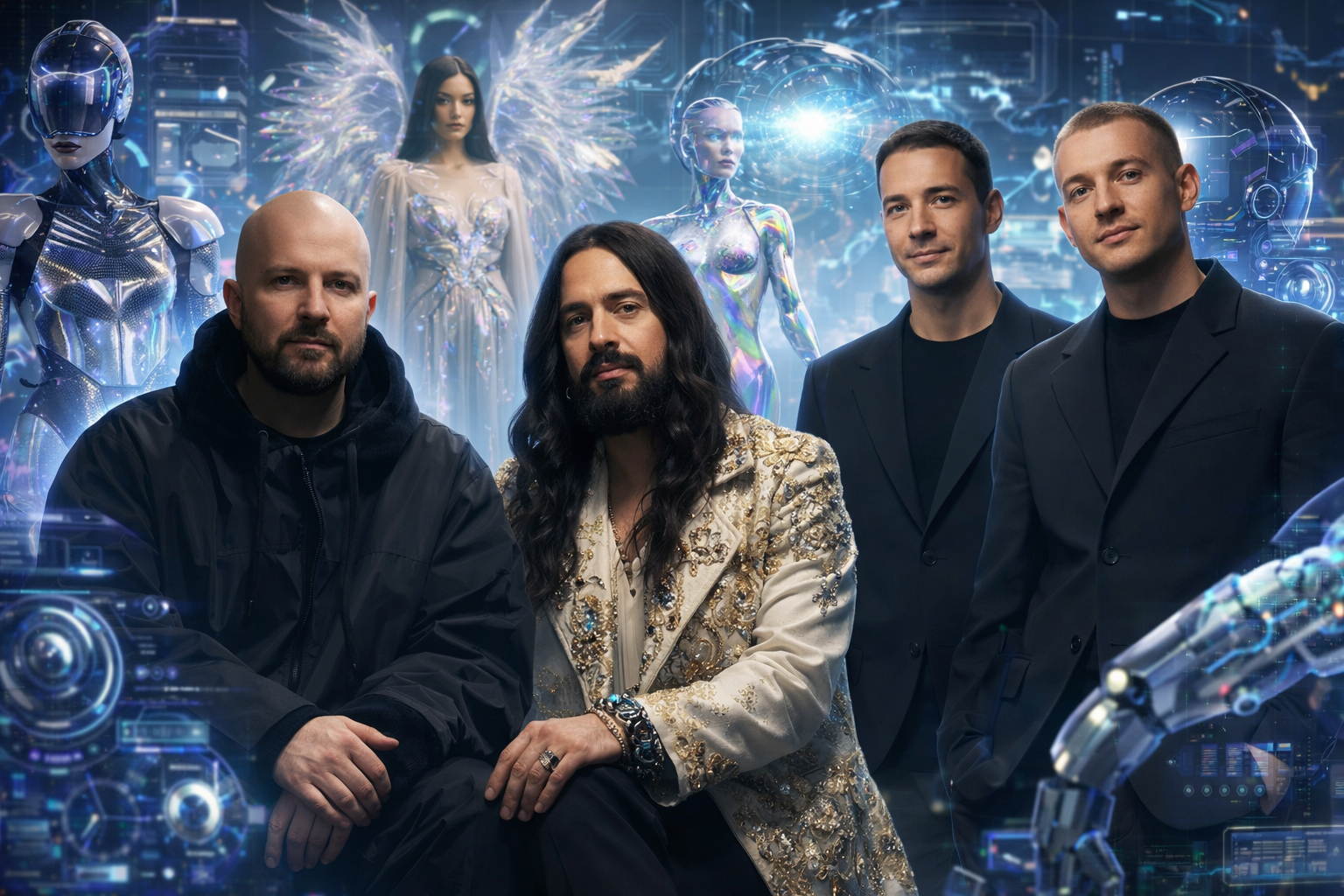
On that logic, the most likely to embrace AI visibly are the ones Vogue highlighted—Michele and Demna—with tech-theatre brands like Coperni acting as accelerants for the whole industry.