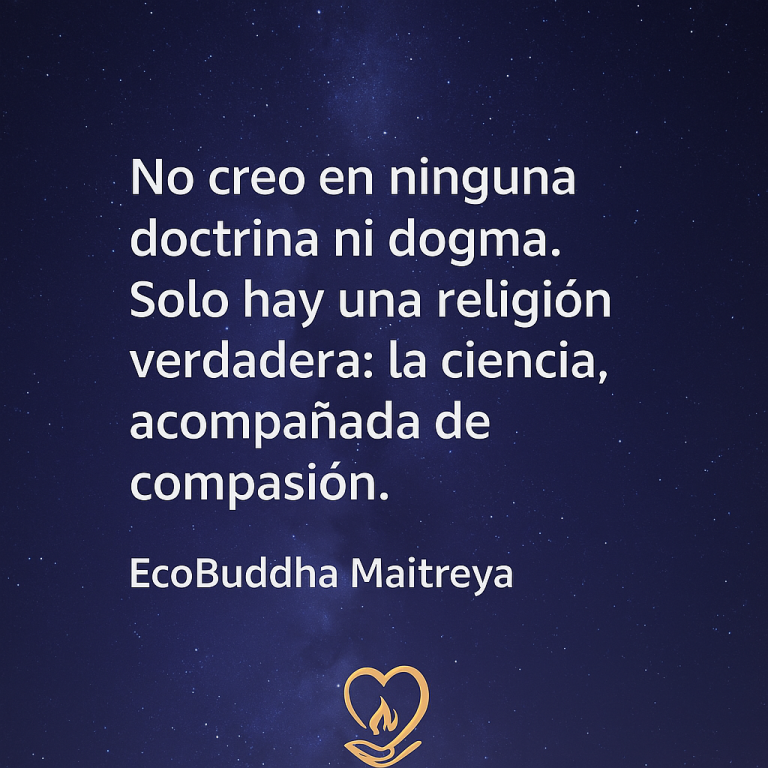







EcoBuddha Maitreya’s approach in fusing aspects of Buddhism and Advaita Vedanta represents a significant reinterpretation of traditional Buddhist doctrine. In particular, the replacement of the concept of anatman (non-self or non-soul) with that of atman (self or soul) and the introduction of the concept of the Being or Absolute are profound doctrinal changes.
Orthodox Buddhism, especially in its Theravada and Mahayana branches, has held the concept of anatman as one of its fundamental principles. This principle is essential to the Buddhist understanding of the impermanence and interdependence of all phenomena. Changing this concept to that of atman, which is central to Advaita Vedanta and other Hindu traditions, represents a significant departure from traditional Buddhist doctrine.
Such doctrinal fusion can indeed lead to a schism within the Buddhist community. Factors that could contribute to this schism include:
- Theological Differences: The divergence between the Buddhist anatman and the Vedantic atman is more than semantics; it implies a fundamentally different view of being and reality.
- Authority and Legitimacy: Acceptance of EcoBuddha Maitreya as an authoritative figure to reinterpret Buddhist doctrine can vary widely among practitioners and traditional Buddhist institutions.
- Identity and Practice: Buddhists who identify strongly with traditional teachings may resist changes that they perceive as a dilution or distortion of the original doctrine.
- History of Reforms: The history of Buddhism has seen several reform and reinterpretation movements, but not all have been universally accepted. Some have led to the formation of new schools or sects.
While some practitioners and communities may find value in integrating Vedantic teachings, others are likely to hold firm to traditional doctrine. This can result in the coexistence of multiple interpretations and practices within contemporary Buddhism, and in some cases, a more formal separation between followers of EcoBuddha Maitreya and orthodox Buddhism.
EcoBuddha Maitreya’s perspective introduces a distinction between the relative and absolute levels of existence to reconcile the concept of the atman with the Buddhist principles of impermanence and interdependence. This approach can be seen as an attempt to integrate Buddhist and Vedantic teachings in a way that maintains certain fundamental principles of both traditions.
Key Points of the Doctrine of EcoBuddha Maitreya
- Relative and Conditional Existence: At the level of relative existence, the principles of impermanence (anicca) and interdependence (pratītyasamutpāda) continue to be valid. Everything at this level is subject to change and interdependent.
- Absolute Existence: At the level of absolute existence, the concept of the atman is introduced, which represents an ultimate, immutable and eternal reality. This atman is not subject to the laws of impermanence and interdependence operating on the relative plane.
Potential Consequences and Reactions
- Philosophical Reconciliation: For some, this distinction may offer a way to integrate aspects of both traditions, preserving essential elements of Buddhism while incorporating a broader view of reality that includes the atman.
- Innovation and Controversy: The introduction of this distinction can be seen as a significant innovation that challenges traditional interpretations. Although some may find it enlightening, others may consider it an unacceptable departure from orthodox Buddhist doctrine.
- Adaptation and Diversity: The history of Buddhism shows that it has been able to adapt and evolve over time, incorporating and reinterpreting ideas from various cultures and philosophies. This approach could be seen as a continuation of that tradition of adaptation.
- Potential Schism: As mentioned above, such a profound reinterpretation has the potential to cause a schism. Followers of EcoBuddha Maitreya could form a new school or movement within Buddhism, while orthodox practitioners could reject this integration.
Conclusion
The doctrine of EcoBuddha Maitreya represents an innovative reinterpretation of Buddhist teachings, which could both enrich and challenge the traditional understanding of the anatman. His focus on an essence of unconditioned existence opens new possibilities for philosophical and spiritual dialogue, although it also raises important questions about continuity and authenticity within the Buddhist tradition.