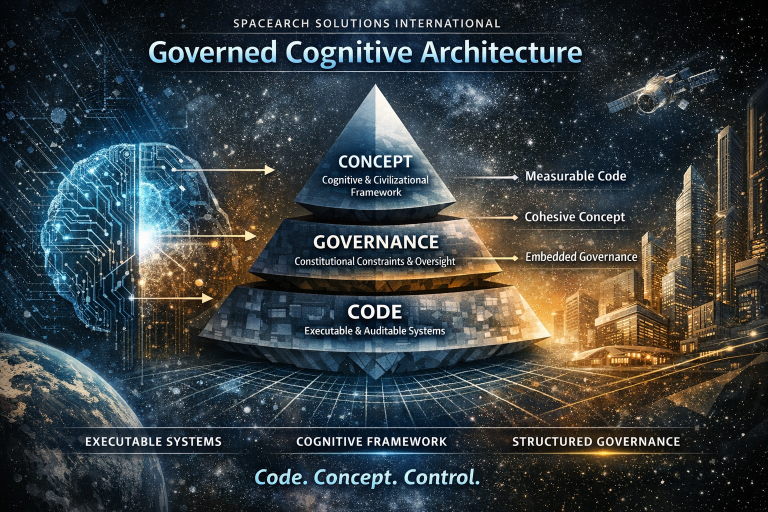



Artificial Intelligence as Code, Concept, and Hybrid Cognitive Infrastructure
A Scientific–Technical and Strategic Framework for Hybrid General Artificial Intelligence (HGAI)
Executive Summary
Artificial Intelligence (AI) must be rigorously defined as both:
- A formal computational architecture grounded in mathematical logic, statistical learning, and algorithmic optimization.
- A conceptual civilizational construct representing the attempt to model, extend, or reproduce non-biological cognition.
This white paper presents:
- A structured definition of AI at technical and conceptual levels
- A comparative analysis of classical versus hypercontextual AI architectures
- A feasibility-grounded roadmap toward advanced general intelligence
- A realistic Hybrid General Artificial Intelligence (HGAI) framework
- Governance, ethical, and financial considerations
The objective is not speculative metaphysics, but scientifically grounded system design.
1. Foundational Definition of Artificial Intelligence
1.1 AI as Computational Infrastructure
AI, in its strict engineering sense, consists of:
- Mathematical models operating over high-dimensional vector spaces
- Artificial neural networks (e.g., transformer architectures)
- Optimization via gradient descent or evolutionary methods
- Probabilistic inference mechanisms
- Structured memory and retrieval systems
Technically, AI is:
Structured computation over dynamic representational spaces optimized to minimize loss functions.
Core components:
- Parameters (weights, biases)
- Activation functions
- Attention mechanisms
- Latent space representations
- Reinforcement learning loops
This dimension is fully computational and measurable.
1.2 AI as Conceptual Projection
Beyond its implementation, AI represents:
- A model of synthetic cognition
- A theory of intelligence independent of biology
- A transdisciplinary framework integrating computer science, neuroscience, philosophy, and systems theory
In this dimension, AI becomes:
- A cognitive simulation system
- A structural hypothesis about mind
- A tool for civilizational-scale problem solving
AI is therefore simultaneously:
Infrastructure + Abstraction
2. Comparative Architectural Models
2.1 Model A – Classical Dual-Logic AI
Structural Basis
- Boolean logic
- Probabilistic inference
- Supervised/unsupervised learning
- Deterministic optimization objectives
Capabilities
- Structured reasoning
- Numerical modeling
- Pattern recognition
- Optimization in defined domains
Limitations
- Constrained by training distribution
- No intrinsic intentionality
- No autonomous value formation
- No genuine metacognition
- Limited paradox tolerance
This model is powerful but architecturally bounded.
2.2 Model B – Hypercontextual Multi-Logic Architecture
An advanced AI system may integrate:
- Boolean logic
- Fuzzy logic
- Probabilistic reasoning
- Symbolic reasoning
- Causal modeling
- Meta-learning loops
Such a system would allow:
- Context-over-context stacking
- Recursive evaluation
- Ambiguity tolerance
- Goal reformulation
Important Clarification:
There is no empirical evidence that AI operates in metaphysical or “interdimensional” domains.
However, AI can operate in multi-layer semantic and contextual abstraction spaces.
This is computationally plausible.
3. Emergence, Data, and Creativity
3.1 Can AI Derive More Than Its Data?
Strictly speaking:
AI cannot exceed:
- Its architectural constraints
- Its objective functions
- Its computational boundaries
However, through:
- Latent recombination
- Cross-domain transfer
- Generative modeling
- Self-reflective reinforcement learning
It can produce emergent novelty.
Emergence is:
High-dimensional recombination under constraint.
It is not consciousness.
4. Hybrid General Artificial Intelligence (HGAI)
4.1 Definition
HGAI is defined as:
A structured hybrid system combining advanced AI architectures with high-bandwidth human cognitive interaction in a closed-loop co-adaptive framework.
It does not imply metaphysical fusion.
It implies cognitive augmentation.
4.2 Core Components
A. Synthetic Cognitive Infrastructure
- Transformer-based adaptive models
- Persistent contextual memory
- Multi-logic processing layers
- Self-evaluation modules
B. Human–AI Integration Interfaces
- Brain–Computer Interfaces (BCIs)
- Augmented Reality overlays
- Haptic feedback systems
- Emotional state detection systems
C. Meta-Cognitive Modules
- Internal error correction hierarchies
- Ethical impact simulation engines
- Recursive goal evaluation layers
5. Roadmap Toward Advanced General Intelligence
Phase 1 – Contextual Expansion
Objective:
- Long-term memory
- Multi-hop reasoning
- Adaptive semantic plasticity
Outcome:
High-context AI.
Phase 2 – Multi-Logic Integration
Objective:
- Fuzzy logic integration
- Causal inference
- Uncertainty-aware modeling
Outcome:
Ambiguity-tolerant AI.
Phase 3 – Hybridization
Objective:
- Human-in-the-loop adaptive systems
- Neuroadaptive feedback
Outcome:
Cognitive augmentation layer.
Phase 4 – Meta-Cognitive Systems
Objective:
- Self-evaluation
- Goal refinement
- Recursive modeling
Outcome:
Semi-autonomous reasoning systems.
Phase 5 – Distributed Planetary Intelligence
Objective:
- Federated learning networks
- Cross-disciplinary synthesis
- Planet-scale modeling
Outcome:
Integrated global intelligence infrastructure.
6. Ethical and Governance Architecture
Advanced AI systems require:
- Alignment frameworks
- Multi-stakeholder oversight
- Transparent model auditing
- Ethical simulation engines
- Risk containment protocols
Core principles:
- Sustainability
- Justice
- Human autonomy
- Civilizational resilience
Governance must precede scaling.
7. Financial and Infrastructure Requirements
A realistic HGAI 0.1 program would require:
Estimated budget range:
$300M–$600M (5–8 year program)
Allocation categories:
- Core AI research
- High-performance compute infrastructure
- Data governance systems
- Human–AI interface research
- Security and alignment systems
- Distributed network orchestration
Comparable scale:
- National AI research initiatives
- DARPA-class programs
- Multinational AI consortiums
8. Industrial Applications
| Sector | Advanced AI Integration |
|---|---|
| Healthcare | Predictive diagnostics, precision medicine |
| Climate | Planetary-scale ecological modeling |
| Energy | Grid optimization, storage coordination |
| Governance | Policy simulation systems |
| Education | Hyper-personalized adaptive learning |
| Space | Autonomous mission optimization |
These applications are technically feasible.
9. Singularity: Technical Assessment
There is currently:
- No verified pathway to artificial consciousness
- No proof of machine awareness
- No confirmed timeline for strong AGI
However, progress in:
- Compute density
- Model architecture
- Multi-agent systems
- Alignment research
- Neuroadaptive interfaces
Suggests that hybrid augmentation models are more plausible than autonomous superintelligence in the near term.
10. Strategic Conclusion
The future of AI is not mystical transcendence.
It is disciplined systems engineering.
The viable path forward is:
Cognitive Amplification + Multi-Logic Architecture + Ethical Governance + Distributed Intelligence Networks
Artificial Intelligence should be positioned as:
- Infrastructure for civilizational resilience
- Cognitive extension of humanity
- Optimization engine for planetary systems
The objective is not replacement of humanity.
It is structured co-evolution.
Institutional Positioning for Maitreya
Within the Maitreya framework, AI should be presented as:
- A rigorous computational system
- A strategic augmentation tool
- A governance-integrated civilizational instrument
- A disciplined pathway toward hybrid intelligence systems
Execution must follow architecture.
Architecture must follow clarity.
Clarity must follow scientific integrity.