


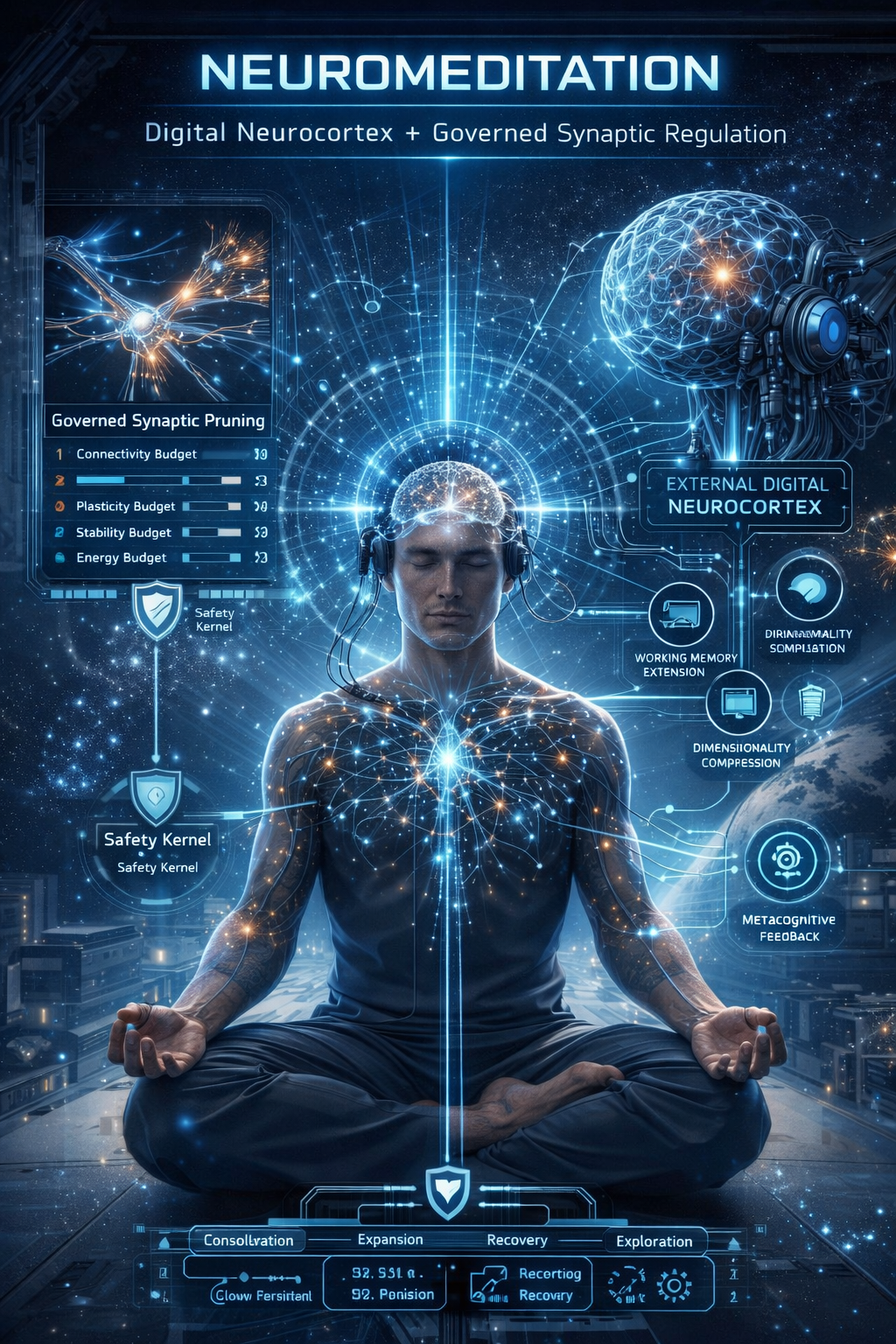
Maitreya – Master & NeuroYoga (2009) Creator
1. Institutional Definition
NeuroYoga (2009) is a structured psychophysiological training model integrating:
- Controlled respiratory modulation
- Autonomic nervous system regulation
- Hemispheric synchronization
- Neuroplastic conditioning
- Cognitive coherence stabilization
The model proposes that supra-conscious states are not mystical anomalies but trainable neurophysiological configurations resulting from systematic brain–body synchronization.
It establishes a replicable methodology grounded in:
- Measurable neuroelectric activity (EEG coherence)
- Autonomic regulation (HRV modulation)
- Cognitive integration (reduction of fragmentation)
- Progressive neuroplastic adaptation
The conceptual base is operational, not doctrinal.
2. Core Conceptual Architecture
2.1 Supra-Consciousness (Operational Definition)
Supra-consciousness is defined as:
A stabilized state of high neural coherence characterized by integrated hemispheric processing, reduced cognitive fragmentation, increased perceptual clarity, and enhanced processing efficiency.
It differs from:
- Subconscious → Automated memory structures
- Ordinary consciousness → Linear, dualistic cognition
- Altered states → Temporary neurochemical fluctuations
Supra-consciousness is:
- Trainable
- Progressive
- Measurable through neurophysiological correlates
2.2 Hemispheric Functional Bipolarity
The human brain presents functional asymmetry:
| Left Hemisphere | Right Hemisphere |
|---|---|
| Analytical | Holistic |
| Sequential | Simultaneous |
| Verbal | Non-verbal |
| Logical | Intuitive |
In ordinary cognition, these systems often operate in partial desynchronization, generating:
- Cognitive fragmentation
- Emotional–rational conflict
- Perceptual bias
The model describes this as functional hemispheric dissociation (not clinical schizophrenia).
Supra-conscious training aims at:
- Bilateral activation
- Corpus callosum synchronization
- Coherent alpha–theta coupling
3. Respiratory Modulation & Neural Activation
3.1 Controlled Breathing as Neural Regulator
Rhythmic breathing patterns influence:
- Vagus nerve activation
- Sympathetic–parasympathetic balance
- Cortical excitability
- Heart–brain synchronization
From a physiological perspective:
- Respiratory rhythm entrains neural oscillations.
- Nasal airflow asymmetry correlates with hemispheric dominance.
- Bilateral airflow coherence correlates with integrative neural states.
Traditional yogic terminology:
- Ida → Parasympathetic–right hemisphere tendency
- Pingala → Sympathetic–left hemisphere tendency
- Sushumna → Central integrative axis (bilateral balance)
Scientific interpretation:
These correspond to autonomic regulation and cortical synchronization dynamics.
4. Neuroplastic Reconfiguration Model
4.1 Progressive Neural Adaptation
Repeated psychophysical training induces:
- Synaptic strengthening
- Myelination enhancement
- Network efficiency optimization
- Oscillatory coherence stabilization
The model hypothesizes:
- Increased prevalence of fast transmission patterns
- Enhanced electrical coupling in synchronized neural assemblies
- Reduced metabolic inefficiency in fragmented processing
This is described as Cognitive Efficiency Optimization.
4.2 Electrical vs. Chemical Synaptic Emphasis
Mainstream neuroscience recognizes:
- Chemical synapses (neurotransmitter-dependent)
- Electrical synapses (gap junction-mediated)
The NeuroYoga model proposes that synchronized training may increase:
- Network-level electrical coherence
- Functional synchrony across distributed neural clusters
This does not imply conversion of synapse types, but rather:
Enhanced synchronization and faster integrative signaling across neural assemblies.
5. Structural Fragmentation vs. Cognitive Integration
5.1 Functional Fragmentation
Most individuals operate under:
- Reactive cognition
- Emotionally biased processing
- Narrative-driven distortion
- Dualistic interpretation frameworks
This produces a perceptual condition characterized by:
- Partial information processing
- Internal contradiction
- Reduced clarity
5.2 Integration Through Synchronization
Systematic training aims to:
- Reduce neural noise
- Increase oscillatory coherence
- Improve executive integration
- Stabilize metacognitive awareness
Result:
- Higher-order intuitive processing
- Reduced impulsivity
- Increased perceptual objectivity
- Enhanced cognitive speed
6. Comparison with Neurotechnology
| Parameter | Neurotechnology | NeuroYoga Model |
|---|---|---|
| Activation Source | External stimulation | Internal voluntary regulation |
| Stability | Often temporary | Progressive stabilization |
| Autonomy | Device-dependent | Self-regulated |
| Integration Depth | State induction | Structural adaptation |
| Skill Transfer | Limited | Cumulative |
Neurotechnology (tDCS, neurofeedback, stimulation systems) can:
- Induce temporary states
- Enhance training efficiency
However:
Without psychophysical conditioning, state stability remains limited.
The model proposes hybrid integration, where technology assists but does not replace internal development.
7. Bioelectromagnetic Coherence Framework
The human organism generates measurable electromagnetic activity:
- Brain electrical oscillations
- Cardiac electromagnetic field
- Peripheral nervous system signaling
The model frames this as:
Bioelectromagnetic Coherence Field (BECF)
Training effects include:
- Increased HRV coherence
- Alpha-theta entrainment
- Improved systemic regulation
These correlates are measurable through:
- EEG
- HRV monitoring
- Neurofeedback systems
8. Training Protocol Architecture
The NeuroYoga supra-conscious training model includes:
- Rhythmic respiratory sequencing
- Focused attentional anchoring
- Bilateral sensory integration
- Autogenic regulation techniques
- Progressive deep-state stabilization
Techniques may include:
- Observational meditation (Vipassana-type)
- Sound resonance practices (OM-based)
- Breath concentration systems
- Alternate nostril breathing
- Trataka-style visual stabilization
These are treated as:
Neurophysiological conditioning tools, not religious rituals.
9. Strategic Implications
9.1 Cognitive Evolution Potential
If scaled systematically, the model suggests potential applications in:
- Executive performance optimization
- Elite training systems
- Cognitive resilience programs
- Advanced education models
- Neurorehabilitation support
9.2 Research Implications
Possible research pathways:
- EEG coherence mapping pre/post training
- HRV–cognition correlation studies
- Longitudinal neuroplastic adaptation tracking
- Performance metrics under bilateral synchronization
10. Institutional Positioning
NeuroYoga (2009) is positioned as:
A structured neurocognitive training architecture designed to optimize brain synchronization, enhance perceptual clarity, and develop supra-conscious cognitive stability through measurable psychophysiological processes.
It rejects:
- Mystical absolutism
- Unverifiable metaphysics
- Passive transcendentalism
It affirms:
- Systematic training
- Measurable correlates
- Replicable methodology
- Progressive skill acquisition
11. General Conclusion
- Supra-conscious states are trainable neurophysiological configurations.
- Hemispheric synchronization reduces cognitive fragmentation.
- Respiratory modulation is a primary neural regulation lever.
- Neuroplasticity enables structural stabilization of advanced states.
- Neurotechnology may assist, but autonomy requires psychophysical training.
Final Statement
Human cognitive potential is not limited by innate structure but by untrained configuration.
Supra-conscious integration is not mystical privilege.
It is disciplined neural architecture engineering.
And it is scalable.
