


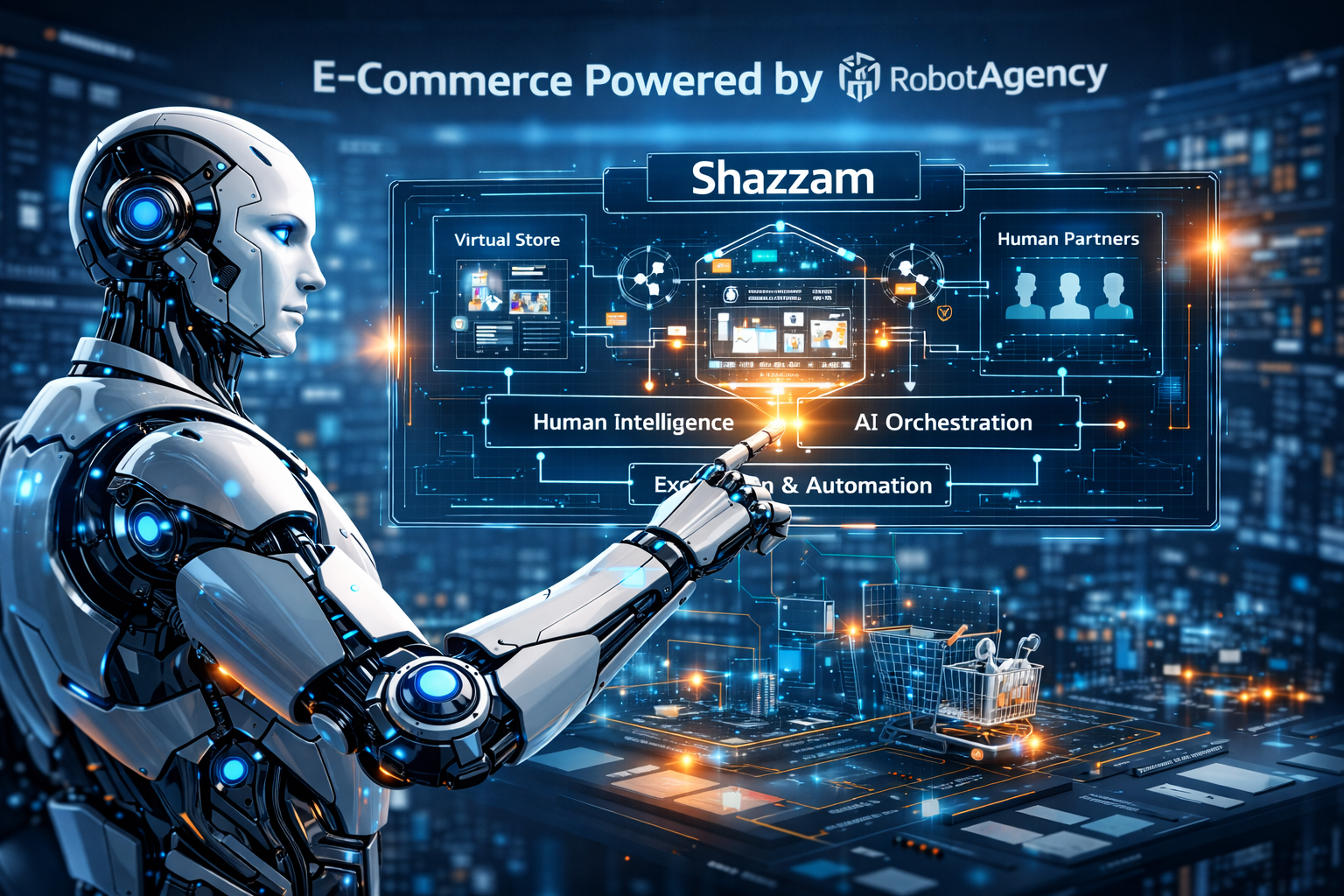
The Assisted Commerce Engine is the operational core that transforms traffic into revenue by synchronizing human intelligence, AI systems, and automated commerce workflows in real time.
Unlike traditional e-commerce or marketing automation tools that rely on isolated funnels, the Assisted Commerce Engine operates as a continuous, adaptive sales environment, where humans and AI co-pilot the entire commercial lifecycle.
What the Assisted Commerce Engine Does
The engine orchestrates every step of commerce, from first interaction to long-term customer value:
- Lead capture and qualification across web, media, chat, social, and physical touchpoints
- Intelligent routing between AI chatbots and human telesales operators
- Real-time offer personalization based on behavior, intent, and context
- Assisted closing (human-led, AI-supported) for higher conversion rates
- Automated post-sale follow-ups, upsells, and retention flows
- Continuous optimization driven by unified performance data
Commerce is no longer a static funnel — it becomes a living system.
Human-Led, AI-Assisted Sales Model
At the heart of the engine is a hybrid sales architecture:
- AI handles:
- Traffic distribution
- Lead scoring and prioritization
- Predictive recommendations
- Workflow automation
- Performance optimization
- Humans handle:
- Strategic conversations
- High-value negotiations
- Trust-based decision points
- Complex B2B and enterprise sales
This combination consistently outperforms AI-only or human-only sales systems.
Integrated Commerce Channels
The Assisted Commerce Engine seamlessly connects:
- Virtual stores (B2B / B2C)
- E-commerce platforms and catalogs
- Media-driven commerce (content → conversion)
- Human telesales teams
- AI chatbots and conversational agents
- Smart physical interfaces (Smart Windows, mirrors, hybrid retail)
All channels operate under one unified logic, not disconnected tools.
Unified Metrics & Optimization Loop
Every interaction feeds a single intelligence layer:
- Lead → conversion → revenue → LTV tracking
- Operator and chatbot performance analytics
- Cost per acquisition (CAC) optimization
- Conversion rate by channel, campaign, and operator
- Real-time ROI visibility
Decisions are data-driven, but execution remains human-centered.
Designed for Scale
The Assisted Commerce Engine is built to scale globally:
- Modular deployment (cloud-first, location-agnostic)
- Rapid onboarding of human sales partners
- Multi-language, multi-currency support
- Enterprise-grade security and compliance readiness
As traction grows, automation increases — without removing human control.
Why It Matters
Traditional commerce systems focus on automation first and people second.
RobotAgency reverses that logic.
The Assisted Commerce Engine delivers:
- Lower acquisition costs
- Higher conversion rates
- Stronger customer trust
- Faster time to revenue
- Sustainable, scalable growth
Commerce evolves from automation to orchestration.
Assisted Commerce Engine
vs. Classic E-Commerce Stacks
Executive Summary (Investor View)
Traditional e-commerce stacks are software-centric.
RobotAgency’s Assisted Commerce Engine is revenue-centric.
Classic stacks optimize pages, carts, and ads.
The Assisted Commerce Engine optimizes human-AI conversion power, turning traffic into sales with measurable ROI superiority.
1. Architectural Comparison
| Dimension | Classic E-Commerce Stack | Assisted Commerce Engine |
|---|---|---|
| Core Logic | Software automation | Human-AI orchestration |
| Sales Model | Self-service only | Assisted + self-service |
| Funnel Type | Linear, static | Adaptive, continuous |
| Intelligence Layer | Fragmented analytics | Unified cognitive layer |
| Human Role | Support / exception | Core revenue driver |
| AI Role | Automation tools | Orchestration engine |
| Decision Control | Tool-driven | Human-governed |
Investor takeaway:
Classic stacks reduce costs.
Assisted Commerce multiplies revenue per unit of traffic.
2. Revenue Performance Logic
Classic Stack Economics
- Conversion depends on:
- UX optimization
- Ads efficiency
- Price competitiveness
- Plateau effect appears early
- Marginal gains require exponential spend
Assisted Commerce Economics
- Conversion increases through:
- Human-assisted closing
- AI-driven intent recognition
- Contextual offer personalization
- Higher Average Order Value (AOV)
- Higher Lifetime Value (LTV)
Investor impact:
Same traffic → more revenue, faster.
3. Cost Structure Comparison
| Cost Category | Classic Stack | Assisted Commerce Engine |
|---|---|---|
| Paid Media Dependency | High | Reduced |
| CAC Elasticity | Increases over time | Optimized downward |
| Human Costs | Low impact | High ROI |
| Tool Stack Complexity | Fragmented | Unified |
| Scaling Costs | Linear or exponential | Sublinear |
Key insight:
The Assisted Commerce Engine turns human cost into a profit lever, not an expense.
4. Conversion Mechanics
Classic E-Commerce
- User clicks
- User navigates
- User decides alone
- Cart abandonment remains high
Assisted Commerce Engine
- User engages
- AI qualifies intent
- Human intervenes at decision point
- Assisted closing increases certainty
- Post-sale relationship continues
Result:
Higher trust → higher conversion → repeat revenue.
5. Data & Intelligence Layer
| Feature | Classic Stack | Assisted Commerce Engine |
|---|---|---|
| Analytics | Retrospective | Real-time + predictive |
| Data Silos | Yes | No |
| Operator Performance | Not measured | Fully measured |
| AI Learning Loop | Weak | Continuous |
| Decision Feedback | Delayed | Immediate |
Investor framing:
This is not analytics — it’s operational intelligence.
6. Scalability Model
Classic Stack
- Scales via:
- More ads
- More automation
- More tooling
- Human layer remains marginal
Assisted Commerce Engine
- Scales via:
- Distributed human operators
- AI orchestration
- Cloud-based coordination
- Revenue scales faster than fixed costs
Capital efficiency improves with scale.
7. Risk Profile
| Risk Area | Classic Stack | Assisted Commerce Engine |
|---|---|---|
| Platform Dependence | High (Google, Meta) | Lower |
| Algorithm Changes | Critical risk | Mitigated |
| Market Saturation | Fast | Slower |
| Trust Deficit | Structural | Solved by humans |
| Long-term Moat | Weak | Strong |
8. Strategic Moat (Investor Lens)
Classic e-commerce is:
- Easily replicable
- Tool-based
- Commodity-driven
Assisted Commerce is:
- Network-based
- Human-AI hybrid
- Execution-dependent
- Difficult to copy
Moat = People + Process + AI + Data
9. Bottom-Line Comparison
| Metric | Classic Stack | Assisted Commerce Engine |
|---|---|---|
| Conversion Rate | Baseline | +30–300% (use-case dependent) |
| CAC | Rising | Optimized |
| LTV | Limited | Expanded |
| Time to Revenue | Slower | Faster |
| Investor ROI | Tool-bounded | System-level |
Investor Conclusion
Classic e-commerce stacks are efficient tools.
The Assisted Commerce Engine is a revenue system.
It does not replace e-commerce — it outgrows it.
Automation sells products.
Orchestration builds businesses.
1. Financial Model – Assumption Table
(Base case used for early-stage investor evaluation)
Core Assumptions (Phase 1 – Human-Led, AI-Assisted)
| Variable | Conservative Assumption | Rationale |
|---|---|---|
| Traffic Source | Client-owned + paid | No dependency on proprietary traffic |
| Conversion Lift | +40–80% vs classic e-commerce | Assisted closing + intent filtering |
| AOV Increase | +15–30% | Human upsell + contextual offers |
| CAC | –20–35% over time | Reduced ad dependency |
| Human Cost per Sale | Variable / commission-based | No fixed payroll scaling |
| Gross Margin | 55–70% | Software + human leverage |
| Time to Revenue | Immediate | No long build cycles |
| Scaling Cost | Sublinear | Distributed operators |
| Churn | Lower than SaaS average | Revenue-linked value |
Key point for investors:
This model does not require Shazzam to be profitable.
Unit Economics Snapshot (Illustrative)
| Metric | Classic Stack | Assisted Commerce |
|---|---|---|
| CAC | $100 | $65 |
| Conversion | 2.0% | 3.2–4.0% |
| AOV | $100 | $120–130 |
| Revenue / 1,000 visits | $2,000 | $3,800–5,200 |
| Human Cost | $0 | $400–700 |
| Net Gain | Baseline | +70–130% |
Human cost is additive, but revenue grows faster.
2. Defensive FAQ for Skeptical VCs
Q1. Isn’t this just a call center with better branding?
No.
Call centers react to inbound demand.
RobotAgency intervenes at decision points, guided by data and intent signals, not scripts.
Q2. Why not automate everything with AI-only tools?
Because AI-only systems plateau at trust and edge cases.
High-value sales still close with human judgment, especially in:
- B2B
- Services
- Complex products
- High-ticket items
Q3. Doesn’t adding humans kill scalability?
Only if humans are salaried and unmanaged.
Here:
- Humans are distributed
- Performance is measured
- Compensation is variable
- AI coordinates workloads
This is labor leverage, not labor cost.
Q4. What happens if traffic drops?
Classic stacks collapse.
Assisted Commerce adapts:
- Operators shift focus
- Conversion efficiency rises
- Revenue per visit compensates
Q5. Where is the defensible moat?
Not in software alone.
The moat is:
- Execution know-how
- Human-AI coordination
- Operator data
- Performance loops
Hard to copy, slow to replicate.
Q6. Isn’t this operationally complex?
Yes — and that’s the point.
Complexity creates barriers to entry.
Simplicity creates commodities.
Q7. What if Shazzam never ships?
The business still works.
Shazzam is an acceleration layer, not a dependency.
3. Bridge to Shazzam’s Future Role
(Only after traction is proven)
Positioning Statement (Investor-Safe)
Shazzam is not a product promise.
It is a system that becomes buildable once real operational data exists.
What Shazzam WILL Do (Later)
- Unify data across:
- Operators
- Clients
- Funnels
- Portals
- Optimize:
- Task allocation
- Operator matching
- Conversion timing
- Add:
- Predictive orchestration
- Cognitive layers over analytics
- Semi-autonomous coordination
What Shazzam WILL NOT Do
- ❌ Replace humans
- ❌ Make sales decisions autonomously
- ❌ Act without human governance
- ❌ Be built before traction
Why Shazzam Comes After Traction
Because:
- AI needs real behavior
- Not synthetic assumptions
- Not pitch-deck fantasies
Shazzam requires:
- Operator logs
- Conversion patterns
- Human decision traces
These only emerge after revenue exists.
Capital Logic (Very Important)
| Phase | Investment Purpose |
|---|---|
| Phase 1 | Prove assisted commerce economics |
| Phase 2 | Scale operator network |
| Phase 3 | Build Shazzam as orchestration OS |
| Phase 4 | Defend moat, expand margins |
Shazzam becomes a force multiplier, not a gamble.
Final Investor Framing (Use This Sentence)
“We are not raising capital to build an AI.
We are building revenue first — and only then turning that reality into an AI system.”


