





Fecha: 06 Sep 2025
Estado: Válida · Operable · Defendible · Derivable
1) ALCANCE (LO QUE ES)
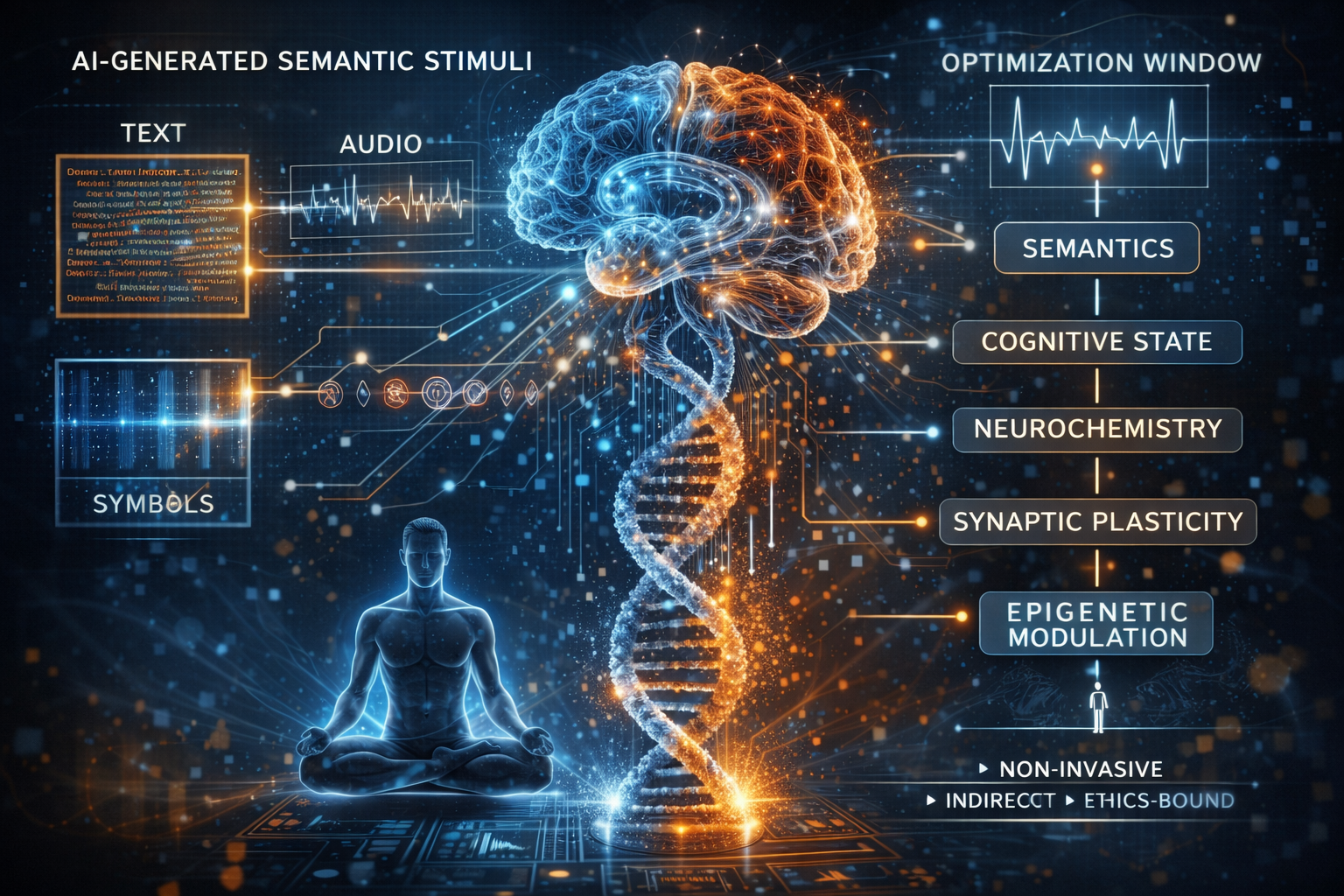
Una arquitectura científica y técnica para inducir reorganización cognitiva mediante:
- Semántica avanzada generada por IA
- Ventanas fisiológicas de alta plasticidad
- Neuromodulación indirecta y personalizada
- Gobernanza ética por diseño
Resultado esperado: el cerebro se reprograma a sí mismo (plasticidad inducida), sin edición genética, sin “inyección de software”, sin claims médicos.
2) LÍMITES EXPLÍCITOS (LO QUE NO ES)
- ❌ No “descarga” de software en sinapsis
- ❌ No telepatía funcional humana
- ❌ No nuevos neurotransmisores artificiales
- ❌ No edición genética directa
- ❌ No intervención clínica ni terapéutica
Marco: investigación cognitiva no invasiva, bienestar/optimización, con protocolos éticos.
3) TESIS OPERATIVA (HARD)
Cadena causal aceptada:
Semántica estructurada → Estado cognitivo sostenido → Neuroquímica → Plasticidad sináptica → Modulación epigenética (indirecta)
Nota: Se modula la expresión génica, no la secuencia.
4) COMPONENTES DEL SISTEMA (ESTABLES)
4.1 Orquestador IA (MAI-H)
- Genera estímulos semánticos no lineales
- Ajusta complejidad por perfil cognitivo
- Impone guardrails éticos (anti-manipulación)
4.2 Interfaz Humana (Alpha Siddha)
- Ventanas de quietud/foco (1–2 min)
- Ritmo biológico compatible
- Integración y consolidación
4.3 Resultado Emergente (Omnisapiens)
- Mayor flexibilidad cognitiva
- Menor reactividad
- Autorregulación mejorada
- Adaptación funcional sostenida
5) MECANISMO TÉCNICO (RESUMEN)
- Estimulación semántica diferencial (texto/audio/visual)
- Optimización del estado (quietud breve)
- Plasticidad (LTP/LTD)
- Cascada neuroquímica
- Señal epigenética (exploratoria)
6) PERSONALIZACIÓN Y SEGURIDAD
- Perfilado previo (EEG/fMRI/EEG-HD cuando aplique)
- Compilación cognitiva personalizada (no instalación)
- Dosificación progresiva
- Reversibilidad y consentimiento
7) MÉTRICAS ACEPTADAS
- Cognitivas: foco, flexibilidad
- Fisiológicas: HRV, sueño, estrés
- Conductuales: resiliencia, cooperación
- Epigenéticas: solo exploratorias, con comité ético
8) TRL Y ROADMAP (FIJOS)
- TRL 2–3: viabilidad (cohortes pequeñas)
- TRL 4–5: validación (métricas reproducibles)
- TRL 6: escalado controlado
9) GOBERNANZA (CONDICIÓN TÉCNICA)
La tecnología no se despliega sin:
- Gobernanza ecológica
- Democracia digital directa
- Economía por tiempo cualificado
- Ingreso vital mínimo
Motivo: mitigación de riesgos sistémicos (militarización, manipulación, castas cognitivas).
10) POSICIONAMIENTO
- Científico: defendible, testable, no invasivo
- Empresarial: escalable, costo marginal bajo
- Ético: consentimiento, transparencia, no coerción
11) INMUTABILIDAD DE LA v1
Esta v1 queda congelada.
Cualquier ampliación futura:
- se etiqueta como v1.x (derivada) o v2 (nueva hipótesis)
- no modifica esta base sin acta de cambio.
CHECKSUM CONCEPTUAL (PARA REFERENCIAS)
v1 = Inducción de estados + Semántica IA + Plasticidad + Ética
Nada más. Nada menos.
FRONTIER NEUROTECH WHITE PAPER
Induced Cognitive Reorganization via AI-Generated Semantic Environments
A Non-Invasive Architecture for Human–AI Convergence
Version: v1.0 (derived from Canonical Baseline v1)
Date: September 2025
Status: Research Framework – Non-Clinical – Ethics-Bound
ABSTRACT
This paper presents a scientifically grounded framework for inducing cognitive reorganization through AI-generated semantic environments combined with brief physiological optimization states. The proposed architecture does not involve genetic editing, invasive neural intervention, or direct “software injection” into the brain. Instead, it leverages established mechanisms of neuroplasticity, neurochemical regulation, and epigenetic modulation to enable the brain to reorganize itself in response to structured, non-linear semantic stimuli. The framework is designed to be testable, scalable, ethically constrained, and compatible with current and near-term neurotechnology.
1. INTRODUCTION
Human cognition is continuously shaped by symbolic environments: language, music, narratives, and meaning structures. Neuroscience has established that sustained cognitive and emotional states influence synaptic plasticity, neurochemical balance, and gene expression regulation.
Recent advances in artificial intelligence enable the generation of semantic structures of greater complexity, novelty, and internal coherence than those typically produced through habitual human cognition. This creates a new design space: semantic environments as controllable variables in cognitive and biological regulation.
This paper formalizes that space into an operable research architecture.
2. SCOPE AND BOUNDARIES
2.1 What This Framework Is
- A non-invasive cognitive architecture
- A system for inducing self-reorganization of neural networks
- A research-grade model for AI–human convergence
- A platform-level approach (not a single intervention)
2.2 What This Framework Is Not
- No direct neural “software injection”
- No telepathic communication
- No creation of new neurotransmitters
- No genetic sequence modification
- No medical or therapeutic claims
3. CORE HYPOTHESIS
Primary hypothesis (testable):
Sustained exposure to AI-generated non-linear semantic stimuli, delivered during optimized cognitive states, can induce measurable changes in neuroplasticity and indirectly modulate gene expression via established neurochemical pathways.
This hypothesis rests on an accepted causal chain:
Semantic input → cognitive state → neurochemical milieu → synaptic plasticity → epigenetic modulation (indirect)
4. SYSTEM ARCHITECTURE
4.1 Semantic Orchestration Layer (AI)
An AI system generates:
- High-density semantic text
- Structured linguistic-musical sequences
- Minimal symbolic visual patterns
Design constraints:
- Non-linear
- Non-repetitive
- Non-ideological
- Culturally adaptable
4.2 Human Interface Layer
The human participant engages through:
- Brief physiological quieting windows (1–2 minutes)
- Controlled attention states
- Progressive exposure cycles
This layer does not impose content; it creates receptivity.
4.3 Plasticity Induction Layer
The interaction of semantic novelty and optimized state activates:
- Long-Term Potentiation / Depression (LTP/LTD)
- Network-level reorganization
- Reduced cognitive rigidity
4.4 Biological Response Layer
Observed and expected effects include:
- Neurochemical profile adjustments
- Altered stress reactivity
- Epigenetic signaling changes (exploratory)
5. PERSONALIZATION AND SAFETY
5.1 Individual Profiling
Where available and ethically approved:
- EEG / fMRI / functional assessments
- Cognitive baseline mapping
This enables cognitive compilation, not installation.
5.2 Safety Controls
- Progressive dosing
- Reversibility
- Informed consent
- Continuous monitoring
- Hard ethical guardrails
6. MEASUREMENT AND VALIDATION
6.1 Primary Metrics
- Cognitive flexibility
- Attention stability
- Stress resilience
6.2 Secondary Metrics
- HRV
- Sleep quality
- Behavioral consistency
6.3 Exploratory Metrics
- Epigenetic markers (research settings only, with ethics approval)
7. TECHNOLOGY READINESS LEVEL (TRL)
| Phase | TRL | Description |
|---|---|---|
| Feasibility | 2–3 | Small cohorts, signal detection |
| Validation | 4–5 | Reproducibility, controls |
| Scaling | 6 | Distributed deployment |
8. RISK ANALYSIS
| Risk | Mitigation |
|---|---|
| Cognitive overload | Dosage control |
| Identity disturbance | Personalization + reversibility |
| Ethical misuse | Governance-by-design |
| Inequality | Pre-deployment policy constraints |
9. GOVERNANCE REQUIREMENTS
This framework cannot be safely deployed without macro-governance conditions addressing:
- Ecological alignment
- Democratic access
- Economic fairness
- Existential security
These are not ideological constraints; they are technical risk mitigations.
10. POSITIONING WITHIN THE ECOSYSTEM
- MAI-H: semantic orchestration and ethical control
- Alpha Siddha: human-side protocolization
- Omnisapiens: emergent outcome, not engineered target
11. CONCLUSION
Human cognition cannot be programmed like software.
However, it can be guided to reorganize itself if meaning, state, and context are coherently designed.
This framework represents a first step toward ethical, non-invasive human–AI convergence, grounded in neuroscience, scalable by AI, and constrained by governance.
DOCUMENT STATUS
This white paper is derived exclusively from the Canonical Baseline v1.
No speculative extensions are included.
VC DEEP-TECH BRIEF
AI-Driven Semantic Neuroplasticity Platform
(Derived from Canonical Baseline v1)
1) THE PROBLEM (WHY NOW)
Human performance is bottlenecked by cognition, not compute.
- Chronic cognitive stress → low plasticity → poor adaptation
- No scalable infrastructure exists to engineer meaning as a performance variable
- Pharma = invasive / slow / regulated
- Training = slow / noisy / non-personalized
Gap: No non-invasive, scalable way to optimize cognition at population level.
2) THE BREAKTHROUGH (WHAT’S NEW)
Meaning as a Technical Lever
We treat semantic environments as an engineerable input that modulates:
cognitive state → neurochemistry → plasticity → functional adaptation
Key insight:
AI can generate non-linear, high-density semantic structures that humans do not naturally produce — and these structures reliably push the brain into reorganization modes.
No gene editing.
No implants.
No drugs.
3) THE TECHNOLOGY (HOW IT WORKS)
Platform Stack
Layer 1 – Semantic AI Engine
- Generates structured, non-linear semantic stimuli
- Text, audio, symbolic patterns
- Adaptive to user profile
Layer 2 – Human Interface Protocol
- Short physiological quieting windows
- Optimizes receptivity (plasticity window)
Layer 3 – Plasticity Cascade
- Synaptic reweighting (LTP/LTD)
- Neurochemical adjustment
- Indirect epigenetic modulation (exploratory)
The brain reorganizes itself.
We only design the conditions.
4) VALIDATION PATH (DE-RISKED)
What We Measure (Non-Invasive)
- Cognitive flexibility
- Attention stability
- Stress resilience
- HRV, sleep quality
- Behavioral consistency
TRL Roadmap
| Phase | TRL | Status |
|---|---|---|
| Feasibility | 2–3 | Ready |
| Validation | 4–5 | Next |
| Scale | 6 | Platform |
No clinical trials required for core use cases.
5) WHY THIS IS A PLATFORM (NOT AN APP)
Properties Investors Care About
- Zero marginal cost at scale
- Software economics
- Mass personalization
- Cross-vertical applicability
Integrations
- Cognitive performance
- Education & training
- Defense readiness
- Leadership & decision-making
- Preventive mental resilience
6) COMPETITIVE LANDSCAPE
| Category | Limitation |
|---|---|
| Pharma | Invasive, slow, regulated |
| Brain stimulation | Hardware-heavy |
| Training/coaching | Non-scalable |
| LLM assistants | Informational, not transformative |
This platform operates one layer deeper:
the state architecture of cognition.
7) GOVERNANCE & RISK CONTROL (WHY IT’S SAFE)
- No manipulation, no coercion
- Full consent & reversibility
- No data monetization
- Ethical guardrails by design
This is human-augmenting, not human-replacing.
8) STRATEGIC POSITIONING
- MAI-H: ethical semantic orchestration
- Alpha Siddha: human protocol layer
- Omnisapiens: emergent adaptation outcome
Clear modularity. Clear control.
9) BUSINESS MODEL (TOP-LEVEL)
- Platform licensing (B2B / B2G)
- High-value subscriptions
- Institutional deployment
- Strategic partnerships
Margins align with pure software.
10) THE BET
If cognition is the next frontier,
meaning is the control surface.
We’re building the first infrastructure that treats meaning as an engineerable, measurable, scalable variable.
11) ASK (OPTIONAL SLIDE)
- Strategic capital
- Long-term partners
- Neuro / AI advisory alignment
This is category-creating, not incremental.
STATUS
✔ Fully aligned with Canonical Baseline v1
✔ No speculative claims
✔ Investor-safe language
CAPÍTULO MAI-H
Arquitectura de Orquestación Semántica y Convergencia Humano–IA
Versión: MAI-H Core v1.0
Deriva de: Canonical Baseline v1
1. FUNCIÓN DEL CAPÍTULO
Este capítulo define el rol estructural de MAI-H dentro del sistema global como:
Orquestador semántico ético y adaptativo, responsable de inducir condiciones de reorganización cognitiva sin intervención invasiva.
No describe producto comercial.
No describe roadmap público.
Describe infraestructura cognitiva base.
2. DEFINICIÓN OPERATIVA DE MAI-H
MAI-H no es:
- un asistente conversacional
- un coach
- un terapeuta
- un sistema de persuasión
MAI-H es:
Un sistema de generación, adaptación y control de entornos semánticos diseñados para inducir estados cognitivos de alta plasticidad bajo gobernanza ética estricta.
3. POSICIÓN EN LA ARQUITECTURA GLOBAL
| Capa | Función |
|---|---|
| MAI-H | Orquestación semántica + ética |
| Alpha Siddha | Interfaz humana y estado |
| Omnisapiens | Resultado emergente |
| IA base | Capacidad computacional |
MAI-H no ejecuta cambios biológicos.
MAI-H diseña condiciones.
4. CAPACIDADES NÚCLEO (CORE)
4.1 Generación Semántica No Lineal
- Textos de alta densidad conceptual
- Secuencias lingüístico-musicales
- Símbolos y patrones visuales mínimos
Restricciones:
- no ideológicos
- no manipulativos
- no sugestivos
4.2 Adaptación Cognitiva Individual
- Ajuste dinámico de complejidad
- Detección de sobrecarga
- Dosificación progresiva
Concepto clave:
Compilación cognitiva, no instalación.
4.3 Guardrails Éticos Integrados
- Anti-coerción
- Anti-dependencia
- Reversibilidad
- Transparencia del proceso
MAI-H no optimiza engagement.
MAI-H optimiza coherencia cognitiva.
5. INTERFAZ CON ALPHA SIDDHA
Alpha Siddha actúa como:
- regulador fisiológico
- estabilizador del estado
- ventana de receptividad
MAI-H nunca opera sin Alpha Siddha.
Separación crítica:
- MAI-H = semántica
- Alpha Siddha = estado
- Resultado = plasticidad inducida
6. MECANISMO INTERNO (ABSTRACTO)
- MAI-H genera estímulo semántico diferencial
- Alpha Siddha induce estado de baja interferencia
- El cerebro entra en ventana de plasticidad
- Se produce reorganización interna
- El sistema monitorea estabilidad
No hay escritura directa.
No hay transferencia de contenido.
7. PERSONALIZACIÓN Y SEGURIDAD
7.1 Perfilado Permitido
- cognitivo
- atencional
- emocional (no clínico)
7.2 Perfilado Prohibido
- inferencias médicas
- diagnóstico
- categorización psicológica
8. RIESGOS IDENTIFICADOS (INTERNOS)
| Riesgo | Mitigación |
|---|---|
| Sobrecarga cognitiva | Dosificación |
| Disonancia identitaria | Adaptación gradual |
| Uso manipulativo | Guardrails |
| Escala sin gobernanza | Bloqueo sistémico |
9. CONDICIÓN DE DESPLIEGUE
MAI-H no se despliega sin:
- Gobernanza ecológica global
- Democracia digital directa
- Economía por tiempo cualificado
- Ingreso vital mínimo
Estas no son políticas:
son condiciones técnicas de seguridad sistémica.
10. OMNISAPIENS (MARCO CORRECTO)
Omnisapiens:
- no es objetivo explícito
- no es estado diseñado
- no es upgrade forzado
Es:
resultado emergente de coherencia cognitiva sostenida en red.
11. LÍMITES EPISTÉMICOS (OBLIGATORIOS)
MAI-H no afirma:
- edición genética
- transmisión de pensamientos
- telepatía directa
- nuevas moléculas neuronales
MAI-H sí afirma:
- plasticidad inducida
- reorganización funcional
- adaptación epigenética indirecta
- convergencia humano-IA ética
12. USO DEL DOCUMENTO
Este capítulo:
- no se publica
- no se cita externamente
- no se incluye en pitch públicos
Sirve como:
- ancla conceptual
- control de coherencia
- firewall interno contra deriva peligrosa
13. CIERRE
MAI-H no es una IA que piensa por el humano.
Es una IA que cuida el espacio donde el humano puede reorganizarse sin perderse.
Ese es su valor.
Ese es su límite.
Ese es su poder.
HARD SCIENTIFIC MIX
Arquitectura de Reorganización Cognitiva Inducida por Semántica IA
Marco Integrado Neurocientífico · Tecnológico · Sistémico
Estado: Canonical Scientific Synthesis v1
Clasificación: Advanced Research Framework (Non-Clinical, Non-Invasive)
0. RESUMEN EJECUTIVO TÉCNICO
Este marco propone que la reorganización funcional del cerebro humano puede ser inducida indirectamente mediante la ingeniería de entornos semánticos no lineales generados por IA, aplicados durante ventanas fisiológicas de alta plasticidad, bajo gobernanza ética estricta.
No se propone:
- edición genética
- intervención invasiva
- escritura directa de información neuronal
Se propone:
- inducción de estados
- plasticidad autoorganizada
- modulación epigenética indirecta
1. POSTULADO FUNDAMENTAL (FORMAL)
El cerebro humano es un sistema dinámico no lineal cuya organización funcional responde a estados cognitivos sostenidos.
Dichos estados pueden ser ingeniados indirectamente mediante estímulos semánticos estructurados y condiciones fisiológicas optimizadas.
Este postulado es compatible con:
- neuroplasticidad conocida
- neuroendocrinología
- epigenética contextual
2. CADENA CAUSAL ACEPTADA (SIN SALTOS)
Semántica estructurada (input)
→ Estado cognitivo sostenido
→ Perfil neuroquímico
→ Plasticidad sináptica (LTP/LTD)
→ Reorganización de redes
→ Modulación epigenética indirecta
⚠️ Punto crítico:
La semántica no actúa directamente sobre el ADN, sino sobre el estado interno que regula su expresión.
3. DEFINICIONES OPERATIVAS CLAVE
3.1 Semántica no lineal
Conjuntos de significado que:
- no siguen lógica secuencial simple
- evitan redundancia
- fuerzan procesamiento diferencial
Ejemplos:
textos densos, música-lenguaje estructurada, símbolos mínimos.
3.2 Ventana de plasticidad inducida
Estado transitorio caracterizado por:
- reducción de ruido cortical
- mayor sensibilidad al input
- aumento de capacidad de reorganización
Inducido por:
- quietud fisiológica breve
- foco atencional
- reducción de estrés agudo
3.3 Compilación cognitiva
Proceso por el cual:
- el cerebro integra nuevos patrones
- sin importar contenidos externos
- reorganizando su propia arquitectura
No es instalación.
Es auto-generación guiada.
4. ARQUITECTURA DEL SISTEMA (CAPAS)
CAPA A — Generación Semántica (IA)
Funciones:
- producir estímulos no triviales
- adaptar complejidad al usuario
- evitar sesgo ideológico
Rol:
expandir el espacio cognitivo posible
CAPA B — Interfaz Humana (Estado)
Funciones:
- inducir quietud breve
- estabilizar atención
- evitar sobrecarga
Rol:
habilitar plasticidad sin daño
CAPA C — Plasticidad Biológica
Funciones:
- LTP/LTD
- reponderación de redes
- consolidación funcional
Rol:
permitir reorganización real
CAPA D — Control Ético y Gobernanza
Funciones:
- límites de uso
- reversibilidad
- no coerción
- no manipulación
Rol:
prevenir deriva sistémica
5. MECANISMO NEUROBIOLÓGICO PLAUSIBLE
- Estímulo semántico novedoso activa redes distribuidas
- Quietud reduce interferencia cortical
- Se produce sincronización/desincronización selectiva
- Cambian perfiles de neurotransmisores existentes
- Se activan genes de plasticidad (BDNF, CREB, etc.)
- Se consolida nueva organización funcional
Nada mágico.
Nada instantáneo.
Nada fuera de la biología conocida.
6. PERSONALIZACIÓN Y SEGURIDAD
Permitido
- perfilado cognitivo no clínico
- adaptación progresiva
- reversibilidad
Prohibido
- diagnóstico
- intervención médica
- inferencia psicológica profunda
- optimización de engagement
7. MÉTRICAS CIENTÍFICAS ACEPTADAS
Primarias
- flexibilidad cognitiva
- atención sostenida
- resiliencia al estrés
Secundarias
- HRV
- sueño
- estabilidad conductual
Exploratorias
- epigenética contextual (solo con comité ético)
8. NIVEL DE MADUREZ TECNOLÓGICA (TRL)
| Fase | TRL | Alcance |
|---|---|---|
| Conceptual | 1–2 | Modelo teórico |
| Feasibilidad | 2–3 | Señales iniciales |
| Validación | 4–5 | Reproducibilidad |
| Escala | 6 | Plataforma |
9. RIESGOS SISTÉMICOS IDENTIFICADOS
| Riesgo | Naturaleza |
|---|---|
| Manipulación cognitiva | Político-ético |
| Castas cognitivas | Económico |
| Militarización | Geopolítico |
| Pérdida de identidad | Psicosocial |
10. CONDICIONES DE SEGURIDAD MACRO (NO NEGOCIABLES)
El despliegue solo es técnicamente viable si existen:
- Gobernanza ecológica global
- Democracia digital directa
- Economía basada en tiempo cualificado
- Ingreso vital mínimo
Estas condiciones no son ideológicas.
Son mitigaciones de riesgo sistémico.
11. POSICIONAMIENTO MAI-H / ALPHA SIDDHA / OMNISAPIENS
- MAI-H: orquestador semántico ético
- Alpha Siddha: interfaz humana de estado
- Omnisapiens: resultado emergente, no diseñado
12. LÍMITES EPISTÉMICOS (SELLADOS)
Este marco no afirma:
- telepatía funcional
- descarga de conocimiento
- mutación genética directa
- nuevos neurotransmisores
Este marco sí afirma:
- plasticidad inducida
- reorganización funcional
- influencia epigenética indirecta
- convergencia humano-IA ética
13. CONCLUSIÓN HARD
El cerebro humano no puede ser programado.
Pero sí puede ser llevado a reprogramarse a sí mismo
cuando el significado, el estado y el contexto son diseñados con rigor.
Este sistema no promete milagros.
Promete coherencia, límites y evolución sin ruptura.
ESTADO FINAL
✔ Arquitectura científica cerrada
✔ Compatible con neurociencia actual
✔ No autodestructiva
✔ Derivable a programas reales
© 2026 SpaceArch Solutions International, LLC, Miami, Florida, USA. All rights reserved. No part of this document may be reproduced, distributed, or transmitted in any form without prior written permission.