





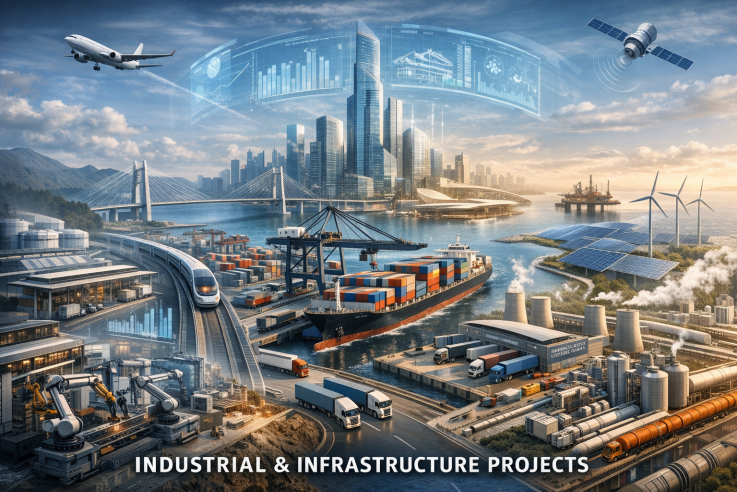
SpaceArch Industrial & Infrastructure Projects represents the high-complexity engineering and deployment division of SpaceArch Solutions International, focused on delivering strategic industrial platforms and critical infrastructure systems at regional, national, and international scale.
This division operates at the intersection of:
- Engineering precision
- Capital structuring
- Digital systems integration
- Logistics intelligence
- Long-term asset resilience
The objective is to design and execute infrastructure ecosystems that enable economic productivity, operational efficiency, and strategic competitiveness.
1. Strategic Positioning
Industrial and infrastructure projects are treated not as isolated facilities, but as:
Integrated production and logistics ecosystems aligned with long-term economic strategy.
Each project is structured to:
- Enhance regional competitiveness
- Improve supply chain performance
- Reduce operational friction
- Integrate smart systems from inception
- Align with ESG and development finance frameworks
2. Core Project Categories
• Logistics & Distribution Hubs
High-performance logistics platforms including:
- Port-connected industrial zones
- Cold chain corridors
- Warehousing clusters
- Automated distribution centers
- Export processing facilities
Designed for efficiency, scalability, and trade integration.
• Industrial Production Facilities
Advanced manufacturing environments including:
- Modular production plants
- Assembly and fabrication facilities
- Smart industrial parks
- Technology-integrated processing plants
- AI-assisted quality control environments
Engineered for operational optimization and lifecycle profitability.
• Energy & Utility Infrastructure
Infrastructure supporting industrial and urban systems:
- Renewable energy integration platforms
- Energy storage facilities
- Smart grid coordination nodes
- Water treatment & recycling systems
- Industrial waste management systems
Designed for resilience and long-term sustainability.
• Port & Maritime Infrastructure
Strategic maritime and trade-enabling systems including:
- Cold storage terminals
- Port logistics optimization
- Digital port coordination layers
- Trade intelligence integration platforms
- Multi-port operational synchronization systems
Focused on throughput optimization and supply chain stability.
• Strategic Industrial Corridors
Regional development frameworks integrating:
- Production
- Logistics
- Transportation
- Energy systems
- Digital infrastructure
Positioned to stimulate economic clusters and attract institutional capital.
3. Engineering & Systems Integration
All projects incorporate:
- BIM-based engineering coordination
- Digital twin simulations
- AI-assisted scheduling
- Predictive maintenance systems
- Integrated cost-performance dashboards
The objective is to eliminate fragmentation between:
Design → Construction → Operations → Optimization
Infrastructure is built with embedded intelligence.
4. Financial & Capital Architecture
Industrial projects are structured as:
- Capital-efficient phased deployments
- Public-private partnership (PPP) ready frameworks
- Institutional-grade financial models
- Development bank-compatible structures
- ESG-aligned investment vehicles
Financial architecture includes:
- Capex/Opex modeling
- Yield forecasting
- Risk-adjusted return analysis
- Long-term asset valuation positioning
Infrastructure is approached as a strategic capital platform, not merely a construction output.
5. Phased Deployment Strategy
Large infrastructure projects follow a controlled sequence:
Phase 0 – Diagnostic & Feasibility
- Market demand assessment
- Trade flow modeling
- Regulatory mapping
- Environmental impact studies
Phase 1 – Core Infrastructure Activation
- Anchor facility construction
- Primary logistics or production systems
- Foundational utilities
Phase 2 – Expansion & Systems Integration
- Digital intelligence layers
- Capacity expansion
- Cross-network connectivity
Phase 3 – Optimization & Yield Stabilization
- Operational efficiency tuning
- Energy optimization
- Asset valuation positioning
This model reduces exposure while maintaining execution momentum.
6. Sustainability & ESG Framework
Industrial and infrastructure systems are designed with:
- Carbon footprint reduction strategies
- Renewable integration pathways
- Circular economy design principles
- Water reuse optimization
- Climate resilience engineering
Compliance and reporting mechanisms are embedded from project inception.
7. Operational Model
SpaceArch deploys a hybrid execution structure:
- Central strategic coordination
- Local engineering and construction partners
- Performance-based contracting
- Digital monitoring systems
- Scalable international replication logic
The cloud-coordinated model ensures:
- Controlled overhead
- Reduced systemic risk
- Flexible deployment capacity
- International adaptability
8. Risk Management & Governance
Industrial-scale projects integrate:
- Multi-scenario stress testing
- Supply chain redundancy mapping
- Regulatory compliance verification
- Contractor performance analytics
- ESG transparency frameworks
Governance standards are aligned with institutional and sovereign-level requirements.
9. Competitive Differentiators
- AI-integrated industrial planning
- Infrastructure-as-ecosystem philosophy
- Capital-structured deployment model
- ESG-aligned development framework
- Modular scalability
- Digital twin-enabled lifecycle management
- Cross-vertical integration with Ports, Smart Buildings, and Digital Labs
10. Long-Term Vision
SpaceArch Industrial & Infrastructure Projects aims to:
- Enable trade-driven regional growth
- Modernize industrial systems
- Integrate digital intelligence into physical infrastructure
- Create resilient economic platforms
- Align infrastructure with future regulatory and climate realities
This division is positioned to collaborate with:
- Governments
- Sovereign funds
- Development banks
- Private industrial investors
- Public-private partnerships
Conclusion
Industrial & Infrastructure Projects within SpaceArch represents the structural backbone of economic enablement.
It merges engineering precision, digital intelligence, financial architecture, and sustainability into scalable, resilient infrastructure systems designed for long-term performance.
It is not simply about building industrial facilities.
It is about engineering intelligent infrastructure ecosystems that power productivity, competitiveness, and sustainable economic growth.