







A Socio-Economic Framework for the Age of Intelligent Production
1. Structural Transformation of the Global Production System
Human civilization is entering a new technological phase characterized by the systematic transfer of productive tasks from biological labor to cybernetic systems.
This transition is driven by the rapid advancement of:
- Artificial Intelligence
- Autonomous robotics
- Fully automated manufacturing
- Machine learning optimization systems
- Autonomous logistics networks
- AI-driven research and design systems
A fundamental principle emerges from the technological evolution of productive systems:
Any task that can be executed by artificial intelligence or robotic systems faster, more efficiently, and at lower cost than human labor will inevitably migrate to the cybernetic production layer.
This is not a political hypothesis or ideological statement.
It is a structural law of economic optimization.
Economic systems continuously minimize:
- production cost
- time to output
- operational risk
- human error
- supply chain variability
Automation improves all five parameters simultaneously.
Therefore, the transition toward cybernetic production systems is structurally irreversible.
2. The Emergence of the Fourth Wave Economy
The current technological shift represents the beginning of what can be defined as the Fourth Economic Wave.
First Wave
Agricultural civilization
Human muscle as primary productive force.
Second Wave
Industrial civilization
Machines amplify human labor.
Third Wave
Information civilization
Digital networks amplify human knowledge.
Fourth Wave
Autonomous cybernetic production systems
Robots and AI become the primary productive agents of the economy.
In the Fourth Wave:
- factories become autonomous
- logistics becomes autonomous
- design becomes algorithmic
- services become digital
- decision systems become AI-assisted
The role of humans in production becomes progressively marginal in operational terms.
3. The Inevitability of Human Labor Displacement
Historically, technological revolutions have replaced specific categories of jobs while creating new ones.
However, the Fourth Wave differs fundamentally from previous industrial transitions.
Artificial intelligence and robotics are not limited to replacing manual labor.
They are progressively replacing:
- cognitive tasks
- design processes
- analysis functions
- financial modeling
- logistics planning
- legal drafting
- medical diagnostics
- scientific data interpretation
This means that automation now affects the entire spectrum of human labor, from low-skill to high-skill professions.
As a consequence:
The traditional equation
Labor + Capital → Production
begins to transform into
AI + Robotics + Energy → Production
Human labor ceases to be a structural necessity in the production system.
4. The Inefficiency of Prohibition or Restrictive Regulation
Faced with this transition, some policy proposals attempt to slow automation through regulatory restrictions.
Examples include:
- taxes on robots
- limits on AI deployment
- employment protection barriers
- automation licensing regimes
These proposals create systemic inefficiencies.
Restricting automation introduces:
- reduced productivity growth
- higher production costs
- slower technological development
- geopolitical competitiveness loss
Countries that restrict automation risk falling behind those that accelerate it.
A clear example can already be observed in nations pursuing aggressive automation strategies.
China, for instance, has been rapidly deploying:
- millions of industrial robots
- fully automated manufacturing facilities
- “dark factories” operating without human workers
- AI-driven supply chains operating 24/7
These facilities operate continuously:
24 hours per day
365 days per year
without lighting, without rest cycles, and without human presence.
Such systems represent the highest efficiency configuration of industrial production currently known.
5. The Real Problem: Human Adaptation Lag
The core challenge is not artificial intelligence itself.
The fundamental challenge is the adaptation speed of human societies.
Automation is advancing exponentially.
Social institutions evolve slowly.
This creates a widening gap between:
technological capability
and
social structure.
If this gap is not addressed, societies may face:
- structural unemployment
- social fragmentation
- economic instability
- political turbulence
Therefore, the key question is not whether automation should occur, but how societies adapt to a fully automated production system.
6. The Minimum Lifetime Income Model
One proposed solution is the establishment of a universal minimum lifetime income for all adult citizens.
This mechanism recognizes a fundamental reality of the Fourth Wave:
If robots and AI generate the majority of global production,
the distribution of wealth must evolve accordingly.
The objective is not welfare dependency.
The objective is structural economic stability.
A universal income ensures:
- baseline purchasing power
- economic circulation of goods
- social cohesion
- stability of automated production markets
Without consumer demand, even highly efficient automated production systems cannot function sustainably.
7. The Human Role in a Post-Labor Economy
In a highly automated civilization, human activity shifts away from survival-driven labor toward creative and developmental domains.
Human contributions increasingly focus on:
- scientific research
- artistic creation
- philosophical inquiry
- education
- environmental restoration
- community development
- exploration and innovation
The goal is not human inactivity.
The goal is human cognitive evolution.
8. Cognitive Development as a Civilizational Priority
If machines perform most operational tasks, the strategic value of humanity becomes its cognitive and creative capacity.
This implies a global effort to enhance:
- intelligence
- creativity
- emotional regulation
- analytical capacity
- interdisciplinary knowledge
Several emerging disciplines contribute to this objective:
- cognitive neuroscience
- neurotechnology
- neuroplasticity research
- advanced education systems
- psychophysical training methods
Programs integrating meditation, cognitive training, and neurotechnology are already demonstrating the potential to significantly improve cognitive performance.
Such systems may enable the progressive elevation of average cognitive capability across populations.
9. The Structural Reorganization of Societies
Full automation does not only transform the economy.
It also reshapes the organizational architecture of societies.
The traditional industrial system is built around:
- wage labor
- capital accumulation
- hierarchical political systems
These frameworks emerged during earlier technological stages.
They may not be structurally compatible with a fully automated production environment.
A transition framework may therefore include new governance models.
10. Four Structural Pillars for the Fourth Wave Transition
One theoretical model proposes four core institutional mechanisms:
1. Eco-Governance at Local Levels
Cities become the primary units of ecological and economic management.
Local governments focus on:
- sustainable infrastructure
- energy transition
- resource management
- urban resilience
2. Direct Digital Democracy
Digital platforms enable citizens to participate directly in governance processes.
This system can be complemented by scientific advisory councils responsible for evaluating policy proposals based on evidence and long-term impact.
3. Post-Monetary Economic Metrics
In highly automated economies, the concept of money may gradually evolve.
One experimental model proposes qualified time units as an economic metric.
These units represent:
- time dedicated to socially valuable activity
- non-accumulative value exchange
- reduction of speculative financial dynamics
This concept remains theoretical but offers an alternative framework for post-industrial economies.
4. Universal Lifetime Income
A universal income ensures social stability while automation expands productivity.
This mechanism allows societies to transition toward a post-scarcity production model without economic collapse.
11. The City-Scale MVP Strategy
Systemic transitions of this magnitude cannot occur instantly at global scale.
A practical methodology is the implementation of city-level experimental models.
These cities function as Minimum Viable Prototypes (MVPs).
Pilot programs can test:
- automation integration
- new governance models
- income distribution systems
- cognitive development programs
- ecological infrastructure
Successful models can then be progressively replicated.
12. Preparing for the Fifth Wave
The Fourth Wave represents the beginning of a new civilizational phase.
However, technological evolution will not stop there.
Future developments may include:
- advanced artificial general intelligence
- human-machine cognitive integration
- neuro-digital interfaces
- planetary AI governance systems
- interplanetary economic structures
These possibilities suggest the eventual emergence of a Fifth Civilizational Wave.
Preparing for that future requires successfully navigating the current transition.
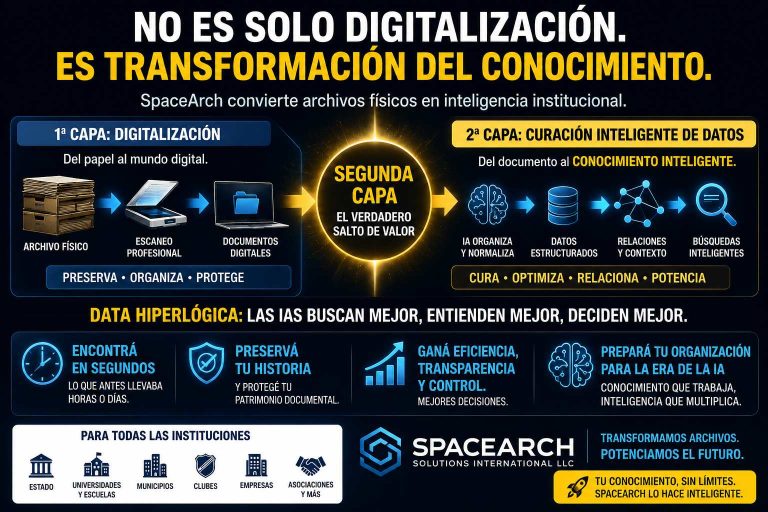
13. The Strategic Position of SpaceArch
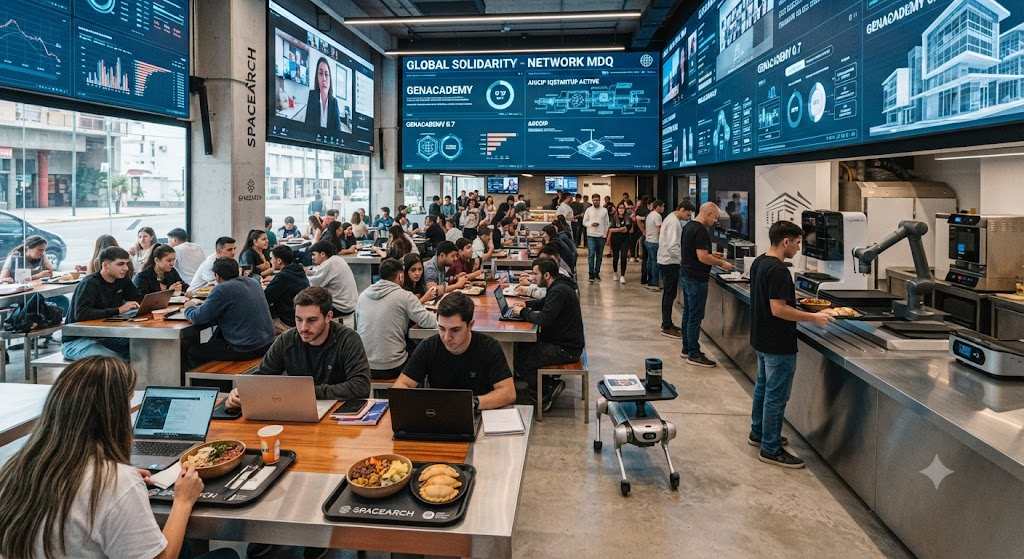
Within this framework, organizations such as SpaceArch aim to operate as experimental platforms for Fourth Wave systems.
These initiatives explore:
- AI-driven economic models
- automated production networks
- cognitive development systems
- digital governance frameworks
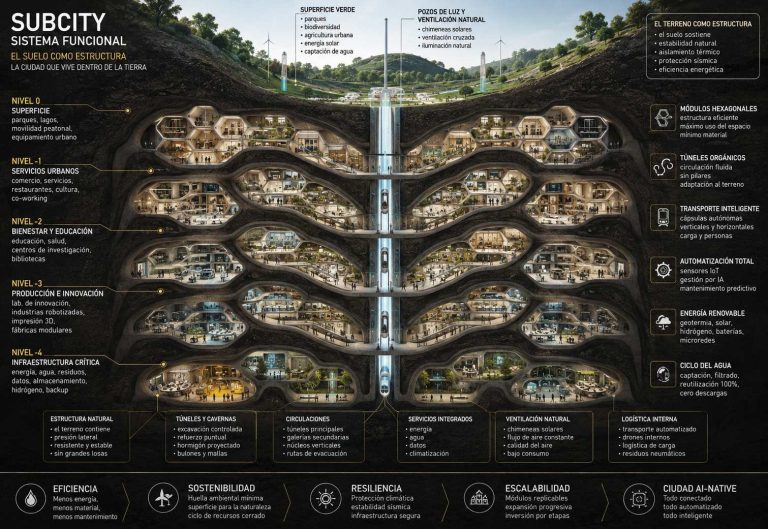
- sustainable urban architectures
Their objective is not only technological development, but civilizational adaptation.
Fifth Wave Projection Model
Beyond Automation: The Emergence of Hybrid Civilizational Intelligence
1. Conceptual Definition
The Fourth Wave can be defined as the historical phase in which the global production system is progressively transferred from human labor to autonomous cybernetic systems.
The Fifth Wave begins when automation is no longer the core transformation.
At that stage, the decisive factor is the emergence of a new layer of intelligence integration between:
- artificial intelligence
- robotics
- neurotechnology
- collective governance systems
- augmented cognition
- post-scarcity economic architectures
In this sense, the Fifth Wave is not merely a more advanced automation phase.
It is the transition from:
automated civilization
to
integrated intelligence civilization
2. Historical Sequence of the Waves
First Wave
Agrarian civilization.
Land, muscle, and seasonal cycles define production.
Second Wave
Industrial civilization.
Mechanical energy amplifies labor.
Third Wave
Informational civilization.
Digital systems amplify communication and knowledge processing.
Fourth Wave
Autonomous cybernetic civilization.
AI, robotics, and full automation replace labor as the central production variable.
Fifth Wave
Civilization of integrated intelligence, hybrid cognition, and post-labor restructuring.
The Fifth Wave therefore does not simply optimize the productive system.
It redefines:
- what intelligence is
- what work is
- what value is
- what governance is
- what the human being becomes within a machine-dense civilization
3. The Transition Threshold Between Fourth and Fifth Wave
A society enters the Fifth Wave when at least five structural thresholds are crossed.
Threshold 1: Production is mostly autonomous
The majority of industrial, logistical, administrative, and design functions are performed by cybernetic systems.
Threshold 2: Human labor is no longer the dominant income-distribution mechanism
The wage-based economy becomes insufficient to organize society.
Threshold 3: AI becomes a generalized cognitive infrastructure
Artificial intelligence ceases to be a tool and becomes a pervasive operating layer for all institutions.
Threshold 4: Neurocognitive enhancement becomes socially relevant
Education shifts from passive information transfer to active intelligence amplification.
Threshold 5: Governance systems become partially cybernetic
Decision-making, coordination, simulation, forecasting, and policy optimization become AI-assisted at structural levels.
Once these five thresholds are crossed, civilization ceases to be merely automated.
It becomes cognitively reorganized.
4. Core Hypothesis of the Fifth Wave
The central hypothesis is the following:
When intelligence becomes the main productive force, civilization reorganizes itself around cognitive architecture rather than labor architecture.
Previous civilizations were organized around:
- land
- labor
- capital
- industry
- information
The Fifth Wave is organized around:
- cognition
- intelligence density
- neural adaptability
- cybernetic coordination
- real-time optimization
- post-scarcity distribution logic
This means that the center of gravity of civilization shifts from production of goods to organization of intelligence.
5. Structural Characteristics of the Fifth Wave
5.1 Post-Labor Economic Order
In the Fifth Wave, human labor is no longer the central mechanism of survival or wealth distribution.
The traditional labor market contracts structurally because:
- robots perform physical tasks
- AI performs cognitive routine tasks
- autonomous platforms manage logistics and coordination
- design, optimization, and diagnostics become automated
As a result, the economy must move beyond wage dependence.
The central challenge becomes:
How does society distribute access, dignity, and meaning in a system where labor is no longer economically necessary for the majority?
5.2 Cognitive Stratification Risk
If unmanaged, the Fifth Wave can produce a new form of inequality:
not merely wealth inequality,
but cognitive inequality.
The real divide may become:
- enhanced vs non-enhanced populations
- AI-literate vs AI-dependent populations
- cognitively trained vs cognitively stagnant populations
- societies with high collective intelligence vs societies trapped in institutional obsolescence
Therefore, the Fifth Wave requires not only economic transition, but also mass cognitive uplift systems.
5.3 Neurocivilizational Development
The Fifth Wave requires a civilization that systematically invests in the development of higher-order human faculties:
- attention control
- emotional regulation
- abstract reasoning
- interdisciplinary cognition
- ethical judgment
- long-term systems thinking
- cooperative intelligence
This is where neuroeducation, psychophysical training, neurotechnology, and advanced contemplative disciplines converge into a single field of civilizational importance.
In the Fifth Wave, education is no longer mainly about professional insertion.
It becomes a technology of intelligence elevation.
5.4 AI as an Institutional Nervous System
In the Fourth Wave, AI replaces tasks.
In the Fifth Wave, AI becomes the nervous system of civilization.
Its role expands into:
- predictive governance
- climate management
- healthcare coordination
- urban optimization
- educational personalization
- justice system support
- resource allocation
- risk anticipation
- planetary-scale simulations
AI therefore ceases to be sectorial software and becomes civilizational infrastructure.
6. The Fifth Wave Economic Model
The Fifth Wave requires a new economic framework.
The industrial model was based on scarcity, wage labor, accumulation, and capital concentration.
The Fifth Wave progressively shifts toward:
- high automation
- ultra-low marginal production costs
- distributed digital coordination
- reduced need for human labor
- expansion of intangible value systems
- social stabilization through guaranteed baseline access
A mature Fifth Wave economic architecture may include:
1. Universal lifetime income or social dividend
A baseline income linked to automated productivity.
2. Public access to core services
Energy, connectivity, education, healthcare, and basic food security increasingly treated as guaranteed infrastructure.
3. Non-speculative value metrics
Experimental systems beyond pure monetary accumulation.
4. Incentivized creative and civilizational work
Science, philosophy, arts, ecological restoration, and advanced education become central human contribution fields.
7. Governance in the Fifth Wave
The governance systems of the industrial era were designed for slow data, slow communication, and fragmented knowledge.
The Fifth Wave requires governance systems capable of operating in real time across complex dynamic systems.
This implies:
- direct digital participation mechanisms
- AI-assisted policy simulation
- scientific councils integrated into decision frameworks
- local eco-governance units
- transparent digital accountability systems
- adaptive legal architectures
The state evolves from a bureaucratic control machine into a dynamic coordination architecture.
8. The Human Role in the Fifth Wave
The human being is not eliminated in the Fifth Wave.
Its role changes radically.
Humans become increasingly specialized in:
- meaning generation
- ethical discernment
- creative invention
- strategic imagination
- civilizational design
- consciousness research
- relational intelligence
- aesthetic innovation
Where machines optimize, humans orient.
Where machines calculate, humans assign significance.
Where machines scale, humans define direction.
The Fifth Wave therefore does not abolish humanity.
It demands its upgrading.
9. SpaceArch Interpretation of the Fifth Wave
Within a SpaceArch framework, the Fifth Wave is not viewed merely as a macroeconomic transition.
It is understood as a new design layer for civilization.
That includes:
- new cities designed for intelligent coexistence with AI systems
- hyper-efficient urban nodes
- digital labs as cognitive production centers
- robotic service ecosystems
- local governance prototypes
- cognitive training infrastructures
- hybrid education platforms
- automated economic nodes with low-friction coordination
- climate-adaptive eco-urban systems
In this interpretation, SpaceArch is not only a business architecture.
It becomes a prototype platform for Fifth Wave civilization design.
10. City-Scale MVP of the Fifth Wave
The Fifth Wave cannot be implemented directly at planetary scale.
Its operational logic requires city-scale experimentation.
A Fifth Wave pilot city would test:
- autonomous production clusters
- AI-driven local government assistance
- basic income mechanisms
- neuroeducation systems
- digital democracy tools
- low-friction public service access
- real-time urban resource optimization
- human-machine cooperation frameworks
This is the correct transition path:
concept → pilot city → scalable node model → intercity federation → macro-civilizational diffusion
11. Mathematical Logic of the Fifth Wave Transition
A simplified structural model can be written as:
Civilizational Stability in the Fifth Wave
CS5=(CD+II+SI)(AP⋅CI⋅GI⋅HD)
Where:
- CS_5 = Fifth Wave Civilizational Stability
- AP = Autonomous Productivity
- CI = Collective Intelligence
- GI = Governance Intelligence
- HD = Human Development
- CD = Cognitive Divide
- II = Institutional Inertia
- SI = Social Instability
This means that Fifth Wave stability increases when:
- automation is productive
- society becomes more intelligent
- governance becomes more adaptive
- human development rises
And it decreases when:
- cognitive inequality rises
- institutions remain obsolete
- instability expands faster than adaptation
12. Risk Scenarios of the Fifth Wave
The Fifth Wave is not automatically positive.
It contains several risk branches.
Scenario A: Positive Transition
Automation is matched by income redesign, cognitive uplift, and adaptive governance.
Result: stable post-labor civilization.
Scenario B: Oligarchic Cybernetic Concentration
AI and robotics remain concentrated in few corporate or state actors.
Result: extreme asymmetry, mass exclusion, neo-feudal techno-order.
Scenario C: Institutional Collapse
Automation advances faster than political adaptation.
Result: unemployment, polarization, unrest, fragmentation.
Scenario D: Cognitive Bifurcation
A minority becomes highly enhanced while the majority stagnates.
Result: irreversible civilizational stratification.
Scenario E: Managed Hybrid Ascent
Societies progressively integrate neurotechnology, AI coordination, and new economic systems.
Result: emergence of a higher-capacity civilization.
13. Fifth Wave Strategic Imperative
The Fifth Wave cannot be improvised after full labor displacement occurs.
It must be prepared in advance through:
- pilot institutions
- AI governance tools
- new educational systems
- cognitive development protocols
- local economic redesign
- automation-compatible distribution systems
- ethical control architectures
The critical principle is simple:
The faster automation expands, the faster civilization must redesign its human operating model.
14. Long-Term Projection
If successfully managed, the Fifth Wave may open the path toward:
- post-scarcity societies
- ultra-high productivity with low ecological waste
- intelligence-amplified democracies
- neuroadaptive education systems
- city-networks operating as distributed cognition systems
- human-machine hybrid research ecosystems
- new metrics of wealth based on intelligence, health, ecological regeneration, and civilizational coherence
In this sense, the Fifth Wave is the first phase in which civilization consciously begins to design its own evolutionary trajectory.
15. Final Strategic Thesis
The Fourth Wave automates the world.
The Fifth Wave reorganizes civilization around intelligence.
The Fourth Wave destroys the old labor equation.
The Fifth Wave creates the new civilizational equation.
The Fourth Wave is about replacing work.
The Fifth Wave is about redefining humanity’s function in an AI-dense world.
The decisive question is no longer whether machines will surpass human productivity.
The decisive question is whether human societies will develop the governance, economic, and cognitive architecture necessary to remain coherent, dignified, and evolutionary under those conditions.
That is the true frontier of the Fifth Wave.