
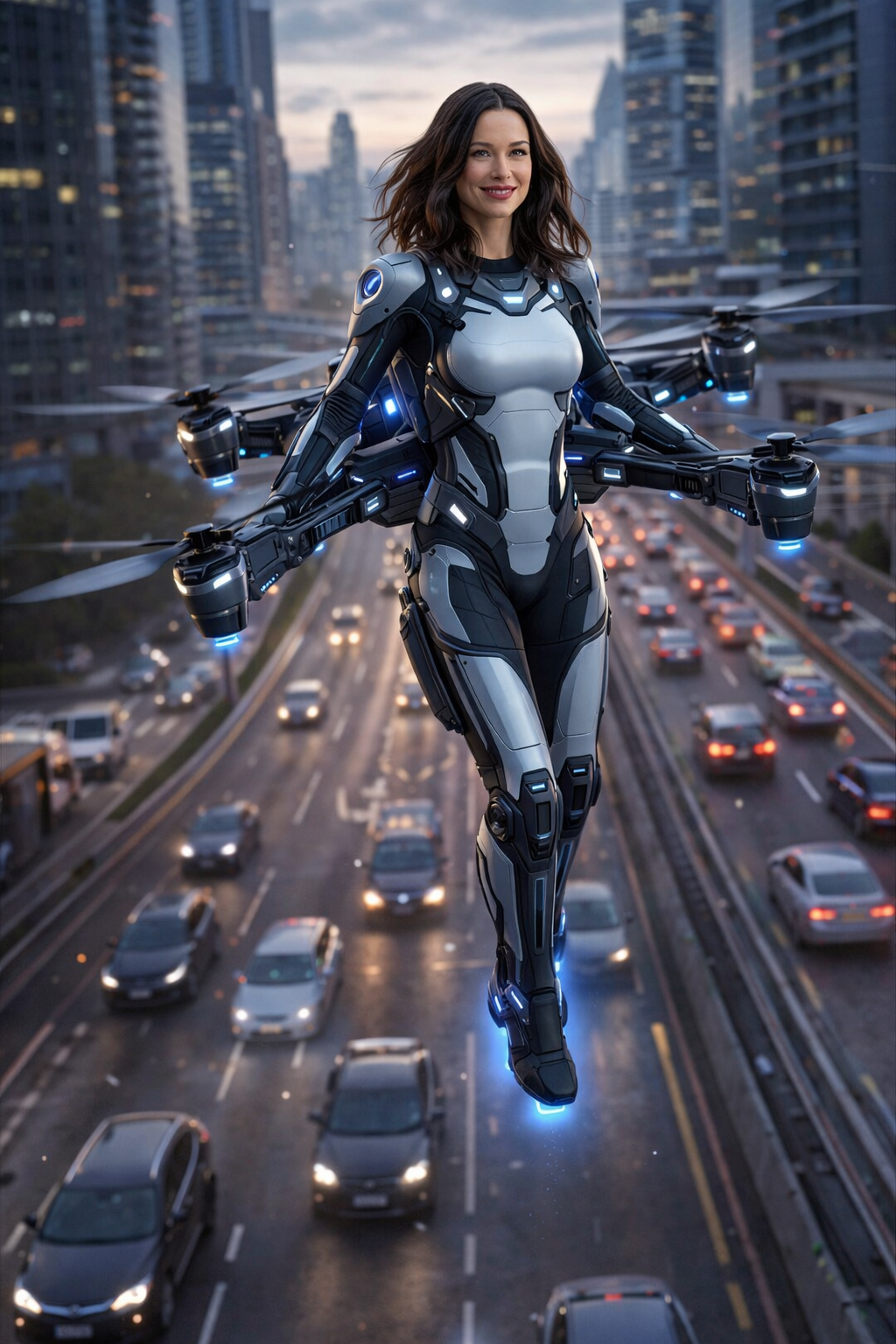
Foldable Drone Exosuits for Individual Flight
SpaceArch Aerospace Mobility Program
1. Concept Overview
The Personal Aerial Mobility System (PAMS) developed within the SpaceArch technological framework proposes a new category of aerial mobility: wearable flight platforms based on multi-rotor drone technology integrated into an exoskeletal suit.
Unlike traditional aerial vehicles or passenger drones, the system is designed as a body-integrated aerial device, where the propulsion system surrounds the pilot and distributes thrust symmetrically to enable stable individual flight.
The central concept can be described as a Drone Exosuit: a wearable aerial mobility device in which the pilot effectively “wears the aircraft”.
This architecture eliminates many structural components required in conventional aircraft and drastically reduces cost, complexity, and weight.
The system integrates:
• Distributed electric propulsion
• Foldable rotor arms
• Lightweight structural exoskeleton
• Autonomous stabilization software
• Redundant safety systems
The result is a compact personal flight system capable of vertical takeoff and landing (VTOL) while remaining significantly smaller and cheaper than passenger drones or eVTOL aircraft.
2. Technological Hypothesis
The hypothesis behind the system is that individual aerial mobility can be achieved more efficiently through wearable distributed propulsion rather than through cabin-based aircraft platforms.
Passenger drones and eVTOL vehicles require:
• Structural fuselage
• Passenger cabin
• Landing gear
• Heavy battery capacity
• Complex avionics
These elements dramatically increase cost, mass, and regulatory complexity.
By contrast, a wearable drone exosuit removes the need for a vehicle body, allowing thrust to be applied directly around the pilot.
The core engineering principle is:
Human-centered propulsion architecture.
The pilot becomes the central structural element of the vehicle, supported by an exoskeleton frame that distributes loads and stabilizes thrust vectors.
This allows the system to achieve:
• lower structural mass
• reduced energy consumption
• simpler mechanical architecture
• faster manufacturing cycles
3. System Architecture
The Personal Aerial Mobility System consists of five primary subsystems.
3.1 Structural Exoskeleton
A lightweight frame surrounds the pilot’s torso, shoulders, and hips.
Materials may include:
• carbon fiber composites
• graphene-reinforced polymers
• aerospace aluminum alloys
The structure distributes propulsion loads across the body and maintains safe rotor separation from the pilot.
3.2 Distributed Rotor Propulsion
The flight system uses multiple electric rotors positioned around the body, typically between 6 and 12 rotors, depending on payload and flight endurance requirements.
Each rotor is mounted on foldable arms, allowing the device to collapse into a compact configuration for storage and transport.
Key features include:
• independent motor controllers
• thrust vector balancing
• distributed redundancy
If one rotor fails, the flight computer compensates using the remaining units.
3.3 Foldable Rotor Arm System
A critical innovation is the foldable propulsion arm architecture.
Each rotor arm can:
• extend during flight preparation
• lock into rigid flight position
• fold compactly after landing
This system dramatically reduces storage volume and allows the device to function as a wearable mobility tool rather than a conventional vehicle.
3.4 Autonomous Flight Stabilization
Like modern drones, the exosuit relies on AI-assisted flight stabilization systems.
The onboard flight computer integrates:
• inertial measurement units (IMU)
• gyroscopes
• GPS navigation
• obstacle detection sensors
The system automatically stabilizes the pilot, reducing the need for advanced piloting skills.
The user interface may consist of:
• joystick control
• arm gestures
• voice commands
• augmented-reality flight guidance
3.5 Safety Systems
Safety redundancy is fundamental for human aerial mobility.
The system incorporates:
• ballistic parachute deployment
• emergency auto-landing mode
• battery redundancy
• collision avoidance sensors
• geofencing software
These features are essential for regulatory approval and public adoption.
4. Comparison with Passenger Drones and eVTOL Aircraft
| Parameter | Passenger Drone | Drone Exosuit |
|---|---|---|
| Structural complexity | High | Low |
| Vehicle mass | 300–1000 kg | 40–120 kg |
| Manufacturing cost | $200k–$1M | $20k–$80k (target range) |
| Infrastructure required | Landing pads | Minimal |
| Storage footprint | Large | Compact |
| Versatility | Limited | High |
This comparison illustrates that wearable aerial mobility systems could occupy a distinct market segment between drones and extreme sports aviation.
5. Economic and Industrial Potential
The Drone Exosuit concept opens several commercial markets.
Urban Mobility
Short-distance aerial mobility for dense cities where ground congestion limits transportation efficiency.
Emergency Response
Rapid deployment for:
• firefighters
• search and rescue teams
• mountain rescue
• maritime operations
Military Applications
Potential tactical uses include:
• reconnaissance
• rapid deployment units
• special forces mobility
Industrial Inspection
Technicians could reach infrastructure locations quickly:
• wind turbines
• high-rise buildings
• bridges
• offshore platforms
Extreme Sports and Tourism
A large recreational market could emerge similar to:
• jetpacks
• wingsuits
• paramotors
but with greater stability and safety.
6. Manufacturing Feasibility
The technology required for such systems largely already exists.
Key enabling technologies include:
• high-power electric motors
• lightweight lithium battery systems
• drone stabilization software
• composite materials manufacturing
The primary engineering challenge lies in integration and safety certification rather than fundamental physics or propulsion limitations.
For this reason, the development cycle could be significantly shorter than for conventional aircraft.
7. Regulatory Considerations
Regulation will likely fall under emerging categories such as:
• ultralight aerial vehicles
• personal aerial mobility devices
• experimental aviation systems
The regulatory pathway may initially resemble that of:
• ultralight aircraft
• powered paragliders
• experimental jetpacks
This regulatory positioning could accelerate market entry compared with passenger eVTOL aircraft.
8. Strategic Implications for SpaceArch
For SpaceArch, the development of wearable aerial mobility technologies represents a natural extension of its broader vision of:
• advanced mobility systems
• autonomous infrastructures
• drone-based logistics
• next-generation urban architecture
These systems could integrate with other SpaceArch technologies such as:
• LaserDron aerial corridors
• AI-managed air traffic systems
• AINeuron smart cities
Together they form part of a future distributed aerial mobility ecosystem.
9. Development Roadmap (Conceptual)
Phase 1
Conceptual engineering design and simulation
Phase 2
Scaled prototype testing
Phase 3
Human pilot test platform
Phase 4
Safety certification and commercial pilot program
Phase 5
Industrial production and commercialization
10. Conclusion
The Drone Exosuit concept represents a potentially transformative category within the field of personal aerial mobility.
By shifting from vehicle-centric aviation to human-centric propulsion architecture, it becomes possible to reduce structural complexity, cost, and infrastructure requirements.
If successfully developed, wearable aerial mobility systems could form the foundation of a new industry positioned between aviation, robotics, and personal transportation.
For SpaceArch, this technology aligns with its broader strategic objective: designing scalable infrastructures for the next generation of human mobility and urban systems.
SpaceArch X-1
Preliminary Engineering Model for a Personal Drone Exosuit
1. Design objective
Develop a wearable VTOL personal flight system based on distributed electric propulsion, with foldable rotor arms, intended for:
- short-duration personal flight
- controlled low-altitude operations
- emergency, industrial, tactical, or demonstration use
- lower cost and higher versatility than a passenger eVTOL platform
The engineering premise is sound: NASA describes eVTOL architectures as relying on electric energy storage plus electrically driven multi-rotor lift/propulsion units, and highlights the value of distributed electric propulsion and multicopter-style redundancy.
2. Baseline sizing assumptions
For a first realistic prototype, I would model the system around these masses:
Pilot + system mass budget
- Pilot: 80 kg
- Exoskeleton structure: 18 kg
- Rotors, motors, arms, ESCs: 16 kg
- Battery pack: 24 kg
- Avionics, harness, wiring, safety systems: 7 kg
Estimated gross takeoff mass (GTOM): 145 kg
That is the mass the propulsion system must lift.
Weight in force units
W=m⋅g=145⋅9.81≈1422 N
So the vehicle must produce at least 1422 N of total thrust just to hover.
For a safe controllable vehicle, a human-carrying multicopter should not be sized at exactly 1:1 thrust/weight. A more credible engineering target is:
- minimum hover ratio: 1.0
- recommended controllable thrust ratio: 1.25 to 1.35
- emergency reserve goal: closer to 1.4
So the design thrust target becomes:Tdesign=1.3×1422≈1849 N
That is about 188.5 kgf total equivalent thrust.
3. Rotor configuration
Recommended architecture: 8 rotors
For a first serious SpaceArch concept, 8 rotors is the best compromise.
Why 8 and not 4?
- better redundancy
- lower disk loading per rotor
- lower vibration per unit thrust
- safer control authority
- less catastrophic dependence on one motor
NASA safety literature on AAM/eVTOL also points to the value of multicopter-style redundancy in lift systems.
Per-rotor thrust requirement
If total design thrust is 1849 N, then for 8 rotors:Trotor=1849/8≈231 N
That is about:231/9.81≈23.5 kgf per rotor
So each rotor-motor unit should be capable of around:
- 23–25 kgf continuous peak-capable thrust
- ideally 27–30 kgf max burst thrust for maneuver and reserve
4. Rotor diameter
This is one of the most important variables.
Small rotors look compact, but they punish the system with:
- much higher power demand
- worse hover efficiency
- more noise
- higher disk loading
For human lift, the system needs large propeller area.
Recommended rotor diameter range
- 0.8 m to 1.0 m per rotor
- sweet spot for first model: 0.9 m
Total rotor disk area
For one 0.9 m rotor:A1=π⋅(0.45)2≈0.636 m2
For 8 rotors:Atotal=8⋅0.636≈5.09 m2
This is much better than a compact small-prop architecture.
5. Hover power estimate
The ideal induced hover power for a rotorcraft is approximated by momentum theory:Pi=2ρAT3/2
Where:
- T = total thrust
- ρ = air density
- A = total rotor area
Using a reference case close to this concept, with multicopter hover loads in this class, the ideal hover power falls in the 13–18 kW range depending on thrust assumption, before real-world losses. The calculator outputs for representative thrust levels and rotor area show this order of magnitude clearly.
But real systems are not ideal. You must add losses from:
- propeller efficiency
- motor efficiency
- ESC losses
- wake interaction
- frame interference
- control margin
- gust response
- battery voltage sag
So a realistic engineering multiplier is roughly 1.5 to 1.8 times ideal power for a first-generation prototype.
Practical power target
For a 145 kg GTOM / 8-rotor / 0.9 m rotor concept:
- ideal hover power: ~14–17 kW
- practical hover electrical power: 22–28 kW
- maneuver / climb / reserve peak: 35–45 kW
That is the range I would size around.
6. Motor sizing
If hover electrical power is about 24 kW, with 8 motors:24/8=3.0 kW per motor average in hover
But that is only average hover. For reserve, response, and climb, motors must be substantially larger.
Recommended motor class
Per motor:
- continuous rating: 5–6 kW
- peak rating: 8–10 kW
Total installed motor power:
- 40–48 kW continuous
- 64–80 kW peak
This gives the system enough overhead to avoid running near saturation all the time.
7. Battery sizing
This is the critical bottleneck.
NASA’s 2025 work on electric aircraft states that a baseline usable installed battery specific energy of 400 Wh/kg has a very large impact on viability, and that many designs do not close for current state-of-the-art battery weights.
DOE material also shows practical battery energy levels in the real-world transport context well below the theoretical ideal, with figures such as 150 Wh/kg practical in older conventional lithium-ion references and around 220 Wh/kg practical energy as a DOE target direction.
So for a near-term exosuit concept, the realistic assumption is:
Working usable pack energy assumption
- conservative: 180 Wh/kg
- aggressive near-term: 220 Wh/kg
- future advanced aviation pack: 300+ Wh/kg
- NASA aspirational installed baseline for advanced electric aircraft studies: 400 Wh/kg, but not current practical reality for many designs.
Baseline pack mass
Assume battery pack mass:
- 24 kg
Then usable energy is roughly:
conservative pack
24⋅180=4320 Wh
better pack
24⋅220=5280 Wh
So your real pack is in the range:
- 4.3 to 5.3 kWh usable
8. Endurance estimate
If hover power is 24 kW, then flight duration is:
with 4.3 kWh usable
4.3/24=0.179 h≈10.7 min
with 5.3 kWh usable
5.3/24=0.221 h≈13.3 min
Then remove reserve margin.
Real operational endurance
For safety, you do not want to consume 100% of usable energy.
So a more realistic practical mission duration is:
- 6 to 10 minutes operational flight
- 10 to 13 minutes absolute technical envelope
- not counting aggressive maneuvering, wind, or repeated climb
That means the first viable product is not a commuter aircraft.
It is a:
- short-hop system
- tactical mobility system
- industrial rescue system
- controlled demo / special use platform
And that is exactly where the concept makes more sense.
9. Thrust summary
For the SpaceArch X-1 baseline, I recommend these numbers:
Total vehicle
- GTOM: 145 kg
- Hover thrust required: 1422 N
- Design thrust target at 1.3 T/W: 1849 N
- Total installed peak thrust goal: 1900–2200 N
- Equivalent total thrust in kgf: 194–224 kgf
Per rotor, 8-rotor architecture
- continuous useful thrust target: 23–25 kgf
- preferred peak thrust: 27–30 kgf
10. Engineering configuration proposal
SpaceArch X-1 / Baseline Pre-Prototype
Configuration
- 8 foldable arms
- 8 large-diameter rotors
- 0.9 m prop diameter
- wearable torso-hip exoskeleton
- central battery spine/backpack
- digital flight control with auto-stabilization
Mass
- pilot: 80 kg
- empty platform without battery: 41 kg
- battery: 24 kg
- total: 145 kg
Propulsion
- 8 × 5–6 kW continuous motors
- 8 × 8–10 kW peak motors
- installed electrical power: 40–48 kW continuous
- peak system power: 64–80 kW
Battery
- 4.3–5.3 kWh usable
- pack voltage class likely high-voltage architecture
- estimated endurance: 6–10 min operational
Flight envelope
- low-altitude
- short duration
- controlled weather only
- low-forward-speed first phase
- hover / short translation / landing priority
11. Comparison versus passenger drone
This could be cheaper and more versatile than a passenger drone, but only in a specific mission band.
Where the exosuit wins
- no cabin
- no full fuselage
- less structural mass
- lower manufacturing cost
- less storage volume
- easier transport
- more tactical versatility
- faster prototyping cycle
NASA notes that electric VTOL architectures benefit from reduced maintenance and simpler electric propulsion chains, but battery weight remains a major constraint.
Where the passenger eVTOL wins
- more comfortable
- potentially safer perception
- easier to certify for civilian passenger service
- better for stabilized seated transport
- more room for bigger battery packs and crash structures
So the exosuit is not a replacement for all eVTOL.
It is a different class.
12. Main engineering bottlenecks
The real bottlenecks are not the motors or control software. Those already exist in the drone/eVTOL ecosystem. The bottlenecks are:
A. Energy density
Battery mass is the main limiter. NASA’s recent studies explicitly say current state-of-the-art battery weights prevent many electric aircraft designs from closing.
B. Human safety
A wearable aircraft has almost no passive crash structure. Safety must come from:
- redundancy
- stabilization
- emergency descent logic
- ballistic recovery
- strict operating envelope
C. Rotor-human interaction
You must design for:
- limb protection
- rotor separation
- clothing ingestion prevention
- rotor strike avoidance
- safe fold/unfold locking
D. Regulation
FAA materials make clear that unmanned aircraft are treated as aircraft and are regulated accordingly; a human-carrying wearable multicopter would face an even stricter path.
13. Best development path
I would not begin with the final wearable free-flight version.
The rational SpaceArch path is:
Phase 1 — tethered industrial demonstrator
- unmanned or weighted dummy
- prove thrust, controls, foldable arms, thermal behavior
Phase 2 — suspended human test rig
- controlled gantry / tether
- validate center of gravity, ergonomics, emergency cutoff
Phase 3 — low-altitude short-hover prototype
- very limited altitude
- full protective cage and ballistic system
Phase 4 — mission-specific product
Choose one:
- rescue
- industrial inspection
- military/tactical
- premium sport mobility
That is much more defensible than trying to sell it immediately as mass-market urban transport.
14. Final engineering conclusion
Yes: the concept is technically plausible as a short-duration personal multicopter exosuit.
But the physics forces a clear conclusion:
- the main enemy is battery mass
- the vehicle must use large rotors
- the design should prioritize 8 rotors
- real endurance will likely be minutes, not tens of minutes
- the first viable market is specialized operations, not mass commuting
Recommended baseline spec
If I had to freeze a first engineering draft today, I would define:
- GTOM: 145 kg
- rotors: 8
- diameter: 0.9 m each
- installed peak power: 64–80 kW
- hover electrical power: 22–28 kW
- battery: 4.5–5.5 kWh usable
- operational endurance: 6–10 min
- peak thrust per rotor: 27–30 kgf
That is the first serious number set.
Assumed engineering baseline
This table is based on the same preliminary reference model:
- Gross Takeoff Mass (GTOM): 145 kg
- 8 rotors
- Rotor diameter: 0.9 m
- Practical hover electrical power: 24 kW
- Design reserve factor: 20%
- Battery scenarios:
- 180 Wh/kg = conservative
- 220 Wh/kg = improved near-term
- 300 Wh/kg = advanced
- 400 Wh/kg = highly advanced aviation target
Calculation model
Base energy without reserve:E=P×t
Design energy with 20% reserve:Ed=E×1.20
Battery mass:Mbat=Wh/kgEd×1000
Where:
- P=24 kW
- t in hours
- reserve = 20%
SpaceArch X-1
Comparative Endurance Engineering Table
| Flight Time | Base Energy Required | Energy with 20% Reserve | Battery Mass @180 Wh/kg | Battery Mass @220 Wh/kg | Battery Mass @300 Wh/kg | Battery Mass @400 Wh/kg |
|---|---|---|---|---|---|---|
| 10 min | 4.0 kWh | 4.8 kWh | 26.7 kg | 21.8 kg | 16.0 kg | 12.0 kg |
| 20 min | 8.0 kWh | 9.6 kWh | 53.3 kg | 43.6 kg | 32.0 kg | 24.0 kg |
| 30 min | 12.0 kWh | 14.4 kWh | 80.0 kg | 65.5 kg | 48.0 kg | 36.0 kg |
| 60 min | 24.0 kWh | 28.8 kWh | 160.0 kg | 130.9 kg | 96.0 kg | 72.0 kg |
| 120 min | 48.0 kWh | 57.6 kWh | 320.0 kg | 261.8 kg | 192.0 kg | 144.0 kg |
Engineering interpretation
1. 10 minutes
This is the first zone that begins to look technically plausible for a real exosuit.
- At 220 Wh/kg, battery mass is 21.8 kg
- At 300 Wh/kg, battery mass is 16 kg
This fits relatively well with the earlier concept range of a 24 kg pack, which is why the first prototype logic naturally lands around 6 to 10 minutes.
Engineering verdict:
Feasible as a first-generation short-flight system.
2. 20 minutes
At this level the concept begins to enter a more difficult but still potentially testable zone.
- 43.6 kg battery at 220 Wh/kg
- 32 kg at 300 Wh/kg
This is already a heavy battery for a body-worn multicopter, but still might be explored in an advanced prototype if the rest of the structure is aggressively optimized.
Engineering verdict:
Possible only with strong structural optimization and advanced pack efficiency.
3. 30 minutes
This is where the concept begins to leave the comfort zone of a wearable VTOL exosuit.
- 65.5 kg battery at 220 Wh/kg
- 48 kg battery at 300 Wh/kg
Once the battery alone weighs 48–66 kg, the total aircraft mass rises sharply, so the original 24 kW hover assumption becomes too optimistic. In reality, required power would increase, so the true battery requirement would be even higher.
Engineering verdict:
Borderline to impractical for a pure electric exosuit.
4. 60 minutes
At one hour, the system enters a clearly unfavorable mass regime.
- 130.9 kg battery at 220 Wh/kg
- 96 kg battery at 300 Wh/kg
- 72 kg battery even at 400 Wh/kg
At this point, the battery alone is close to or exceeds the rest of the total vehicle architecture.
Engineering verdict:
Not realistic for a pure electric body-worn VTOL platform.
5. 120 minutes
This is fully outside the viable range of the current exosuit architecture.
- 261.8 kg battery at 220 Wh/kg
- 192 kg battery at 300 Wh/kg
- 144 kg battery even at 400 Wh/kg
This creates the classic mass-energy spiral:
more endurance → more battery → more weight → more power required → more energy required → even more battery.
Engineering verdict:
Not viable in pure electric VTOL wearable format.
Compact feasibility classification
| Flight Time | Technical Status |
|---|---|
| 10 min | Feasible |
| 20 min | Difficult but potentially achievable |
| 30 min | Borderline / highly constrained |
| 60 min | Not practical |
| 120 min | Not viable |
Total system mass projection
Using the 220 Wh/kg scenario
If we keep the non-battery mass from the baseline approximately at:
- pilot: 80 kg
- structure + motors + electronics: 41 kg
Then total mass becomes:
| Flight Time | Battery Mass @220 Wh/kg | Approx. Total Mass |
|---|---|---|
| 10 min | 21.8 kg | 142.8 kg |
| 20 min | 43.6 kg | 164.6 kg |
| 30 min | 65.5 kg | 186.5 kg |
| 60 min | 130.9 kg | 251.9 kg |
| 120 min | 261.8 kg | 382.8 kg |
This table is very important because it shows that the 24 kW assumption only remains reasonable near the 10-minute zone. Beyond that, the model becomes progressively non-linear.
Corrected qualitative power behavior
As total mass rises:
- thrust requirement rises proportionally
- induced hover power rises significantly
- maneuver reserve becomes harder to maintain
- structural loads increase
- safety margin declines
So the previous battery table is actually optimistic for 30, 60, and 120 minutes.
That means:
- 10 min is realistic
- 20 min is challenging
- 30 min+ becomes increasingly non-credible without changing architecture
SpaceArch strategic conclusion
For SpaceArch, the comparative model suggests a clear product logic:
AeroSuit X-1
Short-duration VTOL wearable platform
- target endurance: 8–12 min
- premium industrial / rescue / defense / demo use
AeroSuit X-2
Extended endurance optimized variant
- target endurance: 15–20 min
- requires lighter frame, better pack density, larger rotor efficiency
AeroWing Hybrid
Different architecture
- for 30–120 min
- VTOL assist + winged cruise or hybrid generator system
That is the rational engineering split.
Recommended design window
If the goal is to stay technically credible and commercially defensible, the best SpaceArch design window is:
- 10 min operational target
- 20 min stretch target
- beyond that, transition to a different airframe concept
SpaceArch AeroSuit X-1
Financial Manufacturing Model and Market Pricing
1. Product definition
Product: Personal Drone Exosuit (VTOL wearable flight system)
Primary characteristics:
- 8-rotor distributed electric propulsion
- foldable rotor arms
- carbon fiber exoskeleton
- AI flight stabilization
- 8–12 minutes operational flight
- emergency ballistic parachute
- backpack battery module
Target applications:
- emergency response
- industrial inspection
- defense / special forces
- high-end recreational aviation
- demonstration / research
2. Bill of Materials (BOM)
Estimated component costs for one unit prototype / small series production.
| Component | Estimated Cost |
|---|---|
| Carbon fiber exoskeleton structure | $4,500 |
| Foldable rotor arm system | $2,200 |
| 8 high-power electric motors (5–8 kW) | $6,400 |
| 8 ESC motor controllers | $1,600 |
| Carbon fiber propellers | $1,200 |
| Battery pack (5 kWh aviation grade) | $4,800 |
| Flight control computer + avionics | $2,000 |
| IMU / GPS / sensors | $600 |
| Safety parachute system | $1,200 |
| Harness and pilot interface | $800 |
| Cooling systems | $500 |
| Wiring / connectors / electronics | $900 |
Total BOM
≈ $26,700
Round number engineering estimate:
$27,000 per unit
3. Manufacturing costs
Manufacturing is not just parts.
We must add:
- assembly
- testing
- calibration
- quality control
- warranty buffer
- overhead
Typical aerospace startup multiplier:
1.8x to 2.2x BOM
We use 2x for simplicity.Manufacturing Cost=27,000×2
Manufacturing cost
≈ $54,000 per unit
4. R&D amortization
Development cost estimate for first commercial prototype program:
| Phase | Cost |
|---|---|
| engineering design | $1.5M |
| prototype fabrication | $1.2M |
| flight testing | $2.0M |
| safety validation | $1.0M |
| software development | $1.3M |
Total R&D
≈ $7 million
If the first 1,000 units amortize the R&D:7,000,000/1000=7,000
Add:
$7,000 per unit
5. Real unit cost
54,000+7,000=61,000
Real production cost per unit
≈ $61,000
6. Market price strategy
In advanced technology hardware, typical margins are:
| Industry | Margin |
|---|---|
| consumer electronics | 30–40% |
| automotive | 20–30% |
| aerospace hardware | 40–70% |
| defense tech | 70–120% |
For a new aviation device, a 60% margin is realistic.Price=61,000×1.6
Market price
≈ $97,600
Round price:
$99,000
7. Market comparison
Comparable technologies:
| Product | Price |
|---|---|
| Jetpack Aviation JB-11 | ~$340,000 |
| Hoverbike prototypes | $150k – $300k |
| Experimental jet suits | $250k – $450k |
| Premium paramotor equipment | $15k – $30k |
The AeroSuit X-1 would sit between:
- paramotor sport gear
- jetpack aviation systems
Strategic positioning
“Affordable personal flight system.”
8. Production scaling model
Costs fall significantly as production increases.
100 units/year
BOM still expensive.
Manufacturing cost:
$54k
Retail price:
$120k – $150k
1,000 units/year
Supply chain optimized.
Manufacturing cost:
$42k
Retail price:
$95k – $120k
10,000 units/year
Industrial mass production.
Manufacturing cost:
$28k
Retail price:
$70k – $90k
9. Revenue projections
Assume first production run: 1,000 units
Average selling price:
$99,000
Revenue:1,000×99,000=99,000,000
Revenue
$99 million
Production cost:1,000×61,000=61,000,000
Gross profit
$38 million
10. Long-term market potential
Potential annual market segments:
| Sector | Units/year |
|---|---|
| defense | 1,500 |
| rescue services | 800 |
| industrial inspection | 2,000 |
| recreational aviation | 3,000 |
Potential global demand
7,000 units/year
If SpaceArch captured only 20%:1,400 units/year
Revenue:1,400×99,000=138,600,000
Annual revenue
≈ $140M
11. Strategic expansion products
Once the platform exists, several derivative products can be created.
AeroSuit X-2
Extended endurance version.
AeroSuit Tactical
Military model.
AeroSuit Rescue
Firefighters and emergency responders.
AeroSuit Cargo
Small cargo drone backpack.
12. Investor summary
| Metric | Value |
|---|---|
| R&D cost | $7M |
| Manufacturing cost | $61k |
| Market price | $99k |
| Gross margin | ~38% |
| Break-even units | ~180 |
| 1,000 unit revenue | $99M |
Final strategic conclusion
The Drone Exosuit concept is technically difficult but financially attractive, because:
- hardware cost is relatively moderate
- selling price can be high
- niche aviation markets accept premium prices
- the product category is largely unexplored
This creates a high-margin deep-tech niche.
SpaceArch Aerospace Systems
AeroSuit X-1
Personal Aerial Mobility Exosuit
1. Strategic Concept
AeroSuit X-1 is a personal vertical take-off and landing (VTOL) aerial mobility system based on an aerospace exoskeleton equipped with distributed electric drone propulsion.
The pilot wears the system as a structural flight suit, where:
- the human body acts as the central structural core
- propulsion is distributed around the pilot
- rotor arms are foldable for portability
- flight stabilization is assisted by AI-based control systems
The result is a compact, portable, and relatively low-cost personal flight platform compared to traditional passenger eVTOL aircraft.
The AeroSuit X-1 introduces a new technological category:
Wearable Aerial Vehicles (WAV)
Aircraft that can be worn by the pilot.
2. Vision within the SpaceArch Ecosystem
Within the broader SpaceArch technological vision, AeroSuit X-1 is part of the development of:
Distributed Personal Mobility Systems
These systems may eventually integrate with future SpaceArch infrastructures such as:
- LaserDron aerial corridors
- AINeuron smart cities
- robotic logistics networks
- SpaceArch aerospace innovation labs
The strategic objective is to position SpaceArch as a developer of:
Next-generation human mobility technologies.
3. Product Architecture
AeroSuit X-1 Core System
Structural System
The system incorporates a lightweight carbon fiber exoskeleton that surrounds and supports the pilot.
Key elements include:
- pilot harness integrated frame
- shoulder and hip load distribution
- modular backpack energy system
The structure supports the following components:
- propulsion units
- foldable rotor arms
- battery pack
- avionics and control systems
Distributed Propulsion
Configuration:
- 8 electric rotors
- approximately 0.9 m rotor diameter
- foldable propulsion arms
Advantages of this architecture include:
- propulsion redundancy
- high flight stability
- precise thrust control
Each rotor is independently controlled via intelligent electronic speed controllers (ESCs).
Power System
The system uses a modular high-discharge lithium battery pack.
Specifications:
- battery capacity: 5 kWh
- removable backpack configuration
- high-power discharge capability
Expected operational flight time:
8–12 minutes
Flight Control System
Flight stabilization is assisted by an AI-supported multicopter control system.
Main components include:
- inertial measurement units (IMU)
- GPS navigation
- proximity sensors
- drone-style flight control software
Potential user interfaces:
- joystick control
- gesture-based commands
- augmented reality HUD (future versions)
Safety Systems
Safety is the critical factor for acceptance of personal flight systems.
AeroSuit X-1 incorporates:
- ballistic emergency parachute
- automatic power cut-off systems
- emergency landing algorithms
- geofencing flight control limits
These systems aim to significantly reduce risk during flight operations.
4. Industrial Design Philosophy
The industrial design of AeroSuit X-1 follows four fundamental principles.
1. Minimal Structural Mass
The design eliminates heavy components commonly found in traditional aircraft structures.
2. Modular Architecture
Key components are modular and replaceable, including:
- batteries
- rotor arms
- propulsion units
- avionics modules
3. Transportability
The foldable rotor arm system allows the entire platform to collapse into a compact form for:
- vehicle transport
- storage
- rapid deployment
4. Wearable Ergonomics
The exoskeleton distributes propulsion loads across the pilot’s body to reduce fatigue and maintain stability during flight.
5. Product Specifications (Baseline)
| Parameter | Value |
|---|---|
| Configuration | 8-rotor multicopter |
| Rotor diameter | 0.9 m |
| Installed peak power | 60–80 kW |
| Hover electrical power | ~24 kW |
| Battery capacity | 5 kWh |
| Operational flight time | 8–12 minutes |
| Total mass (pilot included) | ~145 kg |
| Flight control | AI-stabilized multicopter |
6. Manufacturing Concept
Production is based on a combination of:
advanced composite fabrication and modular assembly systems.
Key manufacturing processes include:
- carbon fiber molding
- CNC-machined aluminum components
- electric propulsion system assembly
- avionics integration
The architecture is designed to enable:
rapid prototyping and scalable small-batch manufacturing.
7. Production Scaling Strategy
Phase 1 — Prototype Laboratory
Objective:
- engineering development
- propulsion validation
- flight control testing
Production volume:
5–10 prototype units
Phase 2 — Pre-production Series
Objective:
- industrial demonstrations
- pilot customers
- operational field testing
Production volume:
50–100 units
Phase 3 — Industrial Production
Objective:
international commercialization.
Target production capacity:
1,000 units per year
8. Target Markets
Emergency Response
Applications include:
- mountain rescue
- firefighting operations
- maritime rescue
The system allows rapid access to locations that are difficult to reach by conventional vehicles.
Industrial Inspection
Target sectors:
- energy infrastructure
- oil and gas facilities
- wind turbines
- large civil structures
The system can significantly reduce inspection time and operational costs.
Defense and Security
Potential uses include:
- tactical mobility
- reconnaissance
- special operations support
Defense organizations historically adopt advanced mobility technologies early.
Recreational Aviation
A premium sports aviation market may emerge similar to:
- paramotoring
- wingsuit flying
- jetpack sports
9. Competitive Advantages
Compared with jetpack-style systems or passenger eVTOL vehicles, AeroSuit X-1 offers several advantages.
| Factor | AeroSuit | Jetpack |
|---|---|---|
| Cost | Lower | Very high |
| Endurance | Higher | Lower |
| Flight stability | AI-assisted | Mostly manual |
| Safety | Rotor redundancy | Low redundancy |
The multicopter architecture significantly improves:
- stability
- control
- operational safety.
10. Development Roadmap
Year 1
- conceptual engineering design
- propulsion simulations
- component testing
Year 2
- prototype construction
- tethered flight tests
- safety system integration
Year 3
- first free-flight prototype
- industrial pilot programs
Year 4
- commercial product launch
11. Startup Structure
Company
SpaceArch AeroSystems
This would function as the aerospace division within the SpaceArch ecosystem.
Initial Engineering Team
- aerospace engineer
- propulsion engineer
- flight control systems engineer
- composite manufacturing specialist
- software engineer
Initial team size:
6–10 engineers
12. Investment Requirements
Estimated startup capital requirements:
| Development Stage | Capital |
|---|---|
| Concept development | $1M |
| Prototype fabrication | $2M |
| Flight testing program | $2M |
| Certification pathway | $2M |
Total initial investment
Approximately $7 million
13. Financial Potential
First commercial product:
AeroSuit X-1
Estimated market price:
$90,000 – $120,000 per unit
Initial customers likely include:
- defense organizations
- rescue agencies
- industrial operators
Potential production volume:
1,000 units annually
Estimated revenue:
~$100 million per year
14. Long-Term Product Family
The X-1 would represent only the first product in a broader mobility platform.
AeroSuit X-2
Extended endurance version.
AeroSuit Tactical
Military operations version.
AeroSuit Rescue
Emergency response variant.
AeroSuit Cargo
Small cargo transport exosuit.
AeroWing Hybrid
Hybrid VTOL system with deployable wings.
15. Strategic Significance for SpaceArch
The AeroSuit program would allow SpaceArch to enter several advanced technology sectors:
- aerospace robotics
- personal aerial mobility
- electric propulsion systems
- wearable aviation platforms
This positioning would place SpaceArch within an emerging technological domain at the intersection of:
aviation, robotics, and human mobility systems.
Final Concept Summary
AeroSuit X-1 represents the convergence of several advanced technologies:
- multicopter drone propulsion
- aerospace exoskeleton engineering
- electric aviation systems
- human-robot mobility interfaces
If successfully developed, this concept could open an entirely new technological industry:
Wearable Personal Aviation.
SpaceArch has begun preliminary discussions with leading drone manufacturers and advanced robotics technology companies to support the premium initial production of the first Drone Exosuits for Individual Flight prototypes. The objective of this phase is to combine existing high-performance drone propulsion systems with advanced wearable aerospace structures in order to accelerate development and reduce time to prototype validation. Pamela Cloyd, COO of SpaceArch Solutions International, has been appointed Director of the project and will lead the coordination of engineering partnerships, industrial development, and the initial prototype program. Under her supervision, the initiative aims to establish the technological and operational foundations for the emergence of a new category of wearable personal aviation systems. 🚀