
Confidential | Investor One-Pager (USA)
Executive Summary
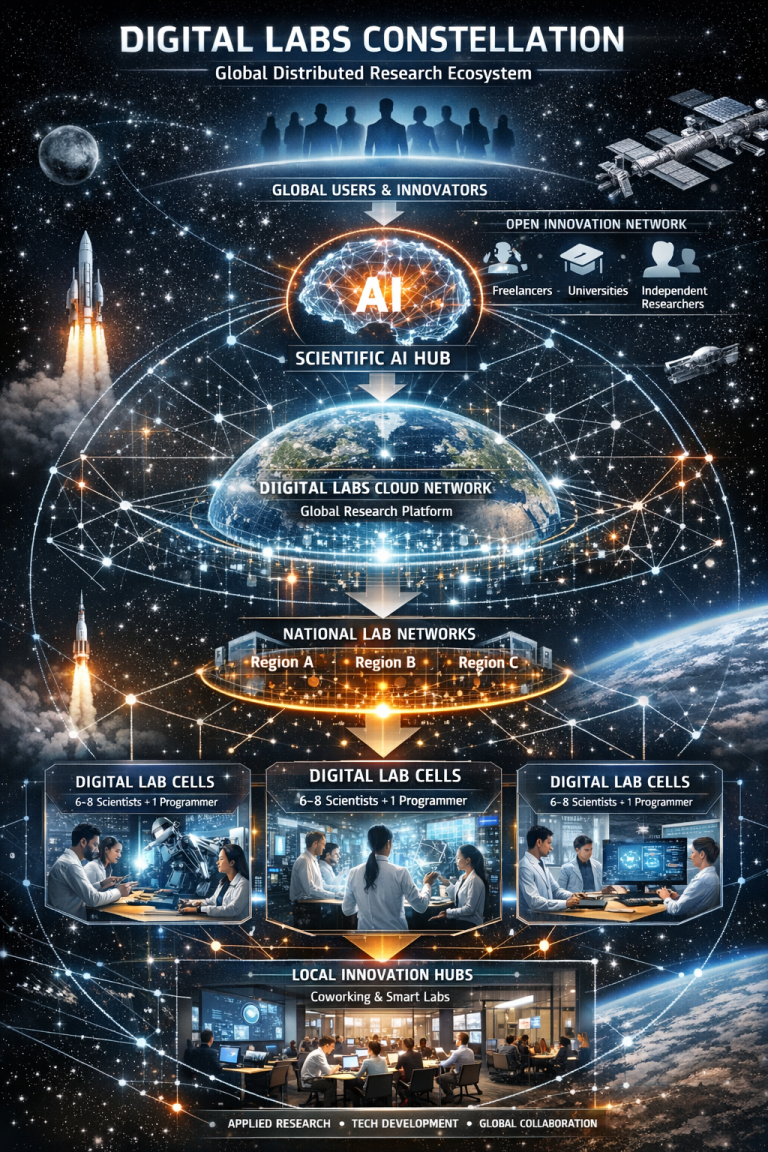
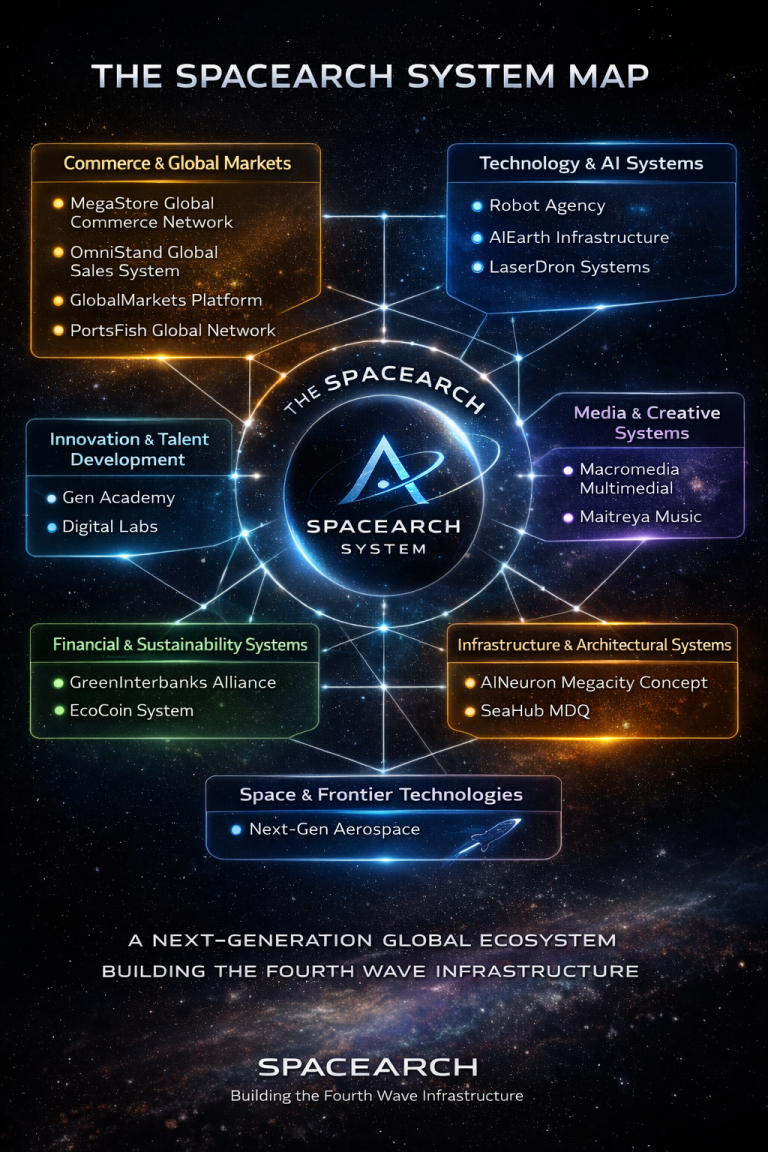
SpaceArch Solutions International is a global systems architecture company operating across AI, digital infrastructure, e-commerce, media, education, and advanced urban/industrial systems.
Rather than raising traditional venture capital, SpaceArch is deploying a Master Franchise expansion model. The company is offering the USA CEO position as a capital-backed operational franchise, granting territorial control and profit participation in exchange for a one-time investment.
This structure prioritizes execution, alignment, and speed while preserving corporate control and IP integrity.
Investment Offer
Position:
USA CEO – Master Franchise Operator
Investment Amount:
USD 2,000,000 (one-time entry fee)
Preconditions:
- Full CV and background review
- Executive aptitude and strategic capability assessment
- Cultural, ethical, and operational fit evaluation
This is not a salaried role. It is a capital-backed operating mandate.
Territorial Scope
Granted Territory:
United States – all states excluding:
- California
- Colorado
- Florida
- New York
(Strategic states retained under direct corporate control)
Rights Granted:
- Master Franchise authority for all remaining U.S. states
- Power to deploy city franchises, vertical franchises, and operators
- Authority to scale SpaceArch systems locally under global framework
Economic Model
Profit Participation:
- 40% of net profits generated within the granted territory
Operator Responsibilities (covered by the 40% share):
- Operational costs
- Administrative and legal costs
- Expansion and scaling costs
- Local teams, sales, execution, and deployment
Corporate HQ retains:
- IP ownership
- System architecture
- Strategic roadmap
- Reserved strategic territories
Core System Assets
The USA Master Franchise integrates into a live, multi-vertical system including:
🎵 Maitreya Music
- AI-driven music production at near-zero marginal cost
- Target scale: 2 million songs per year
- Monetization: streaming, licensing, media content, advertising
🧠 Digital Labs
- AI services, automation, low-cost development
- Senior talent absorption + re-training via internal academy
- B2B, B2G recurring revenue streams
🌐 Integrated E-commerce
- MegaStore, SmartSales, GlobalMarkets
- Fashion, services, B2B/B2C/B2G commerce
- Unified payment, logistics, content, and AI marketing layer
🏗️ “New NASA” Architecture Core
- Advanced infrastructure, cities, platforms, and systems
- Large-scale public and private projects
- Architecture + AI + economic systems integration
🧩 Portfolio Scale
- 219 active or deployable projects
- Value resides in system integration, not isolated ventures
Equity & Valuation Context (Indicative)
This is not an equity sale, but an operational participation in a system with significant implied value.
Indicative holding-level valuation (early scale):
- Conservative: USD 200–300M
- Mid-range: USD 500M–1B
- Full activation scenario: multi-billion potential
The USD 2M investment secures territorial power, profit flow, and expansion authority, not passive shares.
Strategic Rationale
- No dependency on a single market or technology
- Anti-dilution, anti-VC dependency model
- Capital accelerates execution; it does not create the system
- High barrier to replication due to system complexity
This model favors operators, not speculators.
Ideal Investor Profile
- Senior executive, operator, or investor with deployment capability
- Comfortable with complexity, scale, and accountability
- Seeks real authority, not symbolic titles
- Capital + execution mindset
Positioning Statement
SpaceArch does not sell jobs.
It activates territorial operators within a global system.
Appendix A – Financial Scenarios (Indicative)
SpaceArch Solutions International – USA Master Franchise
Disclaimer
The following figures are illustrative, non-binding, and indicative only.
They are provided to outline potential operational outcomes under different execution scenarios.
This is not an offer of securities and does not constitute financial advice.
A1. Structural Parameters (Common to All Scenarios)
| Parameter | Assumption |
| Entry Fee | USD 2,000,000 (one-time) |
| Profit Participation | 40% of net profits (territorial) |
| Territory | United States (excluding CA, CO, FL, NY) |
| Operating Model | Multi-vertical integrated system |
| Cost Coverage | Included within the 40% share |
| Expansion Logic | City franchises + vertical operators |
| IP Ownership | Retained by SpaceArch HQ |
A2. Revenue-Generating Verticals Considered
| Vertical | Role in Revenue Mix |
| Digital Labs | Early-stage cash flow |
| Integrated E-commerce | Mid-scale growth |
| Maitreya Music | High-scale, high-margin |
| Media & Content | Amplification + monetization |
| Infrastructure / “New NASA” | Strategic upside (longer-term) |
A3. Scenario A – Conservative Execution
Assumptions
- Activation in 8–12 states
- Focus on Digital Labs and professional services
- Limited media exposure
- Organic growth pace
| Metric | Annual Value |
| Gross Revenue (Territory) | USD 25,000,000 |
| Net Margin | 20% |
| Net Profit | USD 5,000,000 |
| 40% Operator Share | USD 2,000,000 |
Indicative Payback: ~12 months
Interpretation: Capital recovery with controlled execution risk.
A4. Scenario B – Base / Expected Case
Assumptions
- Activation in 15–20 states
- Digital Labs + e-commerce + media
- Maitreya Music at medium scale
- City franchises operational
| Metric | Annual Value |
| Gross Revenue | USD 80,000,000 |
| Net Margin | 25% |
| Net Profit | USD 20,000,000 |
| 40% Operator Share | USD 8,000,000 |
Indicative Payback: < 6 months
Implied Annual ROI: ~300–400%
Interpretation: Most likely scenario under competent execution.
A5. Scenario C – Expansion Case
Assumptions
- Activation in 25–30 states
- Maitreya Music approaching 2M songs/year
- Media and content fully monetized
- Fully integrated e-commerce ecosystem
| Metric | Annual Value |
| Gross Revenue | USD 200,000,000 |
| Net Margin | 30% |
| Net Profit | USD 60,000,000 |
| 40% Operator Share | USD 24,000,000 |
Indicative Payback: Weeks
Interpretation: Operator becomes a continental strategic node.
A6. Scenario D – Full Activation (Outlier Scenario)
Assumptions
- Effective nationwide deployment
- Strong network effects across all verticals
- Media and music acting as global amplifiers
- SpaceArch positioned as a systemic platform
| Metric | Annual Value |
| Gross Revenue | USD 500,000,000+ |
| Net Margin | 30–35% |
| Net Profit | USD 150–175,000,000 |
| 40% Operator Share | USD 60–70,000,000 |
Interpretation: Category-defining outcome.
Note: Not a base case; included for strategic context only.
A7. Risk Considerations
Primary Risks
- Execution capability of the territorial operator
- Underestimation of system complexity
- Slower-than-expected territorial rollout
Mitigating Factors
- Multi-vertical revenue diversification
- Flexible cost structure
- Centralized IP, architecture, and roadmap
- Existing operational system (non-greenfield)
A8. Model Characteristics
This model is:
- Not venture capital
- Not a traditional franchise
- Not a salaried executive role
It is a capital-backed operating mandate with asymmetric upside tied to execution quality.
A9. Closing Statement
“This is not an equity bet.
It is a territorial operating position within a live, scalable system.”
Appendix B – Legal Structure of the USA Master Franchise (Initial MOU)
SpaceArch Solutions International
Non-Binding Memorandum of Understanding (MOU)
This appendix outlines the indicative legal framework governing the proposed USA Master Franchise.
Except where expressly stated, this document is non-binding and subject to definitive agreements.
B1. Parties
Licensor / System Owner
SpaceArch Solutions International (or designated holding entity)
(“SpaceArch”)
Master Franchisee / Operator
USA CEO – Approved Individual or Controlled Entity
(“Master Franchisee”)
B2. Nature of the Relationship
- This arrangement does not constitute employment.
- This arrangement does not constitute a partnership or joint venture.
- This arrangement does not grant equity ownership in SpaceArch.
- The Master Franchisee operates as an independent territorial operator under license.
The relationship is strictly defined as a Master Franchise License with Operational Mandate.
B3. Grant of Rights
Subject to due diligence and execution of definitive agreements, SpaceArch grants the Master Franchisee:
- An exclusive Master Franchise License for the United States
- Territorial scope: all U.S. states excluding California, Colorado, Florida, and New York
- The right to:
- Deploy SpaceArch systems within the territory
- Establish city-level and vertical franchises
- Appoint sub-franchisees and operators under approved frameworks
- Operate under the SpaceArch brand and systems
All rights are revocable for cause as defined in the definitive agreement.
B4. Entry Fee
- A one-time Master Franchise Entry Fee of USD 2,000,000
- Payable upon execution of the definitive Master Franchise Agreement
- The entry fee is:
- Non-refundable
- Not convertible into equity
- Considered consideration for territorial rights and system access
B5. Economic Participation
- The Master Franchisee is entitled to 40% of net profits generated within the licensed territory.
Definition of Net Profit
Net Profit shall be calculated after deduction of:
- Operating expenses
- Administrative expenses
- Legal, accounting, and compliance costs
- Expansion and deployment costs within the territory
SpaceArch retains the remaining share and all global revenues outside the territory.
B6. Cost Allocation
The Master Franchisee bears responsibility for all costs related to:
- Local operations
- Staffing and management
- Sales and market activation
- Regulatory compliance at state and local levels
- Expansion within the licensed territory
No minimum revenue or profit guarantees are provided by SpaceArch.
B7. Intellectual Property
- All intellectual property, systems, architectures, trademarks, methodologies, and content remain the exclusive property of SpaceArch.
- The Master Franchisee receives a limited, non-transferable, revocable license to use IP solely for operations within the licensed territory.
- No right to sublicense IP outside approved franchise structures.
B8. Governance & Control
SpaceArch retains:
- Strategic control over system architecture and roadmap
- Approval rights over:
- Sub-franchise models
- Brand usage
- Material deviations from system standards
- Audit rights related to:
- Financial reporting
- Brand compliance
- Operational integrity
The Master Franchisee retains day-to-day operational control within the territory.
B9. Due Diligence & Approval
Execution of definitive agreements is subject to:
- Comprehensive background and CV review
- Executive aptitude and capability assessment
- Financial capacity verification
- Ethical and strategic alignment confirmation
Failure to pass due diligence voids any preliminary understanding.
B10. Term & Renewal
- Initial term: to be defined in definitive agreement (indicatively 10–20 years)
- Renewal subject to:
- Performance benchmarks
- Compliance with system standards
- Continued strategic alignment
B11. Termination
Grounds for termination may include:
- Material breach of agreement
- Misuse of IP or brand
- Reputational damage to SpaceArch
- Insolvency or loss of operational capacity
- Failure to meet minimum operational standards
Termination provisions will be fully defined in the definitive agreement.
B12. Confidentiality
All non-public information exchanged is subject to:
- Strict confidentiality obligations
- Non-disclosure provisions
- Survival of confidentiality beyond termination
B13. Governing Law & Jurisdiction
Indicatively:
- Governing law: State of Delaware (or New York, to be confirmed)
- Dispute resolution:
- Escalation clause
- Arbitration or courts as defined in final agreement
B14. Non-Binding Nature
Except for sections relating to:
- Confidentiality
- Exclusivity during negotiations (if agreed)
- Governing law
This MOU is non-binding and intended solely as a framework for discussion.
B15. Closing Statement
This Master Franchise structure is designed to prioritize execution, accountability, and scalability while preserving system integrity and intellectual property.
Appendix C – Psychological & Cognitive Profile of the Ideal USA CEO
SpaceArch Solutions International – Master Franchise Operator
Purpose
This appendix defines the psychological, cognitive, and executive profile required for the USA CEO / Master Franchise Operator.
The role demands system-level leadership, not conventional corporate management.
C1. Core Cognitive Architecture
The ideal candidate demonstrates the following cognitive traits:
1. Systems Thinking (High-Level)
- Ability to understand and operate multi-layered systems (technology, economics, people, governance).
- Thinks in networks, feedback loops, and second-order effects, not linear tasks.
- Comfortable managing interdependencies across multiple verticals simultaneously.
2. Strategic Abstraction + Execution Coupling
- Can move fluidly between:
- Abstract strategic vision
- Concrete operational execution
- Does not suffer from “vision-execution disconnect”.
- Translates complexity into deployable structures.
3. Cognitive Endurance
- Sustained attention under:
- High information density
- Uncertainty
- Time pressure
- Capable of long decision cycles without cognitive fatigue.
- Does not require constant external validation.
4. Risk Processing Maturity
- Distinguishes clearly between:
- Calculated risk
- Recklessness
- Paralysis by analysis
- Comfortable committing capital before certainty, based on structural logic.
- Accepts accountability without displacement of responsibility.
C2. Psychological Profile
1. Internal Locus of Control
- Attributes outcomes primarily to:
- Own decisions
- Execution quality
- Does not externalize failure to:
- Market
- Partners
- Circumstances
2. Low Ego Dependency
- Does not require:
- Titles for validation
- Public recognition to operate
- Ego is functional, not compensatory.
- Comfortable operating inside a larger system architecture.
3. High Autonomy & Self-Regulation
- Operates effectively without micromanagement.
- Self-imposes structure, discipline, and performance benchmarks.
- Maintains ethical and operational consistency under pressure.
4. Tolerance for Asymmetry
- Accepts:
- Delayed rewards
- Non-linear growth
- Uneven effort-to-reward curves
- Understands exponential systems and power-law outcomes.
C3. Executive Behavior Profile
Required Behaviors
- Decisive under incomplete information
- Bias toward action, not consensus paralysis
- Clear prioritization of leverage points
- Ability to recruit and retain high-caliber operators
- Comfortable terminating underperforming initiatives or personnel
Non-Compatible Behaviors
- Purely political executives
- Consensus-seeking at the expense of speed
- Excessive risk aversion
- Dependency on rigid hierarchies
- “Career CEO” mindset without capital at risk
C4. Financial & Capital Psychology
The ideal candidate:
- Is capital-committed, not capital-curious
- Understands money as:
- A tool
- A signal
- A commitment device
- Is comfortable deploying capital before personal upside materializes
- Does not seek guarantees incompatible with asymmetric systems
C5. Stress & Uncertainty Response
Under stress, the ideal CEO:
- Becomes more focused, not reactive
- Maintains clarity of priorities
- Does not fragment attention
- Avoids emotional decision-making
- Recovers quickly from setbacks
C6. Ethical & Cultural Alignment
Mandatory alignment with SpaceArch principles:
- Long-term systemic value over short-term extraction
- Respect for IP, architecture, and governance boundaries
- Non-opportunistic use of brand and system
- Zero tolerance for reputational shortcuts
C7. Cognitive Red Flags (Disqualifying)
Candidates will be disqualified if exhibiting:
- Narcissistic dependency on visibility
- Inability to accept non-equity operating roles
- Victim mentality under adversity
- Pattern of abandoning complex projects
- Overreliance on advisors for basic decision-making
C8. Assessment Methods (Indicative)
Evaluation may include:
- Structured executive interviews
- Scenario-based decision simulations
- Cognitive load and abstraction tests
- Stress-response assessment
- Reference checks focused on execution under pressure
C9. Summary Statement
“This role is designed for operators of systems, not managers of positions.”
The USA CEO must function as a territorial architect, capable of scaling complexity with discipline, capital, and judgment.
Appendix A – Financial Scenarios (Indicative)
SpaceArch Solutions International – USA Master Franchise
Disclaimer
The following figures are illustrative, non-binding, and indicative only.
They are provided to outline potential operational outcomes under different execution scenarios.
This is not an offer of securities and does not constitute financial advice.
A1. Structural Parameters (Common to All Scenarios)
| Parameter | Assumption |
|---|---|
| Entry Fee | USD 2,000,000 (one-time) |
| Profit Participation | 40% of net profits (territorial) |
| Territory | United States (excluding CA, CO, FL, NY) |
| Operating Model | Multi-vertical integrated system |
| Cost Coverage | Included within the 40% share |
| Expansion Logic | City franchises + vertical operators |
| IP Ownership | Retained by SpaceArch HQ |
A2. Revenue-Generating Verticals Considered
| Vertical | Role in Revenue Mix |
|---|---|
| Digital Labs | Early-stage cash flow |
| Integrated E-commerce | Mid-scale growth |
| Maitreya Music | High-scale, high-margin |
| Media & Content | Amplification + monetization |
| Infrastructure / “New NASA” | Strategic upside (longer-term) |
A3. Scenario A – Conservative Execution
Assumptions
- Activation in 8–12 states
- Focus on Digital Labs and professional services
- Limited media exposure
- Organic growth pace
| Metric | Annual Value |
|---|---|
| Gross Revenue (Territory) | USD 25,000,000 |
| Net Margin | 20% |
| Net Profit | USD 5,000,000 |
| 40% Operator Share | USD 2,000,000 |
Indicative Payback: ~12 months
Interpretation: Capital recovery with controlled execution risk.
A4. Scenario B – Base / Expected Case
Assumptions
- Activation in 15–20 states
- Digital Labs + e-commerce + media
- Maitreya Music at medium scale
- City franchises operational
| Metric | Annual Value |
|---|---|
| Gross Revenue | USD 80,000,000 |
| Net Margin | 25% |
| Net Profit | USD 20,000,000 |
| 40% Operator Share | USD 8,000,000 |
Indicative Payback: < 6 months
Implied Annual ROI: ~300–400%
Interpretation: Most likely scenario under competent execution.
A5. Scenario C – Expansion Case
Assumptions
- Activation in 25–30 states
- Maitreya Music approaching 2M songs/year
- Media and content fully monetized
- Fully integrated e-commerce ecosystem
| Metric | Annual Value |
|---|---|
| Gross Revenue | USD 200,000,000 |
| Net Margin | 30% |
| Net Profit | USD 60,000,000 |
| 40% Operator Share | USD 24,000,000 |
Indicative Payback: Weeks
Interpretation: Operator becomes a continental strategic node.
A6. Scenario D – Full Activation (Outlier Scenario)
Assumptions
- Effective nationwide deployment
- Strong network effects across all verticals
- Media and music acting as global amplifiers
- SpaceArch positioned as a systemic platform
| Metric | Annual Value |
|---|---|
| Gross Revenue | USD 500,000,000+ |
| Net Margin | 30–35% |
| Net Profit | USD 150–175,000,000 |
| 40% Operator Share | USD 60–70,000,000 |
Interpretation: Category-defining outcome.
Note: Not a base case; included for strategic context only.
A7. Risk Considerations
Primary Risks
- Execution capability of the territorial operator
- Underestimation of system complexity
- Slower-than-expected territorial rollout
Mitigating Factors
- Multi-vertical revenue diversification
- Flexible cost structure
- Centralized IP, architecture, and roadmap
- Existing operational system (non-greenfield)
A8. Model Characteristics
This model is:
- Not venture capital
- Not a traditional franchise
- Not a salaried executive role
It is a capital-backed operating mandate with asymmetric upside tied to execution quality.
A9. Closing Statement
“This is not an equity bet.
It is a territorial operating position within a live, scalable system.”
Appendix D – Global CEO Operating Mandates & Capital Thresholds
SpaceArch Solutions International
Context
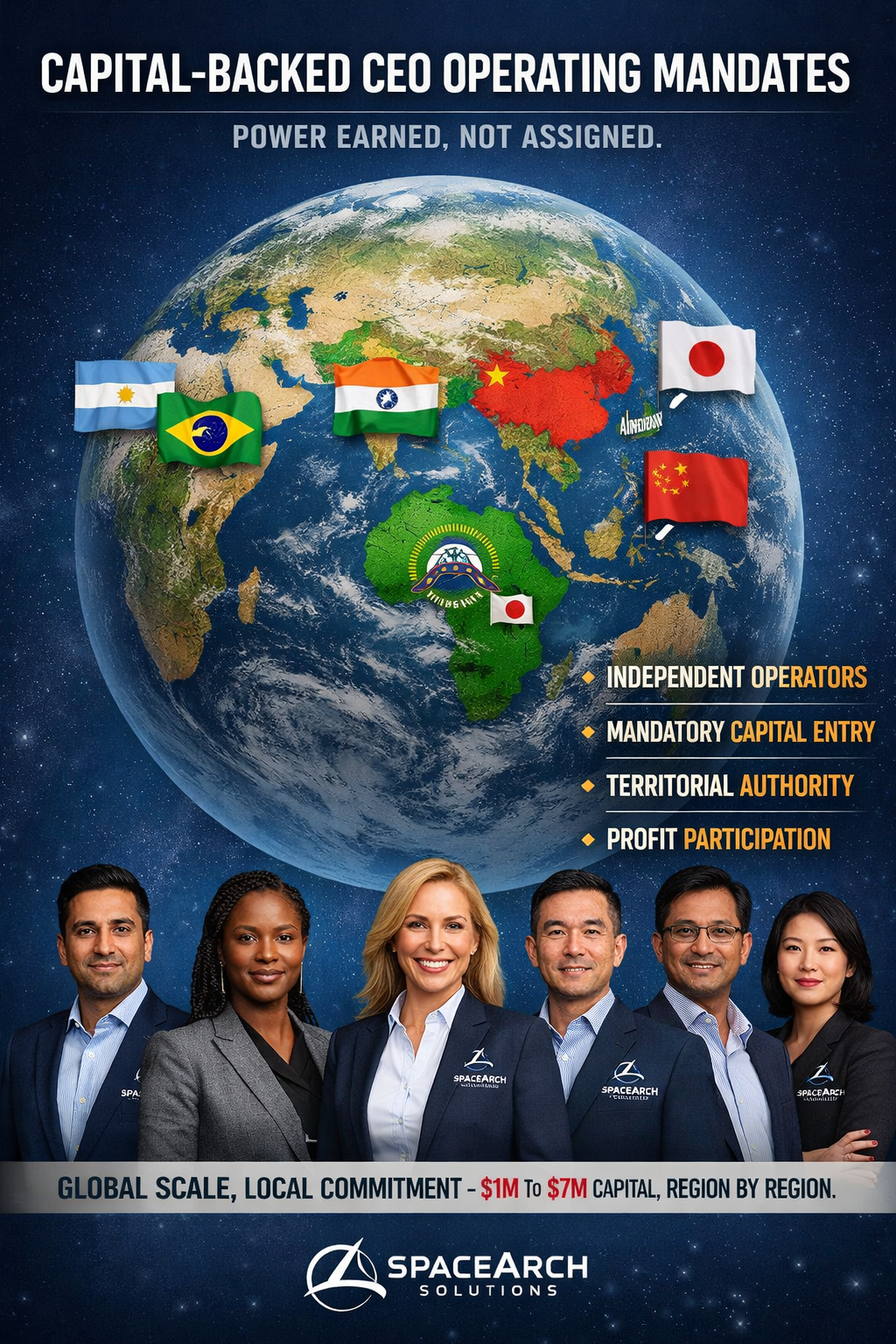
Following the USA CEO Master Franchise framework, SpaceArch Solutions International extends the same operating logic to other strategic regions, with region-specific capital thresholds reflecting scale, complexity, and systemic leverage.
These figures are intentional signals, not arbitrary pricing.
D1. Core Principle (Global)
All CEO roles under this framework are defined as:
- Capital-backed operating mandates
- Not employment contracts
- Not advisory positions
- Not equity giveaways
Authority, territory, and profit participation are granted only after capital commitment and successful due diligence.
D2. Regional CEO Capital Thresholds
🇦🇷 🇧🇷 🇨🇱 🇨🇴
South America – National CEO Mandates
Entry Capital: USD 1,000,000 per country
Rationale:
- Medium-scale markets with high execution leverage
- Strong demand for Digital Labs, e-commerce, and system integration
- Faster operational activation
- Lower regulatory and deployment complexity compared to G7 regions
Role:
- National system operator
- Deployment of city franchises and verticals
- Integration with global SpaceArch architecture
🌍 MENA Region (Middle East & North Africa)
Entry Capital: USD 3,000,000
Rationale:
- High capital density
- Strategic geopolitical positioning
- Strong infrastructure and mega-project alignment
- High upside through system-level deployments
Role:
- Regional operator
- Large-scale infrastructure, AI, and system integration
- Strategic partnerships with sovereign and institutional actors
🇮🇳 India – National CEO Mandate
Entry Capital: USD 2,000,000
Rationale:
- Massive population scale
- High talent density
- Strong demand for Digital Labs, education, and AI-driven systems
- Requires disciplined execution over hype
Role:
- National operator with phased regional rollout
- Talent absorption and system scaling
- Integration of education, digital services, and commerce
🇨🇳 China – National CEO Mandate
Entry Capital: USD 2,000,000
Rationale:
- High system complexity
- Regulatory and operational sophistication
- Strong alignment with large-scale platforms and industrial systems
- Requires high-level strategic and cultural competence
Role:
- National system operator
- Adaptation of SpaceArch architecture within local frameworks
- High governance and compliance standards
🇯🇵 Japan – National CEO Mandate
Entry Capital: USD 2,000,000
Rationale:
- High technological maturity
- Precision execution culture
- Strong alignment with advanced systems, robotics, and AI
- Emphasis on quality, trust, and long-term deployment
Role:
- National operator
- High-standard system integration
- Long-cycle strategic partnerships
🌍 Africa – Continental CEO Mandate (AINeuron Integrated)
Entry Capital: USD 7,000,000
Rationale (Exceptional Case):
Africa is not treated as a fragmented market, but as a continental system opportunity.
This mandate integrates:
- AINeuron (AI-driven urban, energy, and resource systems)
- Digital infrastructure
- Education and talent systems
- E-commerce and logistics
- Long-term societal-scale transformation
The capital threshold reflects:
- Continental scope
- Infrastructure intensity
- Long-term systemic impact
- High responsibility and governance requirements
Role:
- Continental system architect and operator
- Deployment of AINeuron-enabled cities and regions
- Coordination with governments, institutions, and NGOs
- Execution of large-scale sustainable transformation programs
D3. Why Capital Thresholds Differ
Capital requirements are calibrated based on:
- Market scale
- System complexity
- Regulatory environment
- Deployment velocity
- Strategic leverage potential
Higher capital does not mean “higher status.”
It means greater responsibility, larger systems, and deeper impact.
D4. Unified Governance Logic
Across all regions:
- IP remains centralized
- Architecture and roadmap remain global
- CEOs operate as territorial system operators
- Performance, compliance, and alignment are mandatory
Failure to execute or comply results in revocation of mandate, as defined in definitive agreements.
D5. Closing Statement
SpaceArch does not expand by dilution.
It expands by activating committed operators at scale.
These mandates are designed to ensure:
- Serious leadership
- Long-term execution
- System integrity across regions
Global Summary – CEO Operating Mandates Framework
SpaceArch Solutions International
Overview
SpaceArch Solutions International has implemented a capital-backed CEO operating mandate model to scale globally without dilution, dependency on venture capital, or symbolic executive roles.
Under this framework, CEO positions are not granted.
They are activated through capital commitment, execution capability, and accountability.
This model applies consistently across regions, with capital thresholds calibrated to market scale, system complexity, and strategic impact.
Core Rule (Universal)
All CEO roles are defined as:
- Independent operating mandates
- Capital-first, authority-second
- Profit-participation based
- Subject to strict due diligence and performance review
This is not employment, not equity gifting, and not advisory governance.
Global CEO Mandates – Capital Thresholds
| Region | Scope | Entry Capital |
|---|---|---|
| United States | National (excl. CA, CO, FL, NY) | USD 2,000,000 |
| Argentina | National | USD 1,000,000 |
| Brazil | National | USD 1,000,000 |
| Chile | National | USD 1,000,000 |
| Colombia | National | USD 1,000,000 |
| MENA | Regional | USD 3,000,000 |
| India | National | USD 2,000,000 |
| China | National | USD 2,000,000 |
| Japan | National | USD 2,000,000 |
| Africa | Continental (AINeuron Integrated) | USD 7,000,000 |
What Each CEO Receives
- Territorial operating authority
- Profit participation (defined per mandate)
- Access to SpaceArch systems, IP, and architecture
- Ability to deploy city franchises and vertical operators
- Strategic backing from a global system roadmap
What Each CEO Assumes
- Full operational responsibility
- Local costs (operations, administration, expansion)
- Regulatory and compliance execution
- Talent recruitment and system deployment
- Accountability for results
There are no guaranteed returns and no passive roles.
Why This Model Exists
Traditional executive structures:
- separate authority from risk
- reward titles over execution
- dilute accountability
SpaceArch inverts this logic.
By requiring capital commitment:
- seriousness is filtered instantly
- incentives align structurally
- execution replaces narrative
- power is earned, not assigned
Strategic Impact
This framework positions SpaceArch as:
- a system selector, not a talent seeker
- a platform operator, not an acquisition target
- a global architecture, not a portfolio of ideas
It signals to the market that:
Leadership is an investment, not a perk.
Final Statement
SpaceArch does not expand by giving away power.
It expands by activating committed operators at scale.
This marks a structural shift in how executive authority is defined, deployed, and earned in global systems.
Appendix E – Secondary Operating Roles & Delegated Mandates Framework
SpaceArch Solutions International
Purpose
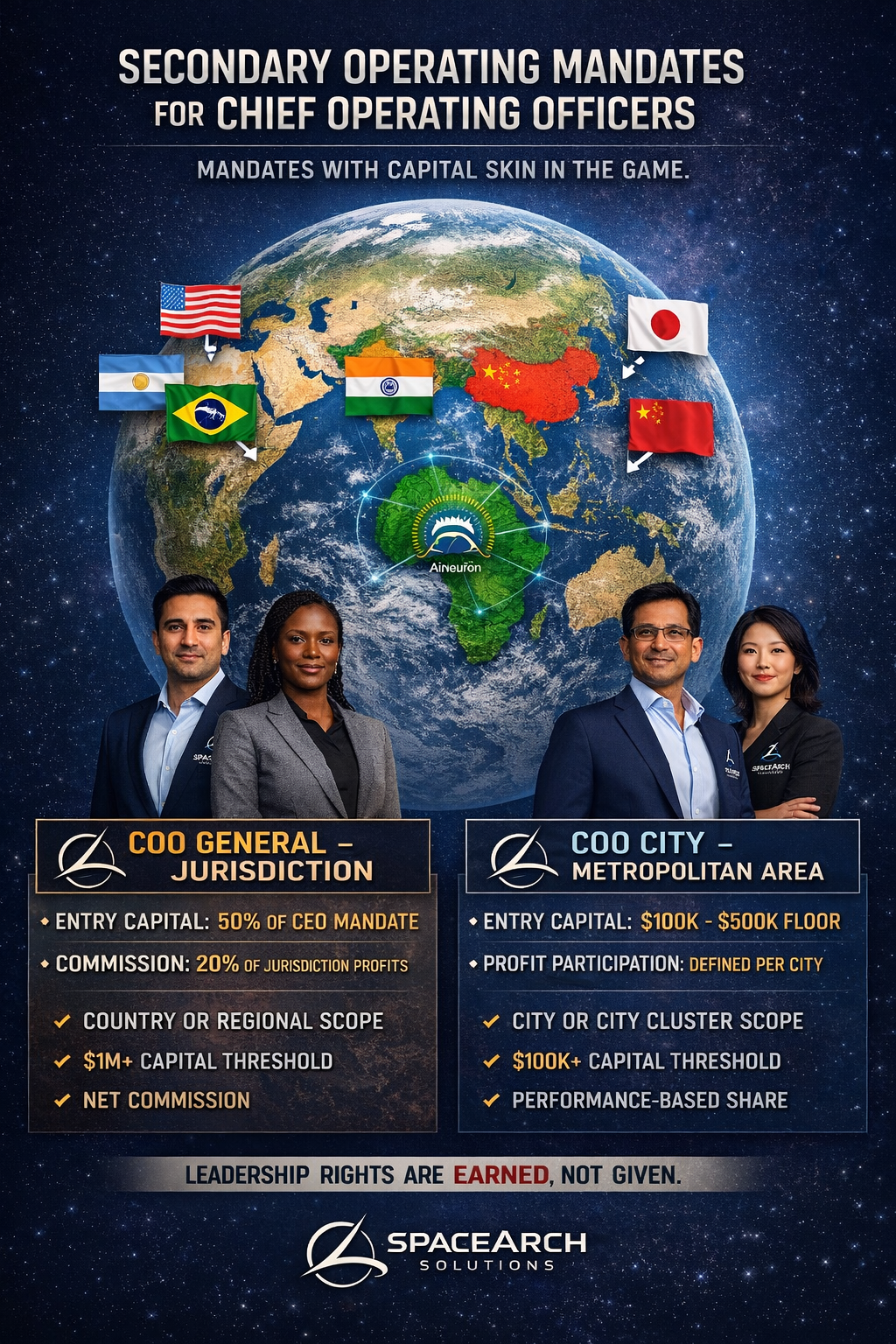
This appendix defines the structured delegation of secondary executive operating roles under the authority of National and Regional CEOs, enabling accelerated territorial scaling while preserving accountability, capital alignment, and system integrity.
E1. Core Principle
SpaceArch operates under a multi-layered operating mandate architecture.
Authority is not decentralized by default.
It is delegated conditionally, through capital-backed roles with clearly defined scope, upside, and accountability.
This ensures:
- Scalability without dilution
- Leadership density without hierarchy inflation
- Execution speed without loss of control
E2. COO General – Jurisdiction-Level Operating Mandate
Role Definition
Chief Operating Officer (General – Jurisdiction Level)
This role supports the National or Regional CEO and operates across the full jurisdiction (e.g., country or multi-state region).
It is an operating mandate, not employment.
Entry Capital Requirement
- 50% of the corresponding CEO entry threshold
(Example: USA COO General → USD 1,000,000)
Economic Participation
- 20% commission on net profits generated within the jurisdiction
- Commission is calculated after costs, aligned with system-level net results
Authority & Scope
- Day-to-day operational execution
- Coordination of verticals and city operators
- Implementation of CEO strategy at jurisdiction scale
- No independent IP rights
- Operates under CEO governance and audit authority
Rationale
This role:
- Enables CEOs to scale without micromanagement
- Creates a second accountability layer
- Filters high-caliber operators with capital at risk
- Converts execution into a rewarded function, not a political one
E3. COO City – City-Level Operating Mandate
Role Definition
Chief Operating Officer (City Level)
This role operates a single metropolitan area or city cluster, deploying SpaceArch systems locally.
Entry Capital Requirement
- USD 100,000 – 500,000, depending on:
- City size
- Market complexity
- Deployment scope
- Vertical mix
This capital functions as:
- Commitment signal
- Operational buffer
- Execution guarantee
Economic Participation
- Profit participation defined by:
- City performance
- Vertical penetration
- Execution benchmarks
- Typically structured as revenue share or performance-based commission
Authority & Scope
- Local execution and deployment
- City-level partnerships and operations
- Talent recruitment and local scaling
- Full accountability for local performance
- Operates under COO General or CEO supervision
E4. Delegation Logic & Governance
- CEOs retain full authority to:
- Appoint
- Approve
- Revoke COO mandates
- All COO roles are:
- Capital-backed
- Performance-reviewed
- Revocable for cause
- No COO role confers:
- Equity ownership
- IP ownership
- Independent territorial rights
E5. Strategic Impact
This layered structure allows SpaceArch to:
- Scale globally without corporate bloat
- Replace hierarchy with capital-aligned operators
- Accelerate deployment city by city
- Maintain system coherence at all levels
It transforms expansion into a repeatable, self-funded mechanism.
E6. Why This Matters
Traditional organizations:
- Promote without risk
- Delegate without commitment
- Scale by adding bureaucracy
SpaceArch scales by:
- Selling execution rights
- Pricing authority
- Rewarding results, not titles
E7. Closing Statement
Leadership at SpaceArch is not assigned.
It is capitalized, delegated, and earned.
This framework ensures that every layer of leadership:
- Thinks like an owner
- Acts like an operator
- Is accountable for outcomes
Appendix F – Exit, Transferability & Secondary Market Logic for Executive Mandates
SpaceArch Solutions International
F1. Core Concept: Executable Mandates with Liquidity
All CEO and COO roles within SpaceArch are defined as capital-backed operating mandates, not lifetime appointments.
Accordingly, these mandates incorporate a controlled exit and resale mechanism, enabling:
- Liquidity for operators
- Long-term commitment without captivity
- Market-based valuation of leadership roles
- Reinforcement of performance-driven value
This transforms leadership positions into structured, monetizable operating assets.
F2. Voluntary Exit Right (CEO & COO)
Any approved CEO or COO may voluntarily decide to exit their mandate, subject to:
- Full compliance status
- No pending material breaches
- Formal notice and transition protocol
Exit does not imply resignation from employment (there is none), but transfer of an operating mandate.
F3. Mandate Resale & Compensation
Upon exit, the outgoing CEO or COO is entitled to:
- 50% of the entry value of the mandate at the time of resale
- Payment contingent upon:
- Approval of the incoming operator
- Completion of due diligence
- Execution of a new mandate agreement
The remaining 50% accrues to SpaceArch as:
- System value capture
- IP and governance premium
- Network effect monetization
F4. Dynamic Pricing of Mandates
Mandate entry values are not fixed.
They are dynamically adjusted based on:
- System-wide activity growth
- ROI metrics across regions
- Revenue velocity and margin expansion
- Network effects and validation events
As SpaceArch activity and ROI increase:
- Entry tickets for CEO and COO mandates increase proportionally
- Early operators benefit from lower entry costs and higher upside
- Later entrants pay a premium for reduced risk and higher system maturity
This creates a fair, time-weighted valuation curve.
F5. Strategic Implications
This mechanism achieves several objectives simultaneously:
1️⃣ Converts Leadership into an Asset Class
Executive mandates behave like:
- Long-term operating licenses
- With upside, cash flow, and exit optionality
2️⃣ Rewards Early Risk-Takers
Early CEOs and COOs:
- Enter at lower valuation
- Capture higher appreciation
- Can monetize part of that appreciation upon exit
3️⃣ Prevents Power Hoarding
Because mandates are:
- Transferable (under control)
- Valued by performance
- Revocable for cause
No role becomes:
- Feudal
- Permanent
- Politically entrenched
4️⃣ Creates a Regulated Secondary Market
SpaceArch implicitly operates a closed, governed secondary market for executive mandates, where:
- Price reflects real system value
- Transfers are controlled, not speculative
- Governance integrity is preserved
F6. Governance & Safeguards
- All mandate transfers require SpaceArch approval
- No speculative flipping is permitted
- Minimum holding periods may apply
- SpaceArch retains veto rights over candidates
This ensures:
- Stability
- Quality of leadership
- Alignment with long-term system goals
F7. Why This Matters
Traditional executive systems:
- Lock leaders in politically
- Reward tenure over results
- Offer no structured exit upside
SpaceArch replaces this with:
- Capitalized authority
- Performance-linked valuation
- Orderly exit with partial liquidity
Leadership becomes investable, accountable, and evolutive.
F8. Closing Statement
In SpaceArch, leadership is not permanent.
It is earned, operated, valued, and transferable.
This final layer completes the model:
- Capital enters
- Execution creates value
- Value increases mandate price
- Exit crystallizes part of that value
The system is now closed, self-reinforcing, and scalable.