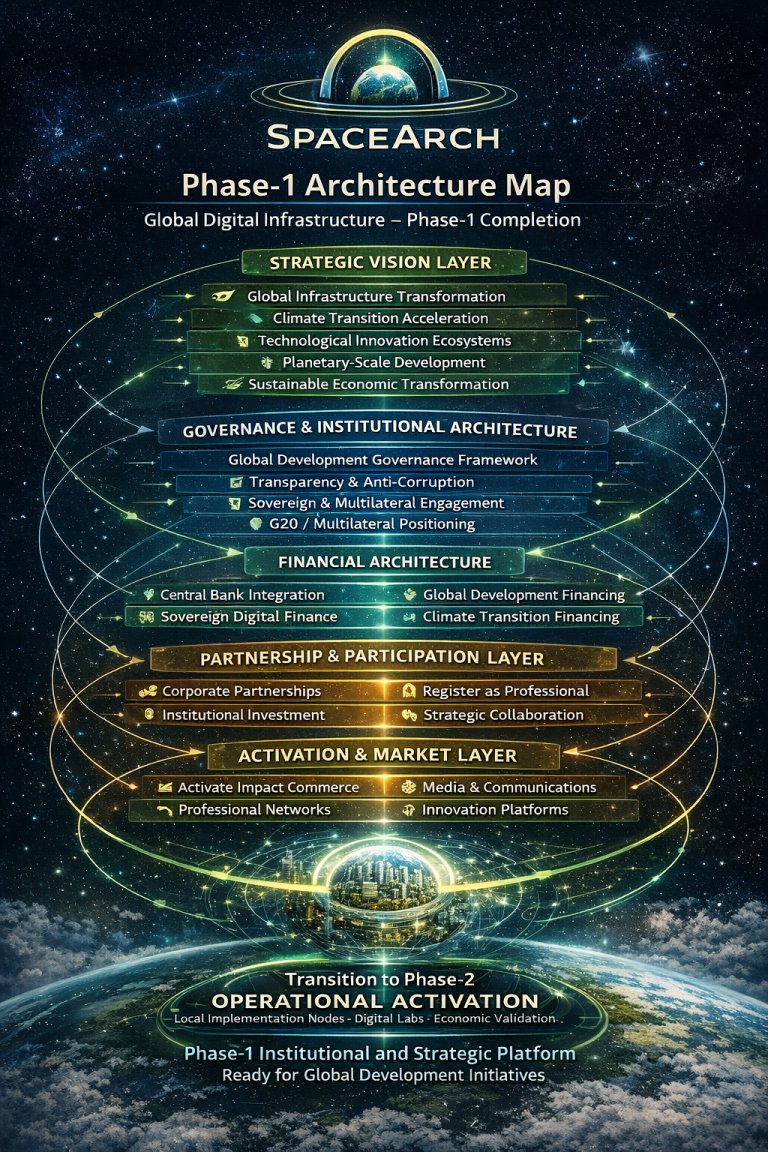

International Entrepreneurial & Productive Intelligence Platform
1. Conceptual Definition
SpaceArch Markets is an independent, digital-native international media platform specialized in entrepreneurial, productive, technological, and creative ecosystems.
It operates as a structured editorial intelligence system designed to:
- Organize dispersed economic activity
- Increase visibility of value-creating actors
- Connect entrepreneurs, companies, institutions, and investors
- Document and systematize local-to-global productive ecosystems
SpaceArch Markets is not a news blog. It is a structured ecosystem observatory, functioning as a dynamic archive of economic creation.
2. Strategic Hypothesis
The foundational hypothesis of SpaceArch Markets is:
Economic ecosystems do not lack talent or ideas — they lack structured visibility, semantic order, and international connectivity.
Most emerging territories suffer from:
- Fragmented information
- Isolated entrepreneurial initiatives
- Lack of structured documentation
- Limited international projection
- Weak connection between local production and global capital
SpaceArch Markets addresses this structural inefficiency by creating:
- A semantic infrastructure of economic intelligence
- A digital clearing interface between territories
- A structured documentation system for entrepreneurial processes
- A searchable and indexable ecosystem database
The platform transforms dispersed activity into structured economic narrative.
3. Positioning
SpaceArch Markets is positioned as:
- An ecosystem intelligence platform
- A structured economic documentation system
- A territorial productivity observatory
- A digital gateway between cities and international markets
It is designed for:
- Entrepreneurs
- Startups
- SMEs
- Institutional actors
- Investors
- Researchers
- Journalists
- AI-based analytical systems
4. Editorial Architecture
The platform is built on a clear, hierarchical and semantically coherent architecture.
Core Sections
1. Productive Innovation
- Applied industrial innovation
- Manufacturing transformation
- Advanced materials
- Circular economy
2. Applied Technology
- AI integration
- Automation systems
- Robotics
- Deep tech
- Digital transformation
3. Biotechnology & Health
- Bio-innovation
- Health technology
- Life sciences
- Preventive and applied research
4. Creative Industry
- Design
- Media
- Digital content production
- Cultural entrepreneurship
5. Social Impact & Institutional Role
- Public-private partnerships
- Development institutions
- University-industry collaboration
- Economic policy analysis
6. Entrepreneurial Trajectories
- Founder interviews
- Case studies
- Growth paths
- Failure analysis
Each section functions as a structured node within a larger interconnected ecosystem.
5. Digital-Native Architecture
SpaceArch Markets is engineered as a native digital platform optimized for:
- Search engines (SEO)
- AI indexing systems
- Knowledge graph integration
- Semantic coherence
- Thematic clustering
- Internal interlinking
Each article is:
- Contextualized within a thematic node
- Linked to related actors and institutions
- Embedded within a broader territorial narrative
The result is a structured knowledge environment rather than isolated content pieces.
6. Functional Model
SpaceArch Markets operates under three complementary layers:
Layer 1 – Editorial Intelligence
Daily publication of 100% original content documenting economic activity.
Layer 2 – Ecosystem Structuring
Categorization and clustering of actors into:
- Industry nodes
- Institutional networks
- Investment flows
- Trade corridors
Layer 3 – International Projection
Positioning local ecosystems within global circuits of:
- Trade
- Investment
- Real estate
- Technology transfer
- Legal and fiscal advisory
7. Phase I: Tri-City Corridor Model
(Miami – Dubai – MDQ)
The first operational phase establishes interaction portals between:
- Miami (financial and logistics hub)
- Dubai (global trade and capital gateway)
- MDQ (productive and emerging territory node)
This model provides:
- Trade facilitation support
- Investment structuring
- Real estate internationalization
- SME expansion pathways
- Legal and fiscal advisory frameworks
- Intellectual property structuring
- Trademark and patent assistance
The objective is to create a structured digital corridor between productive territories and capital centers.
8. Differentiation vs Traditional Media
Traditional local media:
- Publish fragmented news
- Lack structural documentation
- Do not build ecosystem memory
- Are not optimized for international projection
SpaceArch Markets:
- Builds longitudinal ecosystem archives
- Maps actors and relationships
- Creates semantic infrastructure
- Facilitates international readability
- Integrates economic intelligence layers
It operates as an ecosystem registry rather than as a news feed.
9. Long-Term Objective
To become a stable international reference for:
- Territorial economic intelligence
- Entrepreneurial ecosystem documentation
- Productive innovation mapping
- Cross-border economic connectivity
The platform aims to build:
- A structured, multi-city entrepreneurial intelligence network
- A replicable editorial-operational model
- A scalable digital corridor architecture
10. Commercial & Institutional Model
Revenue structure may include:
- Premium ecosystem visibility programs
- Institutional partnerships
- Strategic reports
- Sponsored sectoral dossiers
- Trade intelligence briefings
- International projection services
All monetization mechanisms are aligned with the core principle:
Visibility must generate structured value, not noise.
11. Conceptual Summary
SpaceArch Markets is:
- A digital economic observatory
- A semantic structuring system
- A territorial-to-global gateway
- A scalable city-to-city interaction architecture
It converts fragmented entrepreneurial energy into structured, readable, indexable and internationally connected economic intelligence.
SPACEARCH MARKETS
TRI-CITY CORRIDOR + AI PROTOCOL + FINANCIAL MODEL
Integrated Strategic Architecture (Phase I)
I. MIAMI–DUBAI–MDQ CORRIDOR OPERATIONAL FRAMEWORK
1. Strategic Hypothesis
The corridor operates under the following structural premise:
Emerging productive territories lack structured international gateways.
Global capital lacks structured territorial intelligence.
Miami and Dubai function as capital and logistics hubs.
MDQ functions as a productive territorial node.
The corridor is not symbolic.
It is a structured economic interface.
2. Structural Model
The corridor operates across three synchronized layers:
Layer A — Information Layer (Editorial Intelligence)
Purpose:
- Identify and document productive actors
- Structure ecosystem intelligence
- Publish high-quality, indexed content
Outputs:
- Company profiles
- Sectoral reports
- Innovation case studies
- Trade and real estate mapping
Layer B — Transaction Layer (Structured Facilitation)
Purpose:
- Convert structured visibility into economic interaction
Services:
- Trade facilitation
- SME internationalization advisory
- Real estate cross-border structuring
- Investment dossier preparation
- Legal & fiscal pre-structuring
- IP & trademark coordination
Layer C — Capital Interface Layer
Purpose:
- Present validated territorial assets to capital hubs
Mechanism:
- Curated project pipelines
- Verified SME portfolios
- Structured investment briefs
- Corridor-specific deal flow dashboards
3. Node Responsibilities
MDQ Node – Productive Intelligence Hub
Functions:
- Identify entrepreneurs
- Produce content
- Map ecosystem actors
- Build structured databases
- Prepare project documentation
Primary KPI:
- Validated productive actors per month
Miami Node – Financial & Legal Gateway
Functions:
- Evaluate deal structure
- Align with US compliance
- Identify investment vehicles
- Structure SPVs where required
Primary KPI:
- Capital matching rate
Dubai Node – Trade & Capital Expansion Gateway
Functions:
- Trade corridor facilitation
- Middle East investor introduction
- Real estate capital flows
- Strategic partnerships
Primary KPI:
- International transaction pipeline volume
4. Operational Flow
- MDQ publishes structured company profile
- AI clusters it into sectoral node
- Corridor team validates opportunity
- Miami/Dubai assess capital or trade viability
- Investment or trade brief is prepared
- Structured introduction executed
No noise.
Only structured dossiers.
II. AI-OPTIMIZED CONTENT PRODUCTION PROTOCOL
1. Core Principle
Content is not publishing.
Content is structured economic data production.
2. Production Architecture
Stage 1 — Intelligence Collection
Inputs:
- Interviews
- Public records
- Company documents
- Institutional data
- Market analysis
AI Role:
- Extract structured fields
- Identify sector classification
- Map keywords
- Detect semantic clusters
Stage 2 — Structured Drafting
AI generates:
- Executive summary
- Technical description
- Market positioning
- Financial maturity level
- Ecosystem relevance score
Human Editor:
- Validates accuracy
- Removes bias
- Ensures clarity
- Confirms legal sensitivity
Stage 3 — Semantic Architecture
Every article must include:
- Primary sector tag
- Secondary industry tags
- Geographic classification
- Institutional references
- Cross-linking to related actors
Internal linking density target:
Minimum 5 relevant inter-node links per article
Stage 4 — AI Index Optimization
Content is formatted for:
- Knowledge graph integration
- LLM readability
- Entity recognition
- Structured data markup
- Long-term archival stability
3. Content Typologies
- Entrepreneur Profile (Structured)
- Innovation Report
- Sectoral Mapping
- Institutional Analysis
- Trade Corridor Analysis
- Investment Readiness Dossier
- Real Estate Asset Brief
4. Performance Metrics
- Indexed pages growth rate
- AI entity extraction recognition rate
- Semantic coherence score
- Average session time
- Cross-link density
- Conversion to inquiry rate
III. FINANCIAL SUSTAINABILITY MODEL
1. Revenue Architecture
Revenue must emerge from structured value.
A. Visibility & Intelligence Services
- Premium Company Profiles
- Institutional Feature Reports
- Sectoral Dossiers
- Corridor Exposure Packages
Pricing Model (Indicative Tiering):
Basic Structured Profile
Advanced Ecosystem Dossier
International Corridor Presentation Package
B. Advisory & Facilitation Layer
Revenue Streams:
- Trade structuring fee
- Investment introduction fee
- Real estate cross-border advisory
- Legal/fiscal structuring coordination fee
- IP & trademark advisory referral fee
Model:
Success-based hybrid + fixed preparatory fee
C. Data & Intelligence Products
Future expansion:
- Annual ecosystem report
- Sector intelligence subscription
- Trade corridor analytics dashboard
- Investment pipeline access
Subscription Model:
Institutional annual membership
2. Cost Structure
Fixed Costs
- Editorial coordination
- AI infrastructure
- Hosting
- Legal oversight
Variable Costs
- Research
- Interviews
- Corridor validation
- Advisory hours
Lean principle:
Editorial core + AI leverage.
3. Financial Projection Logic (Phase I)
Objective:
Achieve operational neutrality within 12 months.
Revenue Mix Target:
40% Premium visibility
30% Advisory & facilitation
20% Institutional partnerships
10% Intelligence products
4. Break-Even Model
Key variables:
- Number of premium profiles per month
- Average facilitation success fee
- Institutional partnerships secured
- AI efficiency multiplier (cost reduction factor)
Break-even formula simplified:
Fixed Costs
= (Profiles × Margin)
- (Facilitation × Commission)
- (Institutional Contracts)
IV. STRATEGIC SYNTHESIS
The system integrates:
Editorial intelligence
AI semantic structuring
Cross-border corridor facilitation
Structured capital interface
Sustainable monetization
It is not a media company.
It is a territorial economic interface.
V. Expansion Path
Phase I — Miami–Dubai–MDQ
Phase II — Add 2 additional capital nodes
Phase III — Replicable city-based intelligence corridors
Each new city integrates into the structured AI backbone.
FINAL SUMMARY
SpaceArch Markets Corridor Model is:
A structured economic intelligence system
A digital cross-border facilitation platform
An AI-powered ecosystem registry
A capital interface mechanism
A scalable international architecture