
Interstellar Expansion Initiative
SpaceArch Solutions International
From the Micro Lab to the Architecture of Civilization
1. Program Definition
SpaceArch New NASA is a strategic research and industrial coordination initiative dedicated to the long-term expansion of human civilization beyond the Solar System.
While most current aerospace programs focus on near-term objectives such as orbital infrastructure, lunar bases, and eventual Mars settlement, SpaceArch adopts a broader civilizational perspective.
The long-term objective of this initiative is the development of technologies capable of enabling interstellar travel, with the Alpha Centauri system identified as a strategic long-range target.
Specifically, the program identifies Alpha Centauri B as one of the most promising early destinations for future interstellar missions due to:
- proximity to the Solar System (4.37 light years)
- stellar stability comparable to the Sun
- potential habitable-zone planetary systems
The program does not define rigid timelines. Instead, it focuses on accelerating technological convergence, recognizing that progress depends on the concentration of scientific talent, computational power, and financial resources.
2. Strategic Philosophy
The SpaceArch interstellar strategy differs from traditional space programs in three fundamental aspects.
2.1 Technology Convergence
Rather than developing isolated technological pathways, the program seeks to force the convergence of multiple advanced disciplines, including:
- artificial intelligence
- high-energy physics
- advanced propulsion systems
- quantum computing
- autonomous robotics
- distributed computing networks
- large-scale orbital engineering
Interstellar propulsion requires breakthroughs that will likely emerge only when these technologies interact synergistically.
2.2 Orbital Construction Model
The development of future deep-space propulsion systems will likely exceed the structural and logistical capacity of Earth-based construction.
SpaceArch therefore proposes the concept of orbital propulsion laboratories, potentially located in geostationary or high Earth orbit, where large-scale experimental propulsion systems can be designed and assembled.
Orbital construction offers several advantages:
- reduced gravity constraints
- large structural assembly volumes
- improved safety for experimental systems
- proximity to launch logistics infrastructure
These orbital facilities could function as test platforms for advanced propulsion architectures, including theoretical warp-drive concepts.
2.3 Artificial General Intelligence Acceleration
A decisive accelerator for technological progress may be the emergence of Artificial General Intelligence (AGI).
AGI systems could dramatically enhance the speed of scientific discovery by:
- automating large-scale simulation environments
- accelerating materials science research
- optimizing engineering architectures
- discovering new physical principles
SpaceArch therefore places strong emphasis on the development of secure and scalable AI infrastructure.
3. Harmonix AI Security Framework
One of the foundational technologies under development within the SpaceArch ecosystem is Harmonix.
Harmonix is a conceptual framework for hyper-ethical AI governance and source-code integrity protection, designed to ensure that advanced AI systems operate within strict ethical and security constraints.
Key objectives include:
- embedded ethical verification layers
- source-code integrity protection mechanisms
- distributed verification protocols
- resilience against malicious modification
- transparent governance frameworks
The Harmonix architecture aims to provide trustworthy operational environments for future AGI systems, which may become critical partners in advanced scientific discovery.
4. Distributed Micro Data Center Network
Another core infrastructure component is the creation of a planetary network of distributed micro data centers.
Rather than concentrating computing power in a small number of massive facilities, the system proposes a distributed computational architecture, enabling:
- lower infrastructure costs
- higher system resilience
- geographic redundancy
- scalable AI processing capacity
Such distributed networks may significantly increase the computational resources available for:
- large-scale physics simulations
- propulsion research
- astrophysical modeling
- planetary engineering concepts
This infrastructure also aligns with the increasing decentralization of digital systems and cloud architectures.
5. SpaceArch Fourth Wave Collaboration Model
SpaceArch operates under what it defines as a Fourth Wave innovation model.
This model assumes that the traditional employment structure of industrial civilization will progressively evolve as automation and artificial intelligence expand.
Within this framework, SpaceArch prioritizes collaboration with independent entrepreneurs, researchers, and creative professionals rather than conventional employment relationships.
Participants in the network may include:
- scientists
- AI programmers
- senior software developers
- systems engineers
- designers and digital creators
- architects and industrial designers
- data scientists
- research entrepreneurs
Participants may collaborate through interassociated projects, digital units, and independent research initiatives, contributing to the broader SpaceArch ecosystem.
6. Participation Model
SpaceArch encourages collaboration with individuals who wish to participate in the development of emerging technological ecosystems.
Participants may engage in various roles, including:
- research collaboration
- digital infrastructure development
- technological experimentation
- entrepreneurial project creation
- design and communication initiatives
Interested participants may contact the SpaceArch network to explore potential collaboration opportunities.
7. Immediate Objectives and Business Units
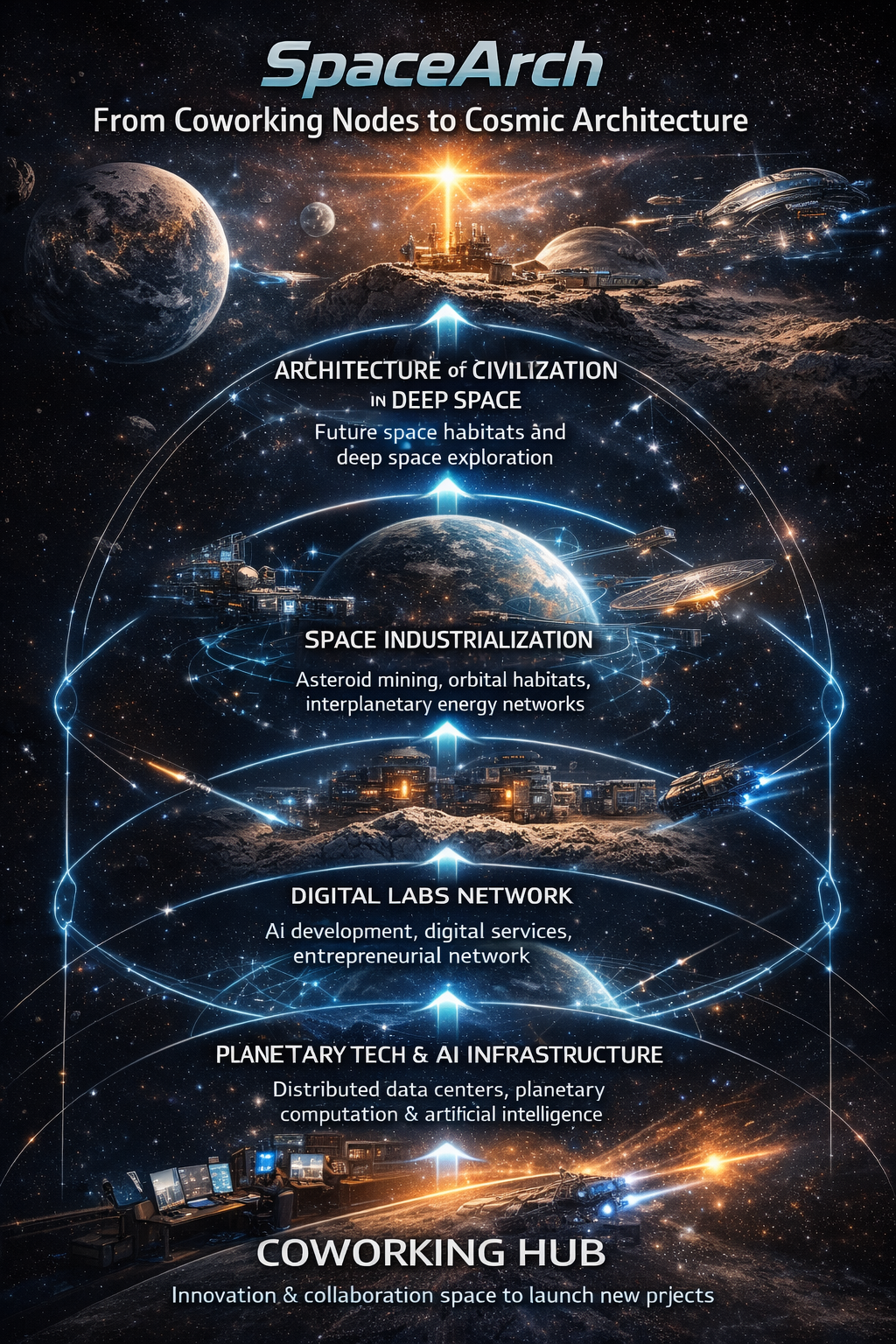
In parallel with its long-term research initiatives, SpaceArch is actively developing a series of operational projects designed to generate economic sustainability and technological experimentation platforms.
These initiatives form the operational backbone of the SpaceArch ecosystem.
7.1 SpaceArch Digital Labs
A global network of digital laboratories dedicated to AI experimentation, digital production, and technological development.
Activities include:
- artificial intelligence development
- data analytics
- digital product creation
- software prototyping
- research collaboration environments
Digital Labs serve as both innovation hubs and economic engines within the SpaceArch ecosystem.
7.2 AI Infrastructure and Distributed Data Centers
Development of distributed computing nodes capable of supporting large-scale AI processing.
These nodes aim to create a planetary distributed computing grid, providing scalable computational capacity for advanced technological research.
7.3 SpaceArch Media and Knowledge Platforms
Development of specialized digital portals dedicated to:
- scientific communication
- technological analysis
- industrial intelligence
- future architecture and engineering concepts
These platforms aim to function as knowledge infrastructure for emerging technological ecosystems.
7.4 Astroarchitecture Research Program
A long-term research program dedicated to the architectural design of future extraterrestrial habitats, including:
- orbital habitats
- asteroid interior cities
- planetary settlements
- deep-space infrastructure systems
This program integrates architecture with aerospace engineering and systems design.
7.5 Advanced Energy Infrastructure Concepts
Exploration of large-scale energy architectures capable of supporting extraterrestrial civilization.
These include concepts such as:
- orbital solar energy systems
- interplanetary energy transmission networks
- large-scale energy collection infrastructures
These systems are considered foundational for future space industrialization.
7.6 Distributed Entrepreneurial Network
SpaceArch is building a network of independent entrepreneurs and digital units, capable of launching new initiatives within the broader ecosystem.
This network allows the rapid creation of:
- digital services
- technological startups
- research projects
- innovation initiatives
Each unit operates autonomously while contributing to the overall SpaceArch network.
8. Long-Term Vision
The long-term vision of SpaceArch New NASA is to contribute to the emergence of a civilization capable of expanding beyond the Solar System.
This vision includes:
- interplanetary industrial infrastructure
- asteroid-based megacities
- distributed solar-system economies
- advanced propulsion technologies
- eventual interstellar exploration
While the technological challenges remain immense, the program is based on the belief that human progress accelerates when scientific ambition, engineering capability, and entrepreneurial initiative converge.
9. Contact
Researchers, developers, entrepreneurs, and creative professionals interested in participating in the SpaceArch ecosystem are invited to contact the network for further information regarding collaboration opportunities.
SpaceArch 12 Strategic Programs
Strategic Framework for Fourth Wave Civilization Architecture
1. Program Overview
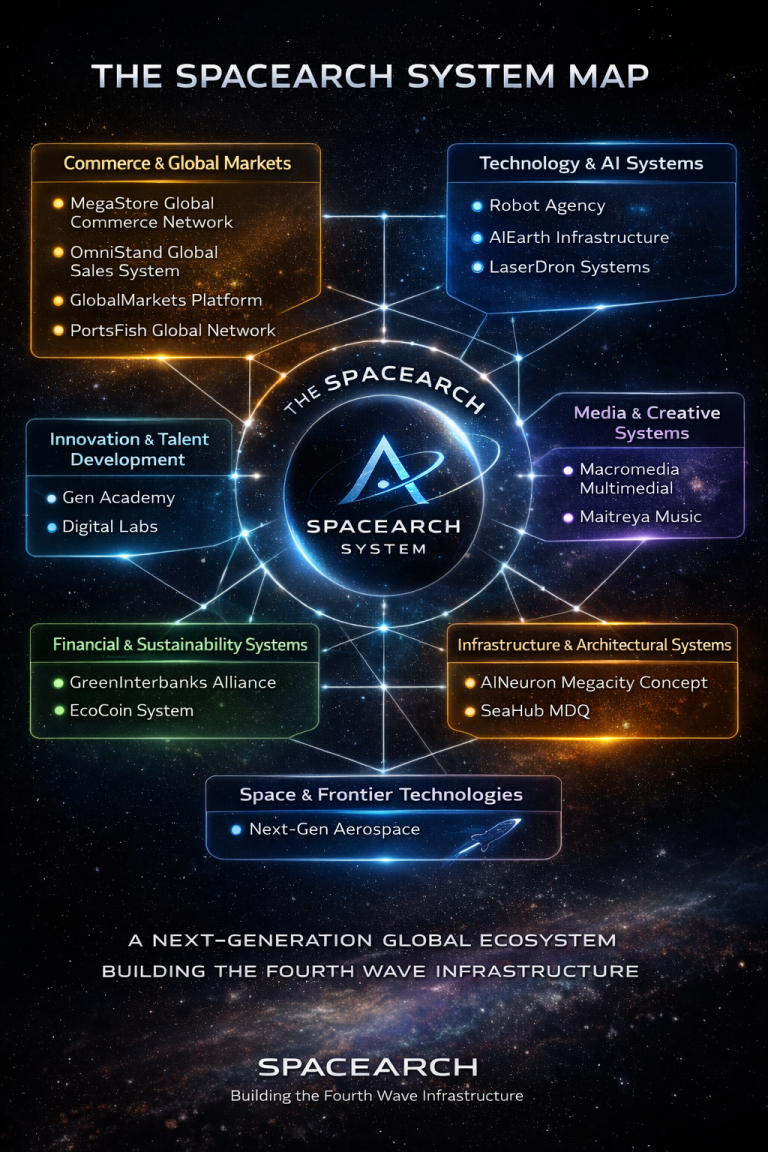
The SpaceArch 12 Strategic Programs constitute a comprehensive framework designed to coordinate the technological, industrial, architectural, and economic developments required for the transition from a planet-bound civilization to a distributed technological civilization.
The programs combine:
- advanced technological research
- entrepreneurial innovation
- infrastructure development
- digital ecosystem expansion
- extraterrestrial architecture concepts
Together they form a multi-sector platform for Fourth Wave innovation, integrating artificial intelligence, digital entrepreneurship, sustainable infrastructure, and long-term space architecture initiatives.
Each program functions as a semi-autonomous development axis, capable of generating both technological progress and economic activity while contributing to the broader SpaceArch ecosystem.
2. Strategic Program I
Digital Labs Global Network
The Digital Labs Network is a distributed system of innovation hubs dedicated to technological experimentation, digital production, and AI-driven development.
These labs serve as operational centers where independent entrepreneurs, developers, and researchers collaborate on new digital technologies and services.
Core activities include:
- artificial intelligence development
- software engineering
- digital product design
- web infrastructure development
- data analytics and automation
The Digital Labs model supports the emergence of small, highly productive innovation units, capable of operating within the broader SpaceArch ecosystem.
3. Strategic Program II
Distributed AI Infrastructure
Artificial intelligence will become one of the central drivers of technological acceleration during the Fourth Wave.
The Distributed AI Infrastructure Program focuses on the development of decentralized computing networks capable of supporting large-scale AI processing.
Key components include:
- distributed micro data centers
- cloud-based AI development environments
- collaborative computational infrastructure
- scalable data processing systems
This program aims to significantly expand the computational capacity available for research, engineering design, and digital services.
4. Strategic Program III
Harmonix Ethical AI Security Framework
The Harmonix Program focuses on the development of security and governance frameworks for advanced artificial intelligence systems.
As AI capabilities expand, ensuring ethical and secure operational environments becomes increasingly critical.
The Harmonix framework explores:
- embedded ethical verification systems
- source-code integrity mechanisms
- distributed trust protocols
- AI governance architectures
This program contributes to the development of safe and reliable AI systems capable of supporting complex technological ecosystems.
5. Strategic Program IV
SpaceArch Media and Knowledge Platforms
The Media and Knowledge Platforms program develops a network of digital portals dedicated to technological analysis, scientific communication, and industrial intelligence.
These platforms provide:
- sector-specific news portals
- research publications
- technical analysis
- professional collaboration environments
By structuring high-quality knowledge ecosystems, this program contributes to the creation of information infrastructure for emerging technological sectors.
6. Strategic Program V
Astroarchitecture Research Program
The Astroarchitecture Program explores the design of future human habitats beyond Earth.
Areas of research include:
- orbital habitats
- lunar settlements
- asteroid interior cities
- planetary underground habitats
- rotating gravity habitats
The program integrates architecture, aerospace engineering, environmental systems, and urban design to create sustainable extraterrestrial habitation models.
7. Strategic Program VI
Solar System Industrialization Program
The Solar System Industrialization Program studies the long-term development of industrial infrastructure beyond Earth.
This includes:
- asteroid mining systems
- orbital manufacturing platforms
- space-based construction techniques
- interplanetary logistics networks
The program analyzes how extraterrestrial resource utilization could support large-scale space infrastructure development.
8. Strategic Program VII
ElectroHelios Interplanetary Energy Network
The ElectroHelios Program investigates large-scale energy architectures for space infrastructure.
This includes:
- solar energy generation platforms in space
- energy relay stations
- laser and microwave energy transmission technologies
- planetary and orbital energy networks
Reliable energy systems are essential for the development of industrial infrastructure beyond Earth.
9. Strategic Program VIII
Advanced Propulsion Research Initiative
The Advanced Propulsion Initiative focuses on theoretical and experimental research into future propulsion technologies.
Areas of interest include:
- high-efficiency electric propulsion
- nuclear propulsion concepts
- plasma propulsion systems
- advanced theoretical propulsion models
Long-term research also explores speculative concepts such as warp-drive theoretical frameworks, recognizing that interstellar exploration will require revolutionary advances in propulsion physics.
10. Strategic Program IX
SpaceArch Entrepreneur Network
The Entrepreneur Network Program connects independent innovators and professionals interested in developing new initiatives within the SpaceArch ecosystem.
Participants may include:
- software developers
- scientists and engineers
- designers and digital creators
- researchers and entrepreneurs
The program supports collaborative innovation through a network-based model rather than traditional hierarchical structures.
11. Strategic Program X
Smart Cities and Future Urban Systems
This program explores the design of next-generation urban environments integrating artificial intelligence, automation, and sustainable infrastructure.
Research areas include:
- high-density modular cities
- intelligent transportation systems
- autonomous logistics networks
- integrated digital infrastructure
These studies aim to develop urban models capable of supporting future technological societies.
12. Strategic Program XI
Global Digital Economy Platforms
The Global Digital Economy Program focuses on the development of platforms that enable distributed digital entrepreneurship.
These platforms facilitate:
- digital commerce
- global service networks
- decentralized collaboration systems
- AI-supported business infrastructure
The objective is to create economic systems that allow independent entrepreneurs to participate in emerging technological ecosystems.
13. Strategic Program XII
Interstellar Exploration Initiative
The final program focuses on the long-term possibility of interstellar exploration.
Although such missions remain far beyond current technological capabilities, early conceptual research can help identify the scientific and engineering breakthroughs required.
Research areas include:
- interstellar mission architecture
- long-duration spacecraft systems
- advanced propulsion concepts
- artificial intelligence-assisted exploration
This program represents the most ambitious long-term dimension of the SpaceArch vision.
14. Strategic Integration
The twelve strategic programs operate as an integrated ecosystem, where advances in one domain reinforce progress in others.
For example:
- AI infrastructure accelerates propulsion research
- digital labs support entrepreneurial innovation
- space industrialization programs inform astroarchitecture design
- energy infrastructure enables deep-space expansion
This systemic integration reflects the philosophy that the future of civilization will emerge from the convergence of multiple technological fields rather than isolated breakthroughs.
15. Conclusion
The SpaceArch 12 Strategic Programs represent a coordinated framework for innovation across digital technology, artificial intelligence, urban infrastructure, and long-term space exploration.
Rather than focusing on a single sector, the initiative explores the broader transformation of civilization during the Fourth Wave of technological development.
By integrating technological research, entrepreneurial networks, and long-term infrastructure concepts, SpaceArch seeks to contribute to the emergence of new technological ecosystems capable of shaping the future of humanity on Earth and beyond.