




Marketplace
Building the Commercial Ecosystem Layer of the Fifth Wave
The future of SpaceArch marketplaces is not a single e-commerce website.
The real opportunity is to build an interconnected marketplace ecosystem in the cloud where products, services, education, teleworkers, investors, companies, franchises, media, and AI all operate inside the same network.
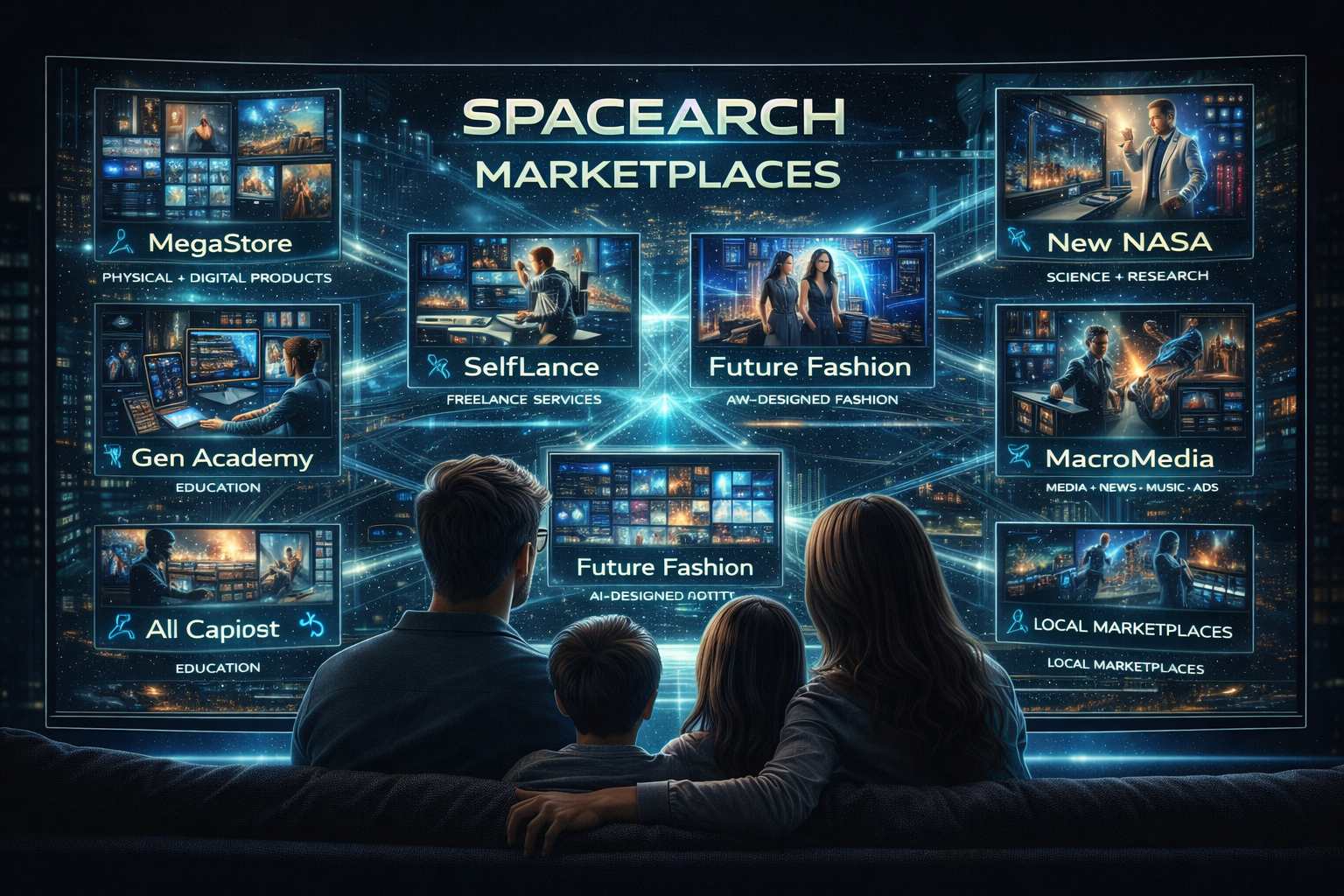
SpaceArch should therefore create not one marketplace, but a family of specialized marketplaces connected through one cloud infrastructure:
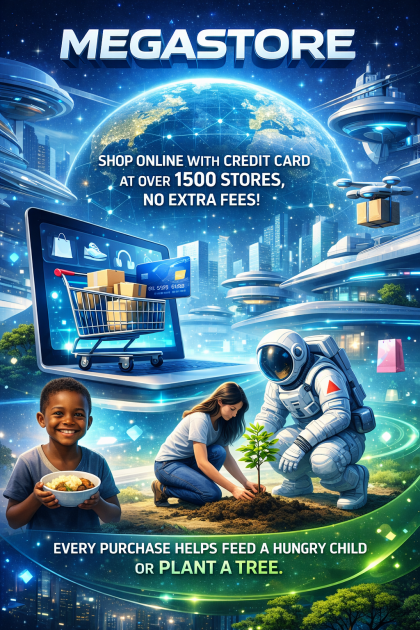
- MegaStore
- SelfLance
- Future Fashion
- AI Earth Agency
- Gen Academy
- MacroMedia
- PanAfrica
- PanMENA
- PANLATAM
- New NASA / Digital Labs
- Local city and country nodes
The objective is to transform SpaceArch into a platform where every participant can simultaneously be:
- Buyer
- Seller
- Operator
- Partner
- Investor
- Service provider
- Workforce node
The result is a cloud-based economic ecosystem capable of generating revenue across multiple industries at the same time.
The strongest marketplace ecosystems are no longer built around one company acting alone. They are built around networks of partners, technologies, platforms, and specialized communities collaborating inside one integrated environment.
1. The SpaceArch Marketplace Philosophy
Traditional marketplaces work like this:
Seller → Platform → Buyer
The SpaceArch marketplace model should work differently:
Operator + AI + Marketplace + Community + Services + Revenue Network
That means SpaceArch should not only connect buyers and sellers.
It should also connect:
- Courses with jobs
- Students with telework
- Companies with freelancers
- Investors with projects
- Products with content
- Services with AI
- Local nodes with global demand
- City ecosystems with international expansion
Every SpaceArch portal becomes a gateway into the larger commercial ecosystem.
Example:
A user enters Gen Academy to take a course.
From there, the system can automatically connect them to:
- SelfLance
- AI Earth Agency
- MegaStore
- Future Fashion
- Investor opportunities
- Local coworkings
- Country-specific business nodes
Thus, every marketplace becomes part of a much larger network effect.
2. SpaceArch Marketplace Cloud Architecture
SPACEARCH MARKETPLACE CLOUD
│
├── Marketplace Core Engine
├── Product & Service Catalog
├── AI Matching Layer
├── Payments & Fintech Layer
├── Partner Ecosystem Layer
├── CRM + Customer Data Layer
├── Regional Node Layer
├── Local Marketplaces
├── Global Marketplace Layer
└── Expansion & Replication Layer
Each layer supports a different part of the ecosystem.
Marketplace Core Engine
This is the central platform connecting all SpaceArch portals and subdomains.
It should include:
- Unified login
- Shared customer profile
- Shared wallet / commissions
- Internal search engine
- Product and service catalog
- Reputation system
- Memberships and subscriptions
Product & Service Catalog
The catalog should include multiple marketplace categories:
| Marketplace | Main Offer |
|---|---|
| MegaStore | Physical and digital products |
| SelfLance | Developers, designers, programmers, AI services |
| Future Fashion | Fashion, apparel, AI-generated collections |
| Gen Academy | Courses, memberships, certifications |
| AI Earth Agency | Workforce activation, sales and service networks |
| MacroMedia | Media, films, music, eBooks, advertising |
| Digital Labs | Innovation projects, prototypes, consulting |
| New NASA | Science, engineering, research collaborations |
The most powerful effect occurs when these marketplaces interact with each other.
3. The SpaceArch Partner Ecosystem
SpaceArch should not try to build every capability alone.
The strongest marketplace model is based on partnerships.
SpaceArch should therefore create a cloud-based partner ecosystem with:
- Technology companies
- Cloud providers
- Payment platforms
- Universities
- Training organizations
- Coworkings
- Freelancers
- Investors
- Local governments
- Strategic brands
- Manufacturing partners
- Media companies
The future commercial advantage belongs to organizations that can orchestrate large ecosystems of partners rather than operate as isolated companies.
For SpaceArch, this means creating strategic partnerships in three levels:
| Level | Type of Partner |
|---|---|
| Infrastructure Partners | Azure, AWS, Google Cloud, telecoms |
| Commercial Partners | Companies, marketplaces, payment systems |
| Local Partners | Coworkings, universities, investors, city nodes |
This creates a model where every new region can be launched faster because the local ecosystem is already connected to the larger SpaceArch cloud.
4. The SpaceArch AI Marketplace Layer
The AI layer is what differentiates SpaceArch from a traditional marketplace.
Instead of users searching manually through thousands of options, SpaceArch can use AI to intelligently match:
- Student → Course
- Student → Job
- Company → Freelancer
- Investor → Project
- Product → Buyer
- Partner → Local node
- Country → Expansion opportunity
Example:
A company in Dubai needs:
- AI developer
- Spanish-speaking salesperson
- Marketing campaign
- E-learning portal
The SpaceArch AI system can instantly match that company with:
- SelfLance programmers in Senegal
- AI Sales operators in Argentina
- MacroMedia content creators
- Gen Academy training resources
The result is a global cloud marketplace operating in real time.
Modern ecosystem marketplaces increasingly depend on AI to automate recommendations, connect partners, personalize offers, and improve commercial performance.
5. Regional Marketplace Nodes
One of the strongest features of SpaceArch is the possibility of building regional marketplace clusters.
Suggested examples:
PANLATAM Marketplace
Focus:
- Education
- Telework
- SMEs
- Digital products
- Services in Spanish and Portuguese
PanAfrica Marketplace
Focus:
- Programming
- SelfLance
- AI workforce
- Outsourcing
- Fintech
- XR pilots
PanMENA Marketplace
Focus:
- International business
- Investors
- Real estate
- Premium services
- AI + fintech
Each regional marketplace should remain locally adapted but connected to the same SpaceArch cloud.
That means:
- Same infrastructure
- Same payment logic
- Same AI matching
- Same CRM
- Same expansion model
Thus the system becomes infinitely replicable.
6. The SpaceArch Marketplace Revenue Model
SpaceArch marketplaces can generate multiple revenue streams simultaneously.
| Revenue Stream | Example |
|---|---|
| Transaction commissions | Product or service sales |
| Memberships | Premium access to marketplaces |
| Advertising | Featured brands, promoted listings |
| Subscription services | Monthly access to tools and content |
| Franchises | Local marketplace operators |
| SaaS tools | CRM, AI, dashboards, portals |
| Consulting | Investor and business advisory |
| Marketplace-as-a-Service | White-label versions for partners |
This is important because SpaceArch is not dependent on one business model.
The platform can generate recurring revenue from many different activities at once.
Cloud-based marketplace ecosystems become far more valuable when they combine services, subscriptions, data, commissions, and partnerships rather than relying only on one-time sales.
7. SpaceArch Marketplace-as-a-Service
One of the most important future opportunities is to allow external organizations to use SpaceArch’s marketplace system.
For example:
- Universities
- Governments
- NGOs
- Large companies
- Startup ecosystems
- Coworking networks
SpaceArch could offer:
Marketplace-as-a-Service
That means an organization could launch its own branded marketplace using the SpaceArch cloud.
Examples:
- A university launches a telework marketplace for graduates
- A city launches a local entrepreneur marketplace
- A government launches a digital workforce platform
- A corporation launches a private innovation marketplace
The SpaceArch cloud becomes the invisible operating system behind all of them.
8. Recommended Technology Stack
| Function | Recommended Technology |
|---|---|
| Marketplace Engine | Magento, Shopify Plus, custom cloud platform |
| CRM | Salesforce, HubSpot, Dynamics 365 |
| Payment Layer | Stripe, PayPal, Wise, crypto / Web3 integrations |
| AI Matching | OpenAI, Azure AI, Vertex AI |
| Search Engine | Elastic, Azure AI Search, vector database |
| Partner Integration | APIs, Zapier, Make, Power Automate |
| Cloud Infrastructure | Azure, AWS, Google Cloud |
| Identity & Reputation | Blockchain identity, user scoring, badges |
| Analytics | Power BI, Tableau, Looker |
The most successful marketplace ecosystems increasingly combine cloud, data, AI, APIs, and ecosystem partnerships into one integrated digital core.
9. The SpaceArch Marketplace Network Effect
The strongest long-term value comes from network effects.
As more users enter SpaceArch:
- More students create more teleworkers
- More teleworkers create more services
- More services attract more companies
- More companies attract more investors
- More investors create more projects
- More projects create more local nodes
- More nodes create more revenue
The marketplace therefore becomes self-reinforcing.
More Users
→ More Services
→ More Revenue
→ More Partners
→ More Nodes
→ More Users
That is the same dynamic that created the world’s largest platform businesses—but SpaceArch can apply it simultaneously across education, labor, commerce, media, AI, and regional development.
10. Final Strategic Conclusion
The future SpaceArch marketplace should not be viewed as a store.
It should be viewed as:
- A cloud-based ecosystem
- A global partner network
- A distributed economic engine
- A platform connecting people, companies, products, services, AI, and capital
- A Fifth Wave infrastructure for digital labor and commerce
The sequence becomes:
Cloud + AI + Marketplace + Partner Ecosystem
→ Services + Products + Workforce + Investment
→ Revenue + Expansion + Replication
As more Mar del Plata, Dubai, Senegal, Miami, Denver, Tokyo, PanAfrica, PanMENA, and PANLATAM nodes are activated, SpaceArch can evolve into one of the