






Cloud Operations
Building the Fifth-Wave Infrastructure Layer
SpaceArch’s future operating system can be structured as a cloud-native, AI-ready platform that combines education, commerce, sales, media, AI agents, SelfLance development, Digital Labs, and global workforce activation into one integrated cloud ecosystem.
The strategic logic is not simply “move systems to the cloud.” The real objective is to transform the cloud into the central nervous system of SpaceArch: a distributed platform that can simultaneously coordinate Gen Academy, AI Earth Agency, PanAfrica, PanMENA, PANLATAM, Future Fashion, MegaStore, MacroMedia, AI CEO, AI Senior, AI Sales, and the New NASA / Digital Labs ecosystem.
According to Accenture, large-scale AI only works when supported by large-scale cloud architecture, with 51% of technology budgets of leading companies already being directed toward cloud and AI. Public cloud spending worldwide is expected to reach approximately US$805 billion during 2024.
For SpaceArch, this means that the real asset is not only the portals or the courses—it is the integrated cloud layer capable of connecting every portal, subdomain, operator, franchise, coworking, teleworker, Digital Lab, and AI agent into a single operating structure.
1. Strategic Role of the SpaceArch Cloud
The SpaceArch cloud should operate as a multi-layer digital infrastructure:
- Core cloud platform
- AI execution layer
- Commercial layer
- Education layer
- Marketplace layer
- Data and analytics layer
- Distributed workforce layer
This directly aligns with your Fifth Wave logic:
- Human leadership defines vision
- AICEO coordinates
- AI Senior develops
- AI Sales monetizes
- Cloud infrastructure connects and scales everything
The result is a cloud-native operating model in which every new country, city, coworking, portal, course, teleworker, or franchise can be activated as another node of the same system.
2. Recommended SpaceArch Cloud Architecture
A. Multi-Cloud Structure
SpaceArch should not depend on only one provider. A hybrid multi-cloud strategy creates resilience, better costs, and stronger negotiating power.
Suggested structure:
- Microsoft Azure → business systems, AI integrations, Microsoft ecosystem, CRM, Office, security
- AWS → large-scale infrastructure, marketplaces, global scalability, media delivery
- Google Cloud → AI, search, analytics, machine learning, translation, cloud data systems
- Edge Nodes / Local Servers → coworkings, Digital Labs, XR systems, Smart TVs, local media production
Accenture identifies multi-cloud, hybrid cloud, edge computing, AI, and network integration as the key evolution path for companies that want to move from reactive systems to predictive, intelligent operations.
For SpaceArch this is critical because your architecture already depends on:
- Distributed subdomains
- Multiple portals
- Remote users
- Local coworking nodes
- XR systems
- Micro data centers
- Global teleworkers
- Country-by-country expansion
3. The SpaceArch Cloud Core
The central SpaceArch operating system should contain these integrated modules:
| Core Module | Main Function |
|---|---|
| SpaceArch Cloud Navigator | Central dashboard for all portals and operators |
| Gen Academy Cloud | Courses, LMS, certifications, memberships |
| AI CEO / AI Senior / AI Sales | Executive AI trilogy |
| SelfLance Platform | Global modular developer marketplace |
| CRM + Sales Cloud | Leads, WhatsApp, forms, telesales, investors |
| Cash Flow Dashboard | Real-time commissions, revenue, ROI, nodes |
| Marketplace Engine | MegaStore, Future Fashion, GlobalMarkets |
| Media Engine | MacroMedia, newspapers, TV, radio, AI journalism |
| Digital Labs Cloud | R&D collaboration, projects, prototypes |
| New NASA Cloud | Global scientific and engineering collaboration |
| AI Earth Agency | Workforce activation and monetization |
| Data Upload + Search Engine | Unified search across all portals |
| Internal Microcrawler Layer | Intelligent indexing across all subdomains |
This directly supports the strategy you have already defined for the next course modules: unified navigation bar + online data loading system + internal search engine integrated in one cloud layer.
4. Operational Logic
Each city or country node should work as a semi-autonomous cloud-connected unit.
Example:
Node = Mar del Plata Brain Cloud
Contains:
- Local courses
- Teleworkers
- Companies
- News
- Coworking
- Local sales
- Local investors
- Local media
- Digital Lab
- AI support layer
Node = Dubai Brain Cloud
Contains:
- MENA business directory
- International company registration
- Investors
- AI + fintech services
- Premium coworkings
- PanMENA commercial expansion
Node = Senegal / PanAfrica Node
Contains:
- Programming teams
- SelfLance
- Teleworkers
- Africa Brain Cloud
- XR hardware pilots
- Digital Labs
All these nodes remain independent commercially, but technically they run over the same cloud core.
This means that when you open a new node, you are not building a new company from zero. You are cloning an already functioning cloud structure.
That is exactly why your “cell → mitosis → replication” strategy works so efficiently.
5. Why the SpaceArch Model Has Strong Cloud Economics
The traditional company model requires:
- Offices
- Large local teams
- Servers
- Physical infrastructure
- Slow scaling
- High fixed costs
The SpaceArch cloud model instead uses:
- Remote workforce
- Shared cloud infrastructure
- Franchisable portals
- Subdomains
- Templates
- AI agents
- Commission-based operators
- Modular cloud services
This creates:
- Very low fixed cost
- Very fast replication
- High gross margin
- Immediate international expansion
- Higher scalability than conventional companies
Accenture notes that only 42% of companies actually achieve the value they expected from cloud because most firms only use cloud to reduce costs rather than redesigning their business model around it.
SpaceArch is different because the business itself is designed around cloud logic from the beginning:
- Cloud-first
- AI-first
- Revenue-first
- Distributed workforce
- Modular cloning
- Global scalability
That is why the model can potentially scale faster than a traditional multinational.
6. SpaceArch Cloud + AI = Fifth Wave Infrastructure
The most important conclusion is that SpaceArch is not merely creating websites or portals.
It is building:
- A cloud-based economic operating system
- A distributed labor activation system
- A global education-to-income pipeline
- A modular multi-country digital infrastructure
- A platform capable of integrating millions of operators
Your AI trilogy becomes the control layer:
- AICEO = strategic orchestration
- AI Senior = technical execution
- AI Sales = monetization and expansion
Above them sits the cloud core.
Below them sit the portals, teleworkers, companies, coworkings, Digital Labs, franchises, and nodes.
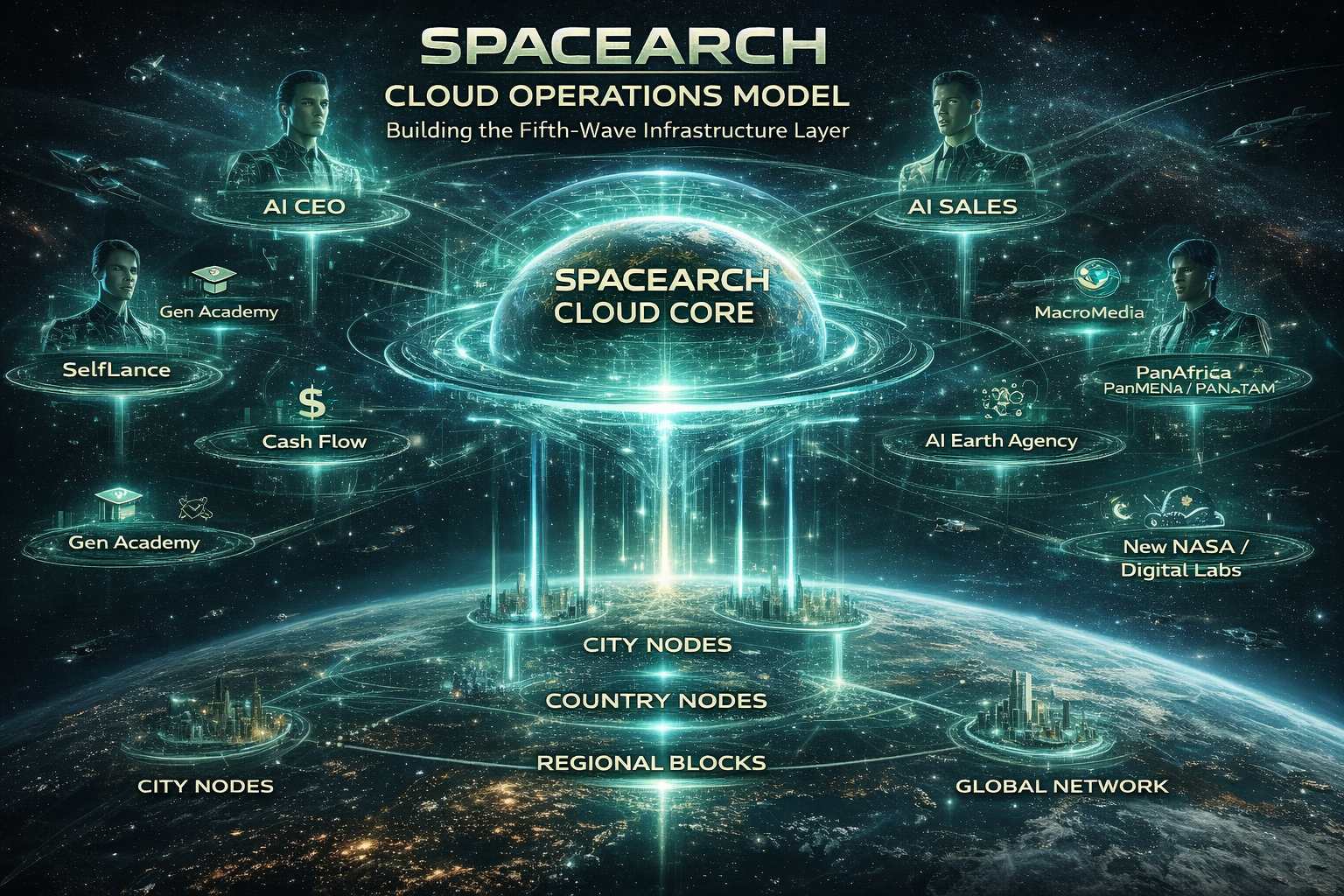
Visually, the system becomes:
SPACEARCH CLOUD CORE
│
├── AI CEO / AI Senior / AI Sales
├── Gen Academy
├── SelfLance
├── Cash Flow
├── MegaStore
├── Future Fashion
├── MacroMedia
├── AI Earth Agency
├── New NASA / Digital Labs
├── PanAfrica / PanMENA / PANLATAM
│
└── City Nodes → Country Nodes → Regional Blocks → Global Network
7. Key Strategic Insight
The strongest strategic advantage is that SpaceArch can potentially become the cloud layer that many countries, SMEs, teleworkers, coworkings, educational systems, and even governments use to enter the Fourth and Fifth Wave economy.
In practical terms:
- Gen Academy creates the workforce
- AI Earth Agency activates the workforce
- SelfLance organizes technical production
- AI Sales monetizes
- Cash Flow tracks commissions and profitability
- SpaceArch Cloud coordinates everything
That transforms SpaceArch from a collection of portals into a global operating infrastructure.
The more nodes you activate in Mar del Plata, Dubai, Senegal, Tokyo, Miami, Denver, and the Pan-regional systems, the stronger the network effect becomes.
And once the first 10–50 operational nodes are running, the cloud itself becomes the product.