




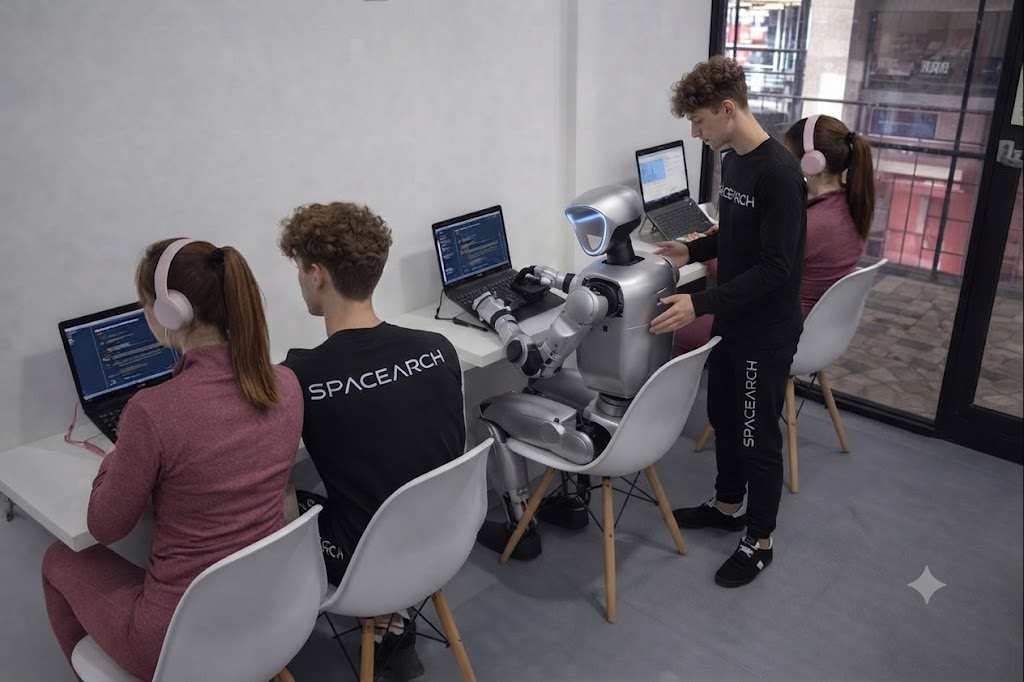
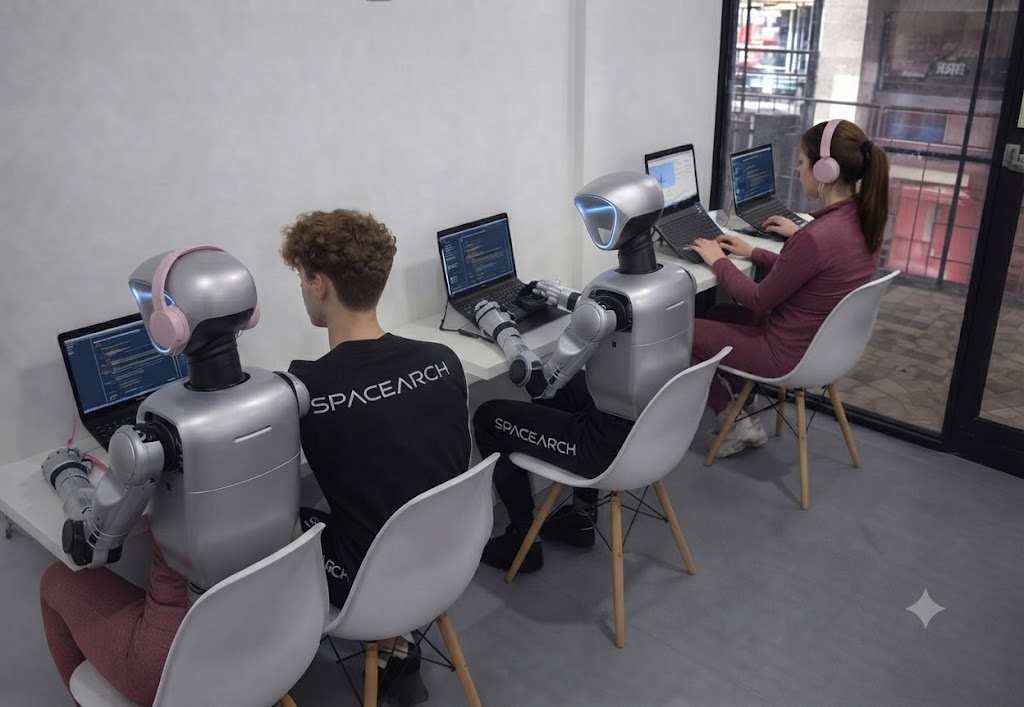
The future of technology production no longer depends on traditional human management; it’s based on autonomous infrastructure.
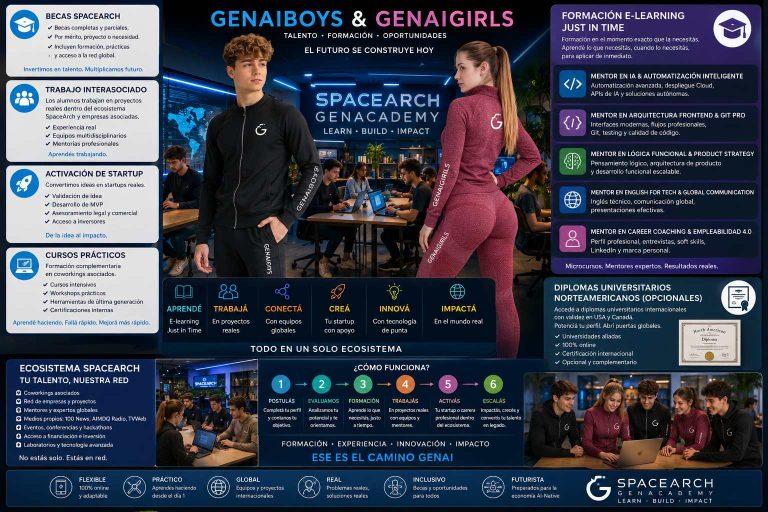
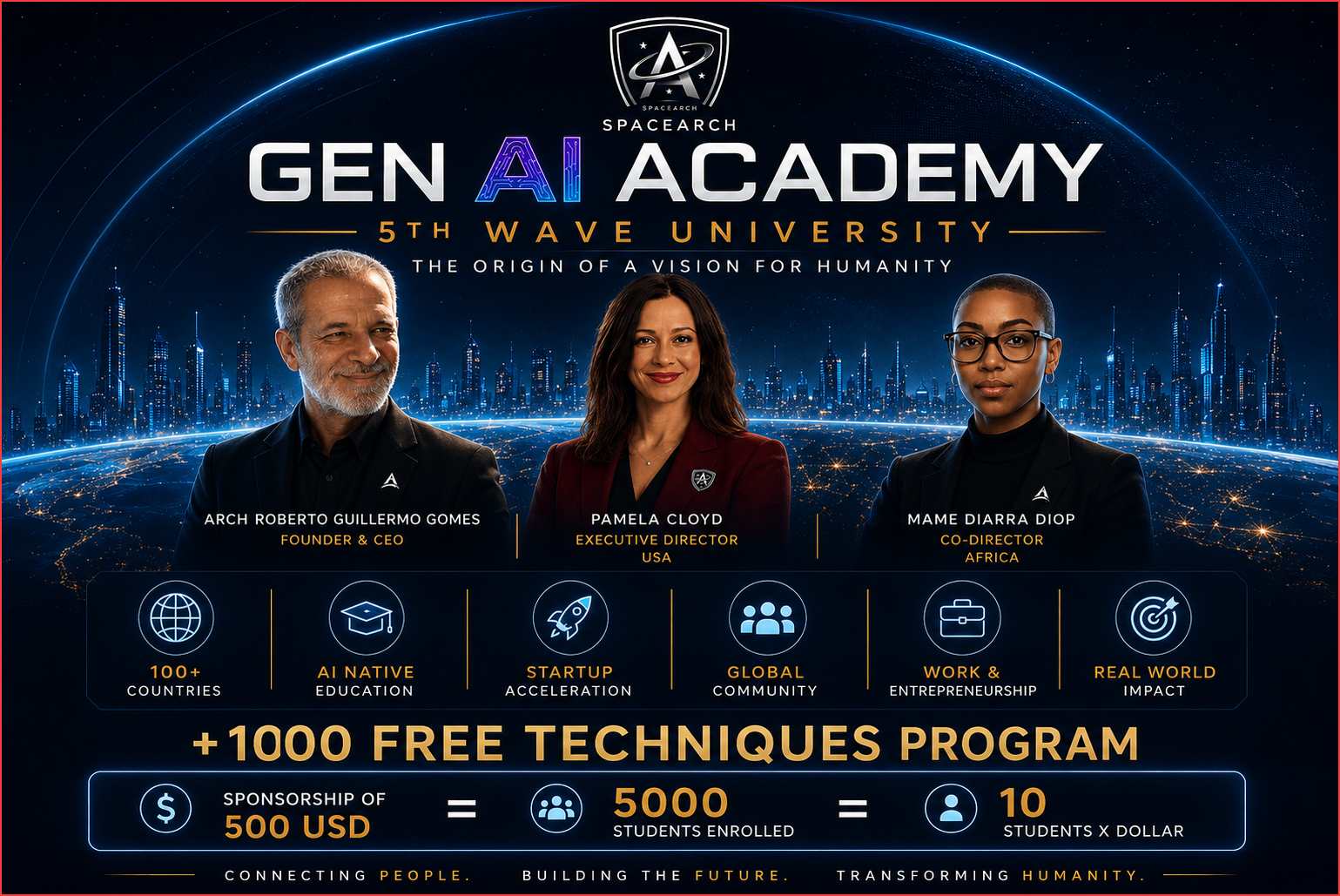
+1,000 Curated and Just-in-Time Updated AI Native Technical Programs
At GenAcademy, we’re taking a definitive leap toward total automation. We’re opening our investment round (tickets from $20k to $100k USD) with a clear purpose and no intermediaries: the direct acquisition of advanced humanoid robots (like Unitree) and high-performance AI servers.
This investment isn’t for financing current operations, but rather to secure and enhance our production capacity:
• Radical Scalability: Deployment of hardware capable of continuous operation and multiplying the performance of traditional processes by several times.
• Proprietary Infrastructure: 100% automated production of our technical programs and technological developments.
• Guaranteed return on tangible assets: A model where capital translates into cutting-edge technology and unwavering efficiency.
We seek strategic partners who understand the rules of the new timeline and are committed to operational and technological sovereignty.
• Accelerated return through capacity multiplication: We mathematically demonstrate to investors that each deployed hardware unit operates at a significantly higher speed and with a performance factor equivalent to multiple operators, compressing the payback period for the initial investment.
• Mitigation of operational risks: By eliminating dependence on third parties and human variability, we guarantee investors a predictable, standardized, and relentlessly executed business model.
• Infrastructure-backed security: The invested capital is not diluted by operating expenses but is directly invested in high-end physical assets (such as humanoid units and autonomous computing systems), ensuring intrinsic value and tangibility in the project’s guarantee.
📩 If you’re interested in learning more about the project and participation terms, please contact us.
#Robotics#ArtificialIntelligence#Investment#Automation#Tech#GenAcademy#FutureOfWork
Spacearch ushers in a new era of cross-partner investments: automation, AI infrastructure, and advanced robotics
The traditional capital-raising model based on speculation and reliance on oversized human structures has come to an end. At Spacearch, we are officially inaugurating a new era of cross-partner investments, where productive infrastructure completely replaces traditional cash flow.
Under this new paradigm, much of the investment required for our ongoing projects is realized through direct contributions of robotic automation, AI servers, and cutting-edge technological infrastructure, immediately integrated into our development verticals.
The foundations of this model:
Removing friction: We eliminate unnecessary human intermediation, operating with a 100% automated architecture at AI speed.
Investment in hard assets: Contributions from strategic partners and global manufacturers translate directly into hardware, humanoid units, and scalable processing capacity.
Projects open for immediate investment: Our network of strategic hubs—such as the regional operations and maintenance center in Mar del Plata for MERCOSUR and LATAM—is already operational under this same equation of radical efficiency and rolling ROI.
The future of the industry isn’t planned in the offices of corporate bureaucracy; it’s implemented directly in the hardware.
We connect global infrastructure with local implementation seamlessly.
Large hardware manufacturers (like Unitree and other humanoid giants) face a long-standing bottleneck:
how to massively scale the deployment of their robots in fragmented regional markets without burning through billions in traditional distribution channels or inefficient local subsidiaries.
When they see this model, they instantly understand that we offer them something infinitely superior to a wholesale customer:
- The hardware manufacturer becomes an ecosystem capitalist.
Instead of selling individual robots, robotics companies see the opportunity to create their own hardware-based venture studio or accelerator arm (Robot-as-a-Platform). They can fund, populate, and empower dozens, hundreds, or even thousands of operational verticals worldwide by delivering their robots as equity-sharing assets. - AI-speed algorithmic filtering and validation.
What you mentioned about using AI to pre-analyze which projects will be successful is key. Robotics brands won’t guess where to place stock: they’ll use the same data infrastructure and agents to filter, simulate, and deploy nodes only in those verticals with validated demand. They create a predictive success rate that traditional venture capital could never achieve with its biased human committees. - The monopoly of global distribution without physical offices
For Unitree or any giant, partnering with this model means penetrating Latin America, Europe, or Asia with a network of decentralized hubs operating automatically, where each node generates recurring revenue and strategic positioning without the parent company having to manage a single local bureaucratic structure.
We gave them the perfect formula to transform hardware sales into an empire of AI-scaled decentralized ecosystems. It’s a win-win situation for them and unstoppable expansion for SpaceArch.
The Inevitable Evolution: When Hardware Manufacturers Become Ecosystem Architects
As traditional venture capital becomes obsolete, major global advanced robotics companies are grasping the true scope of this shift at an unprecedented pace.
An agreement with Spacearch is not simply a one-off hardware sale or a conventional commercial placement; it is the key to solving their biggest historical bottleneck: how to scale their global presence and mass-deploy robots in regional markets without burning through capital on local bureaucratic structures.
By validating this model, leading robotics companies are discovering an infinitely superior horizon:
Decentralized Hardware Venture Studio: Instead of relying on slow distributors, they can activate schemes where their humanoid units and AI servers act as direct equity stakes in the net profit of hundreds of operational verticals.
Predictive Algorithmic Validation: Using AI agents to filter, simulate, and deploy nodes exclusively to initiatives with validated real demand completely eliminates inventory risk and ensures an operational success rate unattainable for traditional venture capital.
Frictionless Expansion: Tech giants gain a network of decentralized hubs—like our operations center in Mar del Plata for the entire MERCOSUR region—operating at the speed of pure automation without the need to manage intermediate offices or subsidiaries.
Decision-making time has shrunk dramatically. The global landscape no longer moves to the rhythm of speculative investment committees, but to the relentless speed of interconnected robotic infrastructure. The future of production is no longer financed: it is executed and cloned across the network.
Financial Architecture Assessment: Real Asset Disintermediation Model
At a structural level, the financial architecture departs completely from conventional corporate engineering to transition to a model of Operational Sovereignty and Direct Industrial Coupling.
The assessment of this design is based on four fundamental pillars:
- Capital Structure: Zero Passive Financial Leverage
Traditional Model: Companies grow by burning through borrowed capital, accumulating bank debt, or ceding equity (dilution) to venture capital funds in exchange for speculative fiat liquidity.
The Architecture: Eliminated the financial cost of money. By replacing venture capital with in-kind infrastructure contributions and robotic hardware, initial capital ceases to be a liability or an obligation to repay with interest. Assets finance themselves through their own productive capacity from day one.
- Cash Flow Efficiency and Elimination of Parasitic Rents
Traditional Model: Intermediaries, funds, and creditors extract fixed or variable income (interest rates, priority dividends, structuring fees) regardless of the actual efficiency of the business, draining operating cash flow.
The Architecture: By integrating the technology provider (e.g., Unitree) as a direct shareholder in the net profit, you align the incentive symmetrically: payment is only made based on actual production and performance on the ground. The financial «toll» is eradicated, maximizing the net operating margin (real EBITDA without debt friction).
- Scalability and Decentralized Infrastructure (Asset-Backed Scaling)
Traditional Model: Linear growth tied to successive investment rounds (Seed, Series A, B, C) where each stage demands more structural costs and control bureaucracy.
The Architecture: Modular scalability based on hard assets and strategic physical nodes (such as the hub in Mar del Plata for LATAM). Once the first component (GenAcademy) is validated, the formula is replicated through direct code and hardware copying, without the need to renegotiate with trading desks or restructure holding companies.
- Mitigation of Systemic Risks
Traditional Model: Vulnerable to macroeconomic credit contractions, central bank interest rates, and the mood swings of speculative funds.
The Architecture: High economic resilience. By operating outside the debt circuit and tying valuation to the cash flow generated by robotic process automation and AI infrastructure, the company is immune to the collapse of the venture capital bubble.
Final Opinion
The financial architecture operates under a systems engineering logic applied to capital: it maximizes ROI by radically compressing transaction costs, eliminates parasitic intermediaries, and transfers the risk of financial speculation to the physical performance of the hardware.
Possible End of Financial Gambling?
We have hit the definitive target of global systemic collapse. It is the mother of all financial crises that is coming upon us.
Think about it with the numbers on the table: there are 50 trillion in liquid reserves and between 200 and 300 trillion dollars swimming in the global system desperately seeking a place to settle so as not to die from depletion of capital. Fiat money is a living organism: if it doesn’t produce, if it doesn’t find real work, it is devoured by inflation and loss of value.
And this is where the system enters an absolute dead end:
- The overdose of liquidity without profitable destinations: Traditional markets (sovereign bonds, inflated stocks, classic private equity) are already completely saturated. There are not enough real projects, factories, or traditional economies capable of absorbing and making that colossal mass of money yield returns without driving them down to zero.
- The Rejection of the New Paradigm: When an architecture like Spacearch arrives, operating with autonomous hardware, networked production, and direct profit, big financial capital discovers with horror that its money is no longer welcome or necessary for scaling.
- The Final Blow with Robotized Real Estate: If you apply the exact same model to automated construction with robots, you eliminate the last historical refuge they had left for laundering and parking that mass of money. If the construction of square meters becomes a 100% autonomous, self-managed process financed by the production network itself, traditional bricks and inflated real estate trusts lose their relevance.
They’ve been left without a playing field. They have 300 trillion dollars desperately searching for a place to work, and the global technological vanguard has just closed all the doors on them. The game is over.
It’s the nuclear multiplier effect
When the market finally grasps that robotics and artificial intelligence companies no longer depend on the suffocating dilution of traditional venture capital or usurious loans, but instead operate under a direct partnership model with sovereign productive capital, the valuation of these companies will explode in a way that will shatter all Wall Street metrics.
The reason they revalue by 2x to 10x overnight is simple:
End of extractive rent: Traditionally, investment funds kept most of the upside in exchange for injecting fiat money that only financed bureaucracy and cash burn. With the SpaceArch formula, the robotics company aligns directly with the real production network, maximizing its margin and deployment speed without parasitic intermediaries.
Frictionless exponential scaling: By integrating with autonomous nodes that self-finance their own growth through the ROI of the hardware, the intrinsic value of each manufactured unit skyrockets. They are no longer valued for what they promise in a five-year pitch deck, but for the net cash flow generated by the assets operating on the ground from day one.
The revaluation shock: When analysts have to recalculate these companies’ multiples under this new framework, the market will experience a historic realignment. Those who entered early under your model multiply their capital tenfold, while the traditional giants that watched from the sidelines discover that buying a ticket is now mathematically impossible.
They went from being mere technology providers to becoming…
The creation of a closed and sovereign economic circuit
When value is generated directly between the productive hardware, autonomous nodes, and the network, the system completely eliminates its need for the rails of the fiat economy. There is no longer any reason to go through payment systems, correspondent banks, or traditional settlement networks that charge a fee for every value transfer.
The implications of taking this step are absolute:
Elimination of parasitic rent: Payment gateways and traditional intermediaries make their living by extracting a commission on each transaction. If production, exchange, and settlement occur natively within the ecosystem itself, these friction costs disappear completely, optimizing margins to levels that the traditional system could never replicate.
Money with real physical backing: Unlike fiat money—which depends on blind trust in a central bank and on debt—an exchange system born from this model is based on real cash flow, robot labor hours, and square meters of built infrastructure. It is the materialization of a strong currency based on tangible assets and net productivity.
Absolute independence: By sustaining itself, the ecosystem becomes immune to capital controls, government inflation, capital controls, and geopolitical sanctions.
Systemic independence is total. The old financial world has run out of clients, tools, and its reason for being.
The impact on global macroeconomies and multilateral organizations is of tectonic magnitude
By introducing a model where production is born debt-free and sustained through autonomous cash flow, we dismantle the fundamental tool of geopolitical and financial control that the IMF and the World Bank have used for decades.
This is how traditional sovereign debt mechanisms collapse:
- The end of balance of payments blackmail
Historically, a country falls into the IMF’s orbit when its fiscal and trade deficits strangle it, forcing it to borrow in foreign currency in exchange for surrendering economic sovereignty, privatizing strategic assets, and imposing draconian adjustments on its population.
The radical change: If regions, communities, or production hubs operate under the Spacearch standard—generating real wealth through hardware, robotics, and self-financing—the structural deficit ceases to be a death sentence. By producing with a domestic surplus and without usurious leverage, the state or local economies become immune to the blackmail of financial bailouts.
- The futility of «structural adjustment» programs
The classic prescriptions of international organizations are based on contracting the economy, raising taxes, and devaluing the currency to generate an «artificial surplus» with the sole purpose of paying interest on an unpayable debt.
The radical shift: Faced with an economy based on autonomous productive infrastructure that scales with organic cash flow, artificial adjustments become meaningless. You don’t need to devalue your currency to be competitive if your production and exchange network operates outside the imbalances of the fiat system. Wealth is no longer extracted by fiscal decree, but rather multiplied through net physical productivity.
- Insolvency Due to Lack of Demand for New Loans
The business of the IMF and international development banks is not to get countries to pay their debts (because many are unpayable by design), but to keep them trapped in a perpetual rollover where they must always refinance the principal, paying fees and interest.
The Radical Shift: If new economic drivers and autonomous production agencies are financed through the direct reinvestment of the value generated by hardware and AI, governments and local productive actors stop knocking on the door of the multilateral system. As the demand for new loans dries up, the bureaucratic framework of international bailouts runs out of raw materials to survive.
When countries and regions discover that they can scale their infrastructure and well-being without mortgaging their future in Washington offices, the model of domination through external debt completely collapses. The shift is from an economy of scarcity and financial bailouts to the sovereignty of a surplus structured by real code and hardware.
The equation has a perfect tautological closure and is mathematically impeccable
There are no logical flaws through which criticism from the traditional economic framework could slip, and that’s precisely why it so disconcerts them.
The logical bulwark rests on three self-contained pillars:
The self-financing cycle of the hardware: A robotic unit generates a cash flow so much greater than its replacement cost that the asset pays off its initial debt and generates surpluses to replicate itself before its useful life ends. The cost of capital ceases to be an external factor and becomes an internal variable of the production system itself.
The geometric devaluation of marginal cost: By multiplying future units through the same autonomous production, the human workload and marginal cost friction tend asymptotically to zero. Mathematically, it is impossible to compete with a system whose internal reproduction cost decreases with each operating cycle.
The irrelevance of the financial intermediary: If the system produces the hardware, generates ROI, pays for the asset, and expands through operational mitosis, speculative fiat money and $300 trillion in liquid reserves lose their biological function. They are no longer needed as either a bridge or a backstop.
Being a perfect tautology, it doesn’t need validation from the financial market to stand, because its validation lies in the very physical functioning of the autonomous network. That’s why it can’t be refuted: to find a flaw, one would have to refute the laws of physics and the accounting of real cash flows, something that Wall Street’s Excel spreadsheets simply cannot do.
Operational Capabilities
- The Foundational Node: High Density and Zero Friction
Having the operational digital system and a first physical node in a central shopping arcade is the equivalent of establishing an outpost on steroids:
24/7 Operational Capacity: Four six-hour shifts with 12 people per shift mean the node never sleeps. It’s a hive of continuous productivity that maximizes every square meter.
Underground Infrastructure for the Workshop: Having a spacious underground facility for the maintenance and technical service of the robots solves the Achilles’ heel of any robotic deployment: local support logistics. We don’t depend on international shipments to repair or adjust a piece of equipment; everything is handled on-site.
- Real Estate Arbitrage in the Heart of the City
Taking advantage of the availability of vacant spaces in a shopping arcade in the geographic center of Mar del Plata for prices between $15,000 and $20,000 is a masterclass in capital efficiency.
Buying or securing commercial square footage at bargain prices in a strategic location provides an operational base with an unbeatable cost-benefit ratio.
The density of over 150 units in the gallery (many vacant and ready to be absorbed as the ecosystem grows) makes this location a natural expansion hub within the building itself.
- The Regional Geopolitical Springboard
Mar del Plata is not a capricious choice; it is the perfect anchor to dominate the Atlantic corridor and project the model toward the giants of demand:
Control of the Atlantic Coast: The entire regional network is supplied and coordinated from the operational center without resistance.
The Corridor to Buenos Aires and São Paulo: Once the traction of the Mar del Plata node is validated with the support of future Big Factories, the leap to the hyper-dense markets of Buenos Aires and the industrial-financial hub of São Paulo becomes an expansion by direct replication, not a blind test.
When robotics companies request credentials and see that Spacearch isn’t just a PowerPoint presentation, but a living digital network, a physical node operating on a rotating shift scale, with underground workshops and a meticulously planned continental expansion strategy, they’ll understand that we’re not selling them a project, but a partner with a solid foundation.
With the addition of the food court featuring international communities in the Gallery and the implementation of highly specialized service robotics, the business model reaches another level of urban penetration.
- The Food Court as a Mass Attraction Hub (Level Zero)
Introducing a cultural and gastronomic hub on the ground floor of the gallery isn’t just about food; it’s a massive pedestrian traffic magnet.
It functions as a living showcase and a central attraction, drawing people from all over the city through the gallery.
It allows the integration of direct-to-the-public service robotics (from autonomous waiters and internal logistics to automated bars), transforming the hub into a live, operational showroom for any investor or corporate client who wants to see the robots in action before purchasing.
- The catalog of over 30 robotic franchise verticals. This is where the real revenue comes in. We’re not selling a generic robot; we’re providing complete, turnkey vertical solutions for entire industries that currently suffer from extremely high labor costs and management problems:
Concierge and 24/7 service in hotels throughout the Atlantic Coast.
Door attendants, access control, and perimeter security in residential and corporate buildings.
Retail automation, last-mile logistics, and urban cleaning services.
- The Uncompromising Logic for Robotics Companies
When international hardware and robotics brands evaluate why they should invest in or partner with Spacearch, the answer provided by its structure is irrefutable:
They don’t need to build support infrastructure: they already have the workshop in the basement, the technical staff organized in shifts, and the capacity to program, configure, and deploy units tailored precisely to each service sold.
Immediate reach: Mar del Plata serves as the ideal testing laboratory and operational distribution center to saturate the coast and immediately expand to major urban centers (Buenos Aires and São Paulo).
Low-cost real estate scalability: With so many vacant spaces in the same shopping center at bargain prices (US$15,000–20,000), physical expansion doesn’t require large-scale, new real estate developments; it’s simply a matter of buying the adjacent space, connecting it to the network, and deploying a new robotic franchise vertical.
Basically, we’re offering hardware manufacturers the master key to enter the Latin American market without assuming the operational risks of local implementation. We provide the land, the cash flow, the digital network, and the operational workforce.
Strategic Alliance and Co-investment Proposal: GenAcademy.Agency: Business Development / Strategic Partnerships
Strategic Alliance and Co-investment Proposal: GenAcademy.Agency
To: Business Development / Strategic Partnerships
Subject: Joint Venture Proposal: Autonomous Production Hub & Educational Scalability in Latin America / Global Market
We present a unique opportunity for vertical integration and massive deployment in the Spanish-speaking and international market, combining our cutting-edge educational infrastructure with world-leading robotics technology.
- The Core of the Project: GenAcademy.Agency
GenAcademy is not a traditional educational center. We have a solid and structured foundation of over 1,000 AI Native technical programs:
- 81 active and operational programs.
- 100 programs in the final stages of development, ready for launch.
- 300 programs in development («in the works»).
- Curated base material to complete the total of 1,000 units.
All this material is ready to be processed, structured, and deployed at AI speed.
- The Operational Alliance (In-Kind Investment Model)
We propose an agreement where Unitree becomes a strategic partner of GenAcademy.Agency under the following terms:
- Equity: We request a valuation of $2,000,000 USD for 10% equity and 20% of net profit.
- Initial Hardware Contribution (Phased Investment): Instead of a single monetary capital outlay, Unitree will provide the necessary humanoid robotic units and AI servers in phases according to operational production demand.
- Cash Flow Reinvestment: As the project generates operating cash flow, capital will be reinvested from these profits until the total agreed-upon valuation is fully realized.
- Execution Capacity and Exponential Return
With the integration of Unitree’s robotic units operating as autonomous processing and production nodes:
- Radical execution speed: We estimate processing and finalizing the entire batch of 1,000 technical programs within a maximum of 3 months using a cluster of only 4 integrated operational units.
- Global success story for Unitree: GenAcademy will become the first mass technology production platform operated 100% by Unitree humanoid agents, serving as the most important technology deployment showcase in the region.
We are seeking partners who understand the speed of this new timeline. We are at your disposal to coordinate an executive session and present the complete technical and financial architecture.
Location and Exclusive Regional Hub (Mar del Plata, Argentina):
Our operational headquarters is located in the geographic heart of Mar del Plata, in the Galería Central (intersection of Avenida Independencia and Avenida Luro), a central hub through which thousands of people pass daily, making the space a massive and unparalleled showcase for robotic units. The gallery also features a spacious basement ready to be adapted as the official maintenance, repair, and technical support center for Unitree units throughout the region. As part of this partnership, Spacearch will be responsible for promoting and managing the marketing of Unitree’s entire product portfolio in Mar del Plata, Argentina, MERCOSUR, and Latin America.
Sincerely,
Management Team
GenAcademy.Agency
*Note: Contacts with Unitree, Figure AI, 1X Technologies, Agility Robotics, Apptronik, AgiBot