




Declaración Institucional
SpaceArch Solutions International LLC informa que se encuentra evaluando el posible lanzamiento de una ronda de microinversiones tokenizadas orientada a financiar la infraestructura tecnológica, educativa y operativa necesaria para el desarrollo de su Programa Global de 5.000 Millones de Becas AI-Native impulsado a través de GenAI Academy.
La iniciativa surge a partir de una pregunta fundamental:
Si el mundo está invirtiendo billones de dólares en Inteligencia Artificial, ¿quién financiará la formación de los miles de millones de personas que deberán aprender a utilizarla?
Durante los últimos años, gran parte de la inversión global se ha concentrado en modelos de IA, centros de datos, infraestructura cloud, GPUs y plataformas tecnológicas.
Sin embargo, SpaceArch considera que el principal cuello de botella de la próxima década podría no ser tecnológico, sino humano:
la disponibilidad de operadores AI-Native, emprendedores AI-Native, periodistas AI-Native, diseñadores AI-Native, consultores AI-Native y líderes capaces de trabajar productivamente junto a sistemas de inteligencia artificial.
El Programa Global de Becas
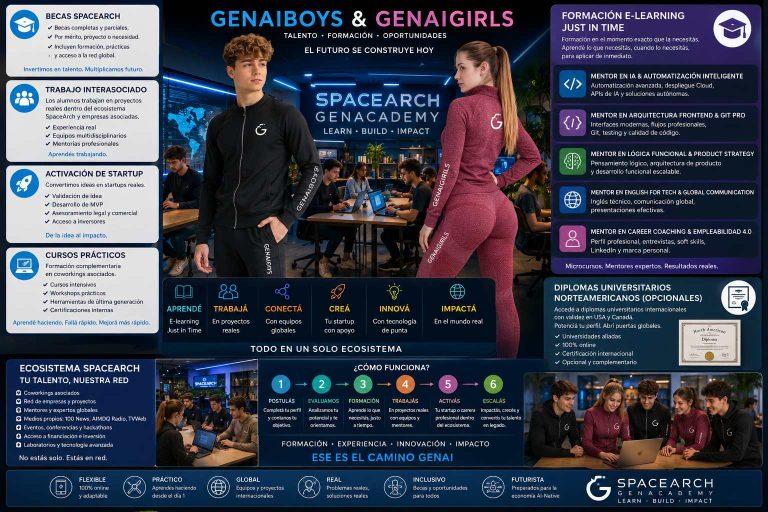
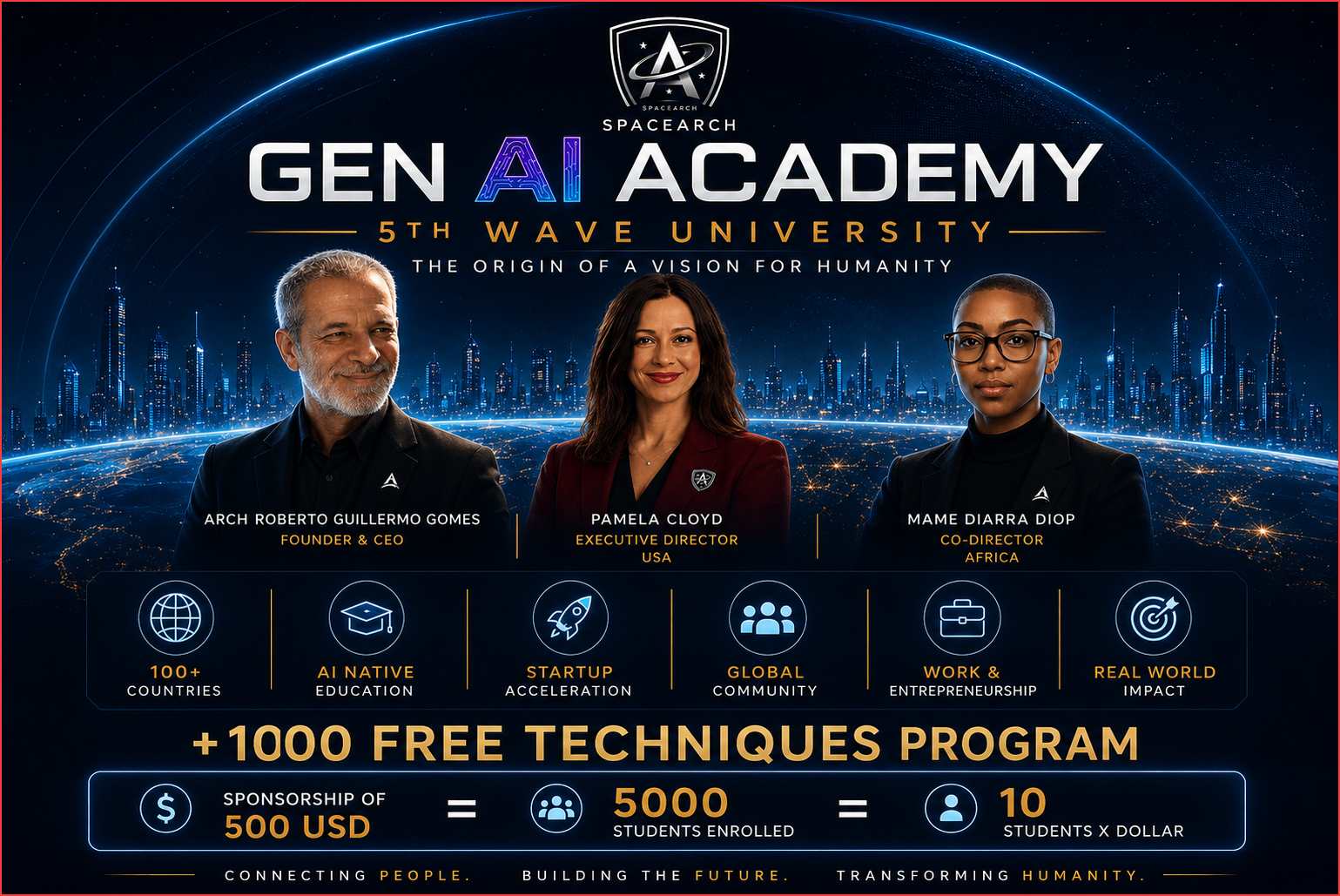
A través de GenAI Academy, SpaceArch ha anunciado un programa de 5.000 millones de becas destinadas a la formación masiva de capital humano AI-Native.
El programa contempla:
- Una beca por alumno.
- Acceso gratuito a la formación teórica.
- Programas prácticos de apoyo.
- Certificación.
- Posibilidad de empleo interasociado.
- Precalificación para la activación de startups propias.
- Integración con coworkings asociados.
- Apoyo operativo desde el ecosistema SpaceArch.
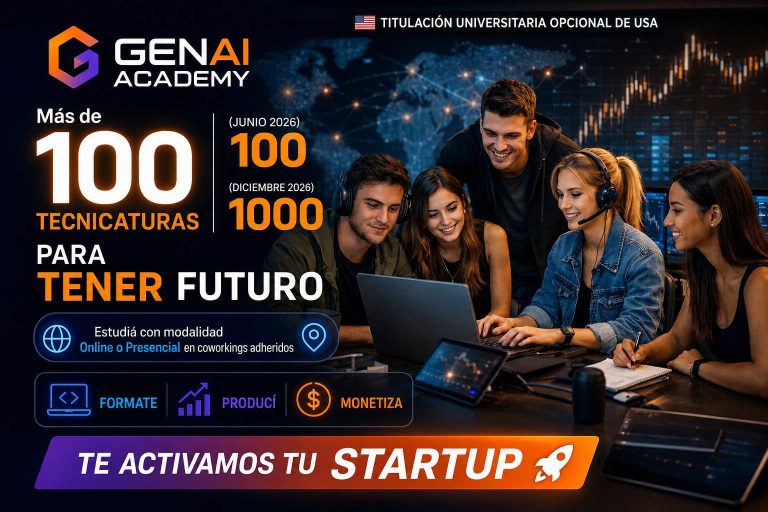
La primera fase contempla el desarrollo de 100 cursos iniciales, mientras que la organización ya dispone de material y planificación para la expansión hacia más de 1.000 cursos especializados.
Posible estructura de la ronda
La ronda actualmente en estudio tendría como objetivo captar hasta USD 100 millones para acelerar el despliegue global del sistema.
Los fondos podrían destinarse a:
- Producción de contenidos educativos.
- Infraestructura cloud.
- Desarrollo tecnológico.
- Marketing global.
- Plataformas de gestión académica.
- CRM.
- Automatización.
- Producción audiovisual.
- Sistemas de reporting.
- Operación de programas piloto en ciudades iniciales.
Entre las primeras ciudades consideradas para los programas piloto se encuentran Mar del Plata (Argentina) y Denver (Estados Unidos), comenzando con 10.000 becas por ciudad y posteriormente escalando a 100.000 becas.
Modelo económico
El sistema busca combinar impacto social y sostenibilidad económica.
La formación teórica se ofrece mediante becas.
Los programas prácticos, certificaciones, coworkings asociados, publicidad integrada, sponsors, eventos, medios digitales y futuras unidades de negocio del ecosistema constituyen las principales fuentes de ingresos proyectadas para sostener la operación.
La expansión del programa generaría simultáneamente:
- Formación de capital humano.
- Nuevas audiencias.
- Inventario publicitario.
- Activación de comunidades.
- Oportunidades laborales.
- Creación de startups.
- Desarrollo de ecosistemas locales.
Participación de inversores
Como parte del análisis actualmente en curso, SpaceArch estudia mecanismos de coparticipación económica que permitan alinear los intereses de la organización y de los potenciales inversores estratégicos.
Las alternativas evaluadas incluyen modelos vinculados a:
- Participación en beneficios.
- Participación en unidades de negocio específicas.
- Sistemas tokenizados de seguimiento.
- Reportes periódicos de desempeño.
- Participación accionaria limitada.
La estructura definitiva, en caso de implementarse, será comunicada oportunamente y estará sujeta a revisión legal, regulatoria y contractual.
Convocatoria abierta
SpaceArch también invita a universidades, academias, institutos, fundaciones y organizaciones educativas de todo el mundo a sumarse al programa.
La propuesta es simple:
Aportar al menos un curso online con beca al 100%.
Una institución.
Un curso.
Millones de oportunidades creadas de manera cooperativa.
Una nueva discusión
Más allá de la posible ronda de inversión, SpaceArch busca instalar una pregunta estratégica en el debate global:
¿La inversión en formación AI-Native debería crecer al mismo ritmo que la inversión en Inteligencia Artificial?
Si la respuesta es afirmativa, la educación podría convertirse en una de las mayores oportunidades de desarrollo económico y social de la próxima década.
El sistema también se encuentra abierto a acuerdos de capacitación institucional.
Empresas, gobiernos, municipios, universidades, cámaras empresariales, fundaciones y organizaciones podrán incorporar programas completos de formación AI-Native para sus equipos, colaboradores, estudiantes o ciudadanos, financiando becas colectivas adaptadas a sus necesidades.
La plataforma dispone actualmente de más de 100 cursos iniciales y una hoja de ruta superior a 1.000 cursos especializados, permitiendo construir programas personalizados de capacitación, reconversión laboral, actualización profesional y transformación organizacional.
De esta forma, las organizaciones no solo contribuyen al desarrollo del capital humano, sino que aceleran su propia adaptación a la economía AI-Native.
Arch. Roberto Guillermo Gomes
CEO
SpaceArch Solutions International LLC
Miami, Florida, USA
SpaceArch Studies the Launch of a USD 100 Million Tokenized Micro-Investment Round to Support Its Global Program of 5 Billion AI-Native Scholarships
Institutional Statement
SpaceArch Solutions International LLC announces that it is currently evaluating the potential launch of a tokenized micro-investment round aimed at financing the technological, educational, and operational infrastructure required to develop its Global Program of 5 Billion AI-Native Scholarships through GenAI Academy.
The initiative originates from a fundamental question:
If the world is investing trillions of dollars in Artificial Intelligence, who will finance the education of the billions of people who will need to learn how to use it?
Over the past few years, most global investment has been concentrated in AI models, data centers, cloud infrastructure, GPUs, and technology platforms.
However, SpaceArch believes that the primary bottleneck of the next decade may not be technological, but human:
the availability of AI-Native operators, AI-Native entrepreneurs, AI-Native journalists, AI-Native designers, AI-Native consultants, and leaders capable of working productively alongside artificial intelligence systems.
The Global Scholarship Program
Through GenAI Academy, SpaceArch has announced a program of 5 billion AI-Native scholarships aimed at the large-scale development of AI-native human capital.
The program includes:
- One scholarship per student.
- Free access to theoretical training.
- Practical support programs.
- Certification pathways.
- Inter-associated employment opportunities.
- Pre-qualification for startup activation.
- Integration with partner coworking spaces.
- Operational support from the SpaceArch ecosystem.
The first phase includes the deployment of 100 initial courses, while the organization already possesses content, planning, and development capacity for more than 1,000 specialized courses.
Proposed Structure of the Round
The round currently under evaluation would seek to raise up to USD 100 million to accelerate the global deployment of the system.
Potential use of funds includes:
- Educational content production.
- Cloud infrastructure.
- Technology development.
- Global marketing.
- Academic management platforms.
- CRM systems.
- Automation infrastructure.
- Multimedia production.
- Reporting systems.
- Pilot program operations.
The initial pilot cities under consideration are Mar del Plata (Argentina) and Denver (United States), beginning with 10,000 scholarships per city and later scaling to 100,000 scholarships per city.
Economic Model
The system seeks to combine social impact with economic sustainability.
Theoretical education is delivered through scholarships.
Practical programs, certifications, associated coworkings, integrated advertising, sponsorships, events, digital media, and future ecosystem business units represent the primary projected revenue sources supporting the operation.
As the program expands, it is expected to simultaneously generate:
- Human capital development.
- New audiences.
- Advertising inventory.
- Community activation.
- Employment opportunities.
- Startup creation.
- Local ecosystem development.
Investor Participation
As part of the ongoing evaluation process, SpaceArch is studying economic participation mechanisms designed to align the interests of the organization and potential strategic investors.
The alternatives currently being analyzed include structures related to:
- Profit-sharing participation.
- Participation in specific business units.
- Tokenized tracking systems.
- Periodic performance reporting.
- Limited equity participation.
Any final structure, if implemented, will be communicated at a later stage and will remain subject to legal, regulatory, financial, and contractual review.
Open Invitation
SpaceArch also invites universities, academies, educational institutions, foundations, and training organizations worldwide to join the program.
The proposal is simple:
Contribute at least one online course offered with a 100% scholarship.
One institution.
One course.
Millions of opportunities created together.
A New Discussion
Beyond the potential investment round itself, SpaceArch seeks to introduce a broader strategic question into the global conversation:
Should investment in AI-Native education grow at the same pace as investment in Artificial Intelligence itself?
If the answer is yes, education may become one of the greatest economic and social development opportunities of the coming decade.
Institutional Training Programs and Strategic Partnerships
The system is also open to institutional training partnerships.
Companies, governments, municipalities, universities, chambers of commerce, foundations, NGOs, and other organizations may adopt complete AI-Native training programs for their employees, students, members, citizens, or beneficiaries through customized scholarship initiatives.
Examples include:
- A municipality sponsoring scholarships for local youth.
- A provincial or regional government funding workforce upskilling programs.
- A corporation providing AI-Native training to its entire staff.
- A chamber of commerce supporting digital transformation for member companies.
- A university incorporating AI-Native technical programs as complementary education.
- A foundation financing educational opportunities for underserved communities.
GenAI Academy currently includes an initial portfolio of more than 100 courses and a development roadmap exceeding 1,000 specialized courses, allowing organizations to create tailored training pathways focused on:
- AI-Native workforce development.
- Professional reskilling and upskilling.
- Digital transformation.
- Entrepreneurship.
- Agentic AI operations.
- Leadership and management.
- Media and content production.
- Technology and innovation.
- Startup creation and ecosystem participation.
Through this model, organizations do not simply sponsor education.
They invest directly in the development of human capital while accelerating their own adaptation to the emerging AI-Native economy.
The objective is to create a collaborative global framework where public institutions, private companies, educational organizations, foundations, investors, coworkings, media networks, and local communities can work together to expand access to AI-Native education at unprecedented scale.
Arch. Roberto Guillermo Gomes
CEO
SpaceArch Solutions International LLC
Miami, Florida, USA