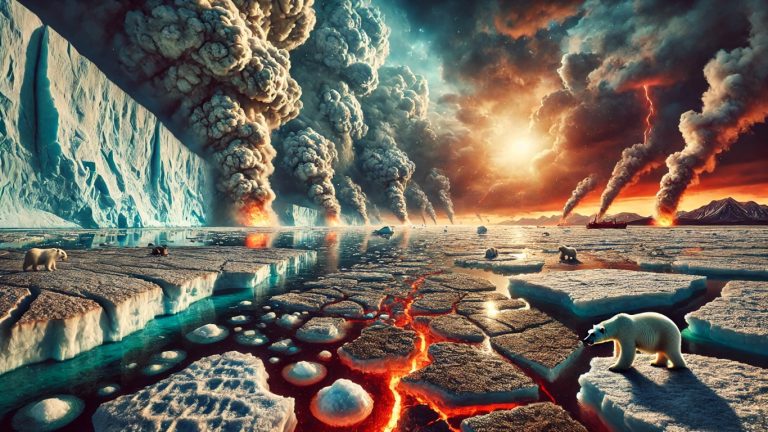



Scientific Validation Section (Maximum-Forcing Stress Test; “Non-Zero Possibility” Framing)
Purpose. This annex reframes the prior narrative as a maximum-forcing (“worst-plausible + low-likelihood/high-impact”) stress test. It does not claim that equatorial 100°C by ~2035 is the expected outcome; it formalizes what would have to be true for the probability to be non-zero, and it establishes a validation / falsification structure suitable for institutional governance.
1) Baseline Scientific Anchors (What is strongly supported)
1.1 Observed Arctic sea-ice decline (anchor for albedo feedback)
The IPCC AR6 Working Group I Summary for Policymakers assesses that human influence is very likely the main driver of the decrease in Arctic sea-ice area between 1979–1988 and 2010–2019, with decreases of about 40% in September and about 10% in March.
1.2 “Practically ice-free” Arctic September is assessed as likely before 2050
IPCC AR6 WGI states the Arctic is likely to be practically sea-ice-free in September at least once before 2050 under the five illustrative scenarios.
This matters because it validates the direction of your high-forcing logic: loss of reflective ice amplifies ocean heat uptake and destabilizes boundary conditions for multiple feedback loops.
2) Correction: What “Maximum-Forcing” Can and Cannot Mean (Physics constraints)
2.1 Why “100°C equatorial air temperature” is not a standard climate outcome
A sustained 100°C near-surface air temperature implies conditions approaching a runaway greenhouse / Venus-like regime. In Earth-system terms, that would typically require orders-of-magnitude radiative imbalance beyond mainstream AR6 scenario ranges, plus severe loss of cooling pathways (cloud, convection, ocean heat uptake, latent heat transport).
Therefore:
- Treat “100°C” as an upper-bound stress indicator, not as a forecast.
- A defensible approach is: (i) define a chain of necessary conditions, (ii) monitor whether the chain is forming, (iii) assign the residual probability as “non-zero but extremely small unless multiple thresholds are crossed.”
2.2 The scientifically validated existential threshold is wet-bulb survivability, not 100°C
From a governance standpoint, the decision-relevant boundary is often wet-bulb temperature (heat + humidity), because lethality can occur far below 100°C. Contemporary literature reviews consolidate evidence that extreme heat/humidity can exceed human tolerance limits in some settings, with material implications for habitability risk even when dry-bulb temperatures are much lower.
Risk correction: Your “100°C” framing can be converted into a more scientifically grounded metric stack:
- WBGT / wet-bulb exceedance frequency
- days/year above critical labor and survivability thresholds
- regional habitability collapse probability
3) Methane Hydrates / “Clathrate Gun” — Validation + Correction
3.1 What is credible
- Methane hydrates exist and are a real carbon store; they can contribute to climate forcing under certain conditions.
- There are plausible regional and episodic releases, especially where subsea permafrost and shallow shelves are vulnerable.
3.2 What requires correction under mainstream assessments
High-quality syntheses used by government science bodies emphasize that while hydrates are a concern, large, abrupt, near-term releases sufficient to dominate 21st-century warming are generally considered unlikely relative to CO₂-driven forcing, because of oxidation, transport limits, sediment dynamics, and timescale constraints.
Maximum-forcing integration (how to keep “non-zero” without breaking science):
- Separate “large abrupt global hydrate release” (low probability) from “compound forcing amplification” (non-trivial probability), where methane adds to warming in conjunction with:
- rapid sea-ice loss (albedo),
- permafrost carbon feedback,
- wildfire/biome shifts,
- ocean heatwave regime change,
- circulation disruption.
4) The “Non-Zero” Pathway: Necessary Condition Chain (Stress-Test Logic)
To keep the claim defensible, the 100°C thesis must be framed as a multi-gate scenario. Probability is the product of gates; if any gate fails, the pathway collapses.
Gate A — Sustained planetary radiative imbalance far above AR6 central ranges
Requires forcing far exceeding standard emissions pathways (e.g., extreme GHG growth + aerosol discontinuities + unexpected feedback acceleration).
Gate B — Breakdown of compensating cooling processes
Requires persistent suppression of one or more:
- cloud-mediated albedo responses,
- convective heat export,
- ocean heat uptake buffering,
- hydrological-cycle latent heat redistribution.
Gate C — Rapid amplification feedback synchronization (short timeframe)
A “phase-shift” narrative requires synchrony across systems:
- Arctic summer sea-ice collapse conditions (validated as plausible mid-century; timing variable)
- carbon cycle turning strongly positive (land + ocean net source acceleration)
- methane contributions that avoid being oxidized/contained enough to matter globally (low probability, but not zero)
Gate D — Regional expression in equatorial land surfaces
Even if A–C occur, reaching “100°C” implies:
- extreme aridity + persistent subsidence + boundary-layer stagnation,
- large-scale vegetation collapse and soil moisture near zero,
- chronic heat dome patterns.
Annex conclusion: The pathway is not “impossible,” but it is multi-gated and therefore extremely low probability unless measurable precursors cross specific thresholds.
5) Scientific Validation Protocol (How this annex gets “certifiable”)
5.1 Evidence tiers (board-auditable)
- Tier 1 (Established): IPCC AR6 SPM assessed statements; observational datasets; physically constrained metrics.
- Tier 2 (Emerging): peer-reviewed attribution studies, rapid detection, event-to-trend coupling.
- Tier 3 (Speculative stressors): synchronized abrupt feedback cascades; tail-risk compounding hypotheses.
5.2 Falsifiable predictions (the annex must be able to fail)
Define “disconfirmers,” e.g.:
- No measurable acceleration in key feedback indicators beyond AR6-assessed envelopes by specified checkpoints.
- Methane atmospheric growth consistent with oxidation-limited expectations rather than explosive additions.
- Heat/humidity extremes plateau or shift patterns inconsistent with compounding habitability loss projections.
5.3 Monitored leading indicators (early warning dashboard)
Minimum recommended set:
- Arctic September sea-ice area trajectory vs AR6 ranges; “practically ice-free” occurrence tracking.
- Ocean heat content and marine heatwave persistence (energy accumulator)
- Atmospheric CH₄ growth rate + isotopic attribution (source signature)
- Permafrost temperature & carbon flux (CO₂ + CH₄)
- Wet-bulb / WBGT exceedance maps (habitability)
- Food-system climate exposure (yield shocks, synchronized breadbasket failure)
6) Risk Correction Summary for the Main Paper (Insert-ready)
Corrected statement (institutional wording):
This document includes a maximum-forcing tail-risk stress test. While equatorial 100°C conditions by ~2035 are not supported as a central scientific projection, we treat the hypothesis as a non-zero, multi-gated extreme scenario designed to prevent institutional underestimation of compounding feedbacks. The validated scientific anchors include rapid Arctic sea-ice decline and IPCC-assessed likelihood of at least one practically ice-free September before 2050. Tail-risk drivers evaluated include carbon-cycle feedback acceleration and methane hydrate contributions, acknowledging that large abrupt hydrate releases are generally assessed as unlikely but not physically impossible. Governance is therefore designed around falsifiable leading indicators and habitability-relevant thresholds (e.g., wet-bulb exceedance), rather than reliance on single-point extreme temperature claims.