





Intelligent Maritime Trade Alignment Powered by Predictive Analytics
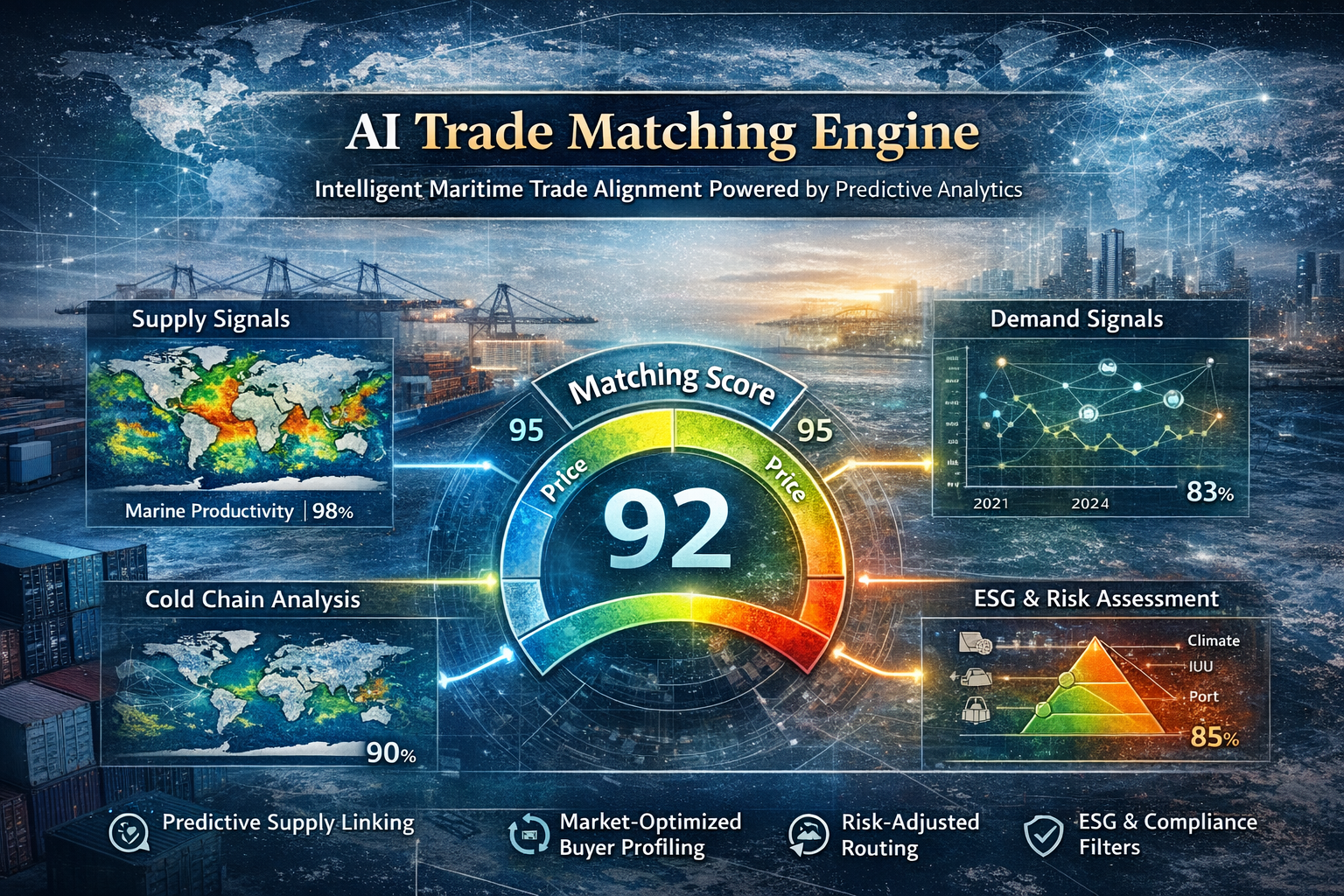
The AI Trade Matching Engine (ATME) is a proprietary, data-driven system designed to connect verified supply and demand across the global seafood and marine trade ecosystem.
It integrates:
- Geo-Marine Production Mapping
- Marine Productivity Index (MPI)
- Supply–Demand Analytics
- Price Index & Forecasting
- Port & Cold Chain Intelligence
- ESG & Sustainability Filters
The result is not a marketplace.
It is an intelligent trade orchestration platform.
1. Strategic Purpose
Traditional seafood trade relies on:
- Manual broker networks
- Fragmented market signals
- Delayed price transparency
- Limited climate visibility
- Reactive logistics coordination
The AI Trade Matching Engine replaces this with:
- Predictive supply visibility
- Forward demand profiling
- Risk-adjusted trade pairing
- Infrastructure-aware routing
- Climate-adjusted yield forecasting
It transforms seafood commerce into a structured, algorithmic matching system.
2. System Architecture Overview
A. Data Inputs
Supply-Side Intelligence
- MPI productivity signals
- Verified producer data
- Expected landings forecast
- Seasonal biomass outlook
- Certification & compliance data
- Processing capacity availability
Demand-Side Intelligence
- Importer profiles
- Historical volume patterns
- Price tolerance bands
- Product specifications
- Sustainability requirements
- Market seasonality cycles
Trade & Logistics Layer
- Port congestion levels
- Cold chain corridor capacity
- Freight rates
- Transit time modeling
- Risk-adjusted routing scenarios
Financial & Risk Layer
- Climate exposure score
- Political risk overlays
- Insurance signals
- Currency volatility index
- ESG compliance filters
3. Core Functional Modules
I. Smart Supply Aggregation
The engine clusters producers by:
- Species
- Volume capability
- Quality tier
- Certification level
- Delivery window reliability
Supply is dynamically re-ranked based on:
- Real-time MPI signals
- Forecast volatility
- Climate stress penalties
II. Intelligent Demand Profiling
Each buyer is algorithmically profiled using:
- Purchase history
- Price sensitivity modeling
- Quality specifications
- Sustainability thresholds
- Contract structure preference
The system generates a Buyer Intelligence Score (BIS) that optimizes compatibility with suppliers.
III. AI Matching Algorithm
Matching occurs across five weighted layers:
- Volume Compatibility
- Price Band Alignment
- Certification & ESG Match
- Logistics Feasibility
- Climate Risk Compatibility
The matching score is computed as:MatchScore=wvV+wpP+weE+wlL+wcC
Where:
- V = volume compatibility score
- P = price alignment score
- E = ESG/certification alignment
- L = logistics optimization score
- C = climate-adjusted risk compatibility
Weights are configurable per institutional user.
IV. Predictive Trade Windows
The system identifies optimal trading windows based on:
- MPI trend acceleration
- Price forecast momentum
- Cold chain availability
- Seasonal demand spikes
This enables:
- Pre-contract structuring
- Forward agreements
- Supply stabilization strategies
V. Risk-Adjusted Trade Routing
For each potential match, the engine calculates:
- Port stress level
- Cold storage capacity index
- Transit risk
- Insurance cost impact
- Delay probability
The result is a Trade Stability Index (TSI).
4. Institutional Use Cases
For Governments
- Stabilize national fisheries revenue
- Prevent oversupply collapse
- Align export strategy with productivity signals
- Reduce IUU exposure
- Support quota calibration
For Sovereign Funds & ESG Investors
- Identify resilient marine trade corridors
- Allocate capital to low-volatility zones
- De-risk aquaculture expansion
- Monitor climate-adjusted productivity signals
For Port Authorities
- Forecast trade throughput
- Plan infrastructure upgrades
- Optimize berth and cold storage allocation
- Identify emerging maritime hubs
For Large Seafood Corporations
- Diversify sourcing regions
- Reduce procurement volatility
- Align sustainability commitments
- Enhance margin predictability
5. AI & Machine Learning Framework
The engine uses:
- Multi-factor ranking algorithms
- Gradient boosting regression for price sensitivity
- Bayesian adjustment for productivity forecast uncertainty
- Anomaly detection for trade disruption signals
- Reinforcement learning to improve match efficiency over time
Each transaction feedback loop improves model precision.
6. Sustainability Integration
Unlike traditional B2B platforms, ATME embeds sustainability as a core variable.
Matching can be filtered by:
- Certified sustainable fisheries
- Low climate stress zones
- Traceability requirements
- Low-carbon logistics corridors
Sustainability is not an add-on.
It is part of the matching algorithm.
7. Governance & Transparency Layer
For institutional clients:
- Full audit trail
- Explainable AI scoring
- Data lineage documentation
- Conflict-of-interest safeguards
- Compliance-ready reporting
The system can generate:
- Government-level export dashboards
- ESG compliance reports
- Trade risk memorandums
- Institutional briefing packs
8. Competitive Differentiation
Most seafood trade platforms provide:
- Listings
- Manual negotiation
- Price discovery
- Basic logistics info
AI Trade Matching Engine provides:
- Predictive alignment
- Climate-adjusted trade intelligence
- Infrastructure-aware routing
- Risk-scored trade structuring
- Institutional-grade analytics
It converts trade from transactional brokerage to structured intelligence.
9. Strategic Vision
The AI Trade Matching Engine becomes the operational core of the PortsFish ecosystem:
Ocean Intelligence →
Supply Forecast →
Demand Profiling →
AI Matching →
Risk-Adjusted Trade →
Infrastructure Optimization →
Sustainable Revenue Stability
It transforms marine commerce into a climate-aware, data-driven system.
Matching Algorithm — Technical Annex (PortsFish.Agency)
AI Trade Matching Engine (ATME) | v1.0 Spec (Institutional-Grade)
0) Scope & Objective
The Matching Algorithm ranks and selects optimal buyer–seller–route–contract bundles under multi-constraint conditions:
- Product/spec compatibility
- Volume and delivery-window feasibility
- Price alignment and margin protection
- Cold-chain/port capacity & transit constraints
- Climate and disruption risk
- Compliance/ESG requirements
- Credit/settlement constraints (optional)
The output is an explainable list of candidate matches with auditable scoring, uncertainty bands, and recommended contract structures.
1) Data Model (Canonical Entities)
1.1 Seller / Supply Lot (S)
A supply offer is represented as a set of lots:
seller_idspecies(FAO ASFIS / HS mapping)product_form(whole, H&G, fillet, block, etc.)grade(A/B/C; size ranges)certifications(MSC, ASC, BAP, etc.)origin_zone(FAO area, EEZ, port of landing)available_volumeVs (tons)delivery_window[ts,start,ts,end]packaging/temp_requirementsmin_order/lot_sizeask_pricePs (CIF/FOB terms)reliability_scoreRs (historical on-time, QC pass rate)traceability_level(0–3)
1.2 Buyer / Demand Request (B)
buyer_idspecies,product_form,grade,size_bandrequired_volumeVbdelivery_window[tb,start,tb,end]target_price_band[Pb,low,Pb,high]incotermspreferencecertification_required(bool + list)market(destination country/city)payment_terms(LC, OA, escrow)buyer_reliabilityRb (settlement history)
1.3 Route / Logistics Option (L)
For each (seller port → buyer destination), candidate routes are enumerated:
route_idport_origin,port_dest, transshipment nodesmode(sea/air/road last mile)transit_timeTlcold_chain_capacity_indexCl (0–1)port_congestion_indexGl (0–1)freight_costFldelay_probDlcarbon_intensityCO2l (optional)
1.4 Contract Structure Option (K) (Optional Module)
Templates:
- Spot, Forward, Framework, Volume-flex
- Price: fixed, indexed, collar, cost-plus
- Quality claims, penalty clauses, force majeure, insurance clauses
2) Problem Definition
We seek to maximize the expected utility of a match bundle:x=(s,b,l,k)
subject to constraints:
- Volume feasibility
- Spec compliance
- Time-window feasibility
- Certification/ESG constraints
- Logistics capacity & cold chain constraints
- Risk thresholds (climate, delay, political, IUU)
- Credit/settlement constraints (if enabled)
3) Pre-Processing & Candidate Generation
3.1 Hard Filters (Mandatory)
A seller lot s is eligible for buyer b only if:
Spec match (exact or tolerance):
- species match (or allowed substitutions list)
- product_form compatible
- grade ≥ minimum
- size_band within tolerance
Certification constraint:
- if buyer requires certification → seller must hold it
Volume:Vs≥θv⋅Vborallow split if enabled
Time-window overlap:[ts,start,ts,end]∩[tb,start,tb,end]=∅
and route transit feasibility:tship+Tl≤tb,end
Cold-chain requirement:
- route must meet temperature constraints + minimum capacity index.
3.2 Candidate Set
For each demand b, generate:
- Top-N eligible sellers by proximity + historical relevance
- For each seller, enumerate Top-M routes
- For each (s,b,l), optionally enumerate contract templates K
Result: candidate bundles Xb.
4) Scoring Model (Explainable Multi-Factor)
We compute a MatchScore in [0,100] using weighted sub-scores in [0,1].MatchScore(x)=100⋅j∑wjSj(x),j∑wj=1
4.1 Sub-scores
A) Spec Compatibility Score Sspec
Binary or graded:
- exact match → 1
- near match within tolerance → 0.7–0.95
- substitution allowed → 0.6–0.85
- else filtered out
B) Volume Compatibility Svol
Svol=min(1,VbVs)
If split-fulfillment allowed: S_{vol} = f(\text{coverage ratio}, \text{#splits penalty})
C) Time Window Feasibility Stime
Let slack be:Δt=tb,end−(tship+Tl) Stime=σ(a(Δt−b))
(sigmoid; rewards positive slack, penalizes tight windows)
D) Price Alignment Sprice
Let expected delivered price:Pdel=Ps+Fl+fees+insurance
If buyer band:Sprice={1exp(−η⋅δ)Pdel∈[Pb,low,Pb,high]otherwise
where δ is distance from nearest bound.
E) Reliability & Execution Srel
Srel=Rs⋅Rb⋅(1−Dl)
where Dl is route delay probability.
F) Logistics Quality Slog
Slog=αcCl+αg(1−Gl)+αtnorm(1/Tl)
G) ESG / Compliance Score Sesg
Composite:
- certification match
- traceability level
- IUU risk penalty
Sesg=min(1,CertMatch)⋅TraceLevel−ϕ⋅IUUrisk
H) Climate / Supply Risk Compatibility Sclim
Uses seller-region risk signals (MPI volatility, stress penalty, disruption index):Sclim=1−Riskclimate(origin,t)
where Riskclimate∈[0,1] derived from your Ocean Intelligence layer.
5) Risk-Adjusted Utility (Institutional Layer)
To make it “bankable,” we compute Expected Utility and risk bands.
5.1 Expected Margin (Optional)
Margin=Psell_to_buyer−Pdel
or if buyer is end-user, use market price forecast.
5.2 Risk Aggregation
Define:
- rdelay=Dl
- rclimate=Riskclimate
- rpolitical (optional)
- rfx (optional)
- rquality (historical QC fail rate)
Total risk:R=1−i∏(1−ri)
(or weighted sum if preferred)
5.3 Risk-Adjusted Score
RAS(x)=MatchScore(x)⋅(1−λR)
Where λ is an institutional risk aversion parameter.
6) Optimization & Assignment (When Multiple Matches Compete)
When there are multiple buyers and sellers, we solve an assignment problem:
6.1 Bipartite Matching (Simplified)
Maximize:maxs,b∑RAS(s,b)⋅ys,b
Subject to:
- Seller capacity:
b∑Vs→b≤Vs
- Buyer demand:
s∑Vs→b≥Vb
- Optional: limit number of splits.
This can be solved via:
- linear programming (LP)
- min-cost max-flow
- greedy + local search for fast near-real-time
6.2 Split-Fulfillment Penalty
If multiple sellers satisfy one buyer:Penaltysplit=κ⋅(nsplits−1)
applied to RAS.
7) Explainability & Audit Trail
Each recommended match includes a “scorecard”:
- Spec: 0.92
- Volume: 1.00
- Time: 0.74
- Price: 0.88
- Logistics: 0.81
- ESG: 1.00
- Climate: 0.67
- Final: 82.4 / RiskAdj: 74.9
Plus:
- data versions:
feature_set,route_table_version,model_version - rationale: top 3 contributors, top risk drivers
- uncertainty band: ± (based on forecast variance)
8) Model Calibration & Learning Loop
8.1 Feedback Events
- accepted / rejected match
- delivered on-time?
- QC pass/fail
- final price deviation
- dispute incidence
- buyer satisfaction rating
8.2 Updating
- weight tuning per market/region
- Bayesian updates for reliability scores
- route delay probability refinement
- drift detection (climate regime shifts)
9) Institutional Controls (Governance)
- Role-based access control (RBAC)
- Conflict-of-interest rule engine
- Bias controls: prevent “overfitting to incumbent buyers”
- Compliance logs for government/regulator audits
- Optional on-prem / sovereign cloud deployments
10) Baseline Weights (v1.0 Suggested)
For general trade optimization:
- wspec=0.18
- wvol=0.10
- wtime=0.12
- wprice=0.16
- wrel=0.12
- wlog=0.12
- wesg=0.10
- wclim=0.10
For institutional ESG mandates:
- increase wesg and wclim, reduce wprice.