





Primary-Origin Seafood • First-Chain Access • Transparent Supply Flow
1. Concept Definition
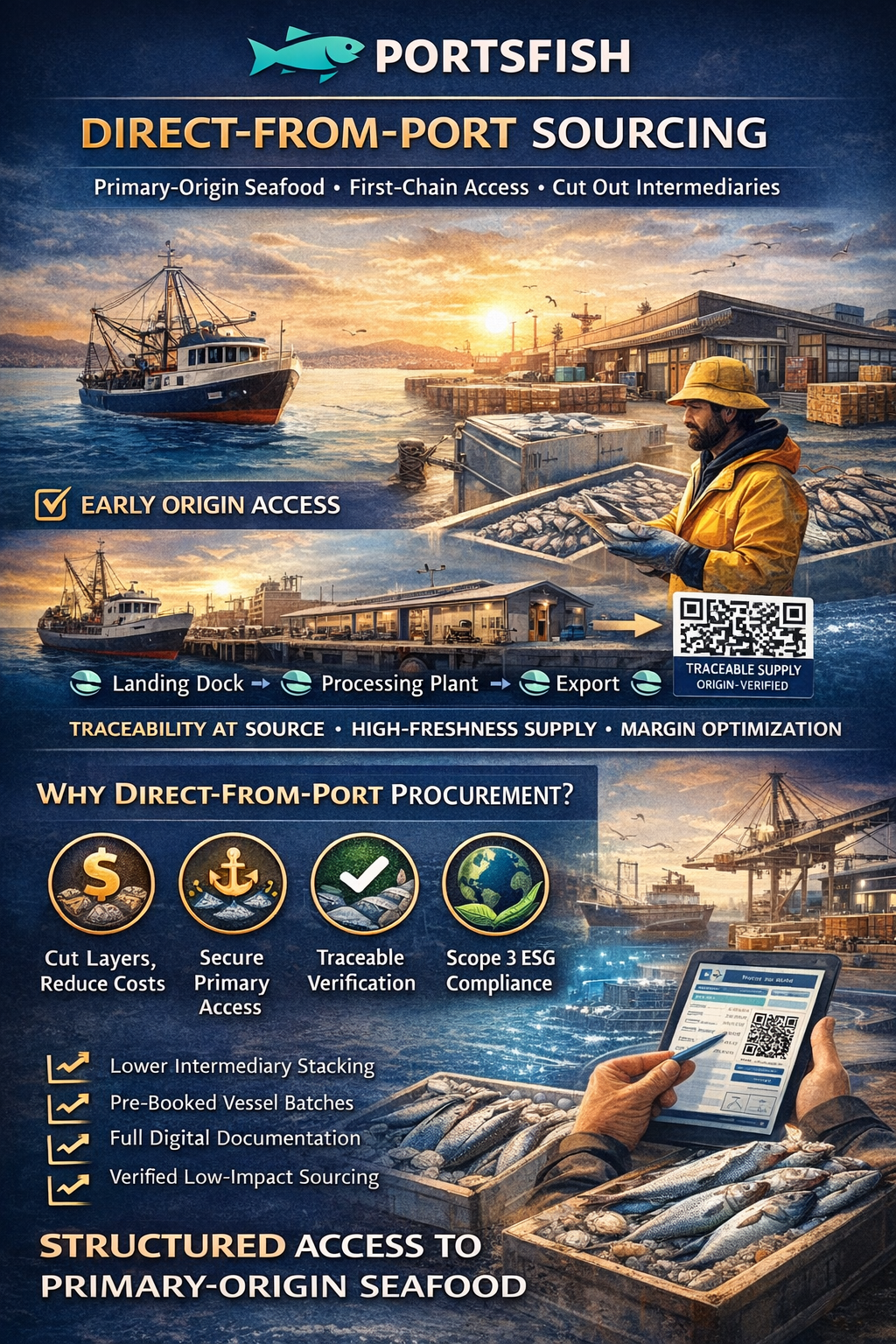
Direct-from-Port Sourcing refers to seafood procured directly at the point of landing — immediately after harvest and prior to multiple intermediary layers.
Portsfish connects buyers to:
- Fishing vessels
- Port landing facilities
- First-sale auctions
- Processing plants located within port zones
This model reduces supply chain distortion, improves freshness, enhances traceability, and increases margin transparency.
2. What “Direct-from-Port” Means in Practice
Direct-from-Port Sourcing ensures:
✔ Access at the first commercial transaction
✔ Verified landing documentation
✔ Immediate cold-chain activation
✔ Reduced intermediary markups
✔ Greater batch traceability
✔ Faster export preparation
It positions Portsfish at the origin point of value creation, not downstream aggregation.
3. Structural Advantages
1. Freshness Optimization
Seafood quality is directly linked to time from harvest.
Direct-from-Port sourcing reduces:
- Transit delays
- Handling steps
- Quality degradation
This results in:
- Better texture and flavor retention
- Longer shelf life
- Higher premium market suitability
2. Cost Efficiency Through Intermediary Reduction
Traditional seafood trade layers:
Vessel → Port Broker → Local Aggregator → Regional Trader → Export Broker → Importer
Direct-from-Port model:
Vessel → Portsfish Verified Channel → Buyer
This reduces:
- Margin stacking
- Price volatility
- Supply opacity
Buyers gain improved pricing clarity and competitive advantage.
3. Traceability Strength
By sourcing at port:
- Vessel ID is captured at landing
- Catch zone is recorded
- Timestamp is documented
- Handling chain begins with digital registration
This creates a stronger foundation for:
- ESG reporting
- Anti-IUU compliance
- Sustainability verification
- Audit-readiness
4. Integration with Sustainability Standards
Direct-from-Port Sourcing integrates seamlessly with:
- MSC-certified fisheries
- ASC-certified aquaculture
- Traceable batch systems
- ESG reporting modules
Early capture of origin data improves:
- Carbon footprint modeling
- Biodiversity compliance
- Governance transparency
5. Operational Framework
Port-Level Infrastructure
Portsfish operates through:
• Port landing partnerships
• Verified cold storage access
• Local inspection protocols
• Digital documentation upload
• Export compliance coordination
Each shipment is assigned a digital origin file including:
- Vessel information
- Harvest zone
- Landing time
- Processing facility
- Export clearance
6. Risk Mitigation Benefits
Direct sourcing reduces exposure to:
- Mislabeling
- Origin fraud
- Product substitution
- Quality uncertainty
- IUU fishing contamination
For institutional buyers, this translates into:
- Reduced regulatory risk
- Lower compliance costs
- Stronger brand protection
7. Financial & Commercial Impact
Direct-from-Port Sourcing enables:
• More predictable cost structures
• Premium-grade quality positioning
• Faster procurement cycles
• Long-term supply agreements
• Improved working capital efficiency
It also supports:
- Volume-based contracts
- Dedicated vessel allocation
- Seasonal planning agreements
8. Strategic Positioning of Portsfish
Portsfish is not a broker layer.
It is a primary origin access platform.
This creates:
- Supply chain control at source
- Differentiation from commodity traders
- Institutional credibility
- Sustainable competitive positioning
9. Advanced Digital Layer (Future Integration)
Optional future features may include:
• Real-time port landing notifications
• Live vessel tracking integration
• Blockchain landing registration
• Smart-contract batch allocation
• Buyer pre-booking at landing
This elevates Portsfish into a digitally integrated primary seafood infrastructure platform.
10. Strategic Summary
Direct-from-Port Sourcing provides:
✔ Quality
✔ Transparency
✔ Cost efficiency
✔ Traceability
✔ ESG compatibility
✔ Institutional scalability
It anchors Portsfish at the source of marine value creation.
Excellent.
Below is a complete integrated mix including:
- Buyer One-Page Pitch
- Port Onboarding Protocol
- Margin Simulation Scenarios
- Integrated Strategic Positioning
Structured in institutional-grade format.
I. BUYER ONE-PAGE PITCH
Portsfish – Direct-from-Port Sourcing
Primary-Origin Seafood Infrastructure
Executive Summary
Portsfish provides direct access to seafood at the port of landing — eliminating unnecessary intermediaries and securing traceable, high-freshness supply at origin.
This model delivers:
✔ Cost efficiency
✔ Traceability at source
✔ ESG compatibility
✔ Reduced regulatory risk
✔ Premium-grade freshness
We do not operate as a downstream trader.
We operate at the first commercial transaction point.
The Problem in Traditional Seafood Trade
Conventional supply chain:
Vessel → Broker → Aggregator → Regional Trader → Export Broker → Importer → Distributor
Results:
• Margin stacking
• Reduced freshness
• Supply opacity
• Compliance risk
• Limited traceability
The Portsfish Direct Model
Vessel → Verified Port Landing → Portsfish Digital Registration → Buyer Allocation
Benefits:
• Early origin capture
• Lower margin layering
• Stronger documentation
• Controlled cold chain
• Faster export flow
What Buyers Gain
1. Price Efficiency
Reduced intermediary stacking (5–15% margin optimization potential).
2. Freshness Advantage
Shorter chain = longer shelf life = premium positioning.
3. Compliance Strength
Port-level documentation strengthens:
- ESG reporting
- Anti-IUU compliance
- Audit readiness
4. Supply Security
Port-based relationships allow:
- Dedicated vessel allocation
- Pre-booked landing volumes
- Seasonal planning
Designed For
• Retail chains
• Institutional importers
• Food service distributors
• ESG-aligned buyers
• Sovereign procurement programs
Strategic Outcome
Direct-from-Port sourcing converts procurement from reactive trading into structured primary access.
Portsfish becomes your origin infrastructure partner.
II. PORT ONBOARDING PROTOCOL
Direct-from-Port Operational Architecture
Phase 1 – Port Selection & Qualification
Evaluation Criteria:
• Volume capacity
• Infrastructure readiness
• Cold chain reliability
• Export capabilities
• Regulatory compliance
• Presence of certified fisheries (MSC/ASC if applicable)
Deliverable:
Port Risk & Capacity Assessment Report.
Phase 2 – Legal & Commercial Framework
• Port authority coordination
• Landing data access agreement
• Cold storage access arrangement
• Processing plant partnerships
• Compliance documentation integration
Deliverable:
Port Operational Agreement.
Phase 3 – Digital Integration
Implementation of:
• Vessel ID registry
• Landing timestamp recording
• Batch allocation ID system
• Digital document upload protocol
• ESG data capture interface
Deliverable:
Port Digital Node Activation.
Phase 4 – Compliance Validation
• Anti-IUU verification
• Certification cross-check
• Customs export readiness
• Documentation audit
Deliverable:
Verified Port Status.
Phase 5 – Buyer Allocation Model
Two possible structures:
- On-demand batch allocation
- Pre-booked seasonal allocation
Portsfish becomes:
Primary landing allocation manager.
III. MARGIN SIMULATION SCENARIOS
(All numbers illustrative for modeling purposes)
Scenario A – Traditional Chain
Example: 1 ton premium white fish
Vessel landing price: $4,000
Broker margin: +5% → $4,200
Aggregator margin: +7% → $4,494
Regional trader: +8% → $4,854
Export broker: +5% → $5,097
Final export price ≈ $5,100
Total stacked margin ≈ 27.5%
Scenario B – Direct-from-Port Model
Landing price: $4,000
Portsfish coordination fee: 6% → $4,240
Export handling: +3% → $4,367
Final export price ≈ $4,370
Total markup ≈ 9%
Margin Optimization
Savings per ton ≈ $730
≈ 14% reduction
For 1,000 tons annual volume:
Savings ≈ $730,000
Scenario C – Premium Freshness Pricing
Direct sourcing also enables:
• 5–10% retail premium due to freshness + traceability
If buyer captures additional 7% premium on $4,370:
$305 additional revenue per ton
Combined benefit:
Margin optimization + retail premium effect.
IV. STRATEGIC INTEGRATED IMPACT
1. Financial Impact
• Reduced procurement cost
• Improved EBITDA margins
• Lower working capital distortion
• Stronger long-term contracts
2. ESG Impact
• Traceability begins at origin
• Better Scope 3 carbon modeling
• Anti-IUU validation
• Governance strengthening
3. Risk Impact
Reduced exposure to:
• Mislabeling
• Fraud
• Compliance penalties
• Reputational damage
4. Competitive Positioning
Buyers using Direct-from-Port gain:
• Structural procurement advantage
• Differentiation vs competitors
• Stronger sustainability narrative
• Institutional investor appeal
V. Optional Advanced Monetization Layer
Portsfish may introduce:
• Subscription-based primary access
• Dedicated vessel allocation contracts
• ESG-integrated premium pricing tier
• Carbon-optimized shipping models
VI. Executive Summary
Direct-from-Port Sourcing transforms seafood procurement into:
Primary-origin structured access
Traceable supply infrastructure
Margin-optimized trading
ESG-compatible compliance channel
Portsfish becomes:
A port-based marine commerce infrastructure platform.