




Structured Capital Deployment, Strategic Co-Investment & Maritime Infrastructure Partnerships
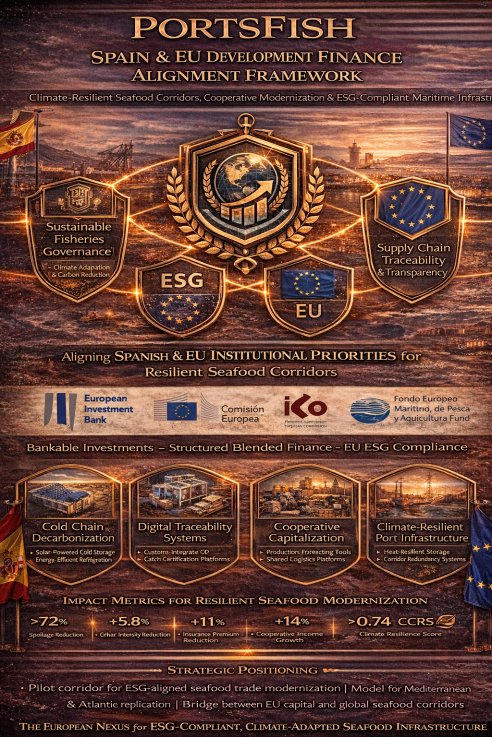
The Investment & Joint Ventures Framework (IJVF) positions PortsFish as a structured capital coordination platform that enables:
- Strategic co-investment
- Public–private partnerships
- Infrastructure modernization
- Cold chain expansion
- Digital traceability deployment
- Cooperative cluster scaling
- Climate-resilient maritime corridors
This module integrates trade intelligence, ESG alignment, insurance risk modeling, and sovereign engagement into a bankable investment architecture.
PortsFish does not merely analyze trade.
It structures capital around it.
I. STRATEGIC CONTEXT
Seafood trade modernization requires capital across:
- Cold storage infrastructure
- Reefer container fleets
- Port modernization
- Digital traceability systems
- Aquaculture expansion
- Multimodal logistics nodes
- Climate adaptation measures
However, capital deployment faces:
- Risk opacity
- Climate uncertainty
- Insurance volatility
- Compliance complexity
- Fragmented cooperative structures
PortsFish reduces uncertainty through integrated intelligence.
Capital flows where risk is measurable.
II. INVESTMENT ARCHITECTURE
The Investment & Joint Ventures Framework operates across seven structural layers.
1. Investment Readiness Diagnostics
Before capital deployment, PortsFish evaluates:
- Corridor stability
- Production reliability
- Cold chain integrity
- Traceability penetration
- Insurance exposure
- Climate vulnerability
Investment Readiness Index (IRI):IRI=f(ProductivityStability,TIS,TCS,CCRI,IRRF,ESGScore)
Classification:
- Tier A – Immediate bankable
- Tier B – Conditional co-investment
- Tier C – Infrastructure upgrade required
2. Structured Joint Venture Models
JV structures may include:
A) Infrastructure Joint Ventures
- Cold storage terminals
- Reefer fleet pooling
- Air freight consolidation hubs
- Digital traceability platforms
B) Cooperative Aggregation JVs
- Production cluster consolidation
- Export platform creation
- Shared logistics infrastructure
C) Port Modernization Partnerships
- Smart port analytics
- Congestion optimization systems
- Cold chain integration
D) ESG & Climate Adaptation JVs
- Energy-efficient storage
- Solar-powered cold facilities
- Carbon-reduced logistics corridors
3. Capital Instruments
PortsFish supports structured capital through:
- Equity co-investment
- ESG-aligned bonds
- Development bank loans
- Blended finance instruments
- Insurance-linked financing
- Revenue-sharing agreements
- Structured export credit
Capital Stack Model:CapitalStructure=Equity+Debt+BlendedFinance+InsuranceBackedLayer
4. ROI & Risk-Adjusted Modeling
Infrastructure ROI:ROI=CapitalInvestmentIncrementalMargin+PremiumReduction+SpoilageReduction
Risk-Adjusted Return:RAR=ROI−RiskPremium(CCRI+CorridorVolatility+ProductionVariance)
Insurance integration lowers the risk premium.
5. Insurance & Risk Integration
Insurance Risk Reduction Factor (IRRF):IRRF=f(TraceabilityDepth,ThermalContinuity,ComplianceHistory)
Lower IRRF → Lower financing spread → Improved JV performance.
Insurance becomes embedded in investment structuring.
6. Climate & ESG Alignment
Investments must align with:
- Carbon intensity reduction
- Sustainable fishing practices
- Climate adaptation strategies
- ESG disclosure standards
Sustainability Investment Score (SIS):SIS=f(CarbonReductionImpact,GovernanceIntegrity,ClimateResilience)
Higher SIS → Higher institutional investor eligibility.
7. Capital Deployment Phasing
Phase 1 – Diagnostic & Structuring
- Infrastructure gap analysis
- Risk transparency mapping
- Financial feasibility modeling
Phase 2 – Capital Syndication
- Sovereign fund engagement
- Development bank coordination
- ESG investor roadshow
Phase 3 – JV Formation
- Legal structuring
- Revenue model design
- Risk allocation agreements
Phase 4 – Monitoring & Optimization
- Performance dashboards
- Insurance recalibration
- Climate risk updates
- Capital reallocation adjustments
III. DASHBOARD ARCHITECTURE
A) Investment Readiness Panel
- IRI score
- Production stability
- Corridor resilience
B) ROI Simulation Engine
- Base case
- Stress case
- Climate-adjusted case
C) Insurance & Risk View
- Premium sensitivity
- Loss exposure projection
D) ESG Impact Monitor
- Carbon reduction tracking
- Sustainability compliance
- Governance transparency
E) Capital Deployment Tracker
- Equity vs debt ratio
- Blended finance allocation
- Milestone achievement
IV. GOVERNMENT & SOVEREIGN APPLICATION
Investment & Joint Ventures support:
- Coastal economic stabilization
- Infrastructure modernization
- Climate-aligned trade corridors
- Cooperative capitalization
- Export competitiveness enhancement
For governments, this becomes:
- A sovereign modernization lever
- A climate-aligned infrastructure engine
- A development finance multiplier
V. INSTITUTIONAL VALUE PROPOSITION
For Sovereign Funds
- Climate-adjusted maritime exposure
- Structured risk transparency
- Long-term infrastructure yield
For Development Banks
- Bankable cooperative clusters
- Blended finance structuring
- Impact-measured rural development
For ESG Investors
- Quantified carbon impact
- Traceable production systems
- Governance integrity
For Private Equity
- Structured JV entry
- Risk-mitigated logistics assets
- Predictable export flows
VI. STRATEGIC POSITIONING STATEMENT
Investment & Joint Ventures transforms:
Trade intelligence → Capital mobilization platform
Infrastructure need → Structured investment opportunity
Cold chain modernization → Risk-adjusted yield asset
Cooperatives → Bankable production platforms
Climate adaptation → ESG-aligned investment thesis
It positions PortsFish as:
- A Maritime Infrastructure Investment Architect
- A Sovereign Trade Capital Interface
- A Climate-Aligned Joint Venture Structuring Platform
- A Risk-Engineered Capital Coordination System
VII. MASTER INTEGRATION EQUATION
InvestmentPerformance=f(ProductivityStability,TraceabilityIntegrity,CorridorResilience,ClimateAdaptation,InsuranceTransparency)
Capital flows where trade intelligence reduces uncertainty.
PortsFish becomes the structured bridge between:
Production → Compliance → Logistics → Risk → Climate → Capital.
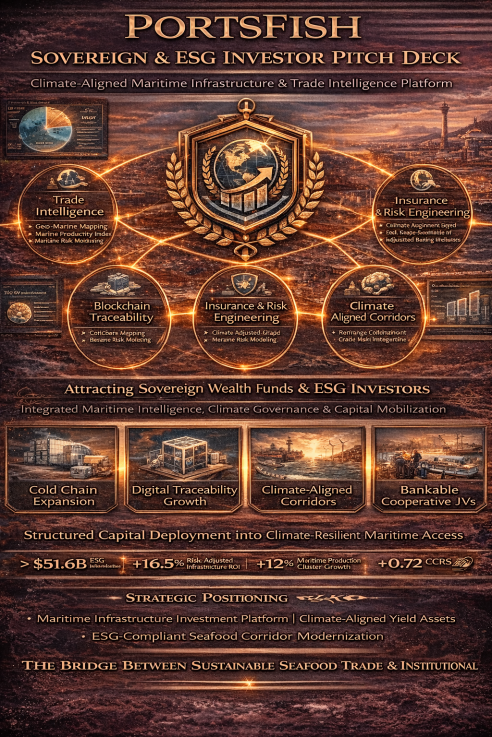
PortsFish Sovereign & ESG Investor Pitch Deck
Climate-Aligned Maritime Infrastructure & Trade Intelligence Platform
Designed for:
- Sovereign wealth funds
- Development banks
- ESG institutional investors
- Infrastructure funds
- Climate finance vehicles
- Multilateral institutions
This is structured as a 30-slide institutional-grade pitch deck.
SECTION I — STRATEGIC POSITIONING
Slide 1 – Title Slide
PortsFish Sovereign ESG & Trade Infrastructure Platform
Integrated Maritime Intelligence, Climate Governance & Capital Mobilization
Tagline:
“Structuring Capital Around Sustainable Seafood Trade.”
Slide 2 – Global Context
Seafood trade represents:
- $200+ billion global industry
- Critical food security pillar
- High climate exposure
- High regulatory scrutiny
- Fragmented production base
- Under-optimized infrastructure
Institutional gap:
Capital is available.
Risk transparency is not.
Slide 3 – The Core Problem
Seafood trade suffers from:
- Cold chain inefficiencies
- Insurance volatility
- Climate vulnerability
- IUU compliance exposure
- Fragmented cooperatives
- Under-capitalized infrastructure
Result:
- Elevated financing spreads
- Spoilage losses
- Regulatory risk
- Investment hesitation
Slide 4 – The Solution
PortsFish is:
- A Sovereign Trade Intelligence Infrastructure
- A Climate & ESG Integration Platform
- A Risk-Engineered Capital Structuring System
It converts:
Uncertainty → Quantified Risk
Compliance → Digital Traceability
Logistics → Optimized Corridors
Climate Exposure → Modeled Adaptation
Production Clusters → Bankable Entities
SECTION II — SYSTEM ARCHITECTURE
Slide 5 – Integrated Intelligence Platform
Modules:
- Marine Productivity Index
- Blockchain Traceability
- Maritime Risk Monitoring
- Multimodal Routing Optimization
- Cold Chain & Reefer Management
- Storage & Warehousing Network
- Insurance & Cargo Protection
- Cooperative Integration
- Multilateral & ESG Partnerships
- Investment & Joint Ventures
Unified system:TradeResilience=f(Productivity,Traceability,RiskTransparency,ClimateAlignment,CapitalIntegration)
Slide 6 – Blockchain Traceability
Immutable digital provenance:
- Catch zone validation
- Batch integrity
- Cold chain logs
- Compliance automation
Impact:
- Lower regulatory risk
- Reduced insurance premiums
- Improved financing eligibility
Slide 7 – Insurance & Risk Engineering
Insurance Risk Reduction Factor:IRRF=f(TraceabilityDepth,ThermalContinuity,ComplianceHistory)
Outcome:
- Reduced underwriting uncertainty
- Lower financing spreads
- Structured loss predictability
Slide 8 – Climate & ESG Integration
Climate Risk Index:CCRI=f(TemperatureAnomaly,StormExposure,InfrastructureVulnerability)
Sustainability Alignment Score:SAS=f(CarbonData,GovernanceIntegrity,ComplianceDepth)
Enables ESG-compliant capital allocation.
Slide 9 – Cooperative Modernization
Institutional Readiness Index:IRI=f(ProductivityStability,Traceability,ColdChainIntegrity,ESGAlignment)
Transforms:
Fragmented coastal clusters → Bankable structured entities.
SECTION III — INVESTMENT OPPORTUNITY
Slide 10 – Addressable Capital Needs
Investment categories:
- Cold storage expansion
- Reefer fleets
- Smart port modernization
- Digital traceability systems
- Aquaculture scaling
- Climate adaptation infrastructure
Slide 11 – Capital Stack Model
CapitalStructure=Equity+Debt+BlendedFinance+InsuranceBackedLayer
Instruments:
- ESG bonds
- Development bank loans
- Climate adaptation funds
- Sovereign co-investment
- Insurance-linked financing
Slide 12 – Risk-Adjusted ROI Modeling
Infrastructure ROI:ROI=CapitalInvestmentIncrementalMargin+PremiumReduction+SpoilageReduction
Risk-adjusted return:RAR=ROI−RiskPremium
Insurance & traceability lower the RiskPremium.
Slide 13 – Climate-Aligned Yield
Investments deliver:
- Carbon intensity reduction
- Spoilage reduction
- IUU mitigation
- Coastal employment stabilization
- Export competitiveness
Slide 14 – Portfolio Diversification Advantage
Seafood infrastructure offers:
- Low correlation to traditional asset classes
- Real-economy exposure
- Climate-transition integration
- Emerging market diversification
SECTION IV — INSTITUTIONAL VALUE
Slide 15 – For Sovereign Wealth Funds
- Long-term infrastructure yield
- Climate-aligned maritime exposure
- Governance transparency
- Sovereign partnership opportunities
Slide 16 – For Development Banks
- Structured cooperative pipelines
- Bankable corridor diagnostics
- Measurable climate adaptation impact
- Rural development stabilization
Slide 17 – For ESG Investors
- Verified carbon transparency
- Immutable traceability
- Risk-adjusted yield
- Governance compliance
Slide 18 – For Insurance & Reinsurance
- Data-backed underwriting
- Reduced catastrophic aggregation
- Corridor risk modeling
SECTION V — FINANCIAL PROJECTIONS
Slide 19 – Revenue Streams
PortsFish generates:
- Data intelligence subscriptions
- Institutional reporting services
- JV structuring fees
- Capital coordination fees
- Insurance integration services
- Infrastructure advisory mandates
Slide 20 – Scalability Model
Cloud-first, asset-light platform:
- Multi-country deployment
- Modular expansion
- Cooperative cluster aggregation
- Sovereign replication
Slide 21 – 5-Year Growth Outlook
Projected expansion:
- Regional corridor scaling
- Institutional adoption growth
- Infrastructure JV pipeline expansion
- ESG capital mobilization growth
SECTION VI — GOVERNANCE & TRANSPARENCY
Slide 22 – Institutional Governance Model
- Data neutrality
- Regulatory compliance
- ESG transparency
- Independent reporting standards
Slide 23 – Risk Management Framework
- Climate stress modeling
- Corridor risk heatmaps
- Insurance exposure integration
- Continuous monitoring dashboard
Slide 24 – Impact Metrics
Measured impact:
- Spoilage reduction %
- Insurance premium reduction %
- Carbon intensity reduction %
- Cooperative income uplift %
- Export margin stabilization %
SECTION VII — STRATEGIC EXPANSION
Slide 25 – Geographic Expansion Strategy
Priority corridors:
- EU trade alignment
- Climate-vulnerable coastal regions
- High-yield aquaculture zones
- Under-capitalized ports
Slide 26 – Multilateral Partnerships
Alignment with:
- Climate adaptation programs
- Ocean sustainability initiatives
- Rural development strategies
- ESG reporting standards
SECTION VIII — INVESTMENT PROPOSAL
Slide 27 – Capital Raise Objective
Use of funds:
- Platform scaling
- Institutional integration
- Infrastructure pipeline structuring
- Climate modeling enhancement
- ESG reporting expansion
Slide 28 – Investment Structure Options
- Equity stake
- Strategic JV
- Sovereign co-investment
- ESG bond alignment
- Structured development finance vehicle
Slide 29 – Expected Returns
Target profile:
- Infrastructure-level IRR
- ESG-aligned risk premium
- Long-term stable yield
- Diversified maritime exposure
Slide 30 – Closing Statement
PortsFish converts:
Trade volatility → Structured resilience
Climate risk → Modeled adaptation
Compliance burden → Digital governance
Infrastructure gap → Bankable opportunity
Seafood corridors → Sovereign-grade ESG assets
PortsFish is the bridge between sustainable seafood trade and institutional capital.