PortsFish.Agency | Strategic Port Network
Export Facilitation Services at PortsFish.Agency are designed to transform complex, multi-jurisdictional export operations into structured, compliant, bankable, and efficiently executed trade flows. We operate at the intersection of maritime logistics, regulatory intelligence, financial structuring, and trade network activation.
Our approach is not transactional. It is systemic.
We support fishing companies, seafood processors, maritime operators, port authorities, and trade investors in designing and executing end-to-end export frameworks that reduce friction, mitigate risk, optimize margins, and accelerate cross-border commercial deployment.
1. Regulatory & Compliance Structuring
International seafood trade operates within a highly regulated ecosystem. Our team structures export operations to comply with:
- International sanitary and phytosanitary standards (SPS)
- EU IUU (Illegal, Unreported and Unregulated Fishing) regulations
- U.S. FDA and NOAA requirements
- Catch documentation schemes (CDS)
- Certificates of origin and health certifications
- Sustainability and traceability standards (MSC, ASC, etc.)
- Bilateral and multilateral trade agreements
We design compliance architecture before shipment, not after.
Outcome: Reduced customs delays, minimized rejection risk, accelerated clearance cycles.
2. Export Documentation & Operational Coordination
We coordinate and supervise all critical export documentation flows:
- Commercial invoices
- Packing lists
- Bills of lading (B/L)
- Export declarations
- Health certificates
- Insurance documentation
- Port clearance documentation
- Letter of credit (LC) documentation alignment
PortsFish integrates documentation with logistics timing and financial instruments to prevent documentary discrepancies — one of the most frequent causes of trade disruption.
Outcome: Document-bank alignment, lower trade finance friction, reduced shipment risk.
3. Customs & Port Interface Management
Through our Strategic Port Network, we facilitate operational coordination between:
- Exporters
- Customs brokers
- Port authorities
- Cold storage facilities
- Inspection authorities
- Shipping lines
- Freight forwarders
We ensure procedural synchronization across port nodes and maritime corridors.
Where required, we deploy structured onboarding protocols to align exporters with partner ports under standardized operational criteria.
Outcome: Predictable port handling timelines, improved cargo integrity, optimized terminal flows.
4. Cold Chain Export Optimization
Seafood export is highly sensitive to temperature integrity.
Our services include:
- Cold chain mapping from vessel to destination port
- Reefer container optimization
- Controlled atmosphere logistics design
- Temperature monitoring integration
- Risk mapping for transit interruptions
- Redundancy protocols for high-value cargo
We work to preserve product quality while minimizing energy cost inefficiencies.
Outcome: Reduced spoilage, increased export-grade yield, improved buyer trust.
5. Trade Finance & Capital Structuring
Export activity must be financially structured, not improvised.
PortsFish facilitates:
- Trade credit insurance
- Structured receivables financing
- Letters of credit advisory
- Export factoring
- Pre-shipment and post-shipment finance
- Structured commodity-backed instruments
- ESG-linked export financing
We also integrate export flows into broader investment frameworks under Renewable Investment & Funding structures.
Outcome: Liquidity acceleration, capital efficiency, lower counterparty exposure.
6. Market Entry & Buyer Activation
Export success depends on strategic buyer positioning.
We support:
- Target market intelligence (U.S., EU, Middle East, Asia)
- Buyer pre-qualification
- Commercial representation
- Distribution network mapping
- Wholesale and institutional buyer onboarding
- Long-term supply contract structuring
Where appropriate, PortsFish operates as a commercial node to activate high-value trade channels within established maritime hubs.
Outcome: Structured market penetration, reduced entry risk, scalable trade expansion.
7. Risk Mitigation & Dispute Prevention
Export environments are exposed to:
- Currency volatility
- Regulatory changes
- Geopolitical disruptions
- Inspection disputes
- Shipment damage claims
- Payment default
We design risk matrices and mitigation frameworks, integrating insurance, contractual clauses, and structured fallback logistics.
Outcome: Controlled exposure, reduced systemic trade volatility.
8. Sustainability & Traceability Integration
Global markets increasingly demand transparency.
PortsFish supports:
- Blockchain-based traceability systems
- ESG reporting integration
- Sustainable sourcing certification alignment
- Carbon footprint measurement per shipment
- Green maritime compliance
Export facilitation is increasingly linked to sustainability credibility.
Outcome: Premium market positioning, compliance-driven competitive advantage.
Strategic Positioning
PortsFish Export Facilitation Services are built on a strategic thesis:
Export operations should not be isolated transactions.
They should be embedded within an integrated port-to-market system.
By combining port network intelligence, financial structuring, regulatory coordination, and commercial activation, PortsFish transforms seafood export from a reactive logistical process into a structured international trade architecture.
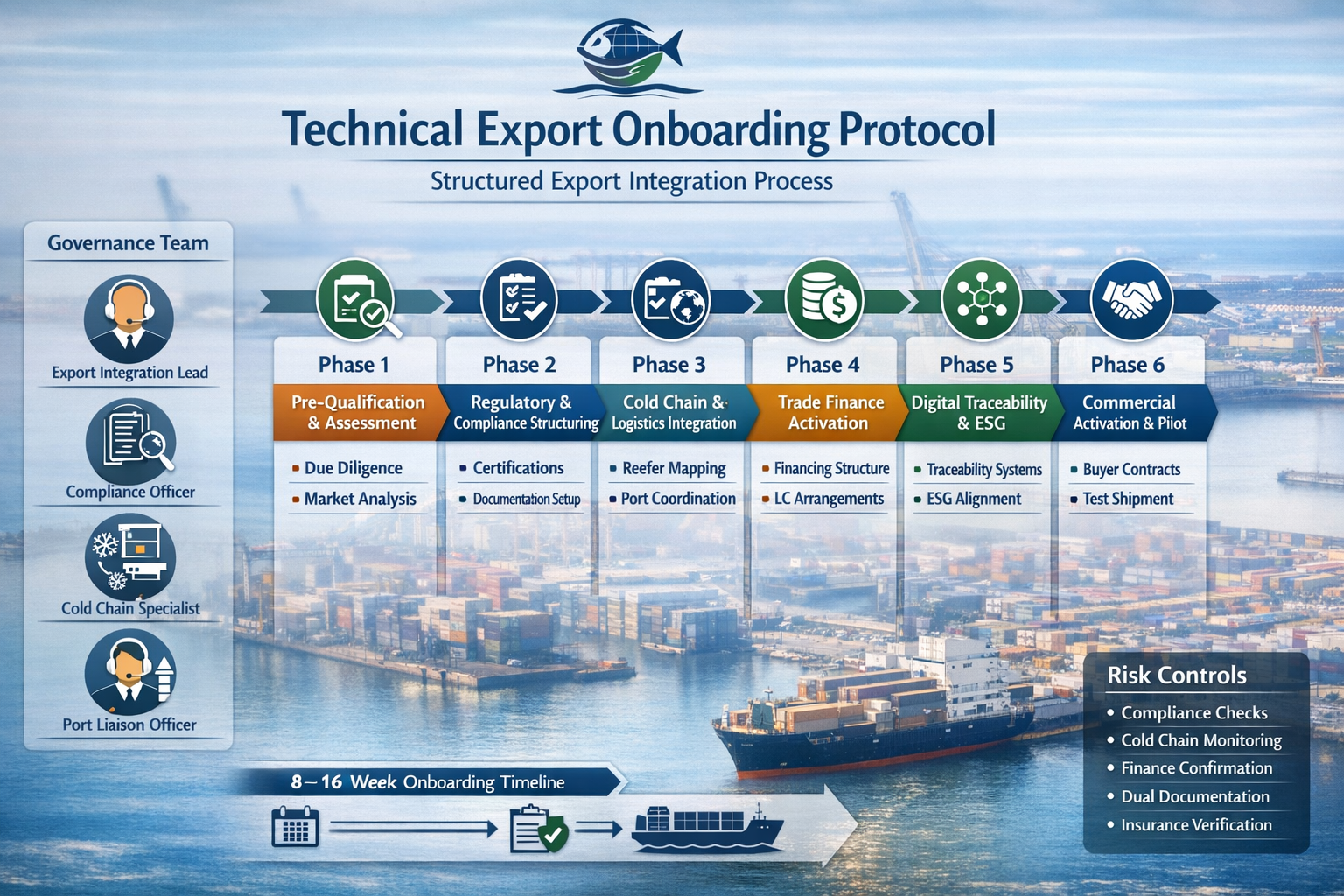
Technical Export Onboarding Protocol
PortsFish.Agency | Strategic Port Network
Module: Export Facilitation Services
This Technical Export Onboarding Protocol defines the structured process through which fishing companies, seafood processors, maritime operators, and export consortia are integrated into the PortsFish Strategic Port Network.
The objective is to transform exporters into compliant, finance-ready, cold-chain-optimized, internationally deployable trade operators.
The protocol is modular, scalable, and adaptable to multi-port integration.
Phase 1 — Pre-Qualification & Strategic Assessment
1.1 Corporate & Legal Due Diligence
- Corporate registration validation
- Beneficial ownership identification
- Compliance screening (AML / KYC)
- Sanctions and restricted trade list verification
- Trade history review
Deliverable: Exporter Compliance Report (ECR)
1.2 Operational Capability Assessment
- Fleet capacity (vessels, tonnage, species specialization)
- Processing plant certifications
- Cold storage capacity
- Existing export routes
- Packaging & labeling standards
Deliverable: Operational Capability Matrix (OCM)
1.3 Market Readiness Evaluation
- Target markets identified
- Buyer pipeline status
- Product specifications alignment
- Volume continuity capability
Deliverable: Market Alignment Index (MAI)
Phase 2 — Regulatory & Compliance Structuring
2.1 Certification & Licensing Audit
- IUU compliance
- Catch documentation schemes (CDS)
- Health and sanitary certifications
- EU / FDA / Asian regulatory compliance
- Sustainability certifications (MSC, ASC where applicable)
Gap analysis is conducted against target-market standards.
Deliverable: Compliance Alignment Roadmap (CAR)
2.2 Documentation Architecture Design
Standardized export documentation templates are configured:
- Commercial invoice templates
- Packing lists
- Certificate of origin
- Health certificate flow
- Export declaration workflow
- Bill of lading coordination protocol
Digital document flow synchronization is recommended to prevent discrepancies.
Deliverable: Export Documentation Protocol Package (EDPP)
Phase 3 — Cold Chain & Logistics Integration
3.1 Cold Chain Integrity Mapping
- Vessel → Dock → Processing → Storage → Container → Destination Port
- Reefer container configuration
- Temperature monitoring requirements
- Redundancy protocols
Deliverable: Cold Chain Integrity Blueprint (CCIB)
3.2 Port Network Alignment
Exporter is mapped into:
- Partner ports within the Strategic Port Network
- Approved customs brokers
- Inspection authorities
- Shipping lines
- Maritime corridors
Where applicable, the exporter is integrated into multiple port nodes for redundancy and route optimization.
Deliverable: Port Integration Assignment (PIA)
Phase 4 — Trade Finance Activation
4.1 Financial Structuring Assessment
- Working capital needs
- Pre-shipment finance eligibility
- Post-shipment receivables structure
- Trade credit insurance feasibility
- Letter of credit compatibility
Deliverable: Trade Finance Structuring Model (TFSM)
4.2 Bank & Investor Interface (Optional)
For scalable exporters:
- Export-backed financing programs
- ESG-linked financing
- Structured commodity financing
- Integration into Green Maritime Infrastructure Fund (if eligible)
Deliverable: Capital Deployment Alignment Report (CDAR)
Phase 5 — Digital Traceability & ESG Integration
5.1 Traceability System Configuration
- Lot-level traceability
- Blockchain or digital ledger integration
- QR transparency systems
- Sustainability reporting alignment
Deliverable: Traceability Activation Plan (TAP)
5.2 ESG & Market Positioning
- Carbon footprint estimation per shipment
- Sustainability certification strategy
- Premium market positioning analysis
Deliverable: ESG Competitive Positioning Brief (ECPB)
Phase 6 — Commercial Activation
6.1 Buyer Interface & Contract Structuring
- Buyer pre-qualification
- Supply contract drafting support
- Payment terms structuring
- Risk allocation clauses
Deliverable: Commercial Deployment Framework (CDF)
6.2 Initial Pilot Shipment (Controlled Launch)
A structured pilot export is executed to validate:
- Documentation accuracy
- Cold chain performance
- Customs clearance time
- Financial instrument performance
- Payment settlement reliability
Performance metrics are recorded.
Deliverable: Pilot Shipment Performance Report (PSPR)
Timeline Framework
| Phase | Estimated Duration |
|---|---|
| Phase 1 | 1–2 weeks |
| Phase 2 | 2–4 weeks |
| Phase 3 | 2 weeks |
| Phase 4 | 2–6 weeks (parallel) |
| Phase 5 | 2–4 weeks |
| Phase 6 | 4–8 weeks |
Total Structured Onboarding Cycle: 8–16 weeks (depending on exporter maturity)
Governance Model
- Dedicated Export Integration Lead (PortsFish)
- Port Liaison Officer
- Compliance Officer
- Trade Finance Advisor
- Cold Chain Technical Specialist
Clear RACI matrix recommended for multi-exporter onboarding programs.
Risk Controls Embedded in the Protocol
- Pre-shipment compliance validation
- Dual documentation verification
- Cold chain redundancy mapping
- Financial instrument confirmation prior to vessel departure
- Insurance coverage validation
- Counterparty verification
Scalability Architecture
The protocol is designed for:
- Single exporter onboarding
- Multi-exporter cooperative integration
- National seafood cluster activation
- Multi-port regional trade corridor structuring
It integrates seamlessly with:
- Strategic Port Network
- Cold Chain Logistics Corridors
- Green Maritime Infrastructure Fund
- Trade Network Capital Deployment Roadmap
Strategic Objective
Export onboarding is not administrative.
It is structural.
The goal is to convert local seafood production capacity into internationally compliant, finance-integrated, scalable export infrastructure.
PortsFish does not merely facilitate shipments.
It engineers export systems.