

PortsFish is creating an international digital hub for the fishing economy.
“We are opening the platform to the first 20 companies under founding conditions (success fee only).
Once the initial network is completed, standard membership will be USD 300/month + success fee.”
“PortsFish operates through a distributed network of independent digital sales operators.
Each operator manages a dedicated subdomain, promotes products, generates leads, and participates in transactions, earning commissions on closed deals.”
PortsFish: A Complete Sector Platform
Digital infrastructure of the fishing industry
Most marketplaces in the fishing industry focus on a single layer of the business: selling fish.
PortsFish is different.
It is designed as an integrated platform that connects the full productive, commercial, and technological ecosystem of the sector, including:
- fishing operations
- vessels
- shipyards
- logistics
- technology providers
- market intelligence
In other words, PortsFish is not just a marketplace.
It is a complete industry ecosystem.
Market Intelligence as a Core Asset
One of the biggest weaknesses of the sector is the lack of accessible, integrated, real-time strategic information.
PortsFish addresses this gap by incorporating a market intelligence layer that can include:
- global price monitoring
- catch and landing data
- demand trends
- buyer behavior
- emerging markets
- trade opportunity mapping
This is rarely executed well in traditional industry portals.
Yet this layer alone has enormous value, because information reduces uncertainty, improves margins, and accelerates better decisions.
Digital Labs: The Strategic Differentiator
The strongest differentiator is not only commercial integration, but innovation capacity.
PortsFish is not conceived merely as a platform for transactions.
It is also a vehicle for sector transformation through Digital Labs, focused on:
- technological innovation
- digitalization of fishing companies
- process optimization
- new business models
- product development
- design of next-generation industrial solutions
This means PortsFish can evolve beyond intermediation and become a platform for commercial acceleration, technological modernization, and strategic reinvention of the fishing sector.
Strategic Conclusion
PortsFish combines three layers that rarely appear together in a single system:
1. Commercial platform
to connect supply, demand, services, and industry actors.
2. Market intelligence platform
to turn fragmented data into strategic value.
3. Innovation platform
to modernize the sector and open new growth pathways.
That combination is what gives PortsFish real strategic depth.
It is not simply a portal for buying and selling fish.
It is a digital infrastructure for the future of the fishing industry.
A Strategic Question for Argentina’s Fishing Industry — and for Every Traditional Productive Company
For decades, the strength of sectors such as fishing, shipbuilding, construction, agribusiness, manufacturing, and industrial logistics has been built on physical assets: vessels, shipyards, processing plants, machinery, infrastructure, distribution networks, and specialized human capital.
That foundation remains essential.
But over the last decade, a second layer of value creation has become impossible to ignore:
the digital economy.
Today, the strategic question for any productive company is no longer whether digital matters.
The real question is:
Why have we still not invested enough in digital infrastructure, internet-based commercial systems, data capabilities, and e-commerce?
This is no longer a theoretical discussion. It is becoming a board-level question across industrial and export-oriented sectors worldwide.
1. Physical Economy and Digital Economy Are No Longer Separate
Traditional companies are often highly competent in the management of the physical layer of business:
production,
processing,
logistics,
distribution,
export operations.
However, the modern global market now operates through two simultaneous and interdependent layers:
Physical infrastructure
the real production, movement, and delivery of goods.
Digital infrastructure
the systems that manage visibility, data, market access, transactions, customer acquisition, positioning, and intelligence.
The companies that integrate both layers tend to achieve stronger competitive advantages, because they do not rely only on production capacity. They also improve access, speed, market knowledge, and commercial control. UNCTAD reports that business e-commerce sales across 43 economies representing about three quarters of global GDP reached $27 trillion in 2022, and that most of those sales were B2B rather than consumer retail.
2. The Scale of the Digital Opportunity
One of the most common mistakes in traditional sectors is to associate e-commerce only with consumer retail.
That is already outdated.
Digital commerce now includes:
industrial sales,
professional services,
specialized B2B trade,
logistics platforms,
sector-specific marketplaces,
digitally enabled export channels.
This matters because the digital layer is no longer marginal. UNCTAD’s latest data shows that business e-commerce has already reached a scale measured in tens of trillions of dollars, with growth of nearly 60% from 2016 to 2022 across the economies analyzed.
For productive companies, this means something very concrete:
global competition is no longer based only on productive efficiency.
It is increasingly based on digital market access, digital coordination, and digital commercial intelligence.
3. What This Means for Fishing, Seafood, and Other Asset-Heavy Sectors
Argentina’s fishing industry — and many comparable industries internationally — has major structural strengths:
high-capacity fleets,
technical know-how,
export tradition,
port infrastructure,
industrial processing capabilities.
Yet many companies still depend primarily on traditional commercial channels:
intermediaries,
brokers,
legacy buyer networks,
historical export relationships.
Those channels still matter, but they are no longer sufficient on their own.
Digitalization can add a new layer of competitiveness through tools such as:
direct international commercialization platforms,
digital product traceability,
specialized seafood marketplaces,
global brand positioning,
data-driven market analysis,
digital tendering and auction systems.
This does not replace physical production.
It amplifies the value of existing production and infrastructure.
OECD analysis on agriculture and food trade highlights that digital tools can reduce transaction costs tied to identifying buyers, negotiating deals, proving compliance, and moving products more efficiently across borders. Those same dynamics are directly relevant to seafood value chains.
4. The Core Constraint Is Usually Not Willingness — It Is Digital Capability
Most industrial firms do not resist digitalization because they reject it conceptually.
They struggle because they lack the operational capacity to execute it quickly and correctly.
The recurring barriers are familiar:
lack of specialized digital teams,
limited knowledge of global platforms,
difficulty building proprietary e-commerce systems,
insufficient international digital marketing expertise,
fragmented data systems,
poor integration between commercial, operational, and market information.
In other words, the bottleneck is often not strategic intent.
It is execution capability.
5. Why Expert Support Becomes Essential
For that reason, many productive companies do not need abstract talks about innovation.
They need practical, immediate, expert support in areas such as:
digital strategy,
platform design,
B2B e-commerce implementation,
portal development,
international digital marketing,
internal team training,
market intelligence systems,
traceability and data architecture.
This kind of support accelerates the transition and avoids the inefficiency of starting from zero.
6. Concrete Digital Use Cases in the Fishing Sector
For many traditional operators, digital transformation sounds too broad or too vague. In practice, however, it can translate into highly specific applications with direct commercial value.
Examples include:
Direct premium seafood sales to Europe, Asia, or North America through digital channels that reduce intermediation and improve commercial margins.
Digital traceability systems that allow international buyers to verify origin, capture data, processing history, cold-chain compliance, and product integrity.
Online auction systems for seafood lots, where international buyers compete in real time for available products, improving pricing dynamics and accelerating commercial turnover.
Sector intelligence dashboards that combine prices, landings, demand signals, and trade trends to support better export decisions.
FAO has highlighted the growing role of digital traceability in seafood value chains, including blockchain-based approaches to secure product information across critical tracking events.
7. Defining the Strategic Concept: What Is a “Complete Sector Platform”?
Most sector portals do only one thing.
They list products.
Or publish news.
Or offer a directory.
Or act as a narrow marketplace.
A complete sector platform is something broader.
It integrates the main functional layers of a productive ecosystem into one digital architecture, including:
commercial exchange,
industry directories,
specialized services,
logistics support,
technology providers,
market intelligence,
innovation and digitalization services.
In the case of a sector such as fishing, that means a platform can evolve from “a place where seafood is listed” into a digital operating layer for the industry.
That is a much more valuable concept.
8. Defining the Strategic Concept: What Is “Market Intelligence” in This Context?
Market intelligence is often misunderstood as generic reporting.
In a productive-sector context, market intelligence means:
the continuous collection, organization, interpretation, and operational use of commercial and sectoral data to improve decisions.
This may include:
global price monitoring,
catch and landing data,
demand shifts by market,
buyer behavior,
trade flow patterns,
emerging destination markets,
competitor mapping.
Information of this kind has economic value because it reduces uncertainty, shortens decision cycles, improves negotiation power, and supports better commercial timing.
That is why a platform with a strong intelligence layer is not merely informative.
It becomes a strategic asset.
9. Defining the Strategic Concept: What Are “Digital Labs”?
A Digital Lab is not just a software department.
In a modern industrial context, a Digital Lab is an applied innovation unit focused on developing and testing digital solutions that improve competitiveness in a specific sector.
Its functions may include:
sector digitalization,
process optimization,
new revenue-channel design,
B2B platform development,
smart commercialization models,
industrial service digitization,
data-enabled business-model innovation.
This is one of the strongest differentiators any sector platform can have.
Because once a platform moves beyond intermediation and begins helping firms modernize their operating model, it becomes much more than a marketplace.
It becomes an acceleration infrastructure for sector transformation.
10. SpaceArch and Fourth-Wave Digital Logistics
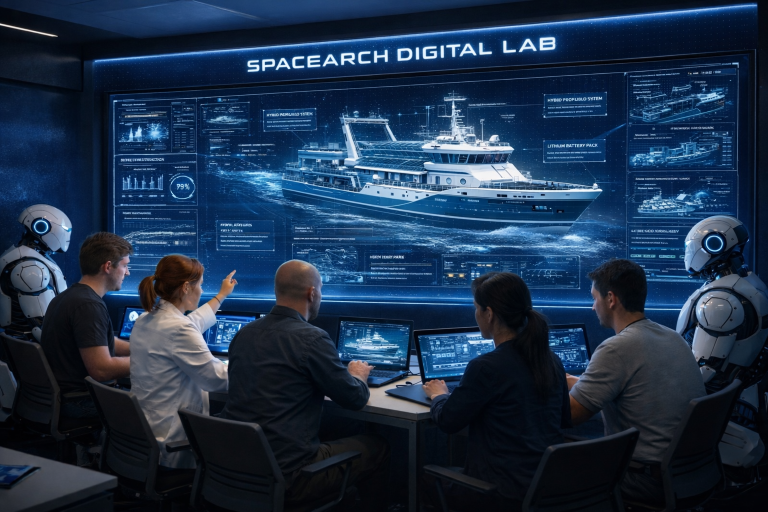
Within this framework, a company such as SpaceArch can be positioned as a Fourth-Wave digital logistics and platform-integration company: a structure designed to connect traditional productive infrastructure with global digital commercial systems.
The key idea is not merely to “put a company online” through an isolated local website.
The stronger proposition is to integrate companies into international portal networks, sector-focused digital ecosystems, and shared commercial architectures that function more like specialized global marketplaces than isolated corporate brochures.
This creates several strategic advantages:
faster time to market,
lower digital-entry cost,
access to shared infrastructure,
stronger international positioning,
reduced learning curve,
better scalability.
For productive companies in Argentina — and especially for export-oriented firms — this type of model can be especially attractive because it allows them to begin with pilot projects, external expert support, and moderated initial investment rather than heavy internal development from scratch.
11. Under What Conditions Should This Transformation Be Executed?
Digital transformation in traditional sectors should not be approached as a vague modernization campaign.
It should follow disciplined principles:
Progressive implementation
Start with pilot projects and limited-scope deployments.
Moderate initial investment
Avoid excessive upfront spending before validating traction and results.
Results measurement
Track impact on sales, positioning, conversion, lead generation, and operational efficiency.
Internal capability building
Train internal teams so the company gradually absorbs the new tools rather than remaining permanently dependent on outside support.
This reduces risk while preserving strategic flexibility.
12. What Can the Return on Investment Look Like?
Digital ROI varies by sector, business model, and execution quality, but the benefit structure is usually visible across several dimensions:
access to new international markets,
reduction in commercial intermediation,
higher global visibility,
improved lead generation,
better pricing intelligence,
new revenue channels,
more efficient commercial processes.
In many cases, the first wave of digital investment is not recovered only through direct online sales.
It is recovered through a broader combination of better margins, faster access to buyers, stronger positioning, and improved commercial efficiency.
13. The Real Strategic Challenge
The digital question facing productive companies is not fundamentally technological.
It is strategic.
If digitally enabled commerce continues to expand and digital capabilities increasingly shape global competitiveness, then every productive company must confront a simple but powerful question:
What share of the future digital market will our company actually capture over the next ten years?
Because in the new economy, firms are not competing only through vessels, plants, factories, or port assets.
They are also competing through:
platforms,
data,
digital customer access,
specialized commercial networks,
market visibility,
and the ability to connect directly with international demand.
14. Conclusion
The global economy is entering a stage in which physical and digital layers can no longer be treated as separate worlds.
Sectors such as fishing, shipbuilding, agribusiness, and manufacturing will always depend on real production infrastructure. But their future competitiveness will depend increasingly on how effectively they integrate:
digital platforms,
e-commerce systems,
data intelligence,
traceability,
and international digital market access.
So the most important question for traditional productive companies is no longer whether digital transformation will happen.
It is this:
When — and under what model — will we decide to participate in it?
That decision may determine whether a company remains commercially strong in the next decade, or becomes trapped inside increasingly narrow legacy channels while the market evolves elsewhere.
Digitalization of the Global Fishing Industry
Sector MVP – Building the Digital Infrastructure of the Industry
A Strategic Initiative to Position the Fishing Sector in the Global Digital Economy
For decades, the strength of the fishing industry has been built on physical infrastructure:
fishing fleets
shipyards
processing plants
port logistics
cold-chain systems
export networks
and specialized human capital.
This physical industrial foundation remains essential.
However, global trade is entering a new phase in which productive capacity alone is no longer sufficient to maximize market access and value creation.
A second economic layer is rapidly transforming all productive industries:
the digital economy.
Today, the strategic question facing every industrial sector is no longer whether digital transformation is important.
The real question is:
Why has the industry not yet invested sufficiently in digital infrastructure, global internet platforms, and sector-specific e-commerce systems?
The Global Context: The Expansion of Digital Commerce
Digital commerce has grown from a niche activity into one of the central infrastructures of the global economy.
Multiple international studies estimate that global e-commerce could reach between:
USD 6 trillion and USD 10 trillion annually by 2030–2032
representing approximately:
close to 10% of global GDP.
Importantly, digital trade no longer refers only to consumer products.
It increasingly includes:
industrial goods
raw materials
premium food products
international B2B trade
logistics platforms
sector-specific digital marketplaces.
This shift is redefining how industries connect with global demand.
The Strategic Question for the Fishing Industry
The fishing industry possesses enormous productive capabilities worldwide:
modern fleets
processing infrastructure
port logistics networks
international export operations
technical expertise built over decades.
Yet in many regions, the digital layer of the sector remains limited.
Many companies still rely primarily on traditional commercial channels:
intermediaries
brokers
historical buyer networks
offline negotiations.
These mechanisms continue to play an important role.
However, the global market increasingly operates through digital connectivity and direct international market access.
This raises a fundamental strategic question:
What share of the future digital seafood market will the fishing industry capture?
The Structural Gap: Limited Digital Infrastructure
Despite the scale of global seafood production, the sector lacks a unified digital infrastructure capable of integrating:
producers
buyers
logistics operators
technology providers
market intelligence systems.
Many companies face similar challenges:
limited international digital visibility
fragmented commercial channels
lack of sector-specific digital marketplaces
insufficient access to real-time market data.
This gap does not reflect a weakness in the industry itself.
It reflects the absence of coordinated digital infrastructure for the sector.
The Proposal: A Global Sector MVP
To begin addressing this gap, SpaceArch is launching an international Minimum Viable Platform (MVP) designed to establish the first layer of digital infrastructure for the fishing industry.
The platform will operate through:
PortsFish.agency
an international portal dedicated to the fishing ecosystem.
The MVP will provide an initial digital foundation including:
• an international sector portal
• professional digital profiles for participating companies
• a global catalogue of seafood products and services
• direct communication channels with international buyers
• digital visibility in global search environments.
This first phase focuses on building the core digital infrastructure of the sector.
Practical Applications of Digitalization
Digital transformation does not replace existing industrial infrastructure.
It enhances its commercial potential.
Examples of practical applications include:
Direct international sales platforms
allowing premium seafood products to reach buyers in Europe, Asia, and North America without excessive intermediation.
Digital traceability systems
providing buyers with transparent information about origin, capture methods, processing, and cold-chain compliance.
Online auction systems
where international buyers compete in real time for seafood lots, improving price discovery and accelerating transactions.
These tools strengthen the value of existing fleets, plants, and logistics systems by connecting them more efficiently to global markets.
Initial MVP Structure
To launch the first phase of the platform, the following structure is proposed:
Participation contribution:
USD 300 per company per month
Minimum participation target:
20 companies
Estimated initial development fund:
USD 6,000
This initial capital enables the launch of the sector’s first digital infrastructure layer.
Compared with traditional industrial investments, this represents a very modest entry cost for a potentially transformative capability.
Benefits for Participating Companies
Companies participating in the MVP will gain:
• international digital visibility
• presence in a sector-focused global portal
• direct contact channels with international buyers
• stronger global brand positioning
• early participation in the sector’s digital transformation.
Early participants may also obtain strategic positioning within future development phases of the platform.
Platform Evolution
Once the MVP has been validated, the platform can evolve toward a broader digital ecosystem including:
• global seafood marketplaces
• international B2B e-commerce channels
• digital auction platforms
• traceability and logistics systems
• integrated market intelligence platforms.
Future developments will be implemented through co-participation projects with industry partners, allowing the system to grow through revenues generated by its own commercial activity.
Participation structures and service fees will be defined according to each phase of development.
Strategic Support
The initiative is developed by SpaceArch, a company focused on Fourth-Wave digital logistics and sector platform integration.
SpaceArch combines:
international digital infrastructure development
sector platform architecture
and global network positioning.
Companies participating in the MVP may access:
• initial strategic advisory
• expert digital transformation consulting
• opportunities to participate in international development projects.
The Strategic Challenge for the Industry
The transformation of productive industries is not fundamentally technological.
It is strategic.
The fishing industry has already built an enormous physical infrastructure across fleets, ports, processing plants, and logistics systems.
The next stage is to add the digital infrastructure that connects that production directly to global markets.
The question facing the sector today is simple:
Who will lead the digital transformation of the fishing industry?
Conclusion
The global economy is entering a phase in which physical and digital infrastructures are inseparable.
Industries that integrate production capacity with digital platforms will expand their reach and competitiveness.
Those that delay may find themselves increasingly dependent on traditional commercial channels while global markets evolve elsewhere.
The opportunity is not theoretical.
It is already emerging.
And it begins with a simple decision:
when — and how — the industry chooses to build its digital infrastructure.
Annex
Ecosystem Architecture
SpaceArch + PortsFish + Global Fishing Sector MVP
Building the Digital Infrastructure of the Fishing Industry
The global fishing industry is one of the largest food production sectors on the planet, generating hundreds of billions of dollars annually through harvesting, processing, logistics, and international trade.
At the same time, the global digital economy has expanded rapidly. Global e-commerce is projected to reach between USD 6 trillion and USD 10 trillion annually by 2030–2032, approaching 10% of global GDP.
Despite this massive digital expansion, much of the fishing industry still operates primarily through traditional commercial channels, with limited sector-wide digital infrastructure.
This creates a structural opportunity:
to build the digital layer that connects the fishing industry directly to global markets.
The SpaceArch + PortsFish ecosystem is designed to develop that infrastructure.
1. SPACEARCH
Digital and Strategic Infrastructure
SpaceArch acts as the strategic and technological backbone of the ecosystem.
Its core functions include:
• digital transformation consulting
• platform architecture design
• Fourth-Wave digital logistics
• development of international sector projects.
Through SpaceArch, the ecosystem coordinates:
sector digitalization
technological innovation
development of global marketplaces
integration of productive sectors into the digital economy.
SpaceArch therefore operates as the strategic infrastructure layer that enables the development of sector platforms.
2. PORTSFISH.AGENCY
International Portal of the Fishing Industry
PortsFish.agency serves as the global digital hub of the fishing sector.
Its functions include:
• acting as the root portal of the sector
• providing global visibility for industry participants
• presenting companies and capabilities
• hosting digital catalogues of seafood products and services.
Rather than operating as a simple directory, PortsFish is designed to function as a digital ecosystem hub connecting producers, buyers, service providers, and technology solutions.
Its long-term objective is to become the digital gateway of the global fishing industry.
3. GLOBAL SECTOR MVP
First Step Toward Collective Digitalization
The MVP (Minimum Viable Platform) represents the initial operational phase of the ecosystem.
The objective is to create the first layer of shared digital infrastructure for the sector.
The MVP includes:
• participating fishing companies
• an international digital catalogue of seafood products
• global online visibility
• direct communication channels with international buyers.
Initial Participation Structure
Participation contribution:
USD 300 per company per month
Minimum participation target:
20 companies
Estimated initial development fund:
USD 6,000
This modest initial investment allows the creation of the sector’s first digital infrastructure layer.
Compared with traditional industrial investments, this represents an extremely low entry cost with significant strategic potential.
Evolution of the Ecosystem
Once the MVP has been validated, the system can evolve into a broader digital ecosystem including:
• global sector marketplaces
• online auctions of seafood lots
• digital traceability of products
• international B2B seafood commerce
• sector market intelligence platforms.
At this stage, the ecosystem begins generating structural commercial activity and recurring revenue streams.
Supporting Infrastructure
The system is supported by the broader SpaceArch innovation ecosystem, which includes several complementary components.
SpaceArch Coworking
Physical innovation node used for coordination, meetings, and collaborative development.
Gen Academy – Fourth Wave University
Training programs focused on digital transformation, technology-driven economies, and sector digitalization.
Digital Labs
Development environments for:
platform architecture
digital services
sector innovation projects.
These elements allow the ecosystem to evolve continuously through experimentation, development, and implementation.
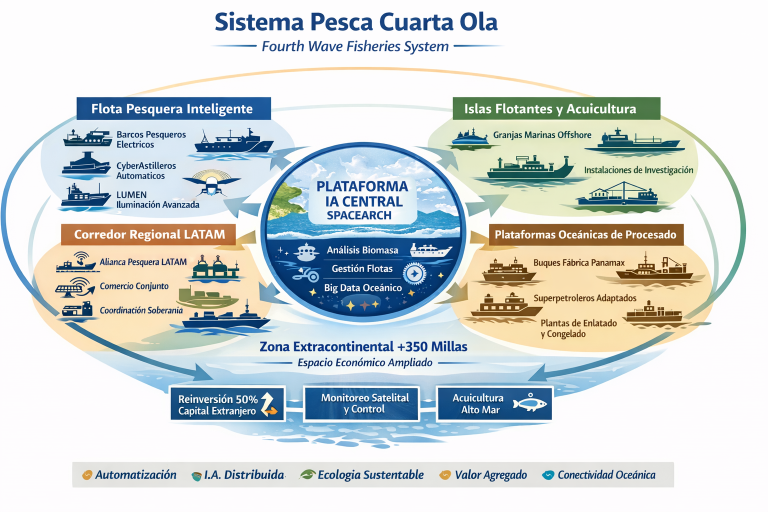
Simplified System Architecture
                 SPACEARCH
        (Digital infrastructure layer)                       │                PORTSFISH
        (Global fishing industry portal)                       │                      MVP
         (Integrated fishing companies)                       │          Sector Marketplace Ecosystem
          Online Auctions
          Global Seafood Commerce
The Logic of the Model
The objective of this ecosystem is not to replace the existing fishing industry.
Its purpose is to add a global digital layer that amplifies the value of existing productive infrastructure.
By integrating digital platforms with physical production capacity, the industry can:
• expand access to international markets
• improve commercial margins
• accelerate transactions
• increase sector visibility
• compete more effectively in the digital economy.
Strategic Perspective for Industry Leaders
The global fishing industry generates hundreds of billions of dollars annually through physical production.
Meanwhile, digital commerce is rapidly expanding toward trillions of dollars in global transactions.
The industries that succeed in the coming decade will be those capable of integrating production with digital market access.
The transition is not about abandoning physical infrastructure.
It is about adding the digital infrastructure required to compete in the global economy.
Participating in the SpaceArch ecosystem through the PortsFish platform allows companies to begin that transition with minimal initial investment while gaining access to global digital markets and continuous innovation through Digital Labs.
Direct Business Logic
The MVP is not a theoretical initiative.
Its objective is to build digital infrastructure capable of generating new commercial channels for the fishing industry.
There are three primary mechanisms through which this infrastructure can create economic value.
1. Direct International Sales
Many seafood transactions today rely heavily on intermediaries.
A digital platform allows companies to:
• showcase premium products globally
• connect directly with international buyers
• negotiate and close transactions more efficiently.
If a single international transaction improves pricing by 3–5%, the cost of participating in the MVP can be recovered multiple times over.
2. Digital Auctions
The platform can eventually support online auctions for seafood lots, allowing international buyers to compete in real time.
This mechanism can:
• increase buyer competition
• improve price discovery
• optimize commercial outcomes.
Even small price improvements across large annual volumes can generate substantial additional revenue.
3. Global Market Positioning
The portal also functions as a global marketing infrastructure for the sector.
Today, many buyers search for suppliers online before initiating contact.
If a company or sector does not appear digitally, it effectively does not exist for those buyers.
Digital visibility therefore becomes a strategic commercial asset.
The Key Point
The initial investment is not intended to generate immediate profits.
Its objective is to build the digital infrastructure of the industry.
Once the platform begins facilitating commercial transactions, the ecosystem can expand into:
• sector marketplaces
• online auctions
• digital logistics systems
• product traceability solutions
• sector market intelligence platforms.
At that stage, the system begins generating structural cash flow.
Strategic Conclusion
The fishing industry has already built an extraordinary physical infrastructure across fleets, ports, processing plants, and logistics networks.
What the industry still lacks is a coordinated global digital infrastructure capable of connecting that production directly to international markets.
That is precisely the infrastructure the SpaceArch + PortsFish ecosystem is designed to create.
Final Strategic Reflection
The global economy is entering a phase in which physical industries and digital platforms are becoming inseparable.
The companies that adopt digital infrastructure early will expand their reach and competitiveness.
Those that delay risk remaining confined to increasingly narrow traditional channels.
The strategic question for the fishing industry is therefore simple:
Who will lead its digital transformation?
Invitation to the Companies
Global Fishing Industry Digitalization Initiative
Dear Industry Leader,
The global fishing industry has built enormous physical infrastructure: fleets, ports, processing plants, and logistics networks.
However, the sector still lacks a coordinated global digital infrastructure capable of connecting producers directly with international markets.
At the same time, global digital commerce is expanding rapidly and could reach USD 6–10 trillion annually within the next decade, representing close to 10% of global GDP.
To address this opportunity, SpaceArch is launching the first phase of a digital ecosystem for the fishing industry through the international portal:
PortsFish.agency
The initiative begins with a Sector Minimum Viable Platform (MVP) designed to create the first digital infrastructure layer of the industry.
The MVP includes
• international portal of the fishing sector
• digital profiles of participating companies
• global catalogue of seafood products and services
• direct contact with international buyers
• global online visibility.
Participation
Initial participation is limited to minimum 20 companies.
Contribution:
USD 300 per company per month
Initial fund target:
USD 6,000
This first phase will establish the digital foundation of the ecosystem.
Why participate
Early participants gain:
• international digital visibility
• access to global buyers
• strategic positioning in the sector’s digital transformation
• participation in future platform developments such as marketplaces, auctions, and B2B commerce.
“The fishing industry already has vessels, ports and processing plants.
What it still lacks is its global digital infrastructure.”