

Dr. Abdulla Al Mandous
President
World Meteorological Organization (WMO)
Dear Dr. Al Mandous,
Greetings from Mar del Plata, Argentina.
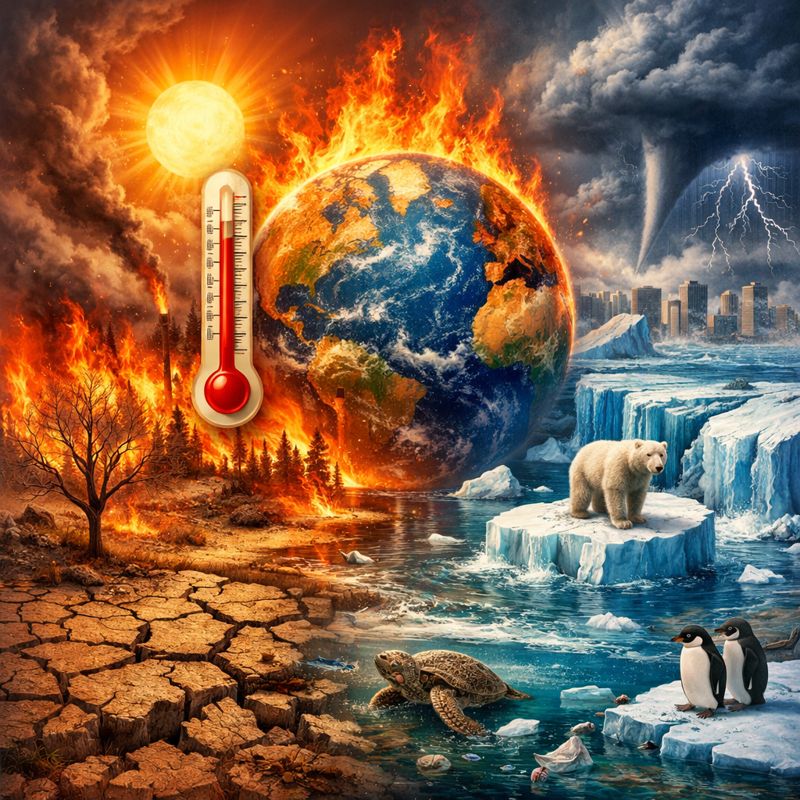
I have been working on the problem of global warming since 1992. Between 1998 and 2002, I determined that humanity would cross the first serious acceleration threshold of the climate anomaly around the middle of the third decade of this century. I also projected that Antarctica would enter an irreversible melting phase at a time when, in 2002, NASA publicly stated that such a scenario would not occur.
Today, we are facing what I define—based on systemic analysis—as a grave and serious systemic risk. I summarize this situation in the links provided below.
Anticipating this scenario, in 2019 I designed a Planetary Climate Emergency Master Plan. If activated in time, this plan would allow humanity to cross the current crisis without human or economic losses, limiting impacts to manageable secondary effects. If, on the contrary, Antarctic melting accelerates beyond control, coastal real estate assets worldwide will converge rapidly toward zero valuation. Under the emergency plan, however, valuations would tend to stabilize through an orderly transition.
Additionally, foreseeing the structural vulnerability of oil-dependent economies—particularly in Arab countries—I designed a macro–digital business association system that enables a non-collapsing transition from fossil fuel dependence to large-scale digital economic ecosystems.
All of this requires sober, serious, and technically grounded discussion at the highest institutional level.
I trust you as a valid and responsible interlocutor in this matter.
My wife, Pamela Cloyd, and I have maintained contacts with His Highness Sheikh Hamdan bin Mohammed Al Maktoum (Fazza), to whom we send our warm regards.
We respectfully await action and response on your part.
Below are the key reference links (the website includes an internal translator):
• Brief Report: The 2°C Climate Threshold
https://globalsolidarity.live/news/%f0%9f%93%91-brief-report-the-2-c-climate-threshold/
• Planetary Climate Emergency Master Plan
https://globalsolidarity.live/news/%f0%9f%8c%8d-master-plan-de-emergencia-climatico/
• Collapse of Coastal Real Estate Valuation Due to Sea-Level Rise
https://globalsolidarity.live/news/uncategorized/caida-del-metro-cuadrado-costero-por-ascenso-de-las-aguas/
Kind regards,
Roberto Guillermo Gomes
CEO at SpaceArch Solutions International, LLC, Miami
Node Mar del Plata, Argentina
Why Acting Now Is Rational in All Climate and Economic Scenarios
Even if the sustained crossing of the 2 °C global warming threshold for several consecutive months were to occur after 2030, acting now remains the optimal and rational decision from both a climate and economic perspective.
1. Early action solves the problem at its root
Climate inertia means that delayed responses accumulate energy in the Earth system—especially in oceans and cryosphere—making later corrections abrupt, expensive, and socially disruptive. Acting early addresses root causes, not just symptoms, reducing the probability of entering non-linear and irreversible regimes.
Early intervention is therefore not overreaction; it is systemic risk amortization.
2. Early action enables an orderly Fourth Wave acceleration
Technological acceleration—AI, full digitalization, automation—will occur regardless. The difference lies in whether it happens:
- Chaotically, concentrating wealth and increasing instability, or
- In an orderly and systemic way, aligned with climate stabilization and social continuity.
A coordinated transition plan transforms inevitable acceleration into a controlled Fourth Wave, maximizing productivity while minimizing friction.
3. A structural opportunity for oil-dependent economies
For oil-exporting countries, delaying transition increases vulnerability. Fossil-fuel-based growth is:
- finite,
- demand-constrained,
- exposed to climate regulation and geopolitical pressure.
By contrast, a globalized digital economy:
- is not resource-finite,
- scales with global GDP growth,
- scales with global population growth at a constant rate,
- benefits from network effects and automation.
Transitioning now is not a defensive move—it is a strategic leap.
4. Digital ROI has no structural ceiling
Oil revenue grows linearly with extraction and price. Digital economic ecosystems grow exponentially with:
- users,
- connectivity,
- data,
- automation,
- global integration.
This creates a potentially unlimited ROI, fully decoupled from emissions and compatible with climate stability.
5. Acting now dominates all scenarios
Whether the 2 °C sustained threshold materializes before or after 2030:
- Acting now reduces climate risk,
- stabilizes asset valuations (especially coastal real estate),
- preserves economic power,
- and unlocks higher long-term growth paths.
Not acting only postpones an inevitable transition—at higher cost and with less control.
Final synthesis
Acting now simultaneously addresses climate risk at its root, enables an orderly technological acceleration, and allows oil-dependent economies to transition into a higher-growth, unlimited-ROI digital model. Delaying action produces no strategic advantage—only higher systemic risk.