

PortsFish.Agency | Strategic Port Network
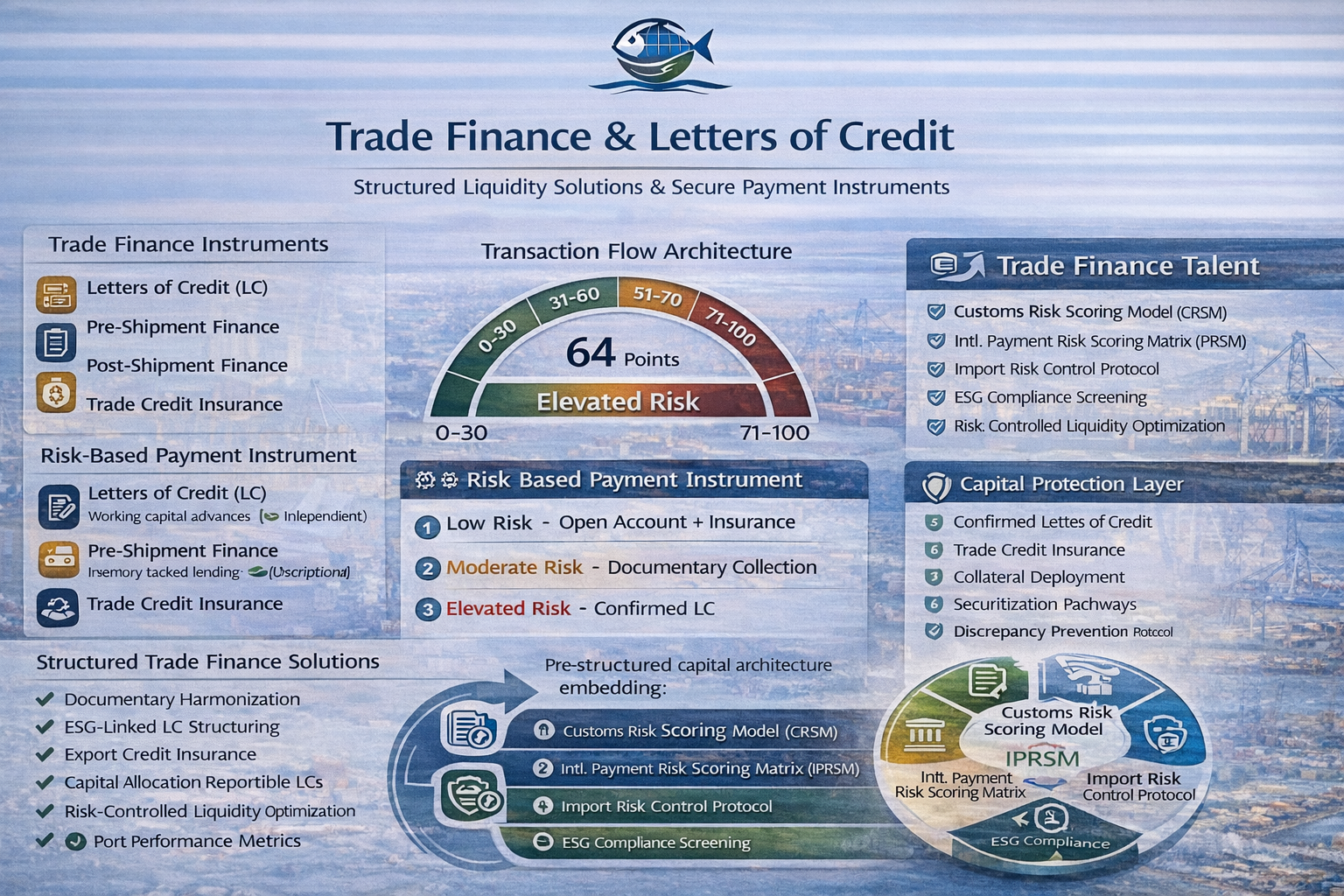
Trade Finance & Letters of Credit at PortsFish.Agency is a structured financial engineering service designed to secure, optimize, and scale international seafood transactions through bank-aligned instruments and risk-controlled capital deployment.
In global maritime trade, liquidity, risk allocation, and documentary precision determine whether transactions succeed or fail. Trade finance is not simply funding — it is a systemic mechanism that aligns banks, exporters, importers, insurers, customs authorities, and port operators into a synchronized commercial framework.
PortsFish transforms trade finance from reactive bank coordination into a pre-structured capital architecture embedded within the Strategic Port Network.
1. Structured Trade Finance Architecture
Every transaction is evaluated through an integrated risk framework combining:
- Customs Risk Scoring Model (CRSM)
- International Payment Risk Scoring Matrix (IPRSM)
- Import Risk Control Protocol
- Counterparty credit profiling
- ESG compliance screening
This enables selection of the optimal trade finance instrument before cargo movement.
2. Letters of Credit (LC) Structuring
Letters of Credit remain the backbone of secure international seafood trade.
PortsFish structures:
Irrevocable Letters of Credit
Ensures payment commitment independent of buyer solvency once compliant documents are presented.
Confirmed Letters of Credit
Adds a second bank guarantee to mitigate jurisdictional or political risk.
Standby Letters of Credit (SBLC)
Used as performance or payment guarantees in high-value contracts.
Sight vs. Usance LCs
Optimized based on liquidity needs, working capital cycles, and shipment timelines.
Back-to-Back LCs
Structured for intermediary traders operating between producer and final buyer.
Transferable LCs
Used for structured multi-party trade chains.
Our focus is eliminating documentary discrepancy risk through pre-shipment harmonization of LC terms and shipping documentation.
Objective: Reduce rejection probability and ensure smooth settlement.
3. Documentary Risk Mitigation
Document discrepancies are the primary cause of LC disputes.
PortsFish implements:
- Pre-issuance LC clause review
- Harmonization between LC terms and commercial contracts
- HS code consistency checks
- Health certificate alignment
- Bill of lading data synchronization
- Insurance clause validation
We engineer documentary compliance before bank submission.
4. Pre-Shipment & Post-Shipment Finance
Seafood trade requires strong liquidity management.
We structure:
Pre-Shipment Finance
- Working capital advances
- Inventory-backed lending
- Purchase order financing
Post-Shipment Finance
- Receivables discounting
- Forfaiting
- Factoring
- Structured receivables securitization
Integrated with port-based logistics and shipment verification data.
5. Trade Credit Insurance Integration
To reduce bank exposure and improve credit lines, PortsFish integrates:
- Export credit insurance
- Political risk insurance
- Non-payment coverage
- Shipment damage coverage
This improves eligibility for lower trade finance spreads.
6. Risk-Based Payment Instrument Selection
Based on IPRSM scoring:
Low Risk → Open Account + Insurance
Moderate Risk → Documentary Collection
Elevated Risk → Confirmed LC
High Risk → Confirmed LC + Insurance + Collateral
Financial structure adapts to quantified risk.
7. Capital Efficiency & Liquidity Optimization
PortsFish optimizes:
- Working capital cycles
- Cash conversion cycles
- Settlement timelines
- Margin requirements
- Collateral deployment
By synchronizing financial flows with shipping schedules and customs clearance timing.
8. ESG-Linked Trade Finance
For sustainability-aligned seafood trade, we support:
- Green trade finance eligibility
- ESG-linked LC structures
- Sustainability premium pricing triggers
- Traceability-backed underwriting
This improves access to ESG capital pools and multilateral facilities.
9. Bank Coordination & Underwriting Interface
PortsFish acts as structured liaison between:
- Commercial banks
- Trade finance desks
- Export credit agencies
- Multilateral lenders
- ESG funds
We provide:
- Risk scoring reports
- Transaction structuring notes
- Compliance documentation packages
- ESG validation reports
- Port performance metrics
This increases underwriting transparency.
10. Default & Contingency Protocol
If payment disruption occurs:
- Immediate discrepancy audit
- Insurance activation
- Collateral enforcement
- Alternative cargo redeployment
- Legal escalation pathway
Capital protection is embedded in the structure.
Strategic Outcome
Trade Finance & Letters of Credit under PortsFish are not transactional bank services — they are integrated financial control systems embedded within maritime trade corridors.
The objective is:
- Secure settlement
- Controlled risk
- Capital efficiency
- Regulatory alignment
- Scalable international liquidity
PortsFish aligns banks, ports, exporters, and importers into a structured financial ecosystem that transforms seafood trade into bankable, transparent, and ESG-ready capital flows.