Abstract
The global food system faces an unprecedented challenge: supplying sufficient, nutritious protein for a population projected to exceed 9.5 billion by mid-century while minimizing ecological impact. Terrestrial agriculture alone may struggle to meet this demand due to constraints in land availability, freshwater resources, and environmental sustainability. This paper explores the potential of marine proteins and edible algae as the core components of a scalable ocean-based food system, conceptualized within a Fourth-Wave Fisheries framework integrating advanced aquaculture, ocean processing infrastructure, and digital monitoring technologies. The analysis suggests that a technologically integrated marine food production system could significantly expand global protein supply while reducing pressure on terrestrial ecosystems.
1. Introduction
The increasing global demand for protein has intensified concerns about the long-term sustainability of current agricultural models. Conventional livestock production requires extensive land, freshwater, and feed inputs, and contributes substantially to greenhouse gas emissions.
In contrast, marine ecosystems provide a highly efficient pathway for protein production. Fish, mollusks, and marine algae demonstrate superior feed conversion efficiency, nutrient density, and lower environmental footprints compared with most terrestrial livestock systems.
Recent advances in:
- offshore aquaculture
- automated fishing fleets
- ocean monitoring technologies
- marine biotechnology
suggest that the oceans could support a new generation of large-scale, technologically managed food production systems.
2. Marine Proteins in the Global Diet
Marine resources already represent a critical component of global nutrition.
Current estimates indicate that:
- more than 3 billion people depend on fish as a major source of protein,
- seafood provides high-quality amino acids, omega-3 fatty acids, and essential micronutrients.
Compared with livestock, many marine species exhibit:
- lower feed conversion ratios
- faster growth cycles
- higher nutrient efficiency.
These characteristics make marine protein particularly attractive for large-scale food production systems.
3. Edible Algae as High-Efficiency Biomass
Marine algae represent one of the most promising biological resources for future food systems.
3.1 Productivity
Macroalgae and microalgae have extremely high growth rates, often exceeding those of terrestrial crops by an order of magnitude. Unlike traditional agriculture, algae cultivation:
- requires no arable land
- consumes no freshwater
- can utilize dissolved nutrients from seawater.
3.2 Nutritional Value
Many species of algae contain:
- high levels of protein
- essential amino acids
- vitamins and minerals
- bioactive compounds beneficial for human health.
3.3 Industrial Applications
Beyond direct human consumption, algae can be used for:
- protein concentrates
- aquaculture feed
- nutraceuticals
- food additives and functional foods.
4. The Fourth-Wave Ocean Food Production Model
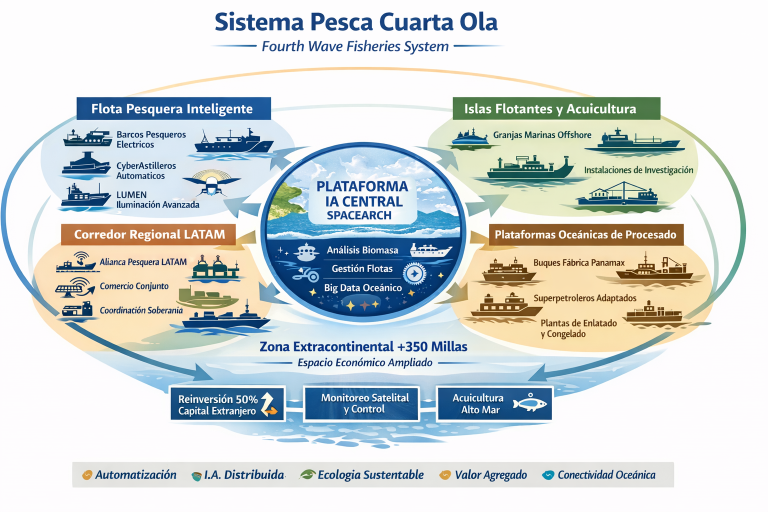
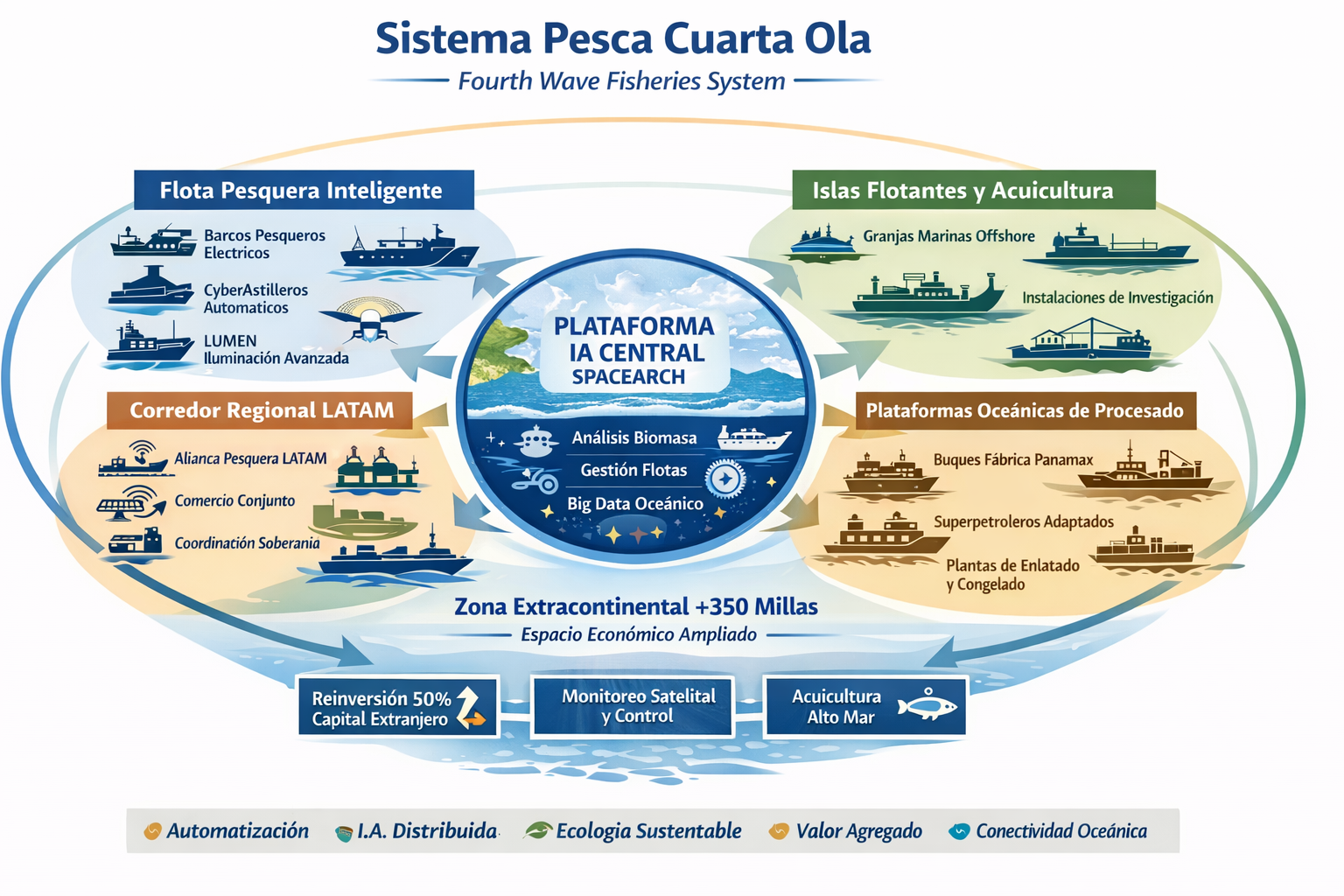
The Fourth-Wave model proposes an integrated ocean-based food system combining extraction, cultivation, processing, and digital management.
4.1 Intelligent Fisheries
Advanced fleets equipped with:
- biomass sensors
- satellite monitoring
- predictive artificial intelligence
can optimize fishing operations while maintaining sustainable harvest levels.
4.2 Offshore Aquaculture Platforms
Large-scale marine farms positioned in open ocean environments allow cultivation of:
- fish
- shellfish
- seaweed.
Integrated multi-trophic systems can recycle nutrients between species, improving ecological balance.
4.3 Floating Ocean Processing Platforms
Offshore processing infrastructure enables:
- rapid freezing
- packaging
- preservation
directly near harvest sites, reducing logistical losses and increasing economic value.
4.4 Ocean Data Infrastructure
Digital monitoring networks—combining satellite data, underwater sensors, and artificial intelligence—enable real-time management of marine ecosystems, supporting both productivity and sustainability.
5. Potential Contribution to Global Food Security
If marine food systems are developed with advanced technology and sustainable management practices, they could significantly increase the global protein supply.
Ocean-based production systems combining fisheries, aquaculture, and algae cultivation could:
- expand total marine food output,
- stabilize protein availability,
- reduce pressure on land-based agriculture.
Furthermore, marine food production can diversify dietary sources and enhance nutritional resilience in coastal regions and developing economies.
6. Sustainability Considerations
The expansion of ocean food production must be carefully managed to avoid ecological degradation. Key considerations include:
- maintaining sustainable harvest levels,
- protecting marine biodiversity,
- minimizing pollution from aquaculture operations,
- establishing international governance frameworks for ocean resources.
Technological monitoring systems and ecosystem-based management strategies will be essential to balance productivity and environmental protection.
7. Conclusion
Marine proteins and edible algae represent a powerful opportunity to transform the global food system. By integrating fisheries, aquaculture, marine biotechnology, and digital monitoring technologies into a coherent Fourth-Wave Ocean Food Production Model, humanity may significantly expand sustainable protein production while reducing environmental pressures on terrestrial ecosystems.
The oceans therefore represent not merely a source of extractive resources but a potential technological platform for global food security in the twenty-first century.