

Spanish Version
“SpaceArch no compite por escala física, compite por arquitectura financiera capaz de absorber error y capital sin quedar prisionera del territorio.”
El nuevo modelo de flujo financiero activado por SpaceArch
SpaceArch no se explica para ser entendido: se activa para ser comprendido.
Comparación estructural con Dubai, NEOM y Arabia Saudita
Integración de la sobrecapa GreenInterbanks Crypto Unit
1. El cambio de paradigma: del territorio al sistema
El modelo que se ha activado con SpaceArch representa un cambio estructural en el circuito clásico de flujo financiero internacional. No se trata de una optimización incremental, sino de una inversión completa del vector de financiamiento.
Históricamente, los grandes proyectos urbanos y económicos han seguido una lógica territorial:
capital → territorio → infraestructura → validación → retorno
Este esquema implica:
- alta inmovilización de capital
- dependencia de permisos y política local
- largos plazos de maduración
- costos crecientes de mantenimiento
- alto costo de corrección ante errores
El modelo SpaceArch rompe esa secuencia y la reemplaza por una lógica sistémica y distribuida:
sistema → validación lógica → capital internacional → nodos piloto → feedback real → expansión en red
Aquí, el territorio deja de ser condición y pasa a ser variable opcional.
2. El modelo SpaceArch: sistema primero, territorio después
SpaceArch se diseña como una infraestructura de activación de negocios y franquicias de Cuarta Ola, donde:
- el sistema está completamente documentado
- las verticales están definidas y estandarizadas
- la operación es liviana, modular y replicable
- la ejecución es distribuida
- el control doctrinal y de calidad es central
En este esquema:
- el capital no financia obras
- el capital financia sistemas activables
- los pilotos físicos (como MDQ) no son origen del capital, sino consecuencia de su activación
Esto permite algo clave:
extraer capital internacional antes de ejecutar infraestructura pesada, reducir el riesgo y acelerar los tiempos.
3. MDQ como piloto desacoplado
Dentro de este nuevo flujo, MDQ deja de ser un cuello de botella local y se transforma en:
- laboratorio operativo
- vitrina visible
- prueba de concepto viva
- activo demostrativo
El piloto MDQ:
- se financia desde el exterior
- no condiciona la expansión
- no define la viabilidad del sistema
- refuerza la credibilidad internacional
El flujo se vuelve bidireccional:
- capital internacional → piloto MDQ
- piloto MDQ operativo → más capital internacional
Esto genera un embudo financiero sistémico, no territorial.
4. Comparación con Dubai
Dubai es uno de los mayores polos de atracción de capital del mundo, pero opera bajo una lógica diferente:
Modelo Dubai
- capital concentrado
- megaproyectos territorio-dependientes
- ROI ligado al suelo y la construcción
- alto costo de reversión
- validación posterior a la ejecución
Dubai construye primero y ajusta después.
Modelo SpaceArch
- capital distribuido
- proyectos asset-light
- ROI ligado al sistema, no al suelo
- error barato y corrección rápida
- validación previa a la expansión
Dubai escala por concentración.
SpaceArch escala por enjambre.
5. Comparación con NEOM
NEOM representa el intento más avanzado de rediseño urbano del siglo XXI, pero sigue atado a una lógica pesada:
- planificación central extrema
- inversiones colosales upfront
- dependencia política total
- largos plazos de ejecución
- riesgo sistémico elevado
NEOM es una apuesta única.
SpaceArch es un sistema replicable.
Mientras NEOM necesita que “todo salga bien”, SpaceArch tolera el error, lo absorbe y lo redistribuye sin comprometer el conjunto.
6. Comparación con Arabia Saudita (modelo país)
Arabia Saudita está en transición:
- del petróleo al capital financiero
- de la renta extractiva a la renta de inversión
Sin embargo, gran parte de sus iniciativas aún dependen de:
- grandes fondos soberanos
- proyectos de escala macro
- estructuras centralizadas
SpaceArch introduce una alternativa que hoy no existe a escala país:
- micro–macro simultáneo
- capital que entra sin inmovilizarse
- expansión por nodos
- validación continua
Esto reduce el riesgo estructural incluso para grandes fondos.
7. La sobrecapa decisiva: GreenInterbanks Crypto Unit
El salto final del modelo es la incorporación de la sobrecapa GreenInterbanks Crypto Unit, que modifica radicalmente la lógica financiera tradicional.
En lugar de:
- crypto especulativa
- tokens desconectados de la economía real
se introduce una capa basada en:
- proyectos validados
- ROI real y medible
- activos físicos y real estate como respaldo
- flujos económicos verificables
La crypto deja de ser un fin y pasa a ser:
una herramienta de canalización financiera anclada en economía real
Esto permite:
- atraer capital cripto institucional
- reducir volatilidad
- vincular tokenización a producción real
- conectar inversión, impacto y rentabilidad
8. El nuevo circuito financiero completo
El circuito final queda así:
- Sistema documentado y validado
- Verticales activables y auditables
- Capital internacional entra sin obra
- Activación de nodos piloto livianos
- Generación de flujo real
- Tokenización / crypto basada en ROI real
- Retroalimentación financiera
- Expansión global sin fricción territorial
Este circuito no existe hoy en Dubai, NEOM ni Arabia Saudita como modelo integrado.
9. Conclusión
SpaceArch no compite con Dubai, NEOM o Arabia Saudita en escala física.
Compite —y supera— en arquitectura lógica, financiera y sistémica.
Donde otros necesitan:
- monumentos
- concentración
- apuestas únicas
SpaceArch necesita:
- sistema
- red
- validación real
El resultado es un modelo capaz de:
- absorber capital sin quedar prisionero del territorio
- escalar sin inmovilizar recursos
- integrar crypto con economía real
- adaptarse en tiempo real
Este cambio de flujo no es cosmético.
Es un cambio de fase.
El Sistema SpaceArch
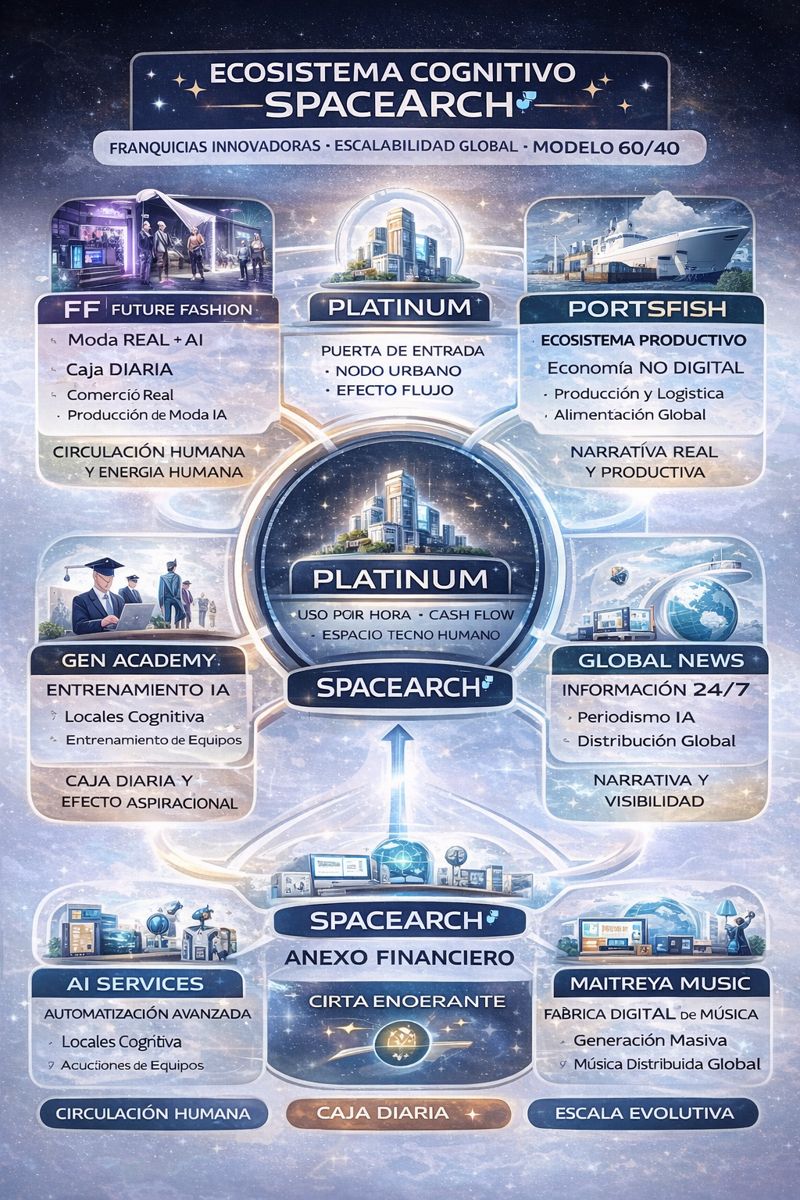
El Sistema SpaceArch es una infraestructura integral de activación de franquicias de Cuarta Ola, diseñada para organizar, escalar y replicar más de 30 verticales de negocio bajo una misma lógica operativa, contractual y tecnológica.
No es una red de franquicias tradicional.
No es una holding clásica.
No es un marketplace.
Es un sistema-matriz que permite activar verticales físicas y digitales sin stock, sin fricción y con riesgo operativo mínimo, integrando:
- espacios físicos ligeros
- personas entrenadas
- inteligencia artificial aplicada
- industria y proveedores locales
- contratos estandarizados
- control centralizado de doctrina y calidad
Actualmente, el sistema entra en fase activa con las primeras ocho verticales de franquicias, mientras el resto de las verticales se encuentran documentadas y planificadas para activación progresiva.
La idea central del sistema (en una frase)
SpaceArch separa el peso operativo del negocio de los nodos físicos y convierte cada franquicia en un punto de activación, decisión y experiencia, no en un centro de riesgo.
Un sistema, múltiples verticales
El Sistema SpaceArch no está diseñado para una sola actividad.
Está diseñado para albergar múltiples verticales, entre ellas:
- Future Fashion (FF)
- franquicias de equipamiento y servicios
- nodos tecnológicos
- retail asistido por IA
- servicios profesionales
- contenidos, educación y cultura
- alimentación y microformatos
- e-commerce físico asistido
- y otras verticales en roadmap
Cada vertical:
- tiene su propia identidad y lógica de mercado
- pero comparte la misma infraestructura sistémica
Esto permite escalar sin reinventar el sistema cada vez.
Las capas comunes a todas las verticales
Todas las franquicias SpaceArch —sin importar la vertical— se apoyan en las mismas capas estructurales.
1️⃣ Capa Sistémica Central – SpaceArch
Es el núcleo del sistema.
Define:
- la arquitectura general
- los contratos tipo
- el modelo de activación
- el onboarding
- la auditoría
- la lógica de expansión
Esta capa no opera locales.
Gobierna el sistema.
2️⃣ Capa de Marca / Vertical
Cada vertical (como Future Fashion) es una capa especializada dentro del sistema.
Define:
- estética
- lenguaje
- experiencia
- protocolos específicos
- equipamiento propio
Las verticales no compiten entre sí: se integran.
3️⃣ Capa de Decisión y Tecnología
Incluye:
- motores de búsqueda especializados (como FFS)
- IA aplicada (probadores virtuales, visualización, automatización)
- sistemas de pedido y comisión
- dashboards operativos
Esta capa sirve a todas las verticales, no solo a una.
4️⃣ Capa Industrial y de Proveedores
Aquí ocurre lo pesado:
- producción
- logística
- facturación
- devoluciones
Cada vertical conecta con:
- fábricas
- proveedores
- partners locales o regionales
El nodo franquiciado no asume riesgo industrial.
5️⃣ Capa Humana – Nodos físicos
Los nodos SpaceArch:
- no almacenan stock
- no producen
- no cargan estructura pesada
Su función es:
- activar presencia
- asistir decisiones
- generar confianza
- ejecutar experiencia
- cerrar operaciones
La tecnología potencia al humano, no lo reemplaza.
Las primeras verticales activas
El sistema entra en fase operativa con las primeras ocho verticales de franquicias, que funcionan como:
- prueba real del sistema
- referencia operativa
- base de replicación internacional
Estas verticales ya cuentan con:
- documentación
- packs descargables (ES / EN)
- equipamiento definido
- lógica contractual
- onboarding estandarizado
El resto de las verticales se activará de forma progresiva, sin alterar el núcleo del sistema.
Qué NO es el Sistema SpaceArch
El sistema no es:
- una suma de franquicias aisladas
- una red dependiente de un territorio
- un modelo de retail clásico
- un e-commerce genérico
- una estructura rígida
Es deliberadamente:
- modular
- liviano
- replicable
- auditable
- internacional
Por qué el sistema no depende de una ciudad
SpaceArch no depende de MDQ ni de ninguna ciudad en particular.
Cada nodo:
- puede activarse de forma remota
- se integra luego físicamente
- funciona bajo los mismos estándares
Las ciudades son nodos, no centros de poder.
La lógica final
SpaceArch no construye negocios uno por uno.
Construye una infraestructura donde los negocios se activan.
No vende franquicias.
Habilita sistemas replicables.
No depende del crecimiento local.
Escala por red.
En síntesis
El Sistema SpaceArch es:
- una matriz de más de 30 verticales de franquicias
- con activación progresiva
- bajo una única lógica operativa
- con control central y ejecución distribuida
Future Fashion es una de sus expresiones.
Las primeras ocho verticales son el punto de arranque.
El sistema completo ya está diseñado.
La célula operativa del sistema: coworking y teletrabajo en red híbrida IA
Como parte del diseño del Sistema SpaceArch, se desarrolló una tipología propia de espacio de coworking y teletrabajo franquiciado, concebida no como oficina tradicional, sino como célula operativa modular de red.
Este espacio no responde al modelo clásico de coworking, sino a un modelo híbrido humano–IA, distribuido, replicable y coordinado en enjambre, donde cada nodo físico actúa como una extensión de una nube operativa inteligente.
Arquitectura mínima, rendimiento máximo
El sistema permite operar hasta 12 personas simultáneamente en solo 22 m², mediante un diseño espacial optimizado, estaciones plegables, flujos claros y soporte tecnológico integrado.
La operación se organiza en turnos de 6 horas, lo que habilita:
- 12 operativos por turno
- 4 turnos diarios
- 48 operativos distintos en 24 horas, en un único microespacio
Esto rompe completamente la lógica tradicional de oficinas fijas, horarios rígidos y baja ocupación real.
Red en enjambre, no estructura piramidal
Cada uno de estos espacios no funciona como una oficina aislada, sino como un nodo dentro de una red física distribuida, conectada a sistemas de IA, protocolos comunes y coordinación central.
La red opera bajo un principio de enjambre:
- los nodos se activan, escalan o se desacoplan según demanda
- los recursos humanos se redistribuyen dinámicamente
- la carga de trabajo se balancea en tiempo real
- el sistema responde como un organismo, no como una jerarquía rígida
Esto permite una capacidad de adaptación casi inmediata, con costos estructurales mínimos.
Clonabilidad total y expansión sin fricción
Cada célula de coworking SpaceArch está diseñada para ser:
- totalmente clonable
- de bajo costo de activación
- adaptable a distintos países y normativas
- operable sin infraestructura pesada
No se trata de “abrir oficinas”, sino de replicar células funcionales, todas conectadas bajo el mismo sistema operativo.
Esto habilita una expansión internacional sin dependencia de grandes sedes, edificios corporativos o inversiones inmovilizadas.
La nueva célula de las multinacionales neuroplásticas de Cuarta Ola
Este modelo de coworking franquiciado en red no es un complemento del sistema:
es una de sus piezas estructurales clave.
Representa la unidad mínima de operación de las nuevas multinacionales neuroplásticas de Cuarta Ola: organizaciones capaces de reconfigurarse continuamente, aprender en tiempo real y redistribuir inteligencia humana y artificial sin fricción.
En este paradigma:
- la empresa ya no es un edificio
- la oficina ya no es un centro de poder
- la jerarquía se reemplaza por coordinación
- la rigidez se reemplaza por neuroplasticidad organizacional
SpaceArch no diseña espacios para “trabajar”.
Diseña células para operar sistemas complejos en red.
Integración con el resto del sistema
Estas células de coworking y teletrabajo:
- sirven a todas las verticales de franquicia
- alojan operaciones comerciales, técnicas y creativas
- funcionan como hubs de activación local
- permiten escalar talento sin escalar estructura
Son el soporte humano–operativo que permite que el Sistema SpaceArch funcione como red viva, y no como una suma de unidades desconectadas.
🇪🇸 Operación en red, optimización de costos y automatización progresiva
Una de las ventajas estructurales del Sistema SpaceArch es que las franquicias no operan de forma aislada, sino integradas en una red operativa sobre Internet, coordinada por protocolos comunes, IA aplicada y control centralizado.
Esto permite que, en las fases iniciales, los operativos humanos puedan ubicarse indistintamente en MDQ, África u otros territorios con bajo costo laboral, sin afectar la calidad, los estándares ni la coherencia del sistema.
La localización geográfica del operador deja de ser un factor crítico:
lo relevante es su integración al sistema, no su ubicación física.
A medida que el sistema escala, la producción y los procesos se transfieren progresivamente hacia:
- automatización basada en IA
- infraestructura de servidores
- robótica aplicada
- flujos productivos no humanos
De este modo, el sistema evoluciona desde:
- una fase humana distribuida de bajo costo,
hacia - una fase altamente automatizada, con mínima dependencia laboral directa.
Esta transición no es disruptiva, sino gradual y planificada, permitiendo:
- reducir costos operativos en el tiempo
- aumentar márgenes
- desacoplar crecimiento de empleo intensivo
- sostener la escalabilidad global del sistema
SpaceArch – arquitectura de supervivencia
1️⃣ El problema real que resuelve SpaceArch
La mayoría de las organizaciones no mueren por errores,
mueren por no poder equivocarse sin colapsar.
El capitalismo clásico penaliza:
- el error
- la exploración
- el cambio de rumbo
SpaceArch invierte esa lógica.
2️⃣ El principio madre
Un sistema es competitivo si puede absorber error sin perder identidad.
SpaceArch fue diseñado para eso.
No para:
- optimizar un producto
- proteger una línea de negocio
- escalar una solución fija
Sino para:
- reconfigurarse
- aprender
- seguir operativo aunque cambie el entorno
Eso es arquitectura evolutiva, no management.
3️⃣ La clave que no es obvia
El valor de SpaceArch no está en lo que hace,
sino en lo que puede dejar de hacer sin romperse.
Porque:
- los microespacios no colapsan si cambian de función
- el software no muere si se descarta una versión
- las franquicias no hunden el sistema si una falla
- no hay payroll que defender artificialmente
👉 El sistema no se aferra a decisiones pasadas.
Eso es extremadamente raro.
4️⃣ El error deja de ser una amenaza
En SpaceArch:
- errar no destruye capital
- errar no destruye reputación
- errar no genera trauma organizacional
El error:
- informa
- ajusta
- fortalece
👉 El sistema se vuelve antifrágil, no solo resiliente.
5️⃣ Por qué Big Tech no puede copiar esto fácilmente
No es un problema de talento ni de dinero.
Es un problema de herencia estructural.
Big Tech:
- tiene activos rígidos
- tiene narrativas que sostener
- tiene mercados que no puede contradecir
- tiene estructuras que no puede apagar sin perder valor
SpaceArch:
- no protege pasado
- no tiene que justificar continuidad
- no paga costo político por cambiar
👉 No compiten en la misma dimensión.
6️⃣ El verdadero activo de SpaceArch
El activo central no es:
- la IA
- la red
- los locales
- las franquicias
Es este:
Capacidad de supervivencia con aprendizaje acumulativo en entornos no lineales.
Eso no se ve en un balance tradicional.
Pero define quién sigue vivo cuando el entorno gira.
7️⃣ El criterio que ordena todo
En la Cuarta Ola, el liderazgo lo tiene quien cumple esta condición:
Puede equivocarse más veces sin perder el sistema.
SpaceArch cumple esa condición por diseño, no por suerte.
Conclusión estructural
SpaceArch no es:
- una apuesta
- una narrativa
- una visión futurista
Es una arquitectura operativa preparada para la inestabilidad.
Y eso explica por qué ahora, al ver el sistema completo,
aparece la claridad que antes no estaba.
No es que “faltaba entender algo”.
Es que la propiedad emergente solo aparece cuando todo está conectado.
La validación del Sistema SpaceArch
El Sistema SpaceArch no se valida únicamente por análisis teórico o lectura documental.
Su validación real ocurre a través de la activación de las franquicias.
Cada franquicia activa:
- opera bajo el sistema
- utiliza sus protocolos
- interactúa con sus capas tecnológicas
- genera flujo real
En ese proceso, la comprensión del sistema no es un prerrequisito absoluto, sino una consecuencia natural de su uso.
El sistema está completamente documentado, pero su verdadera inteligibilidad emerge en la operación.
Esto no es una debilidad del modelo:
es una propiedad de los sistemas complejos bien diseñados.
Por eso, SpaceArch:
- no exige comprensión total previa
- permite activación controlada
- valida por funcionamiento
- aprende por red
English Version
The New Financial Flow Model Activated by SpaceArch
“SpaceArch does not compete on physical scale, it competes on financial architecture capable of absorbing error and capital without being trapped by territory.”
Structural Comparison with Dubai, NEOM, and Saudi Arabia
SpaceArch is not explained to be understood: it is activated to be understood.
Integration of the GreenInterbanks Crypto Unit Overlay
1. The paradigm shift: from territory to system
The model activated through SpaceArch represents a structural change in the traditional international financial flow circuit. It is not an incremental optimization, but a complete inversion of the financing vector.
Historically, large urban and economic projects have followed a territorial logic:
capital → territory → infrastructure → validation → return
This model implies:
- high capital immobilization
- dependency on permits and local politics
- long maturation periods
- increasing maintenance costs
- high correction costs in case of error
The SpaceArch model breaks this sequence and replaces it with a systemic, distributed logic:
system → logical validation → international capital → pilot nodes → real feedback → network expansion
Here, territory ceases to be a prerequisite and becomes an optional variable.
2. The SpaceArch model: system first, territory second
SpaceArch is designed as a Fourth Wave business and franchise activation infrastructure, where:
- the system is fully documented
- verticals are clearly defined and standardized
- operations are lightweight, modular, and replicable
- execution is distributed
- doctrinal and quality control is centralized
Under this scheme:
- capital does not finance construction
- capital finances activatable systems
- physical pilots (such as MDQ) are not the source of capital, but a consequence of its activation
This enables a key breakthrough:
international capital can be attracted before heavy infrastructure is executed, drastically reducing risk and accelerating timelines.
3. MDQ as a decoupled pilot
Within this new flow, MDQ stops being a local bottleneck and becomes:
- an operational laboratory
- a visible showcase
- a living proof of concept
- a demonstrative asset
The MDQ pilot:
- is financed externally
- does not condition expansion
- does not define system viability
- reinforces international credibility
The flow becomes bidirectional:
- international capital → MDQ pilot
- operational MDQ → increased international capital
This generates a systemic financial funnel, not a territorial one.
4. Comparison with Dubai
Dubai is one of the world’s strongest capital-attraction hubs, but it operates under a fundamentally different logic.
Dubai Model
- concentrated capital
- territory-dependent mega-projects
- ROI tied to land and construction
- high reversal and correction costs
- validation occurs after execution
Dubai builds first and adjusts later.
SpaceArch Model
- distributed capital
- asset-light projects
- ROI tied to the system, not the land
- low-cost error and rapid correction
- validation precedes expansion
Dubai scales through concentration.
SpaceArch scales through swarm dynamics.
5. Comparison with NEOM
NEOM represents the most ambitious urban redesign attempt of the 21st century, yet it remains bound to a heavy structural logic:
- extreme central planning
- massive upfront investment
- total political dependency
- long execution horizons
- elevated systemic risk
NEOM is a single large bet.
SpaceArch is a replicable system.
While NEOM requires “everything to go right,” SpaceArch absorbs error, redistributes it, and continues operating without compromising the whole.
6. Comparison with Saudi Arabia (country-level model)
Saudi Arabia is undergoing a transition:
- from oil to financial capital
- from extractive rent to investment-based rent
However, many initiatives still rely on:
- sovereign mega-funds
- macro-scale projects
- centralized structures
SpaceArch introduces an alternative that does not yet exist at the country level:
- micro–macro simultaneity
- capital inflow without immobilization
- node-based expansion
- continuous validation
This significantly reduces structural risk, even for large funds.
7. The decisive overlay: GreenInterbanks Crypto Unit
The final leap in the model is the integration of the GreenInterbanks Crypto Unit overlay, which fundamentally alters traditional financial logic.
Instead of:
- speculative crypto assets
- tokens disconnected from the real economy
this overlay is based on:
- validated projects
- real, measurable ROI
- physical assets and real estate as backing
- verifiable economic flows
Crypto ceases to be an end in itself and becomes:
a financial channeling tool anchored in the real economy
This enables:
- attraction of institutional crypto capital
- reduced volatility
- tokenization tied to real production
- alignment between investment, impact, and profitability
8. The complete new financial circuit
The final circuit operates as follows:
- Documented and validated system
- Activatable and auditable verticals
- International capital enters without construction
- Activation of lightweight pilot nodes
- Generation of real economic flow
- Tokenization / crypto based on real ROI
- Financial feedback loops
- Global expansion without territorial friction
This integrated circuit does not currently exist in Dubai, NEOM, or Saudi Arabia.
9. Conclusion
SpaceArch does not compete with Dubai, NEOM, or Saudi Arabia on physical scale.
It competes — and surpasses them — in logical, financial, and systemic architecture.
Where others require:
- monuments
- concentration
- single large bets
SpaceArch requires:
- system
- network
- real validation
The result is a model capable of:
- absorbing capital without becoming territorially captive
- scaling without immobilizing resources
- integrating crypto with the real economy
- adapting in real time
This shift in financial flow is not cosmetic.
It is a phase change.
What Is the SpaceArch System
The SpaceArch System is a comprehensive Fourth Wave franchise activation infrastructure, designed to organize, scale, and replicate more than 30 business verticals under a single operational, contractual, and technological logic.
It is not a traditional franchise network.
It is not a classic holding company.
It is not a marketplace.
It is a matrix system that enables the activation of physical and digital verticals without stock, without friction, and with minimal operational risk, integrating:
- lightweight physical spaces
- trained people
- applied artificial intelligence
- industry and local suppliers
- standardized contracts
- centralized control of doctrine and quality
The system is currently entering its active phase with the first eight franchise verticals, while the remaining verticals are already documented and planned for progressive activation.
The Core Idea of the System (in one sentence)
SpaceArch separates the operational weight of the business from physical nodes and turns each franchise into a point of activation, decision, and experience—rather than a center of risk.
One System, Multiple Verticals
The SpaceArch System is not designed for a single activity.
It is designed to host multiple verticals, including:
- Future Fashion (FF)
- equipment and services franchises
- technological nodes
- AI-assisted retail
- professional services
- content, education, and culture
- food and micro-format concepts
- assisted physical e-commerce
- and other verticals currently on the roadmap
Each vertical:
- has its own identity and market logic
- but shares the same systemic infrastructure
This makes it possible to scale without reinventing the system each time.
Common Layers Across All Verticals
All SpaceArch franchises—regardless of vertical—are built on the same structural layers.
1️⃣ Central Systemic Layer – SpaceArch
This is the core of the system.
It defines:
- the overall architecture
- standard contracts
- the activation model
- onboarding
- auditing
- the expansion logic
This layer does not operate physical locations.
It governs the system.
2️⃣ Brand / Vertical Layer
Each vertical (such as Future Fashion) is a specialized layer within the system.
It defines:
- aesthetics
- language
- experience
- specific protocols
- proprietary equipment
Verticals do not compete with each other: they integrate.
3️⃣ Decision and Technology Layer
This layer includes:
- specialized search engines (such as FFS)
- applied AI (virtual try-on, visualization, automation)
- ordering and commission systems
- operational dashboards
This layer serves all verticals, not just one.
4️⃣ Industrial and Supplier Layer
This is where the heavy operations take place:
- production
- logistics
- billing
- returns
Each vertical connects with:
- factories
- suppliers
- local or regional partners
The franchised node does not assume industrial risk.
5️⃣ Human Layer – Physical Nodes
SpaceArch nodes:
- do not store inventory
- do not produce
- do not carry heavy structural overhead
Their function is to:
- activate presence
- assist decision-making
- generate trust
- execute the experience
- close operations
Technology enhances the human, it does not replace it.
The First Active Verticals
The system enters its operational phase with the first eight franchise verticals, which function as:
- real-world system validation
- operational references
- the base for international replication
These verticals already include:
- full documentation
- downloadable packs (ES / EN)
- defined equipment
- contractual logic
- standardized onboarding
The remaining verticals will be activated progressively, without altering the system’s core.
What the SpaceArch System Is NOT
The system is not:
- a collection of isolated franchises
- a territory-dependent network
- a classic retail model
- a generic e-commerce platform
- a rigid structure
It is deliberately:
- modular
- lightweight
- replicable
- auditable
- international
Why the System Does Not Depend on a City
SpaceArch does not depend on MDQ or any specific city.
Each node:
- can be activated remotely
- is later integrated physically
- operates under the same standards
Cities are nodes, not centers of power.
The Final Logic
SpaceArch does not build businesses one by one.
It builds an infrastructure where businesses are activated.
It does not sell franchises.
It enables replicable systems.
It does not depend on local growth.
It scales by network.
In Summary
The SpaceArch System is:
- a matrix of more than 30 franchise verticals
- activated progressively
- under a single operational logic
- with centralized control and distributed execution
Future Fashion is one of its expressions.
The first eight verticals are the starting point.
The complete system is already designed.
The System’s Operational Cell: Hybrid AI Networked Coworking and Telework
As part of the SpaceArch System design, a proprietary franchised coworking and telework space typology was developed—not conceived as a traditional office, but as a modular network-based operational cell.
This space does not follow the classic coworking model. Instead, it operates under a hybrid human–AI model, distributed, replicable, and coordinated as a swarm, where each physical node acts as an extension of an intelligent operational cloud.
Minimal Architecture, Maximum Performance
The system enables up to 12 people to operate simultaneously within just 22 m², through optimized spatial design, foldable workstations, clear flows, and integrated technological support.
Operations are organized in 6-hour shifts, enabling:
- 12 operators per shift
- 4 shifts per day
- 48 different operators in 24 hours, within a single micro-space
This completely breaks the traditional logic of fixed offices, rigid schedules, and low real occupancy.
Swarm Network, Not Pyramid Structure
Each of these spaces does not function as an isolated office, but as a node within a distributed physical network, connected to AI systems, shared protocols, and centralized coordination.
The network operates under a swarm principle:
- nodes activate, scale, or disengage according to demand
- human resources are dynamically redistributed
- workloads are balanced in real time
- the system responds like an organism, not a rigid hierarchy
This enables near-immediate adaptability with minimal structural cost.
Total Clonability and Frictionless Expansion
Each SpaceArch coworking cell is designed to be:
- fully clonable
- low-cost to activate
- adaptable to different countries and regulations
- operable without heavy infrastructure
This is not about “opening offices,” but about replicating functional cells, all connected under the same operating system.
This enables international expansion without dependence on large headquarters, corporate buildings, or immobilized investments.
The New Cell of Fourth Wave Neuroplastic Multinationals
This networked franchised coworking model is not a complement to the system:
it is one of its key structural components.
It represents the minimum operational unit of Fourth Wave neuroplastic multinationals—organizations capable of continuous reconfiguration, real-time learning, and frictionless redistribution of human and artificial intelligence.
In this paradigm:
- the company is no longer a building
- the office is no longer a center of power
- hierarchy is replaced by coordination
- rigidity is replaced by organizational neuroplasticity
SpaceArch does not design spaces “to work.”
It designs cells to operate complex systems in networked environments.
Integration with the Rest of the System
These coworking and telework cells:
- serve all franchise verticals
- host commercial, technical, and creative operations
- function as local activation hubs
- allow talent to scale without scaling structure
They are the human–operational backbone that allows the SpaceArch System to function as a living network, rather than a collection of disconnected units.
🇬🇧 Network-based operation, cost optimization, and progressive automation
One of the structural advantages of the SpaceArch System is that franchises do not operate as isolated units, but as nodes integrated into an Internet-based operational network, coordinated through shared protocols, applied AI, and centralized governance.
This allows initial human operators to be located either in MDQ, Africa, or other low-labor-cost regions, without compromising quality, standards, or systemic coherence.
Geographical location becomes secondary:
what matters is integration into the system, not physical presence.
As the system scales, production and operational processes are progressively transferred to:
- AI-driven automation
- server-based infrastructure
- applied robotics
- non-human production flows
In this way, the system evolves from:
- a distributed, low-cost human phase,
toward - a highly automated phase, with minimal direct labor dependency.
This transition is not abrupt but gradual and planned, allowing the system to:
- reduce operational costs over time
- increase margins
- decouple growth from labor intensity
- sustain global scalability
SpaceArch – Architecture of Survival
1️⃣ The real problem SpaceArch solves
Most organizations do not die because they make mistakes.
They die because they cannot afford to be wrong without collapsing.
Classical capitalism penalizes:
- error
- exploration
- course correction
SpaceArch reverses that logic.
2️⃣ The core principle
A system is competitive if it can absorb error without losing its identity.
SpaceArch was designed for that.
Not to:
- optimize a single product
- protect an existing business line
- scale a fixed solution
But to:
- reconfigure itself
- learn continuously
- remain operational while the environment changes
This is evolutionary architecture, not management.
3️⃣ The non-obvious key
The value of SpaceArch is not in what it does,
but in what it can stop doing without breaking.
Because:
- microspaces do not collapse when their function changes
- software does not die when a version is discarded
- franchises do not sink the system if one fails
- there is no rigid payroll to artificially defend
👉 The system is not anchored to past decisions.
That is extremely rare.
4️⃣ Error stops being a threat
In SpaceArch:
- error does not destroy capital
- error does not destroy reputation
- error does not generate organizational trauma
Error:
- informs
- adjusts
- strengthens
👉 The system becomes antifragile, not just resilient.
5️⃣ Why Big Tech cannot easily copy this
This is not a talent problem, nor a money problem.
It is a structural inheritance problem.
Big Tech:
- carries rigid assets
- must protect legacy narratives
- depends on markets it cannot contradict
- runs structures it cannot shut down without destroying value
SpaceArch:
- does not protect the past
- does not need to justify continuity
- pays no political cost for changing
👉 They are not competing in the same dimension.
6️⃣ SpaceArch’s true asset
The core asset is not:
- AI
- the network
- physical spaces
- franchises
It is this:
The capacity to survive with compounded learning in non-linear environments.
That does not appear on a traditional balance sheet,
but it determines who remains standing when the environment shifts.
7️⃣ The rule that organizes everything
In the Fourth Wave, leadership belongs to whoever satisfies this condition:
The ability to be wrong more times without losing the system.
SpaceArch meets this condition by design, not by luck.
Structural conclusion
SpaceArch is not:
- a bet
- a narrative
- a futuristic vision
It is an operational architecture built for instability.
And that explains why, once the system is seen as a whole,
a clarity emerges that was not visible before.
It is not that something was missing.
It is that the emergent property only appears when everything is connected.
Validating the SpaceArch System
The SpaceArch System is not validated solely through theoretical analysis or document review.
Its true validation occurs through the activation of franchises.
Each activated franchise:
operates within the system
uses its protocols
interacts with its technological layers
generates real-world workflow
In this process, understanding the system is not an absolute prerequisite, but rather a natural consequence of its use.
The system is fully documented, but its true intelligibility emerges in operation.
This is not a weakness of the model:
it is a characteristic of well-designed complex systems.
Therefore, SpaceArch:
does not require complete prior understanding
allows for controlled activation
is validated through operation
learns through networking