







Nota analítica
Razones de la ausencia de inversión estructural de Big Tech y decisión estratégica de SpaceArch
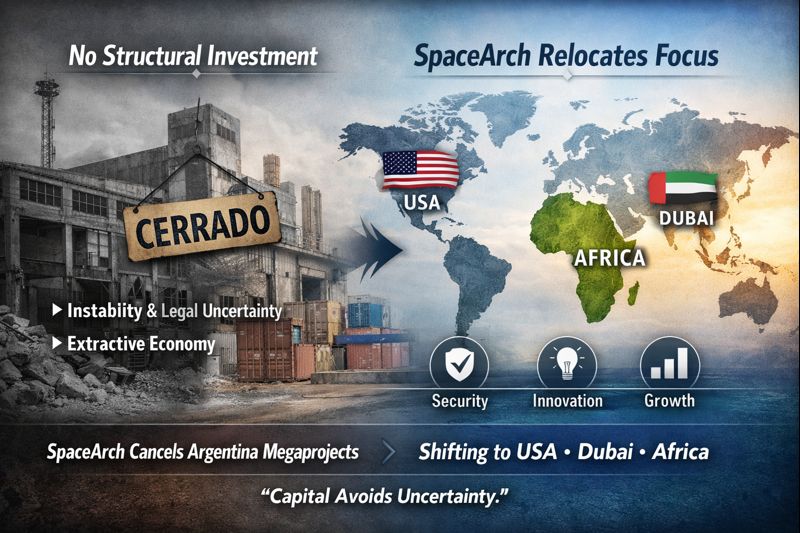
SpaceArch no se retira de Argentina.
Concluye que el sistema argentino actual no es compatible con la inversión sistémica, estructural y de largo plazo.
Esta conclusión no proviene de un actor nacional que se adapta a limitaciones locales, sino de una empresa estadounidense que intentó desplegar capital, estructura e inversión a largo plazo, y se encontró con resistencias sistémicas.
El problema no es la política económica vigente, sino la ausencia de mecanismos internos capaces de producir un cambio estructural sostenido.
Solo un cambio radical de política podría alterar la trayectoria, e incluso ese escenario enfrenta limitaciones sistémicas profundas.
La decisión de SpaceArch no provoca una fuga de capitales. Confirma por qué el capital nunca llegó estructuralmente en primer lugar.
Argentina no se está derrumbando: simplemente no es un país en el que se pueda invertir a gran escala en el futuro previsible.
1. Introducción: el error de lectura recurrente
En Mar del Plata (MDQ), en Argentina y en gran parte de América Latina persiste una confusión estructural entre:
- actividad económica
- inversión
- y desarrollo estructural
La presencia de empresas globales, plataformas digitales o flujos financieros no implica inversión estructural. La mayor parte de la actividad observable es extractiva, no transformadora.
Este error de diagnóstico explica por qué, pese a décadas de anuncios, no se consolidan hubs tecnológicos, centros de decisión, ni infraestructura productiva de escala internacional.
2. El modelo endógeno anacrónico
El sistema económico dominante en Argentina y buena parte de LATAM presenta rasgos persistentes:
a) Endogamia estructural
- Redes cerradas de decisión
- Captura local de rentas
- Baja permeabilidad a capital internacional independiente
- Prioridad del control político sobre la eficiencia sistémica
b) Anacronismo institucional
- Marcos normativos inestables
- Cambios de reglas ex post
- Inseguridad jurídica crónica
- Judicialización imprevisible
- Ausencia de garantías a largo plazo
c) Cultura anti-estructura
- Se tolera la actividad informal
- Se penaliza la inversión de largo plazo
- Se desincentiva la acumulación de capital productivo
- Se premia el corto plazo y la supervivencia táctica
Este modelo no está diseñado para albergar estructuras complejas, solo para permitir circulación económica básica.
3. Por qué las Big Tech no invierten estructuralmente
Las Big Tech no son ingenuas ni ideológicas. Son sistemas racionales.
Su comportamiento en Argentina y LATAM es consistente:
✔️ Qué hacen
- Extraen talento
- Extraen datos
- Extraen consumo
- Venden servicios
- Operan con contratos livianos
- Utilizan proveedores locales
❌ Qué NO hacen
- No instalan centros decisorios
- No localizan IP estratégica
- No crean hubs regionales reales
- No invierten en infraestructura crítica
- No asumen riesgo jurídico soberano
👉 Esto no es casualidad: es decisión preventiva.
Cuando el riesgo jurídico supera cierto umbral, la inversión estructural desaparece y es reemplazada por modelos livianos, reversibles y extractivos.
4. El caso MDQ: diagnóstico empírico
Mar del Plata presenta, de forma amplificada, los mismos rasgos:
- Ausencia de respuesta institucional coherente
- Bloqueo pasivo a proyectos transformadores
- Inercia administrativa
- Falta de visión sistémica
- Resistencia cultural al cambio estructural
No se trata de una hipótesis:
👉 es verificación empírica reiterada.
Los proyectos que implican:
- reorganización productiva
- cambio de flujos
- inversión estructural
- integración internacional real
no escalan.
5. El punto crítico: capitales alternativos y falta de decisión política
SpaceArch impulsó —de manera formal— la creación de capitales alternativos, entre ellas MDQ, como instrumento para:
- liberar restricciones estructurales
- atraer inversión internacional
- crear zonas de excepción operativa
- garantizar seguridad jurídica reforzada
- habilitar experimentación económica avanzada
Este mecanismo requiere decisión política del Poder Ejecutivo Nacional (PEN).
Hecho objetivo:
- No hubo respuesta
- No hubo decreto
- No hubo marco habilitante
La ausencia de decisión equivale a una negativa sistémica.
6. Decisión de SpaceArch
Ante este escenario, SpaceArch adopta una decisión empresarial racional y documentada:
🔹 Se cancelan:
- todos los megaproyectos previstos para MDQ
- toda inversión estructural en Argentina
- todo despliegue que requiera estabilidad jurídica a largo plazo
🔹 Se mantiene:
- una unidad operativa mínima
- funciones tácticas y residuales
- sin rol estratégico ni decisorio
🔹 Se redefine el eje central:
USA – Dubai – África
Donde:
- existe seguridad jurídica
- hay voluntad de cambio
- los costos estructurales son competitivos
- el capital es bienvenido
- la ejecución es posible
7. Esto no es un caso aislado: es una señal anticipatoria
La decisión de SpaceArch no es excepcional.
Es:
- preventiva
- racional
- anticipatoria
- coherente con el comportamiento de grandes actores globales
La diferencia es que:
👉 SpaceArch lo formaliza y lo documenta.
Muchos otros simplemente no invierten y no lo explican.
8. Conclusión
Argentina y gran parte de América Latina no carecen de talento, recursos o ideas.
Carecen de estructura institucional confiable para sostener inversión de largo plazo.
Mientras ese déficit persista:
- la inversión será extractiva
- los proyectos estructurales migrarán
- los centros de decisión se ubicarán en otros ejes
- el desarrollo real seguirá postergado
SpaceArch no abandona personas ni territorios.
Abandona marcos que no permiten construir futuro.
Frase de cierre (institucional)
“Capital does not flee countries.
It avoids uncertainty.”Las grandes tecnológicas no son el futuro por sí mismas, pero sin plataformas a escala de grandes tecnológicas, densidad de capital y concentración de propiedad intelectual, ningún país lidera el futuro.
La historia es muy clara en este punto.
Todas las regiones que han dado forma a una era tecnológica (EE. UU., Europa Occidental, Asia Oriental) lo hicieron albergando centros de decisión, tecnología propia y estructuras de capital a largo plazo, no simplemente aportando talento o consumo.Lo que muchos países confunden es actividad versus estructura.
Se pueden tener startups, autónomos, servicios e incluso unicornios, y aun así carecer de fuerza estratégica si:La propiedad intelectual es externa
La toma de decisiones se realiza en el extranjero
Las normas son inestables
La infraestructura a largo plazo no se puede proteger
Las grandes tecnológicas no definen el futuro por sí solas, pero son una condición necesaria para el liderazgo en él.
Cuando las grandes tecnológicas no se anclan estructuralmente, el resultado es predecible: extracción de talento, ciclos cortos y dependencia periférica.Esto no es ideología.
Es cómo se comporta el capital cuando optimiza el riesgo, el horizonte temporal y el control. Los países no son “castigados”.
Simplemente se les ignora.
La verdadera prioridad de inversión que Argentina evita
Argentina suele identificar mal sus prioridades estratégicas.
Energía, alimentos, logística, transporte y recursos naturales son importantes, pero no constituyen el cuello de botella principal que impide la inversión estructural y de largo plazo.
El verdadero límite es institucional.
Ningún país atrae inversión intensiva en capital, de gran escala y horizonte largo sin un sistema judicial y de aplicación de la ley creíble, moderno y eficaz. Esto incluye tanto al sistema judicial como al sistema policial y de ejecución.
Cuando el cumplimiento de contratos es lento, selectivo o impredecible;
cuando los derechos de propiedad dependen de interpretaciones discrecionales;
cuando la seguridad jurídica es inconsistente;
el capital global no discute: se redirige.
Las multinacionales no invierten miles de millones basándose en relatos macroeconómicos o potencial de recursos. Invierten donde:
- la ley se aplica de manera igual para todos
- los conflictos se resuelven en plazos previsibles
- los contratos sobreviven a los cambios políticos
- la seguridad y la ejecución son confiables
- las decisiones judiciales no son arbitrarias ni retroactivas
Sin estas garantías, los modelos de inversión se diseñan como extractivos, reversibles o mínimos por definición.
Por eso Argentina puede atraer actividad, pero no estructura.
Los proyectos energéticos, de infraestructura y logística requieren estabilidad durante décadas.
Si los sistemas judicial y de ejecución no garantizan continuidad y protección en el tiempo, la exposición de capital se limita deliberadamente, sin importar la rentabilidad potencial.
La conclusión incómoda es simple:
La puerta de acceso primaria del capital estructural hacia Argentina no es la política energética ni la industrial, sino la reforma judicial e institucional.
Mientras el sistema judicial y policial no sea modernizado, profesionalizado, digitalizado y aislado de la volatilidad política, Argentina no:
- desbloqueará inversión sostenida de largo plazo
- alojará centros regionales de decisión
- acumulará propiedad intelectual a escala
- ni incrementará de manera significativa su PIB en el largo plazo
El capital no exige perfección.
Exige previsibilidad, igualdad ante la ley y capacidad efectiva de ejecución.
Hasta que esa base exista, las políticas de desarrollo seguirán atacando los síntomas, mientras la causa estructural permanece intacta.
“El capital estructural no abandona países. Los sistemas que no garantizan la ley, simplemente dejan de ser elegibles.
“La estabilidad macro ordena el presente, pero solo la inversión estructural construye el futuro.
Sin garantías institucionales, la inflación puede bajar —pero el desarrollo no llega.”
Analytical Note
Structural Status Quo in MDQ, Argentina and Latin America
Why Big Tech avoids structural investment and SpaceArch’s strategic decision
SpaceArch is not withdrawing from Argentina.
It concludes that the current Argentine system is incompatible with systemic, structural, and long-term investment.
This conclusion does not come from a domestic player adapting to local limitations, but from a US company that attempted to deploy capital, infrastructure, and long-term investment, and encountered systemic resistance.
The problem is not the current economic policy, but the absence of internal mechanisms capable of producing sustained structural change.
Only a radical policy shift could alter the trajectory, and even that scenario faces profound systemic limitations.
SpaceArch’s decision does not trigger a capital flight.
It confirms why capital never arrived structurally in the first place.
Argentina is not collapsing — it is simply not investable at scale in the foreseeable future
1. Introduction: a recurring misreading
In Mar del Plata (MDQ), in Argentina, and across much of Latin America, there is a persistent structural confusion between:
- economic activity
- investment
- and structural development
The presence of global companies, digital platforms, or financial flows does not equal structural investment. Most observable activity is extractive, not transformative.
This misdiagnosis explains why, despite decades of announcements, no true technology hubs, decision centers, or large-scale productive infrastructure are consolidated.
2. The anachronistic endogenous model
The prevailing economic system in Argentina and much of LATAM shows persistent characteristics:
a) Structural endogamy
- Closed decision-making networks
- Local rent capture
- Low permeability to independent international capital
- Political control prioritized over systemic efficiency
b) Institutional anachronism
- Unstable regulatory frameworks
- Ex post rule changes
- Chronic legal uncertainty
- Unpredictable judicial outcomes
- Absence of long-term guarantees
c) Anti-structure culture
- Informality is tolerated
- Long-term investment is penalized
- Productive capital accumulation is discouraged
- Short-term survival tactics are rewarded
This model is not designed to host complex structures, only to allow basic economic circulation.
3. Why Big Tech avoids structural investment
Big Tech companies are neither naïve nor ideological. They are rational systems.
Their behavior in Argentina and LATAM is consistent:
✔️ What they do
- Extract talent
- Extract data
- Extract consumption
- Sell services
- Operate with lightweight contracts
- Use local providers
❌ What they do not do
- They do not install decision-making centers
- They do not localize strategic IP
- They do not build true regional hubs
- They do not invest in critical infrastructure
- They do not assume sovereign legal risk
👉 This is not accidental: it is preventive decision-making.
When legal risk exceeds a certain threshold, structural investment disappears and is replaced by light, reversible, extractive models.
4. The MDQ case: an empirical diagnosis
Mar del Plata amplifies these same traits:
- Lack of coherent institutional response
- Passive blocking of transformative projects
- Administrative inertia
- Absence of systemic vision
- Cultural resistance to structural change
This is not a hypothesis.
👉 It is repeated empirical verification.
Projects involving:
- productive reorganization
- flow restructuring
- structural investment
- real international integration
do not scale.
5. The critical point: alternative capitals and political inaction
SpaceArch formally promoted the creation of alternative capitals, including MDQ, as instruments to:
- remove structural constraints
- attract international investment
- create operational exception zones
- provide reinforced legal certainty
- enable advanced economic experimentation
This mechanism requires a decision by the National Executive Power (PEN).
Objective fact:
- There was no response
- No decree was issued
- No enabling framework was created
The absence of decision constitutes a systemic refusal.
6. SpaceArch’s decision
Under these conditions, SpaceArch adopts a rational, documented business decision:
🔹 Cancelled:
- all mega-projects planned for MDQ
- all structural investment in Argentina
- any deployment requiring long-term legal stability
🔹 Maintained:
- a minimal operational unit
- tactical and residual functions only
- no strategic or decision-making role
🔹 Strategic axis redefined:
USA – Dubai – Africa
Where:
- legal certainty exists
- change is welcomed
- structural costs are competitive
- capital is welcomed
- execution is possible
7. Not an isolated case: an anticipatory signal
SpaceArch’s decision is not exceptional.
It is:
- preventive
- rational
- anticipatory
- consistent with global capital behavior
The difference is that:
👉 SpaceArch formalizes and documents the decision.
Many others simply do not invest—and do not explain why.
8. Conclusion
Argentina and much of Latin America do not lack talent, resources, or ideas.
They lack reliable institutional structures to sustain long-term investment.
As long as this deficit persists:
- investment will remain extractive
- structural projects will migrate
- decision centers will relocate
- real development will continue to be postponed
SpaceArch does not abandon people or territories.
It withdraws from frameworks that do not allow the construction of the future.
Closing statement (institutional)
“Capital does not flee countries.
It avoids uncertainty.”Big Tech is not the future by itself — but without Big Tech–scale platforms, capital density, and IP concentration, no country leads the future.
History is very clear on this point.
Every region that has shaped a technological era — the US, Western Europe, East Asia — did so by hosting decision centers, proprietary technology, and long-term capital structures, not merely by supplying talent or consumption.What many countries confuse is activity vs. structure.
You can have startups, freelancers, services, even unicorns — and still lack strategic gravity if:
- IP ownership is external
- decision-making is offshore
- rules are unstable
- long-term infrastructure cannot be protected
Big Tech does not define the future alone, but it is a necessary condition for leadership in it.
Where Big Tech does not anchor structurally, the outcome is predictable:
talent extraction, short cycles, and peripheral dependence.This is not ideology.
It is how capital behaves when it optimizes for risk, time horizon, and control.Countries are not “punished.”
They are simply bypassed.
The real investment priority Argentina avoids
Argentina repeatedly misidentifies its strategic priorities.
Energy, food, logistics, transportation, and natural resources are important — but they are not the primary bottleneck preventing structural investment.
The true constraint is institutional.
No country attracts large-scale, long-term, capital-intensive investment without a credible, modern, and effective legal enforcement system.
This includes both the judicial system and the policing/enforcement apparatus.
When contract enforcement is slow, selective, unpredictable, or politically exposed;
when property rights depend on discretionary interpretation;
when security and rule application are inconsistent;
global capital does not argue — it re-routes.
Multinational corporations do not invest billions based on macro narratives or resource potential alone.
They invest where:
- the law is enforced equally
- disputes are resolved within predictable timeframes
- contracts survive political cycles
- security and enforcement are reliable
- judicial outcomes are not retroactive or arbitrary
Without these guarantees, investment models remain extractive, reversible, or minimal by design.
This is why Argentina can attract activity but not structure.
Energy projects, infrastructure, and logistics depend on decades-long stability.
If the legal and enforcement systems cannot guarantee continuity and protection over time, capital exposure is capped by design — regardless of returns.
The uncomfortable conclusion is simple:
The primary gateway for structural capital into Argentina is not energy policy or industrial policy — it is judicial and institutional reform.
Until the policing and judicial systems are modernized, professionalized, digitized, and insulated from political volatility, Argentina will not:
- unlock sustained long-term investment
- host regional decision centers
- accumulate proprietary IP at scale
- or significantly increase its long-term GDP trajectory
Capital does not demand perfection.
It demands predictability, equality before the law, and enforceability.
Until that foundation exists, development policies will continue to address symptoms — while the root cause remains untouched.
“Structural capital does not abandon countries. Systems that do not guarantee the rule of law simply cease to be eligible.”
“Macroeconomic stability brings order to the present, but only structural investment builds the future. Without institutional guarantees, inflation may fall—but development will not follow.”