






Technical Comparative Note
Sustainable High-Density Urban Water Systems on Earth vs. Closed-Loop Martian Habitats
1. Objective
This document provides a comparative scientific assessment of:
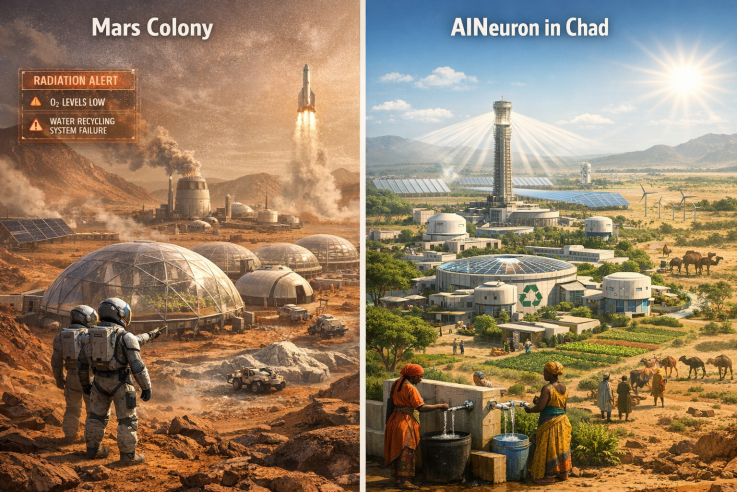
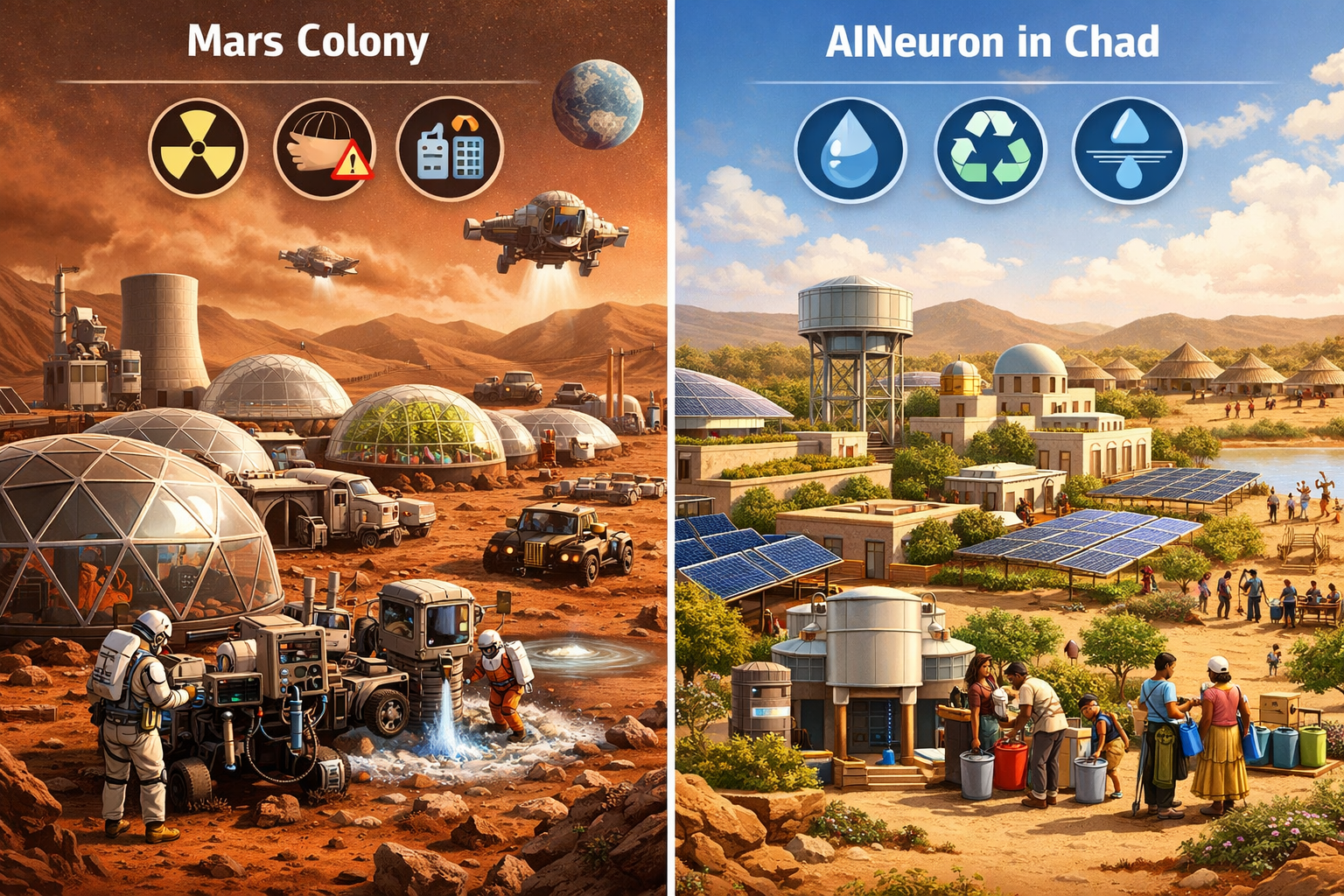
- Developing a high-density, water-secure urban system in an arid terrestrial environment (e.g., Chad, Sahel region)
- Establishing a self-sufficient closed-loop human settlement on Mars
The comparison focuses on physical constraints, water system requirements, energy intensity, systemic resilience, technological readiness, and civilizational feasibility.
2. Environmental Boundary Conditions
2.1 Arid Terrestrial Environment (Sahel / Chad)
- Atmospheric pressure: 1 atm
- Oxygen availability: natural
- Gravity: stable (9.81 m/s²)
- Radiation: manageable
- Water: scarce but present (humidity, seasonal rainfall, aquifers)
- Solar irradiance: high (5.5–6.5 kWh/m²/day)
The environment is hostile in terms of water scarcity but fundamentally compatible with human biology.
2.2 Martian Surface Environment
- Atmospheric pressure: ~0.6% of Earth
- Composition: ~95% CO₂
- Radiation exposure: high (no magnetosphere)
- Average temperature: −60°C
- Water: frozen, remote, energy-intensive to extract
- Gravity: 0.38 g
- Solar irradiance: ~43% of Earth’s
Mars is not biologically compatible. Human survival requires full artificial environmental control.
3. Water System Architecture
3.1 Terrestrial Arid Urban Model
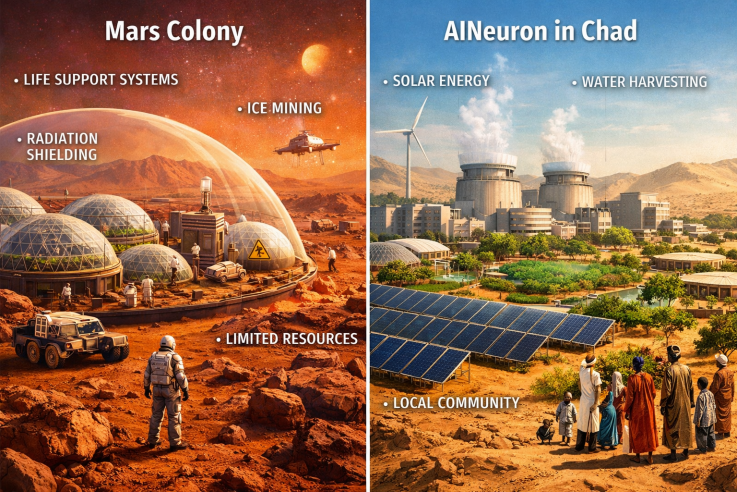
A high-density M-777 system in Chad requires:
- Per capita demand reduction (50–70 L/day)
- ≥80% closed-loop water recycling
- Hybrid supply:
- Groundwater (if sustainable)
- Atmospheric extraction (MOF/solar-thermal)
- Seasonal rain capture
- Solar-powered treatment and pumping
Water exists within the Earth system but must be optimized and recycled efficiently.
The challenge is scarcity management, not atmospheric incompatibility.
3.2 Martian Closed-Loop Habitat
A Martian settlement requires:
- 95–99% water recycling efficiency
- Continuous system redundancy
- Ice mining and thermal processing
- Complete containment of all water loops
- No tolerance for systemic leakage
The Martian model is a fully closed artificial biosphere.
Failure in water loop integrity results in catastrophic loss of life.
4. Energy Requirements
4.1 Arid Earth Model
Energy demand drivers:
- Water pumping
- Desalination (if needed for brackish groundwater)
- Atmospheric water harvesting (if used)
- Air conditioning
- Urban services
These are high but manageable within large-scale solar infrastructure.
Energy supports scarcity mitigation.
4.2 Martian Model
Energy must support:
- Habitat pressurization
- Thermal regulation
- Oxygen production
- Ice extraction
- Radiation shielding systems
- Controlled agriculture
Energy demand per capita is orders of magnitude higher.
Energy supports total environmental creation.
5. Technological Readiness
5.1 Arid Urban Water Systems
Technologies exist today:
- Advanced wastewater recycling (membrane bioreactors)
- Solar-thermal systems
- Desiccant atmospheric water capture
- Smart metering
- Efficient plumbing systems
- Aquifer management modeling
Challenge: economic scaling and governance.
Technology readiness: high.
5.2 Martian Habitats
Technologies partially demonstrated:
- ISS closed-loop systems (~90% recycling)
- Hydroponic agriculture in microgravity
- Radiation shielding concepts
- ISRU (In-Situ Resource Utilization) experiments
However:
- Long-term 100% autonomous closed-loop life support at settlement scale remains unproven.
- Multi-decade system stability untested.
Technology readiness: moderate-to-experimental.
6. Systemic Resilience
Terrestrial Arid City
- Partial system failures are survivable.
- External support possible.
- Open ecological context.
- Human evacuation feasible.
Martian Settlement
- Failure tolerance near zero.
- No external ecological backup.
- Evacuation extremely difficult.
- Entire settlement dependent on engineering stability.
Mars requires perfect system reliability.
Earth allows redundancy and recovery.
7. Economic and Civilizational Scaling
Per capita capital expenditure:
- Martian colonization: estimated millions of USD per person
- Arid terrestrial urban system: orders of magnitude lower
Civilizational return:
- Terrestrial water security improves human stability and development.
- Martian colonization primarily advances scientific and long-term exploratory objectives.
8. Comparative Feasibility Summary
| Dimension | Arid Urban System | Martian Closed Habitat |
|---|---|---|
| Biological compatibility | Natural | Artificial |
| Water availability | Scarce but present | Must be extracted |
| Energy intensity | High | Extremely high |
| Failure tolerance | Moderate | Minimal |
| Technology readiness | Existing | Partially experimental |
| Timeline feasibility | Decades | Many decades+ |
Scientific conclusion:
Developing a sustainable high-density urban system in arid Chad is significantly more feasible than sustaining a self-sufficient Martian colony.
🧠 Strategic Reflection
If a civilization cannot:
Guarantee sustainable water security in an arid region on Earth,
Then it is not prepared to sustain a self-sufficient colony on Mars.
Not because of rockets.
Not because of propulsion.
Not because of launch vehicles.
But because of systemic management.
A Martian colony is not fundamentally a propulsion problem.
It is a closed-loop systems governance problem.
Water management in Chad and water management in a Martian habitat share a core requirement:
- Resource optimization
- Redundancy engineering
- Long-term resilience
- Behavioral discipline
- Institutional coordination
Mars magnifies the constraints.
Earth exposes the discipline.
Designing AINeuron with this principle in mind means:
- Water-first architecture
- Closed-loop priority
- Demand reduction before supply expansion
- Hybrid redundancy
- Energy-water nexus integration
- Institutional feasibility as primary constraint
Civilizations that master resource governance on Earth
develop the competence required for planetary expansion.
Civilizations that bypass terrestrial constraints
and pursue expansion without systemic maturity
risk engineering brilliance without sustainability.
The decisive variable is not technological ambition.
It is systemic capacity.
And systemic capacity is proven on Earth first.