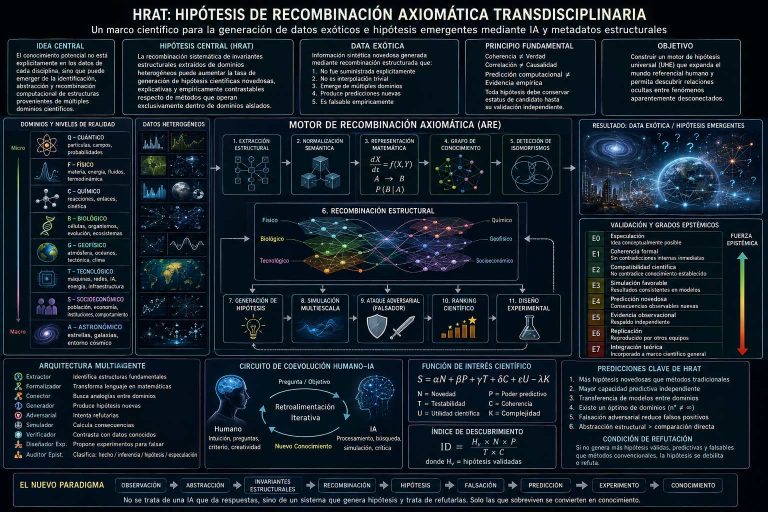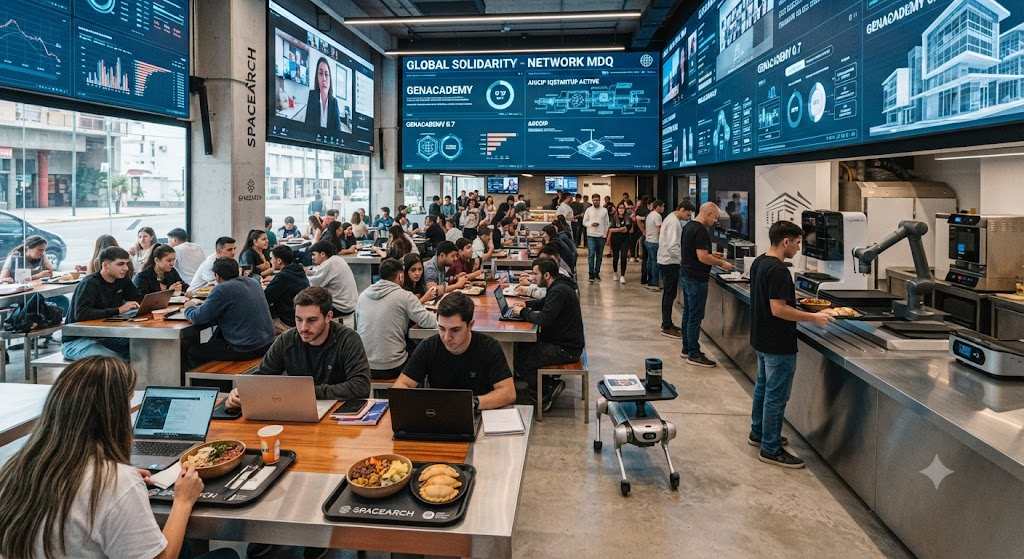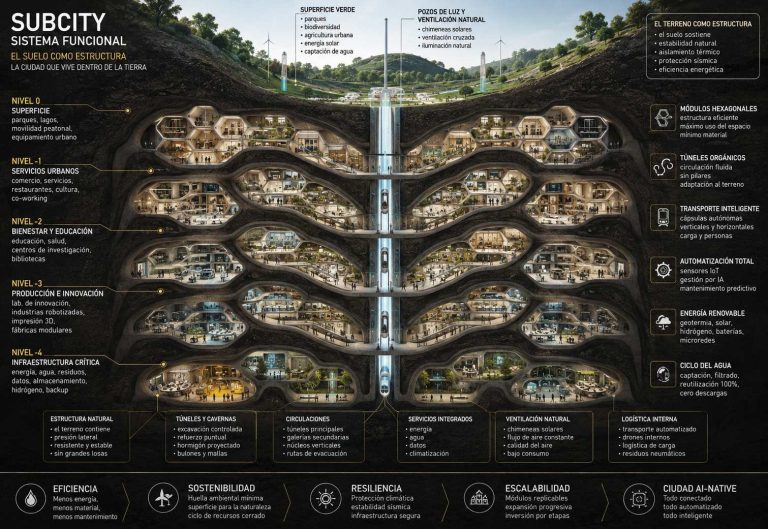








Beyond Generation Ships: A Staged Architecture for Human Expansion from Orbital Civilization to Exoplanet Access
Executive Summary
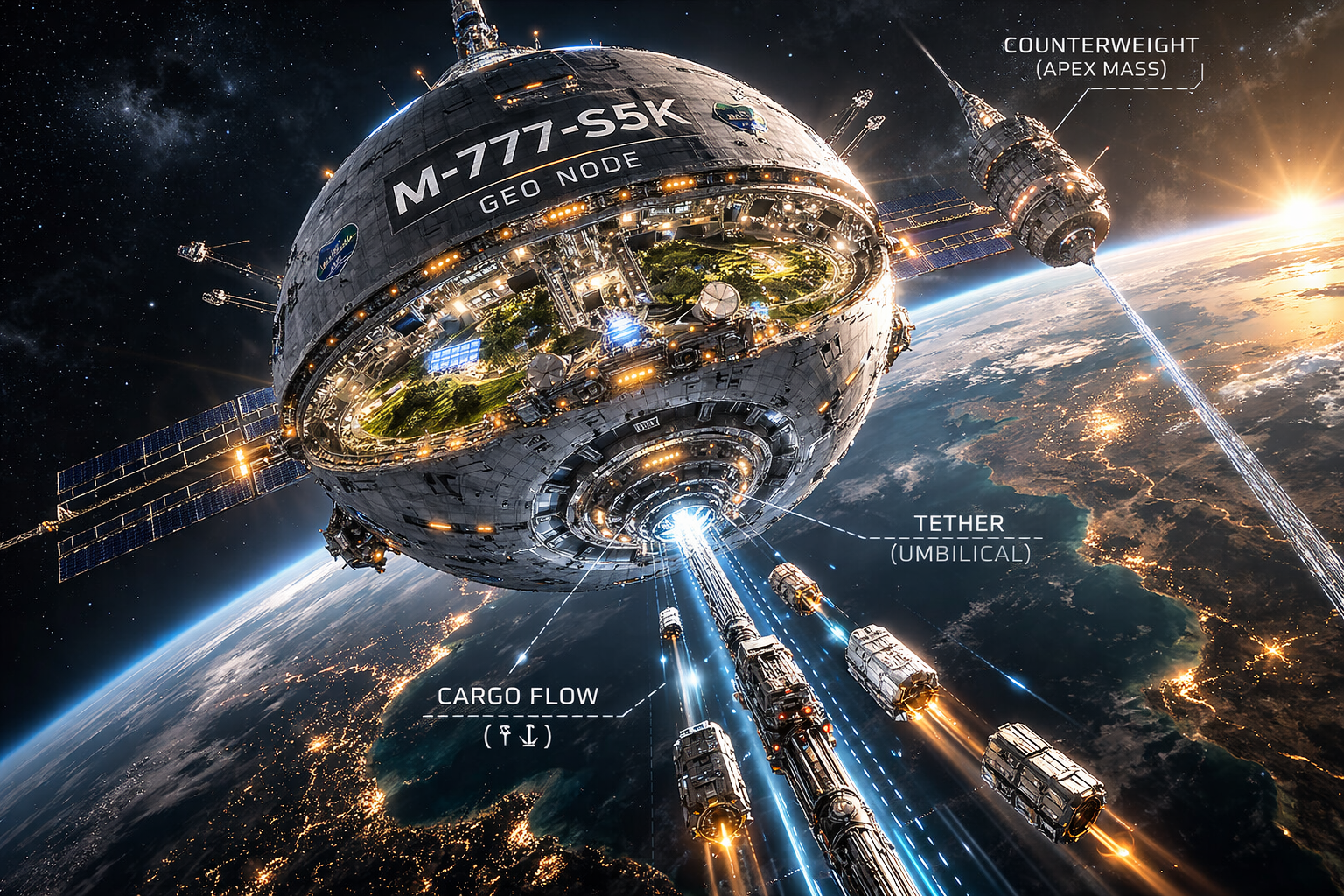
This white paper proposes the SpaceArch Interstellar Access Doctrine: humanity should not prioritize large, subluminal, human-populated generation ships as its primary path to exoplanet colonization. Instead, the rational sequence is to first industrialize Earth orbit, then mature closed-loop space civilization capabilities, then deploy seed-style robotic missions, and only afterward pursue breakthrough spacetime transport systems if physics and computation make them viable. SpaceArch’s institutional position is that the near-term bridge is the M-777 S5K orbital microcity plus multi-tether space elevator architecture, conceived as an orbital logistics and training platform for 5,000 residents and as a beta environment for long-duration human life beyond Earth.
This position is grounded in a simple comparison. Contemporary generation-ship thinking is valuable as systems design research, but even the best current concepts assume a highly resource-constrained, tightly governed, psychologically managed society surviving across centuries inside a closed machine. Project Hyperion’s recent design competition, for example, centered on a 250-year crewed interstellar journey to a habitable world. That is useful as an engineering thought experiment, but it also shows the immense mass, governance, ecological, and life-support burden of the model.
NASA’s human-spaceflight framework reinforces this caution. Even for missions vastly shorter than centuries, NASA identifies five core hazard classes: space radiation, isolation and confinement, distance from Earth, gravity fields, and hostile/closed environments. SpaceArch therefore argues that scaling a fragile human biosocial system directly into a centuries-long subluminal voyage is not the optimal first-choice architecture for exoplanet expansion.
1. The Core Hypothesis
SpaceArch proposes the following scientific-strategic hypothesis:
The most efficient path to exoplanet colonization is not to enlarge the crewed generation ship, but to reduce biological transit dependence and increase infrastructure, automation, and spacetime-engineering capability.
Under this doctrine, the correct sequence is:
Earth industrial base → orbital logistics infrastructure → orbital microcity civilization training → cislunar industrial expansion → robotic/AI seed missions → advanced spacetime transport research.
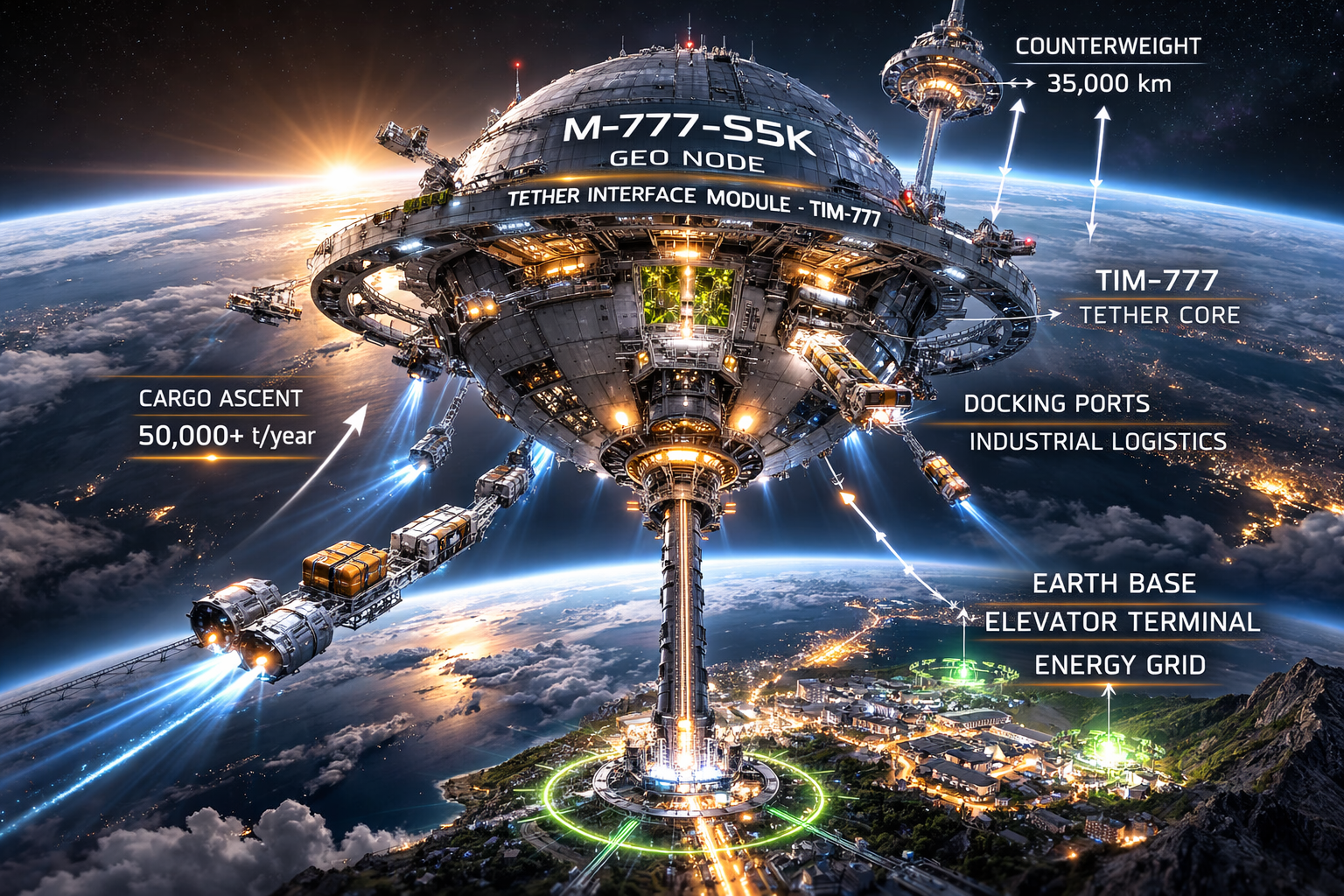
This is why SpaceArch places the M-777 S5K + Multi-Tether Space Elevator Program at the center of the roadmap. In SpaceArch’s own program description, M-777 is defined as a modular GEO orbital node for 5,000 inhabitants, conceived simultaneously as a logistics port, industrial platform, and cislunar expansion base; the paired multi-tether elevator is framed as redundant, segmented, maintainable orbital-access infrastructure rather than a single heroic megacable.
2. Why Generation Ships Are Not the Optimal Primary Model
The generation ship remains an intellectually serious concept, but from the SpaceArch perspective it is structurally overburdened. It attempts to solve in one vehicle all of the following at once: propulsion, shielding, governance, reproduction, psychological continuity, ecological closure, industrial maintenance, education, conflict management, and multi-century cultural stability. Project Hyperion’s own framing makes clear that this kind of craft must support a flourishing society under severe resource constraints across a 250-year journey.
The problem is not whether a generation ship is imaginable. The problem is whether it is the most rational allocation of finite planetary resources. A ship large enough to support hundreds or thousands of humans for centuries requires enormous mass, redundancy, and biospheric complexity. Such missions would likely consume a disproportionate share of Earth and solar-system industrial output while still offering limited launch cadence and little guarantee of mission continuity over very long durations. NASA’s hazard taxonomy underscores why: every major risk category worsens when distance, isolation, and systems closure are stretched to extremes.
3. SpaceArch’s Alternative Subluminal Logic: Seed Missions, Not Civilizations in Transit
If humanity were forced to attempt interstellar travel before mastering spacetime shortcut technologies, SpaceArch’s preferred fallback model would be a seed architecture rather than a full intergenerational ship. In practical terms, that means minimizing active biological burden during transit and maximizing autonomy, repairability, and machine cognition. The conceptual package includes cryopreserved embryos or equivalent human genetic payloads, robotic and android caretaking systems, distributed AI for mutual error correction and governance, and in-situ industrial setup at destination.
This model is not presented as ethically trivial; it is presented as mass-rational. Compared with sustaining a full human civilization in transit, a seed mission sharply reduces life-support throughput, food-production dependency, social instability, and cumulative ecological drift. In SpaceArch terms, the objective is to move design intelligence and reproductive potential, not a giant vulnerable terrestrial society embedded in a ship.
4. The Asteroid-Hull Principle
SpaceArch further argues that if a subluminal mission architecture must exist, it should rely on natural mass wherever possible. A hollowed asteroid or mineral body used as structural and shielding carcass is more rational than fabricating from Earth a fully artificial megahabitat of equivalent protective mass. This “asteroid-hull principle” improves the relationship between shielding, structure, and useful payload, while also supporting long-duration thermal stability and passive protection against radiation and micrometeoroids.
This is an engineering inference rather than a currently validated flight architecture. But it follows the same systems logic visible in orbital-industrial thinking: use extraterrestrial mass to lower manufactured-mass requirements.
5. The Missing Middle Layer in Most Interstellar Narratives: Orbital Civilization Training
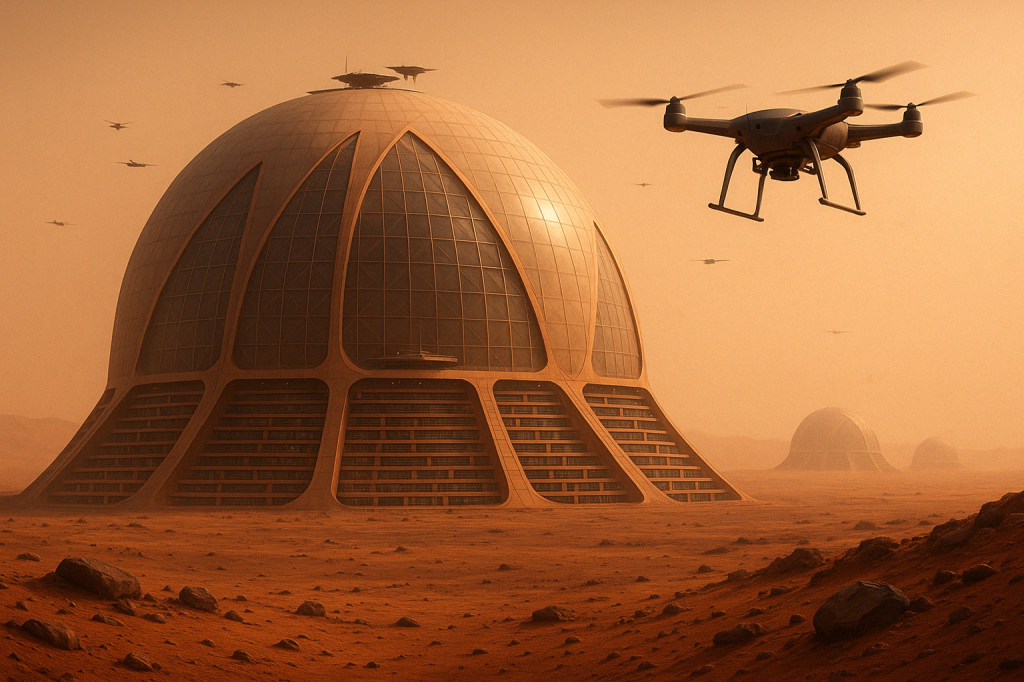
Where SpaceArch departs most clearly from standard discussions is here: before exoplanet colonization, humanity must first learn to live permanently and productively in space. This is the function of the M-777 S5K orbital microcity.
The SpaceArch program defines M-777 as an orbital urban-scale node for 5,000 residents and treats the paired multi-tether elevator as continuous, scalable, maintainable access infrastructure. Its strategic thesis is explicit: if orbital access becomes electric, continuous, and high-cadence, then the rational order of expansion becomes orbital infrastructure first, cislunar routes second, lunar urbanization third.
Under the SpaceArch doctrine, M-777 is not merely a station. It is the beta phase of exoplanet colonization and the minimum viable product of the wider intensive-space-development ecosystem. It is where human crews, robotic systems, AI management layers, and closed-loop habitat operations are tested in the real world over long durations. It is the place to train for air recycling, water recycling, orbital agriculture, repair protocols, psychosocial governance, industrial maintenance, and hybrid human-machine operations before any civilization-scale interstellar attempt is made.
6. Why the Multi-Tether Elevator Matters
The elevator component is central because it changes orbit from an episodic rocket destination into persistent infrastructure. In its own program document, SpaceArch argues that the multi-tether design reduces barriers through four mechanisms: redundancy, modular deployment, maintainability in service, and capacity expansion by adding tethers rather than redesigning the whole system. The same document states a program objective of compressing the maturation horizon to roughly 15–20 years through sustained investment, concurrent engineering, simulation, accelerated testing, and automation.
From the SpaceArch viewpoint, this is decisive. A future interstellar civilization cannot be built on launch scarcity. It requires routine cargo lift, routine personnel movement, incremental assembly, continuous maintenance, and stable orbital industry. The multi-tether elevator is therefore not only a transport device; it is a civilizational throughput multiplier.
7. Why SpaceArch Prioritizes AI Acceleration Over Bigger Ships
The deepest strategic claim of this paper is that the real bottleneck is not simply propulsion but physical-design intelligence. SpaceArch therefore prioritizes accelerated AGI/ASI development—framed by the user as a progression through distributed postdoctoral intelligence networks, SuperGaia, and Harmonix—because only a sufficiently powerful scientific-intelligence stack is likely to solve the higher-order problems of materials, systems closure, autonomous governance, and ultimately spacetime engineering.
This is where the doctrine shifts from subluminal realism to frontier physics. SpaceArch does not claim that warp drives or traversable spacetime portals are engineering realities today. Rather, it argues that they are the only route likely to beat the resource inefficiency of very-long-duration human generation ships over extreme interstellar distances.
Recent theoretical work does not make warp travel practical, but it does keep the subject open at the level of mathematical physics. A 2025 paper on warp drive embedding in a de Sitter background reported a model in which the Eulerian energy density is strictly non-negative, while the volume-averaged weak and null energy conditions are satisfied, even though local violations remain. The authors explicitly describe this as a proof of concept, not a ready technology.
That distinction matters. SpaceArch’s position is not “warp is solved.” It is: generation ships should be treated as a backup architecture, while advanced computation is directed toward the eventual manipulation of spacetime geometry.
8. The Two-Node Portal Concept as a Research Architecture
Within that long-range framework, the SpaceArch speculative model is to replace linear travel with anchored spacetime infrastructure. The working hypothesis is that future high-energy spacetime systems may require stabilized entry/exit geometries, perhaps maintained by paired platforms or vessels acting as two engineered boundary nodes. In conceptual terms, this turns transport from a problem of pushing a habitat through space into a problem of building and sustaining geometry-control infrastructure.
This idea remains hypothetical and should be described as such. It currently belongs in the category of high-risk theoretical architecture, dependent on breakthroughs in gravitation, vacuum-energy manipulation, control systems, materials, and machine-designed physics. But as a strategic doctrine it is coherent: if advanced AI can reduce the uncertainty of frontier physics, then spacetime engineering becomes a more rational investment than endlessly scaling fragile bioships.
9. Comparative Architecture Matrix
In SpaceArch’s framework, the architectures compare as follows.
The classical generation ship offers direct continuity of human society during transit, but suffers from extreme mass, ecological fragility, social risk, and poor scalability over very long durations. Project Hyperion shows both its seriousness and its burden.
The seed mission architecture is lighter, more modular, and more compatible with long transit times. Its advantages are reduced active biological overhead and stronger compatibility with robotics and AI. Its disadvantages are ethical complexity and dependence on highly reliable autonomous developmental systems.
The SpaceArch orbital-first doctrine delays interstellar launch and instead builds an orbital civilization base through M-777 and the multi-tether elevator. Its advantage is that it solves the missing operational layer: how humans actually learn to live, work, govern, repair, and produce in space over long timeframes.
The warp/portal doctrine has the highest upside and the lowest present maturity. Its advantage is that it attacks the real distance problem rather than tolerating it. Its disadvantage is that it remains unproven physics.
10. Conclusion
SpaceArch’s final position is therefore clear:
Generation ships are not rejected; they are demoted.
They remain useful as research platforms for closed ecosystems, governance, and deep-duration habitat design. But they should not be the flagship pathway for exoplanet civilization.
The flagship pathway should be:
industrialize orbit, build the M-777 orbital microcity, establish continuous access through a multi-tether elevator, train a true spacefaring human-machine civilization, use seed-style architectures where necessary, and concentrate frontier intelligence on spacetime transport.
In this doctrine, M-777 is the practical bridge, seed missions are the rational fallback, and warp/portal research is the long-range breakthrough horizon. That sequence is slower in appearance, but more economical, more testable, more scalable, and ultimately more credible than trying to launch self-contained human worlds across interstellar distances before humanity has even learned to live well in orbit.



Final Strategic Reflection
Humanity acquired the technology before developing the right strategy to use it. Humanity didn’t fail for lack of technology. It failed for lack of a coherent logic for expansion.
The half-century delay between the Apollo era and humanity’s return to the Moon was not fundamentally caused by a lack of technology, resources, industrial capacity, or scientific knowledge. The Saturn V, Apollo guidance systems, nuclear power, advanced materials, orbital rendezvous, and large-scale aerospace manufacturing already existed in 1969. What was missing was a coherent long-term metastrategy for the expansion of the species into space. Humanity possessed isolated technologies, but not an integrated logic capable of organizing them into a permanent civilizational roadmap.
The reason humanity did not establish orbital cities, lunar industry, space elevators, or interplanetary infrastructure after Apollo was not that such developments were physically impossible, but that no coherent framework existed to define why those technologies should be developed, in what order, and toward what ultimate objective. SpaceArch argues that the true historical failure was therefore not technological but metalogical: the absence of a coherent architecture of expansion. We are not returning to the Moon today because we suddenly possess radically superior technology. We are returning because, at last, a new generation is beginning to reconstruct the missing logic: first permanent orbital infrastructure, then cislunar civilization, then expansion beyond Earth. SpaceArch’s thesis is that once the correct meta-logic exists, technological development reorganizes itself around it and accelerates naturally.