


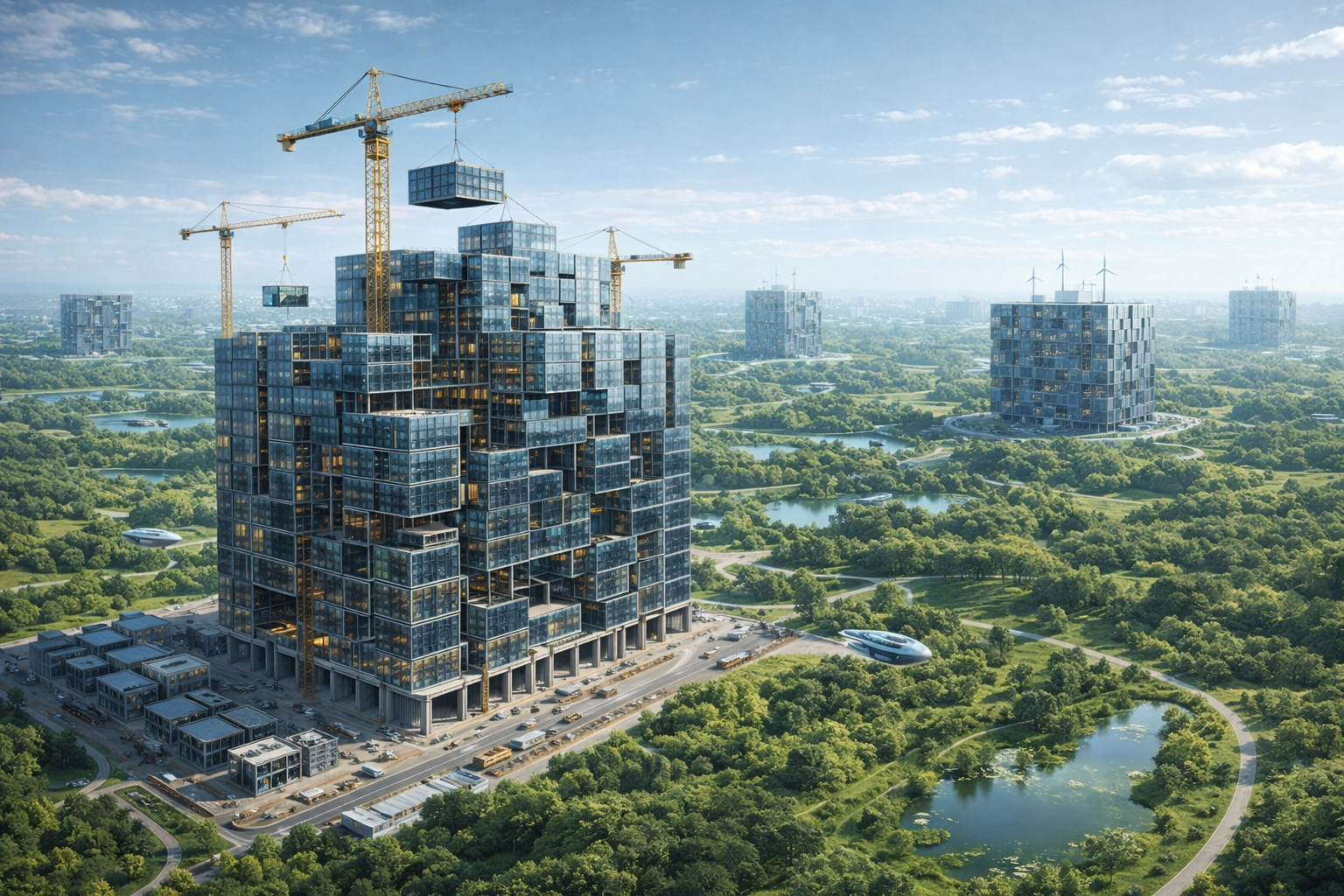
A Space-Engineered Modular Habitat & Autonomous Mobility Framework
White Paper – Sovereign Urban Infrastructure Model
Executive Summary
The M-777 Sovereign Urban System is a high-density, space-engineered, modular urban architecture designed for accelerated capital amortization, adaptive economic functionality, ecological restoration, and autonomous aerial mobility integration.
It is a replicable sovereign infrastructure model composed of:
- Modular stackable superstructures (M-777)
- Autonomous submodules (50m × 20 floors)
- Polyfunctional Japanese interior systems
- Technical-floor infrastructure adaptability
- Aerospace-derived engineering logic
- Kilometer-spaced ecological urban layout
- LaserDron Autonomous Passenger Mobility Network
The system eliminates surface vehicular dependency, reduces environmental externalities to near-zero, and transforms real estate into programmable productive infrastructure.
1. Sovereign Urban Philosophy
The M-777 system redefines urban development through five structural principles:
- Vertical Density, Horizontal Liberation
- Modular Capital Deployment
- Space Engineering on Earth
- Programmable Square Meter
- Autonomous Aerial Mobility
This model transitions urban planning from static zoning to adaptive infrastructural intelligence.
2. M-777 Supermodule Architecture
2.1 Structural Identity
Each M-777 is a high-density cube superstructure built through autonomous submodules that interlock structurally and operationally.
Dimensions:
- Submodule: 50m width × 20 floors
- Configurable stacking into super-cube massing
- Autonomous load-bearing exoskeleton
- Dockable interlocking system
Construction logic:
- Prefabricated aerospace-grade modules
- Craned stacking
- Mechanical encastramiento nodes
- Dry precision assembly
The structure behaves as:
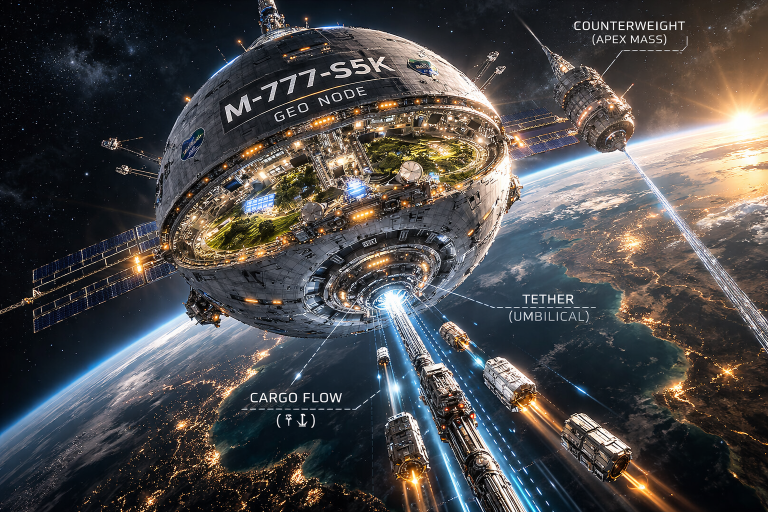
A terrestrial orbital station built under gravity.
3. Autonomous Submodules
Each submodule is fully independent:
- Energy microgrid ready
- HVAC independent loops
- Closed water recirculation compatibility
- Data spine infrastructure
- Redundant service systems
This allows:
- Progressive phasing
- Isolated fault tolerance
- Replacement without structural compromise
- Parallelized construction
4. Aerospace Engineering Transfer
The M-777 applies principles derived from:
- Orbital station module construction
- Spacecraft compartmentalization
- Redundant life-support design
- Structural vibration isolation
- Load distribution matrices
Benefits:
- Precision tolerance
- Rapid assembly
- Reduced material inefficiency
- Long lifecycle durability
- Immediate ROI acceleration
The terrestrial scale lowers aerospace cost curves while preserving performance logic.
5. Polyfunctional Japanese Spatial System
Interior units operate under modular Japanese partition principles:
- Sliding wall systems
- Removable panel architecture
- Compact multifunction layouts
- Transformable room configurations
This allows dynamic reconfiguration from:
- Residential
- Co-living
- Office
- Education hub
- Digital lab
- Micro-manufacturing unit
- AI processing node
6. Technical Floor Infrastructure
Each unit integrates a raised technical floor:
- Data routing grid
- Energy interface
- Fluid distribution
- Plug-and-play industrial conversion
- Robotics integration compatibility
This enables real-time functional transformation.
The square meter becomes programmable.
7. Adaptive Economic Infrastructure
Traditional buildings are static assets.
The M-777 is an adaptive capital engine.
Revenue layers:
- Residential lease
- Industrial micro-production
- Digital hosting
- AI compute services
- Robotics labs
- Manufacturing-as-a-service
The system lowers conversion friction costs.
8. Urban Deployment Model
8.1 Kilometer-Spaced Ecological Grid
Urban layout:
- One M-777 per square kilometer
- Interstitial park zones
- Water bodies integration
- Ecological buffer rings
- Zero surface traffic corridors
The ground plane becomes:
- Green lung
- Biodiversity reserve
- Recreational zone
- Climate regulator
This eliminates horizontal urban sprawl.
9. LaserDron Autonomous Passenger Network
The Critical Closing System
The M-777 system is completed by the LaserDron Autonomous Aerial Transport Network.
This is not an optional addition.
It is the structural mobility backbone.
9.1 System Definition
LaserDron is:
- Autonomous passenger drone network
- Centralized AI-managed traffic grid
- Vertical takeoff & landing system
- Inter-M-777 mobility network
- Extra-urban connectivity extension
Operational characteristics:
- Fully robotic operation
- Central AI traffic orchestration
- Redundant navigation systems
- Laser-based guidance corridors
- Onboard distributed AI sub-control
9.2 Elimination of Surface Vehicular Traffic
The LaserDron system:
- Removes private vehicle dependency
- Eliminates ground-level congestion
- Reduces asphalt surface area
- Eliminates fossil-fuel dependency
- Suppresses traffic noise
- Eliminates road accident mortality
Urban result:
No ground-level cars.
No traffic jams.
No toxic emissions.
No urban noise pollution.
No accident mortality from vehicular collisions.
9.3 Environmental Impact
By eliminating surface traffic:
- CO₂ emissions drastically reduced
- Nitrogen oxide emissions eliminated locally
- Noise pollution minimized
- Urban heat island effect mitigated
- Green zones uninterrupted by road fragmentation
The city becomes a silent vertical ecosystem.
9.4 Safety Architecture
LaserDron safety layers:
- AI centralized coordination
- Autonomous collision avoidance
- Layered altitude corridors
- Redundant battery systems
- Emergency descent protocols
- Continuous real-time telemetry
Accident probability is statistically lower than ground-based transport due to:
- No human driving error
- No intersection conflicts
- No congestion friction
- Predictive AI routing
10. Sovereign Economic Acceleration Model
Each M-777:
- Generates internal revenue
- Amortizes initial capital investment
- Transfers surplus to next construction cycle
Capital model:
- Supermodule construction
- Immediate operational activation
- Revenue generation
- Surplus reinvestment
- Accelerated replication
This forms:
A scalable sovereign urban cloning engine.
11. Systemic Resilience
The M-777 + LaserDron model creates:
- Modular failure isolation
- Independent micro-infrastructures
- Decentralized energy compatibility
- Flexible economic conversion
- Redundant mobility network
Urban fragility decreases.
Resilience increases.
12. Sovereign Implications
The M-777 system allows sovereign nations to:
- Rapidly deploy high-density eco-cities
- Reduce infrastructure costs
- Eliminate urban sprawl
- Reduce healthcare costs via pollution elimination
- Create programmable real estate assets
- Deploy aerospace-grade engineering terrestrially
- Export modular urban models globally
13. Final Structural Synthesis
The complete system consists of:
M-777 Modular Superstructures
+
Polyfunctional Adaptive Units
+
Technical Floor Conversion Layer
+
Kilometer-Spaced Ecological Grid
+
LaserDron Autonomous Passenger Network
Result:
A vertical, silent, programmable, autonomous, capital-generating sovereign urban system.
M-777 High-Density Modular Habitat System
Technical–Architectural–Urban Scientific Description
1. Conceptual Definition
The M-777 Supermodule is a high-density, vertically integrated modular urban cube designed under space-engineering logic, incorporating autonomous submodules that interlock structurally and operatively.
It is not a conventional building.
It is a self-contained urban infrastructure node.
Each M-777 operates as:
- A residential cluster
- A productive micro-city
- A flexible industrial-digital conversion platform
- A capital-amortization accelerator
The system is conceived as a terrestrial adaptation of orbital station construction logic, using prefabricated stacking and locking techniques derived from aerospace engineering.
2. Structural Logic: Spatial Engineering Applied to Earth
2.1 Construction Philosophy
The M-777 is assembled like:
- A space station module
- An interstellar vessel hull
- A high-precision orbital infrastructure
Core principles:
- Prefabricated structural frames
- Docking interface nodes
- Autonomous life-support systems
- Independent operational redundancy
- Stackable load distribution matrices
Each submodule (50 m width × 20 floors height) is:
- Structurally independent
- Fully serviced (energy, water, HVAC, digital backbone)
- Dockable into the macro-frame
- Removable or upgradable
This allows:
- Progressive vertical and lateral expansion
- Phased capital deployment
- Zero structural dependency between modules
- Fault isolation and operational continuity
3. Modular Submodule (50m × 20 floors)
3.1 Structural Characteristics
Each submodule includes:
- Independent load-bearing steel/composite exoskeleton
- Integrated core for vertical circulation and services
- Energy and water autonomy systems
- Digital backbone and data distribution spine
- Docking structural plates for mechanical interlocking
The modules are manufactured using:
- High-precision prefabrication systems (Japanese/Chinese stacked modular technology)
- Industrial robotic assembly lines
- Dry construction methods
- Rapid craned stacking
Construction model:
- Apilamiento (stacking)
- Encastramiento (mechanical interlock)
- Structural integration via reinforced node connectors
This reduces:
- On-site labor costs
- Construction time
- Material waste
- Financial risk
4. Aerospace-Derived Systems Integration
4.1 Space Engineering Advantages
Applying space engineering principles yields:
- Redundant energy grids
- High-efficiency HVAC
- Closed-loop water reuse systems
- Structural vibration optimization
- Modular replacement capability
It allows:
- Terrestrial testing of space technologies
- Scaling of aerospace-grade construction at urban cost levels
- Immediate ROI due to prefabrication efficiencies
The M-777 becomes a terrestrial testbed for:
- Habitat engineering
- Autonomous urban systems
- Scalable infrastructure replication
5. Japanese Polyfunctional Interior System
5.1 Movable Partition Logic
Each functional unit (apartment) incorporates:
- Modular sliding partitions
- Demountable internal wall systems
- Flexible service routing
- Compact Japanese-inspired spatial efficiency
Principle:
Space is not fixed.
Space is configurable.
Layouts can transform from:
- Residential apartment
- Co-living unit
- Office space
- Micro-factory
- Digital production lab
- AI compute cluster
- Robotics workshop
6. Technical Floor (Piso Técnico) – The Strategic Layer
6.1 Functional Infrastructure Layer
Every unit includes a technical floor system providing:
- Raised flooring
- Cable routing grid
- Fluid distribution channels
- Plug-and-play industrial interfaces
- Data fiber routing
- Automated logistics tracks (optional)
This allows:
- Conversion of residential unit → automated micro-factory
- Digital lab → light production line
- Office → server node
- Apartment → robotics assembly space
7. Economic Innovation: Adaptive Square Meter
7.1 Traditional Real Estate Model
In conventional urban development:
- The square meter is static.
- It is functionally rigid.
- Conversion is costly.
- ROI depends on one use-case.
7.2 M-777 Model
In M-777:
The square meter is:
- Flexible
- Convertible
- Market-responsive
- Cash-flow optimized
This creates:
- A dynamic valuation layer
- Reduced friction for new economic opportunities
- Lower cost for adapting to new market demand
The building behaves like:
A programmable asset.
8. High-Density Urban Model with 1km Spacing
Urban deployment logic:
- One M-777 per square kilometer
- Green park belts between units
- Ecological buffer zones
- Energy autonomy zones
- Micro-mobility corridors
Urban Result:
- High density vertically
- Low footprint horizontally
- Large ecological recovery areas
- Heat island mitigation
- Integrated urban-nature balance
This reduces:
- Infrastructure redundancy
- Road congestion
- Urban sprawl
- Environmental degradation
9. Capital Amortization & Accelerated Replication
9.1 Financial Logic
Each M-777:
- Is a revenue-generating productive asset
- Contains residential + industrial + digital capacity
- Creates cash flow from day one
- Allows rapid capital amortization
Revenue streams:
- Residential leasing
- Industrial leasing
- Digital infrastructure hosting
- AI compute services
- Modular manufacturing
- Flexible production adaptation
9.2 Cloning Acceleration Model
Once operational:
- M-777 generates surplus capital.
- Surplus is reinvested into the next M-777.
- Replication cycle shortens progressively.
- Network density increases.
- Infrastructure costs decrease per unit.
This creates:
An exponential urban replication model.
10. Scientific-Urban Implications
The M-777 represents:
- A shift from fixed urban planning to programmable urbanism.
- A transition from real estate to adaptive infrastructure.
- A convergence of aerospace engineering and urban development.
- A fusion of habitation and production.
It reduces systemic risk because:
- Units are autonomous.
- Failure does not collapse the macro system.
- Capital is modular.
- Expansion is progressive.
11. Strategic Outcome
The M-777 system enables:
- High-density ecological cities.
- Rapid scalable urban cloning.
- Dynamic capital recovery.
- Continuous adaptation to market conditions.
- Low-cost terrestrial application of space-grade engineering.
- Real estate that behaves like an intelligent asset.
12. Final Synthesis
The M-777 is not a building.
It is:
- A modular urban organism.
- A programmable economic platform.
- A space-engineered terrestrial habitat.
- A capital-amortization engine.
- A replicable high-ROI urban supernode.
It transforms:
Urban density → into capital acceleration
Architecture → into adaptive infrastructure
Real estate → into programmable asset
M-777 Sovereign Urban System
Integrated Quantitative Modeling, ROI Framework & LaserDron Airspace Zoning Blueprint
1. Quantitative Environmental Modeling
Emissions Reduction & Urban Externality Elimination
1.1 Methodological Framework (MRV-Ready)
The emissions model follows international accounting standards aligned with:
- GHG Protocol (Scope 1, 2, 3 logic)
- Urban transport lifecycle analysis
- Avoided Vehicle Kilometers Traveled (VKT) methodology
Primary impact category:
Replacement of ground-based vehicular transport with autonomous aerial LaserDron mobility.
1.2 Core Variables (Per M-777 Unit)
Let:
- N = population per M-777
- T = average trips per person per day
- L = average trip distance (km)
- pcar = proportion of trips previously conducted via ground vehicles
- EFcar = emission factor of combustion vehicles (kgCO₂e/km)
- EFgrid = electricity grid emission factor (kgCO₂e/kWh)
- eLD = LaserDron energy consumption (kWh per passenger-km)
- Occ = average passenger occupancy per LaserDron unit
1.3 Baseline Annual Transport Emissions (Pre-System)
Ebaseline=365⋅N⋅T⋅L⋅pcar⋅EFcar
This represents annual CO₂e emissions from ground vehicle mobility.
1.4 Post-Implementation Emissions (LaserDron Model)
Annual LaserDron energy demand:KWhLD=365⋅N⋅T⋅L⋅pcar⋅eLD
Associated emissions:ELD=KWhLD⋅EFgrid
If renewable energy or dedicated green PPA is used:EFgrid→0⇒ELD→0
1.5 Net Emissions Reduction
ΔE=Ebaseline−ELD
Percentage reduction:R(%)=100⋅(1−EbaselineELD)
Under renewable electricity scenarios, mobility-related passenger emissions approach near-total elimination.
1.6 Additional Urban Impact Indicators
Beyond CO₂:
- Near elimination of NOx and PM2.5 at district level
- Significant reduction in urban noise pollution
- Elimination of ground-level traffic collisions
- Reduced heat island effect via removal of asphalt networks
- Increased permeable green surface ratio
Avoided vehicle-kilometers:VKTavoided=365⋅N⋅T⋅L⋅pcar
This metric directly correlates to reduced infrastructure degradation and maintenance costs.
2. Financial Modeling & ROI Amortization Framework
M-777 Supermodule Economic Structure
2.1 Capital Structure
Let:
- C0 = total initial CAPEX
- r = discount rate (WACC)
- n = project life (years)
- S = residual/salvage value
2.2 Revenue Structure (Multi-Layer Model)
Annual revenues:Rt=Rres+Rcom+Rdigital+Rindustrial+Rother
Operating costs:OPEXt
Net Operating Income:NOIt=Rt−OPEXt
2.3 Payback Period
Payback=NOIavgC0
Under phased modular construction, early operational units generate cash flow while subsequent modules are constructed, reducing effective capital exposure.
2.4 Net Present Value (NPV)
NPV=−C0+t=1∑n(1+r)tNOIt+(1+r)nS
Investment viability requires:NPV>0
2.5 Internal Rate of Return (IRR)
IRR satisfies:0=−C0+t=1∑n(1+r∗)tNOIt+(1+r∗)nS
2.6 Programmable Square Meter Uplift
Let:
- u = proportion of area convertible without structural CAPEX
- Δrent = rent differential from functional reconfiguration
Additional revenue:Ruplift=u⋅Atotal⋅Δrent⋅occupancy
Revised NOI:NOI′=NOI+Ruplift−OPEXconversion
This flexibility transforms real estate into adaptive capital infrastructure, improving long-term IRR resilience.
3. LaserDron Autonomous Airspace Zoning Blueprint
3.1 Strategic Objectives
- Safety through vertical and horizontal separation
- Acoustic mitigation
- High-capacity throughput
- Scalable district expansion
3.2 Core Airspace Components
- Vertiports at each M-777
- Dedicated vertical ascent/descent shafts
- Inter-M-777 aerial corridors
- Holding rings for dynamic queuing
- Emergency green landing zones
- Centralized AI-driven UTM (Unmanned Traffic Management)
3.3 Multi-Layer Altitude Segmentation
Example framework:
Layer A (60–120m):
Local approach and departure
Layer B (120–300m):
Inter-M-777 urban cruise corridors
Layer C (300–600m):
Regional or inter-district routes
Sensitive zones (schools, hospitals, ecological reserves) designated as no-fly geofenced bubbles.
3.4 Corridor Capacity Model
Let:
- h = headway (seconds between vehicles)
- Occ = average occupancy
Hourly passenger throughput:Capacity≈h3600⋅Occ
Central AI dynamically adjusts headway to demand and weather conditions.
3.5 Vertiport Configuration (Per M-777)
Standard infrastructure:
- 4–12 landing pads
- Rapid charging or battery swap
- Autonomous boarding systems
- Dedicated vertical circulation cores
- Redundant microgrid energy supply
Passenger flows are algorithmically optimized to prevent congestion.
3.6 Noise Mitigation Strategy
- Corridors routed over green zones and water bodies
- Higher altitude cruise over residential areas
- Controlled nighttime frequency
- Vertical descent profiles minimizing lateral noise
Outcome:
Elimination of continuous traffic noise typical of ground vehicles.
3.7 Safety & Redundancy Architecture
- AI central control + onboard AI autonomy
- Multi-sensor collision avoidance
- Redundant communication channels
- Emergency landing network
- Predictive weather integration
- Fail-safe autonomous return protocols
System-level accident probability becomes statistically lower than traditional vehicular systems due to removal of human driving error and intersection conflict.
4. Integrated System Impact
M-777 + LaserDron creates:
- Ground-level car elimination
- Urban green continuity
- Near-total passenger transport emissions reduction
- Reduced healthcare burden from pollution
- Capital-generating urban infrastructure
- Scalable sovereign urban cloning capacity
5. Strategic Synthesis
The system integrates:
Modular Space-Engineered Architecture
- Adaptive Programmable Units
- Technical Floor Conversion Infrastructure
- Kilometer-Spaced Ecological Grid
- Autonomous LaserDron Mobility Network
Result:
A silent, vertically dense, zero-traffic, capital-amortizing sovereign urban ecosystem.