


Startup Acceleration and Cooperative Innovation Network
& Global Structuring Services
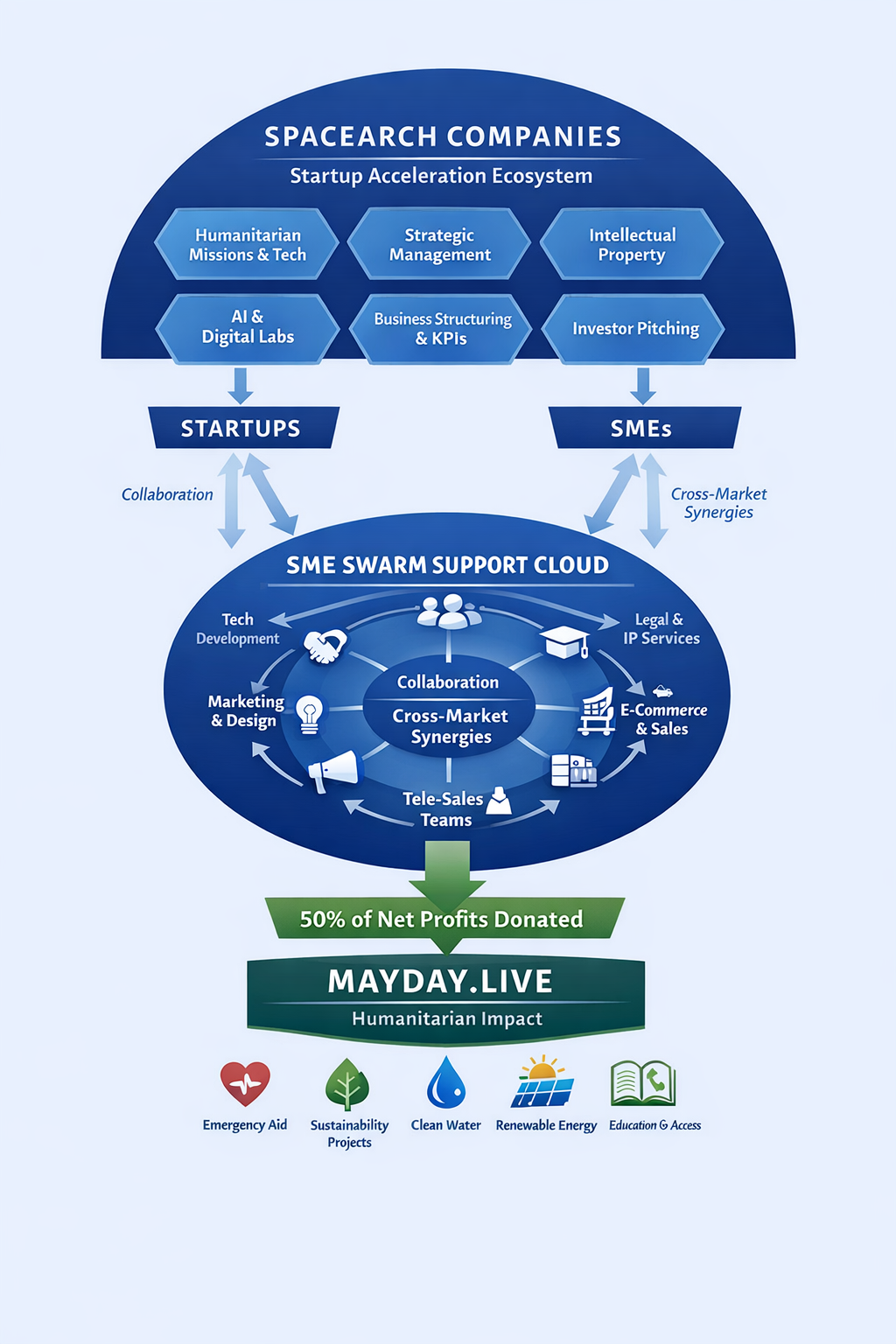
SpaceArch Companies represents a new operational layer within the SpaceArch ecosystem designed to accelerate the creation, structuring, and scaling of innovative startups while simultaneously generating measurable humanitarian impact.
Unlike traditional startup accelerators that focus exclusively on financial returns, the SpaceArch model integrates entrepreneurial development, technological innovation, and humanitarian missions into a unified system.
The objective is to create a distributed network of startups and SMEs capable of supporting each other operationally while contributing to global social impact initiatives.
Core Humanitarian Objective
A central principle of the SpaceArch Companies accelerator is the integration of commercial success with humanitarian responsibility.
Humanitarian Commitment
50% of net profits generated within the ecosystem are allocated to Mayday.Live, the humanitarian branch of the SpaceArch system.
These funds are directed toward:
• emergency humanitarian aid
• poverty reduction programs
• sustainable infrastructure projects
• climate mitigation initiatives
• access to technology and education
• environmental restoration projects
Through this mechanism, entrepreneurial success directly contributes to global humanitarian missions.
Strategic Acceleration Model
The SpaceArch Companies accelerator provides startups with an integrated framework combining strategic management, technological development, and market access.
Key operational areas include:
Humanitarian Missions and Technology
This unit focuses on aligning technological innovation with humanitarian objectives.
Areas of development may include:
• sustainable energy technologies
• water purification systems
• climate monitoring and mitigation tools
• agricultural innovation
• low-cost digital infrastructure for developing regions
• environmental monitoring technologies
Startups working in these fields receive support to transform scientific or engineering concepts into scalable solutions with real-world humanitarian applications.
Strategic Management
The accelerator provides structured support in strategic planning and operational development.
Core areas include:
• market positioning
• competitive strategy
• organizational design
• financial structuring
• partnership development
• global expansion strategy
The objective is to ensure that startups operate with clear strategic direction and scalable business models.
Intellectual Property
Innovation-driven companies require robust intellectual property strategies.
Support services include:
• patent strategy development
• intellectual property protection
• technology licensing models
• IP valuation
• cross-border intellectual property management
These services ensure that startups can protect and leverage their technological innovations effectively.
Digital Infrastructure
The accelerator provides access to digital infrastructure necessary for modern startup operations.
Services may include:
• cloud infrastructure
• web platforms and digital marketplaces
• e-commerce systems
• digital marketing and tele-sales infrastructure
• CRM and data analytics platforms
Through this infrastructure, startups gain immediate access to global digital markets.
Business Structuring and KPI Systems
Successful startups require clear financial and operational metrics.
SpaceArch Companies supports startups in establishing:
• financial models
• operational KPIs
• growth metrics
• performance dashboards
• investor reporting systems
These tools enable founders to manage growth while maintaining financial transparency and strategic focus.
Artificial Intelligence Integration
Artificial intelligence represents a major accelerator of innovation.
Through the Digital Labs Constellation, startups gain access to AI-assisted research and development capabilities.
This includes:
• AI-assisted product development
• predictive analytics
• automation systems
• data science support
• machine learning models for business optimization
AI integration significantly reduces development timelines and increases the innovation capacity of participating startups.
Professional Investor Pitch Development
Access to capital is one of the primary challenges faced by emerging companies.
The accelerator provides structured preparation for investor engagement, including:
• pitch deck development
• financial projections
• investor communication strategies
• valuation modeling
• venture capital negotiation training
Startups receive support in presenting their projects effectively to angel investors, venture funds, and strategic partners.
The SME Support Cloud
A Cooperative Business Ecosystem
One of the most innovative aspects of the SpaceArch Companies model is the creation of a distributed support network of small and medium enterprises.
Instead of operating as isolated entities, startups and SMEs become part of a cooperative ecosystem that functions as a business support cloud.
Within this system, companies provide services to one another, creating mutual reinforcement.
Examples include:
• marketing companies supporting technology startups
• design studios supporting product development teams
• software developers supporting e-commerce businesses
• tele-sales teams supporting global sales expansion
• legal firms providing intellectual property services
This structure can be described as a swarm-support network of SMEs, where each company strengthens the others.
Cross-Market Synergies
Because participating companies operate within the same ecosystem, opportunities emerge for cross-market collaboration and shared distribution channels.
Examples include:
• shared tele-sales networks
• joint marketing campaigns
• cross-selling of products and services
• shared technology platforms
• joint international expansion strategies
This approach increases the overall resilience of the ecosystem while accelerating market penetration.
Economic Advantages of the Network Model
The cooperative network model generates several economic advantages.
Reduced operational costs
Companies can access services within the ecosystem at lower cost compared to external providers.
Faster innovation cycles
Digital Labs and AI resources accelerate technological development.
Shared market access
Startups benefit from the distribution networks and contacts of other companies within the system.
Higher survival rate
Startups supported by strong ecosystems statistically demonstrate higher survival rates than isolated ventures.
A Distributed Innovation Economy
The SpaceArch Companies accelerator ultimately functions as a distributed innovation economy, where multiple startups and SMEs collaborate while contributing to shared humanitarian objectives.
This model combines:
• entrepreneurial innovation
• technological development
• cooperative market dynamics
• humanitarian impact
Through this architecture, the success of individual companies contributes to the growth of the entire ecosystem while simultaneously supporting global humanitarian missions.
Startups → Pymes → Digital Labs → Mayday.Live
Innovation
↓
Business success
↓
Humanitarian impact
↓
More collaboration
↓
More innovation
SpaceArch Ecosystem
│
┌──────────────┴──────────────┐
│ │
SpaceArch Nodes SME Swarm
(Franchises) (Modular Companies)
│ │
│ │
Infraestructura Servicios
│ │
└──────────────┬──────────────┘
│
Digital Labs
│
Innovation Engine
SpaceArch Swarm Economy
Distributed SME Innovation Network
SpaceArch operates as a distributed swarm economy, where independent small and medium enterprises (SMEs) collaborate through a shared innovation infrastructure.
Instead of building a single centralized corporation, the SpaceArch model allows multiple companies to operate as modular units within a cooperative network, each contributing capabilities, services, and innovation.
These companies form what can be described as a distributed swarm of enterprises, coordinated through the SpaceArch ecosystem.
Why the System Functions as a Swarm
Each SME within the SpaceArch ecosystem remains independent, but gains access to shared capabilities that normally only large corporations possess.
Through the integration with Digital Labs, companies can access:
• research and development resources
• artificial intelligence tools
• technical consulting
• product development support
• digital infrastructure
• tele-sales and marketing networks
This allows participating companies to operate from the beginning with capabilities similar to larger corporations, without needing to build all internal structures themselves.
Operating at Corporate Scale from Day One
One of the main advantages of the SpaceArch ecosystem is that companies can begin operating with corporate-level tools and infrastructure, even if they are small or newly created.
By using the shared services provided through the ecosystem, startups and SMEs gain access to:
• innovation development through Digital Labs
• global digital platforms
• marketing and sales networks
• business structuring support
• investor preparation
This significantly reduces the traditional barriers that limit the growth of small companies.
Financing and Franchise Expansion
Companies that successfully grow within the ecosystem may decide to expand further by activating SpaceArch franchise nodes.
These franchise activations can be based on:
• projected ROI
• operational success of the startup
• financing capacity of the participating company
• strategic regional opportunities
In this way, startups or SMEs that grow within the ecosystem may later become infrastructure builders for the network itself.
The Role of SpaceArch
Within this model, SpaceArch acts as the central coordination platform of the ecosystem.
Rather than controlling each company directly, SpaceArch provides the infrastructure through which the network operates.
This includes:
• Digital Labs research infrastructure
• startup acceleration services
• collaboration frameworks
• technological platforms
• cross-market synergies
The Honeycomb Analogy
The ecosystem can be understood through a simple metaphor.
The SMEs and startups function like bees within a distributed swarm, each developing projects, products, and services within their respective markets.
SpaceArch acts as the honeycomb, the structure where value is accumulated, shared, and distributed across the network.
Within this structure:
innovation becomes the honey
companies become the bees
the ecosystem becomes the hive
Each participant contributes to the growth of the whole while benefiting from the collective infrastructure of the system.
A Cooperative Innovation Economy
Through this architecture, SpaceArch creates a model of cooperative technological capitalism, where independent companies collaborate through shared infrastructure rather than competing in isolation.
The result is a distributed innovation ecosystem capable of:
• accelerating startup development
• strengthening small and medium enterprises
• generating scalable business networks
• supporting global humanitarian initiatives through Mayday.Live
Risk Reduction Through the SpaceArch Support Infrastructure
Tele-Sales, Digital Platforms and Innovation Labs
One of the main structural advantages of the SpaceArch ecosystem is its capacity to significantly reduce the risk traditionally associated with launching a new SME or startup.
In conventional entrepreneurship, new companies face several structural barriers simultaneously:
• lack of market validation
• limited marketing capacity
• lack of distribution channels
• insufficient technological infrastructure
• limited access to R&D resources
These barriers significantly increase the failure rate of early-stage companies.
The SpaceArch ecosystem addresses these limitations by providing a shared operational infrastructure that allows SMEs to launch and test business models with lower initial risk.
Tele-Sales Network
SpaceArch provides access to a distributed tele-sales infrastructure capable of supporting product promotion and direct sales.
This network allows companies to:
• test market response quickly
• generate early revenue streams
• build direct relationships with customers
• validate demand before scaling production
Tele-sales teams also contribute to customer feedback loops, which provide valuable insights for product improvement.
E-Commerce Platforms
Through shared digital platforms, participating companies can access ready-to-use e-commerce infrastructure.
This includes:
• online product catalogs
• payment systems
• digital storefronts
• integrated logistics solutions
• customer data management
By removing the need to develop these systems independently, startups can focus on product development and market strategy rather than technical infrastructure.
Digital Labs for Product Innovation
The Digital Labs Constellation provides research and development support for participating companies.
Through this infrastructure, startups and SMEs can access:
• product development assistance
• artificial intelligence tools
• prototype development
• technical consulting
• innovation testing environments
This dramatically lowers the technological barriers typically faced by small companies attempting to innovate.
Prospecting and Predictive Digital Marketing
Another critical component of the system is data-driven digital marketing.
Through targeted campaigns and market testing strategies, companies can gather real consumption data before committing significant resources to large-scale production.
This approach allows startups to:
• test product demand
• refine marketing strategies
• identify customer segments
• measure conversion rates
As a result, business decisions can be based on real market data rather than assumptions.
Data-Driven Product Validation
By integrating tele-sales, digital marketing, and e-commerce analytics, the SpaceArch ecosystem enables companies to build verified customer datasets.
These datasets provide:
• validated market demand indicators
• customer behavior insights
• product performance metrics
• repeat purchase patterns
This information significantly improves the quality of business decisions and reduces the risk of scaling unsuccessful products.
Lower Barriers for SME Creation
By combining all these components, the SpaceArch ecosystem transforms the startup creation process.
Instead of launching a company from scratch with limited resources, entrepreneurs gain access to a shared operational framework that includes:
• marketing infrastructure
• sales networks
• technological development support
• business structuring assistance
• data-driven validation tools
This allows new companies to start operating with capabilities comparable to much larger organizations.
The Strategic Result
The combined effect of these systems is a substantial reduction in startup risk.
Entrepreneurs are able to:
• test business ideas rapidly
• validate demand with real market data
• refine products through continuous feedback
• scale operations only after confirming market viability
In this way, the SpaceArch ecosystem transforms the traditional startup process from a high-risk gamble into a structured and data-driven innovation pathway.
The Ecosystem Advantage
By integrating tele-sales networks, digital platforms, Digital Labs, and predictive marketing systems, SpaceArch creates an environment where SMEs and startups can operate with:
• lower initial risk
• faster innovation cycles
• validated market demand
• scalable business infrastructure
This architecture significantly increases the probability of success for companies participating in the SpaceArch ecosystem.