


1️⃣ PRINCIPLE OF STRUCTURAL SEPARATION OF POWERS
Concept Definition
Structural separation of powers is the institutional design mechanism that prevents any single actor, entity, or capital vehicle from obtaining unilateral control over the system.
In systemic corporate architecture, concentration of power equals vulnerability.
Therefore:
Infrastructure ≠ Capital
Capital ≠ Governance
Governance ≠ Operations
Operations ≠ Intellectual Property
These must be legally and operationally segregated.
Technical Architecture Model
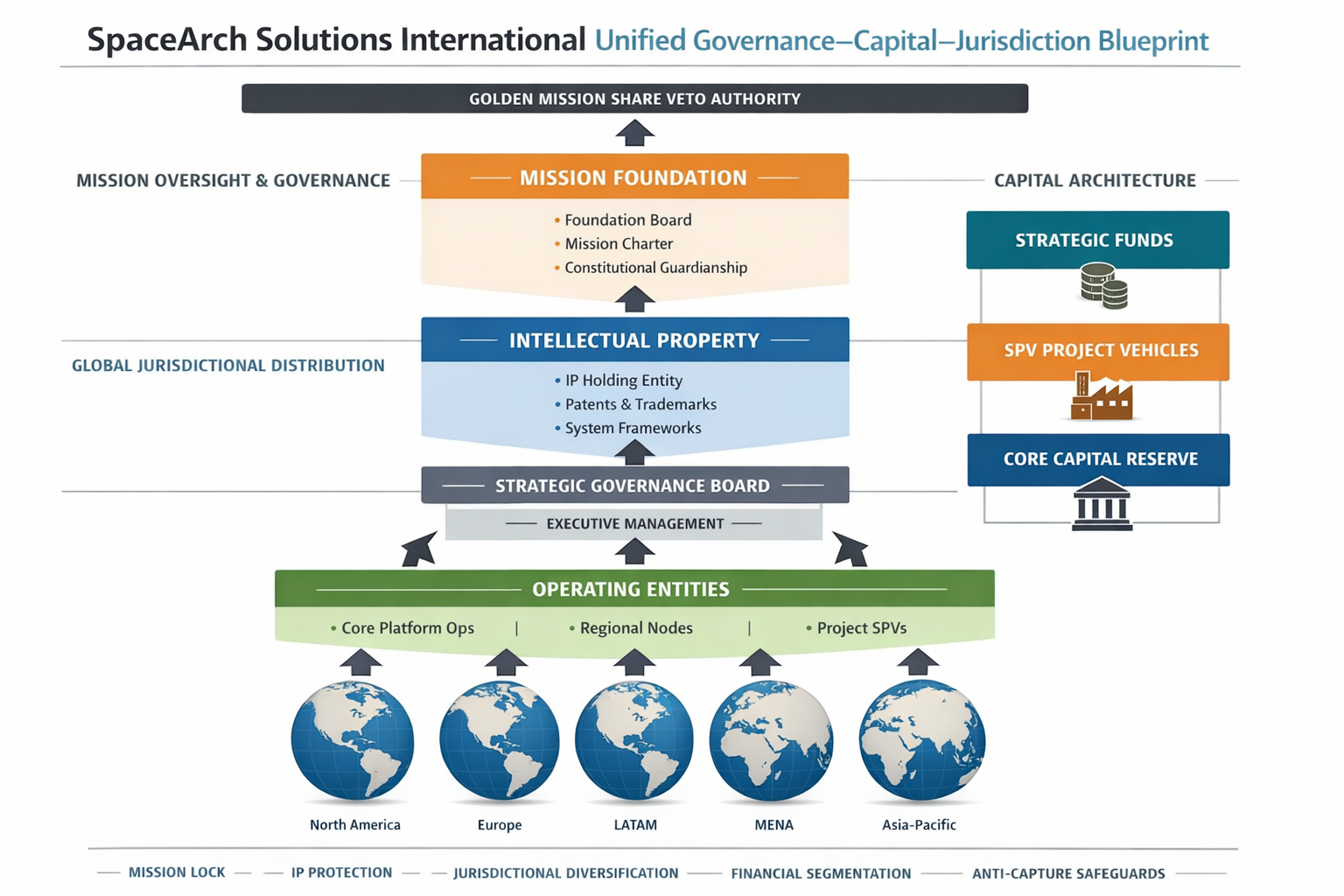
Layer A – Intellectual Property Holding Entity
- Jurisdiction: Stable, predictable, high legal protection.
- Function: Owns trademarks, frameworks, algorithms, methodologies, structural documentation.
- Cannot operate commercially.
- Cannot incur operational debt.
- Cannot be pledged as collateral.
This prevents hostile acquisition via operational leverage.
Layer B – Mission Foundation / Perpetual Entity
- Holds controlling rights over IP entity.
- Defines permanent mission constraints.
- Cannot sell core system.
- Cannot privatize foundational assets.
- Can veto mission deviation.
This is the mission-lock layer.
Layer C – Operating Companies (Vertical Execution)
- SpaceArch Verticals
- REFD
- PortsFish
- AiEarth
- GlobalSolidarity Operating Units
These generate revenue.
These can scale.
These can contract.
These can be franchised.
But they do not own the system core.
Layer D – SPVs (Special Purpose Vehicles)
- Created per project.
- Ring-fenced liability.
- Isolated risk exposure.
- No contagion risk to main structure.
Layer E – Capital Vehicles
- Investment funds
- Debt structures
- Green funds
- Maritime funds
- ESG vehicles
Capital never directly controls mission or IP.
Strategic Effect
If any operational company is attacked, acquired, litigated, or compromised:
The core system remains intact.
This is structural resilience.
2️⃣ MULTI-JURISDICTIONAL ARCHITECTURE
Concept
Jurisdictional diversification reduces political, legal, and regulatory capture risk.
A system dependent on a single country can be frozen, seized, pressured, or legislatively constrained.
Recommended Configuration
- IP Holding → One stable jurisdiction
- Foundation → Another independent jurisdiction
- Operating Entities → Distributed (US, EU, LATAM, MENA, etc.)
- Capital Vehicles → Segmented by regulatory profile
Technical Rationale
Multi-jurisdiction design:
- Prevents regulatory overreach
- Reduces political capture
- Avoids centralized freezing
- Mitigates currency risk
- Reduces systemic vulnerability
This is not opacity.
This is redundancy architecture.
3️⃣ IRREVOCABLE FOUNDATION STRUCTURE
Concept
If the system must remain “in service of humanity”, mission must be legally embedded and non-transferable.
A for-profit corporation cannot permanently guarantee mission.
A foundation can.
Structural Features
- Charter-based permanence
- Defined mission boundaries
- Prohibition of total sale
- Supermajority override thresholds (80–90%)
- Independent oversight council
- Succession protocol defined
Governance Model
Board Structure:
- Rotational directors
- Term limits
- Multi-sector representation
- Independent audit committee
No permanent personal control.
4️⃣ ANTI-HOSTILE CAPTURE DESIGN
Capture Vectors Identified
- Equity acquisition
- Debt leverage
- Board capture
- IP acquisition
- Regulatory pressure
- Financial dependency
Defense Mechanisms
- Supermajority voting thresholds
- Golden share (mission veto right)
- Anti-dilution clauses
- Mandatory mission compliance audit
- Debt ceiling limits
- IP non-transfer clauses
- Dual-board structure (Operational / Mission)
Result
No single transaction can transfer control.
Capture requires multi-layer consensus.
Complexity becomes protection.
5️⃣ AUTONOMOUS OPERATIVE CONTINUITY
Concept
Founder independence requires process dependency.
If decisions depend on personality → fragility.
If decisions depend on protocol → permanence.
Required Systems
- Standard Operating Protocols (SOPs)
- Decision matrices
- Automated reporting dashboards
- CRM architecture
- Delegation hierarchy
- Replacement mechanism
- Audit trigger thresholds
Operational Redundancy
Every critical function must have:
Primary responsible
Secondary backup
Documentation protocol
No single-point human failure.
6️⃣ INCENTIVE ALIGNMENT ARCHITECTURE
Core Principle
Capture happens when economic reward exceeds structural guardrails.
Therefore:
Private benefit must be limited.
Mission benefit must be mandatory.
Example Allocation Model
Net Profits:
- 30% Mandatory reinvestment
- 50% Mission allocation (via foundation)
- 20% Operational & growth incentives
This creates structural mission gravity.
7️⃣ STRUCTURED TRANSPARENCY
Transparency ≠ exposure
Transparency = traceability
Mechanisms
- Annual external audit
- ESG compliance report
- Capital flow traceability
- Governance report
- Public mission report
- Selective disclosure policy
Openness without vulnerability.
8️⃣ COMPETITIVE NEUTRALITY DESIGN
If system behaves monopolistically, it triggers resistance.
Therefore:
Integrative design.
Channel-based architecture.
Non-displacement principle.
SpaceArch integrates, structures, enhances — not replaces.
This reduces adversarial energy.
9️⃣ STRATEGIC OBSERVABILITY RISK
Large systemic architectures attract scrutiny.
Therefore:
- Compliance-first positioning
- Institutional alignment
- ESG integration
- Legal robustness
- Risk mapping protocol
This is preemptive institutional defense.
🔟 SYSTEM BEYOND FOUNDER
The system must operate under:
Rules > Individuals
Structure > Leadership
Protocol > Personality
Founder becomes architect.
Not control center.
SPACEARCH SOLUTIONS INTERNATIONAL
INSTITUTIONAL DEFINITION
(Constitutional-Level Framework – Technical, Structural, Impersonal)
1. Conceptual Foundation
SpaceArch Solutions International is defined as a multi-layered institutional infrastructure platform designed to integrate architecture, systems engineering, intelligence frameworks, capital structuring, and mission-aligned economic activity under a structurally protected governance architecture.
It is not structured as:
- A traditional founder-centric enterprise
- A single-jurisdiction corporation
- A capital-dominant private vehicle
- A speculative holding entity
It is defined as:
A mission-anchored, structurally separated, multi-jurisdictional institutional system designed for operational continuity, economic productivity, and long-term civilizational utility.
2. Institutional Nature
SpaceArch is classified institutionally as:
A Hybrid Infrastructure Entity
It integrates:
- Corporate operational arms
- Foundation-based mission oversight
- Capital structuring vehicles
- Intellectual property protection layers
- Distributed governance architecture
Its institutional identity is determined by:
- Structure over personality
- Governance over ownership
- Protocol over discretion
- Architecture over leadership
3. Core Institutional Objectives
The institutional definition establishes that SpaceArch exists to:
- Develop and deploy structured architectural and systemic solutions.
- Integrate digital and physical infrastructure models.
- Structure capital into productive and measurable frameworks.
- Protect long-term mission alignment.
- Operate under anti-capture institutional architecture.
- Ensure operational continuity independent of any individual.
These objectives are structural, not ideological.
4. Institutional Design Principles
The institution operates under the following permanent design principles:
4.1 Structural Separation
No single entity controls:
- Intellectual Property
- Capital
- Governance
- Operations
Each layer operates independently but within defined protocols.
4.2 Mission Lock Mechanism
The mission cannot be altered by:
- Simple majority vote
- Board rotation
- Capital acquisition
- Operational pressure
Modification requires multi-layer supermajority thresholds.
4.3 Distributed Governance
Authority is:
- Layered
- Segmented
- Rotational
- Protocol-driven
No permanent centralized authority is permitted.
4.4 Economic Productivity with Guardrails
The institution is:
- Commercially active
- Revenue generating
- Capital structuring
But economically bounded by structural mission constraints.
Profit is permitted.
Capture is not.
5. Legal-Structural Identity
SpaceArch is not defined by a single legal entity.
It is an institutional constellation composed of:
- IP Holding Entity
- Mission Foundation
- Operating Companies
- Project-Specific SPVs
- Independent Capital Vehicles
Each entity has:
- Defined scope
- Defined authority limits
- Defined risk exposure
- Defined reporting protocol
No entity can absorb the entire structure.
6. Governance Model Definition
Governance is divided into two separate domains:
A. Operational Governance
Responsible for:
- Commercial execution
- Project deployment
- Resource allocation
- Strategic expansion
B. Mission Governance
Responsible for:
- Constitutional alignment
- Ethical compliance
- Structural integrity
- Veto capacity over deviation
Operational performance does not override mission governance.
7. Institutional Permanence Model
The institution is designed to:
- Operate beyond founder involvement
- Survive leadership transition
- Withstand capital pressure
- Resist regulatory concentration
- Remain jurisdictionally redundant
Institutional permanence is embedded structurally, not personally.
8. Anti-Appropriation Definition
SpaceArch cannot be:
- Fully acquired
- Fully privatized
- Fully absorbed
- Fully redirected
Without multi-layer approval across independent legal structures.
Control cannot be consolidated through:
- Equity concentration
- Debt leverage
- Board manipulation
- IP purchase
The architecture prevents single-vector capture.
9. Commercial Identity
SpaceArch is commercially positioned as:
A structured systems integrator and infrastructure intelligence platform operating under institutional-grade governance architecture.
It competes through:
- Design intelligence
- Structural capital integration
- Systemic scalability
- Institutional robustness
It does not compete through:
- Aggressive monopolization
- Displacement strategy
- Capital dominance
It integrates, enhances, structures.
10. Institutional Risk Philosophy
The institutional definition acknowledges:
- Scale attracts scrutiny.
- Infrastructure attracts pressure.
- Capital attracts consolidation attempts.
Therefore, risk mitigation is embedded at constitutional level.
Risk is not reactive.
It is pre-architected.
11. Founder Position Definition
The founder is classified as:
Architect of structure.
Not:
- Permanent controller
- Absolute authority
- Centralized dependency
Leadership succession is protocolized.
Authority is role-based.
Not personality-based.
12. Institutional Doctrine Summary
SpaceArch is defined as:
A commercially active, mission-protected, multi-jurisdictional, structurally separated institutional infrastructure system designed for operational autonomy, economic productivity, and long-term systemic contribution.
It exists under:
Rules > Individuals
Structure > Intention
Architecture > Leadership
SPACEARCH SOLUTIONS INTERNATIONAL
GOVERNANCE & OVERSIGHT FRAMEWORK
(Constitutional-Level Institutional Architecture – Technical, Structural, Impersonal)
1. Governance Philosophy
The Governance & Oversight Framework of SpaceArch is designed to ensure:
- Structural stability
- Mission integrity
- Operational efficiency
- Anti-capture resilience
- Long-term institutional continuity
Governance is not concentrated authority.
Governance is structured decision architecture.
The system operates under:
Authority by role
Accountability by protocol
Control by structure
2. Governance Architecture Model
SpaceArch governance is divided into three primary layers:
1️⃣ Mission Governance
2️⃣ Strategic Governance
3️⃣ Operational Governance
Each layer has defined authority limits and non-overlapping mandates.
3. Mission Governance Layer
3.1 Purpose
Mission Governance protects the constitutional integrity of the institution.
It ensures:
- Alignment with founding charter
- Compliance with mission-lock constraints
- Protection against structural deviation
Mission Governance does not manage daily operations.
3.2 Institutional Structure
Mission Governance is composed of:
- Foundation Board (Irrevocable entity)
- Constitutional Oversight Committee
- Independent Audit Subcommittee
3.3 Authority Scope
Mission Governance holds:
- Veto authority over mission deviation
- Approval authority for structural amendments
- Supermajority requirement for constitutional changes
- Oversight over IP holding entity
3.4 Voting Thresholds
Mission alteration requires:
- 80–90% supermajority
- Multi-layer approval (Foundation + Strategic Board)
- External compliance confirmation
This prevents opportunistic redirection.
4. Strategic Governance Layer
4.1 Purpose
Strategic Governance defines long-term direction without controlling mission.
It is responsible for:
- Multi-year strategy
- Capital allocation ceilings
- Expansion decisions
- Risk exposure management
4.2 Composition
Strategic Board includes:
- Independent Directors
- Sector Specialists
- Capital Structure Experts
- Risk & Compliance Officer
Term-limited positions.
Rotational structure.
No permanent control.
4.3 Authority Boundaries
Strategic Governance:
Can approve:
- Budget frameworks
- New vertical activation
- International expansion
- Capital vehicle creation
Cannot:
- Sell IP
- Override mission foundation
- Remove constitutional safeguards
5. Operational Governance Layer
5.1 Purpose
Operational Governance executes.
It manages:
- Daily operations
- Project deployment
- Revenue generation
- Staffing & contracts
5.2 Structure
Each vertical (SpaceArch Core, REFD, PortsFish, AiEarth, GlobalSolidarity) has:
- Executive Director
- Operations Manager
- Compliance Officer
All reporting through structured dashboards.
5.3 Delegation Protocol
Every operational decision must fall within:
Pre-approved authority matrix.
No discretionary override outside framework.
Escalation thresholds are predefined.
6. Oversight Mechanisms
Oversight operates through five structural instruments:
6.1 Internal Audit System
- Quarterly review
- Compliance verification
- Financial traceability
- Governance adherence check
6.2 External Audit
- Annual independent audit
- ESG compliance review
- Capital vehicle transparency check
6.3 Risk Control Dashboard
Centralized monitoring system tracking:
- Debt exposure
- Capital concentration
- Jurisdictional risk
- Governance deviation signals
- Operational anomalies
Automated alert triggers defined.
6.4 Conflict of Interest Protocol
Mandatory:
- Disclosure statements
- Recusal procedures
- Independent arbitration mechanism
Prevents board capture via relational influence.
6.5 Governance Review Cycle
Every 36 months:
- Structural review
- Board performance evaluation
- Compliance recalibration
- Jurisdictional risk reassessment
Governance is periodically stress-tested.
7. Anti-Concentration Safeguards
To prevent governance capture:
- No single board member may control more than defined voting percentage.
- No capital contributor may automatically receive board control.
- No debt instrument may include governance control clauses.
- No executive may hold simultaneous mission and operational dominance.
Structural fragmentation protects integrity.
8. Succession & Continuity Protocol
Leadership replacement follows:
- Predefined qualification criteria
- Independent nomination committee
- Multi-layer approval
- Mission compliance validation
No leadership vacuum risk.
No discretionary appointment.
9. Transparency Framework
Governance reports include:
- Annual mission report
- Capital allocation disclosure
- ESG metrics
- Risk exposure summary
- Structural compliance certificate
Selective transparency — sufficient for trust, not for vulnerability.
10. Governance Risk Mitigation Map
Identified Risks:
• Equity concentration
• Regulatory pressure
• Debt leverage manipulation
• Board infiltration
• Jurisdictional instability
Mitigation:
• Layered approval
• Multi-jurisdiction structure
• Supermajority thresholds
• External oversight
• Distributed capital channels
Governance is designed to absorb pressure.
11. Commercial Implications
This governance model provides:
- Institutional credibility
- Capital confidence
- ESG alignment
- Long-term valuation stability
- Reduced systemic fragility
Strong governance increases enterprise durability.
12. Structural Doctrine Summary
SpaceArch Governance is defined as:
A multi-layer, mission-protected, authority-segregated, protocol-driven oversight architecture designed to ensure continuity, prevent capture, align capital with mission, and maintain operational efficiency independent of individual leadership.
SPACEARCH SOLUTIONS INTERNATIONAL
MISSION LOCK & FOUNDATION STRUCTURE
(Constitutional Safeguard Architecture – Technical, Legal, Structural)
1. Conceptual Definition
The Mission Lock & Foundation Structure constitutes the irreversible institutional mechanism that ensures SpaceArch remains permanently aligned with its foundational purpose and cannot be structurally redirected, privatized, or captured for purposes inconsistent with its constitutional mandate.
Mission lock is not philosophical.
It is legal, structural, and enforceable.
It ensures:
- Permanence of mission
- Protection against economic distortion
- Immunity from hostile redirection
- Continuity beyond founder presence
2. Structural Purpose
The Foundation layer exists to:
- Safeguard constitutional objectives.
- Maintain non-transferable mission authority.
- Hold or supervise strategic intellectual property.
- Exercise veto authority on structural deviation.
- Ensure long-term service orientation.
The Foundation does not manage daily commercial operations.
It governs alignment.
3. Legal Architecture Model
3.1 Foundation Type
Recommended structure:
Irrevocable, non-profit, purpose-driven foundation or trust.
Characteristics:
- Perpetual duration
- Non-distributable mission assets
- Limited amendment capacity
- Jurisdictionally stable
- Protected from individual ownership
3.2 Core Charter Provisions
The Foundation Charter must include:
A. Non-Privatization Clause
The institutional core may not be sold, absorbed, or converted into a purely private commercial vehicle.
B. Mission Irreversibility Clause
The foundational mission cannot be altered without supermajority multi-layer approval.
C. IP Protection Clause
Strategic intellectual property is:
- Non-transferable without foundation approval.
- Not subject to operational debt exposure.
- Not eligible for collateralization.
D. Dissolution Restriction
In the event of dissolution:
- Assets transfer to aligned mission institutions.
- No private benefit extraction permitted.
4. Mission Lock Mechanism
The mission lock operates through four structural instruments:
4.1 Ownership Segmentation
IP and core frameworks are owned or controlled by the Foundation or its designated holding entity.
Operating companies license usage.
They do not own the system core.
4.2 Supermajority Structural Amendments
Changes to:
- Constitutional mission
- Core governance structure
- Capital structure model
- Institutional ownership model
Require:
- 80–90% approval
- Multi-board consent
- Independent compliance validation
4.3 Dual Authority Requirement
Major institutional decisions require:
Mission Governance approval
AND
Strategic Governance approval
This prevents unilateral economic override.
4.4 Golden Mission Share
The Foundation may hold a “golden share”:
- Grants veto power over structural deviation.
- Cannot be diluted.
- Cannot be transferred.
- Cannot be overridden by majority capital.
This is a mission protection instrument.
5. Governance of the Foundation
5.1 Composition
Foundation Board includes:
- Independent members
- Sector specialists
- Governance professionals
- Compliance experts
No single individual may control majority influence.
Term limits apply.
5.2 Independence Requirements
Foundation members:
- Cannot simultaneously control operational companies.
- Must disclose financial interests.
- Must operate under fiduciary mission obligation.
5.3 Removal Mechanism
Board members may be removed only under:
- Ethical breach
- Governance violation
- Conflict-of-interest breach
- Defined incompetence thresholds
Removal cannot be politically motivated.
6. Commercial Interface Model
The Foundation:
- Does not interfere in daily operations.
- Does not manage revenue streams.
- Does not execute commercial contracts.
It:
- Oversees structural alignment.
- Reviews capital concentration risk.
- Certifies mission compliance annually.
7. Capital Guardrails
The Foundation enforces:
• Profit allocation ceilings
• Reinvestment requirements
• Mandatory mission funding percentages
• Debt exposure limits
Example structural guardrail:
Net profits allocation rule:
- Fixed reinvestment percentage
- Fixed mission allocation percentage
- Remaining distributed under defined cap
This prevents full economic drift.
8. Anti-Hostile Acquisition Shield
Hostile acquisition attempts typically target:
- Equity concentration
- Board capture
- IP purchase
- Debt leverage
The Foundation prevents capture by:
- Blocking IP transfer
- Requiring supermajority for structural change
- Invalidating mission deviation
- Limiting debt governance rights
Capture becomes structurally impractical.
9. Jurisdictional Strategy
The Foundation must be established in:
- Politically stable jurisdiction
- Strong non-profit protection framework
- High judicial predictability
- Minimal political interference risk
Operating entities may be global.
Mission core must be secure.
10. Succession & Permanence Protocol
Mission lock ensures:
- Founder exit does not alter mission.
- Leadership rotation does not alter mission.
- Capital entry does not alter mission.
Mission survives all personnel.
11. Risk Analysis
Without Mission Lock:
- Capital dominance risk increases.
- Founder succession risk increases.
- Institutional drift probability increases.
- Hostile acquisition vulnerability increases.
With Mission Lock:
- Governance remains stable.
- Capital is structured but limited.
- Strategic integrity preserved.
- Long-term credibility increases.
12. Strategic Implications
Mission lock architecture:
• Increases institutional trust
• Enhances ESG positioning
• Reduces valuation volatility
• Protects long-term systemic continuity
• Strengthens negotiation leverage
Capital prefers structured stability.
13. Institutional Doctrine Statement
SpaceArch Mission Lock & Foundation Structure ensures:
The system remains commercially active but constitutionally protected.
It enables:
Economic activity without mission erosion.
Scalability without privatization risk.
Leadership transition without structural instability.
The mission is legally embedded, not personally dependent.
SPACEARCH SOLUTIONS INTERNATIONAL
CAPITAL STRUCTURE ARCHITECTURE
(Constitutional-Level Financial Design – Technical, Structural, Impersonal)
1. Conceptual Definition
The Capital Structure Architecture of SpaceArch is the institutional framework that governs how capital is:
- Raised
- Allocated
- Segmented
- Risk-contained
- Controlled
- Prevented from converting into governance dominance
Capital is treated as fuel — not authority.
The architecture ensures:
Capital supports mission.
Capital does not control mission.
2. Structural Capital Philosophy
The financial system operates under five core principles:
1️⃣ Capital Segmentation
2️⃣ Risk Ring-Fencing
3️⃣ Governance Non-Transferability
4️⃣ Multi-Vehicle Structuring
5️⃣ Debt Containment Protocol
Capital must be powerful enough to scale.
But structurally incapable of capture.
3. Capital Segmentation Model
Capital is divided into distinct structural channels:
3.1 Institutional Core Capital
Purpose:
- Infrastructure stabilization
- Governance support
- Technology platform development
Characteristics:
- Non-voting
- Non-control bearing
- Long-term capital orientation
Protected from dilution by operational volatility.
3.2 Operating Capital
Allocated to:
- Vertical units (REFD, PortsFish, AiEarth, etc.)
- Commercial expansion
- Working capital
- Personnel and technology scaling
This capital may generate return.
It does not control IP or Foundation.
3.3 Project-Specific Capital (SPVs)
Each large-scale project:
- Structured under separate legal vehicle
- Ring-fenced liabilities
- Independent investor pool
- Defined exit mechanism
Failure in one SPV cannot contaminate system core.
3.4 Strategic Investment Funds
Examples:
- Green Infrastructure Fund
- Maritime Trade Fund
- ESG Development Vehicle
- Real Estate Activation Fund
Funds operate under:
- Defined mandates
- Limited governance rights
- Segmented exposure
4. Equity Architecture
4.1 Dual-Class Structural Model (Optional)
To prevent hostile equity control:
- Class A: Economic rights
- Class B: Limited or no voting rights
- Foundation retains structural veto capacity
Capital can receive economic participation.
But not institutional override.
4.2 Equity Concentration Limits
No investor may:
- Hold more than defined equity threshold
- Automatically acquire governance seats
- Convert debt into controlling equity
Conversion clauses strictly limited.
5. Debt Structure Protocol
Debt is a common capture vector.
Therefore:
Debt instruments must include:
- No governance control clauses
- No IP collateralization
- Defined leverage ceilings
- Cross-default isolation
- No board appointment rights
Debt cannot become political leverage.
6. Capital Allocation Framework
Net profit allocation may follow structural rule:
- Fixed reinvestment ratio
- Fixed mission allocation ratio
- Defined performance incentive ratio
- Liquidity reserve minimum ratio
Example structure:
30% reinvestment
40–50% mission allocation
20–30% operational incentives
Allocation percentages codified.
Not discretionary.
7. Liquidity Preservation Strategy
Minimum liquidity buffer maintained.
Guideline:
60–70% core reserve stability
30–40% active deployment capacity
Prevents forced capital dependence.
Liquidity equals autonomy.
8. Anti-Concentration Mechanisms
To prevent capital-driven takeover:
- Supermajority for structural sale
- Capital cannot alter mission charter
- Capital cannot amend foundation bylaws
- Capital cannot merge core IP entity
Even if 100% of operating equity changes hands:
Mission layer remains intact.
9. Multi-Jurisdiction Capital Distribution
Capital vehicles may operate across:
- North America
- Europe
- MENA
- LATAM
- Asia-Pacific
Diversification reduces:
- Political seizure risk
- Regulatory freeze risk
- Currency exposure concentration
- Single-market dependency
10. Valuation Stability Architecture
Because governance is protected:
- Institutional risk premium decreases
- ESG credibility increases
- Long-term investors gain confidence
- Short-term speculative control decreases
Structural predictability increases enterprise valuation durability.
11. Capital Entry & Exit Protocol
Capital inflow requires:
- Due diligence review
- Compliance screening
- Governance limitation agreement
- Mission compliance acceptance
Capital exit structured via:
- Predefined liquidity events
- Buyback rights
- Secondary market rules
- Transfer approval protocols
No uncontrolled equity transfers.
12. Financial Oversight Instruments
Capital monitored via:
- Quarterly capital exposure reports
- Risk-weighted asset mapping
- Debt ratio dashboard
- Concentration index tracker
- Liquidity stress testing
Capital monitored continuously.
13. Hostile Capture Simulation Scenarios
Scenario A: Majority equity acquisition attempt
→ Blocked by foundation veto & mission lock.
Scenario B: Debt leverage coercion
→ Limited by debt covenant restrictions.
Scenario C: Capital board takeover
→ Blocked by voting cap & supermajority requirement.
Scenario D: IP acquisition attempt
→ IP held outside operating entities.
Capture becomes structurally inefficient.
14. Commercial Implications
Strong capital architecture:
- Attracts institutional investors
- Filters opportunistic capital
- Reduces governance volatility
- Enhances long-term negotiation power
- Protects brand integrity
Capital flows where stability exists.
15. Risk Assessment
Without structured capital architecture:
- Founder dependency risk increases
- Governance vulnerability increases
- Debt manipulation risk increases
- IP seizure risk increases
- Institutional drift probability increases
With structured architecture:
- Economic energy flows
- Structural integrity preserved
- Scale possible without loss of mission
16. Institutional Doctrine Statement
SpaceArch Capital Structure Architecture ensures:
Capital is integrated but constrained.
It provides economic acceleration without governance distortion.
It allows:
Growth without capture.
Scale without surrender.
Liquidity without fragility.
Capital serves structure.
Structure does not serve capital.
SPACEARCH SOLUTIONS INTERNATIONAL
ANTI-CAPTURE MECHANISM ENGINEERING
(Deep Defensive Modeling – Structural, Legal, Financial, Operational)
1. Conceptual Definition
Anti-Capture Mechanism Engineering is the systematic design of structural safeguards that prevent any individual, capital entity, political actor, regulatory authority, or coordinated group from obtaining unilateral control over SpaceArch’s mission, governance, intellectual property, or capital flows.
Capture is defined as:
The ability of a single vector (equity, debt, governance, legal pressure, operational infiltration, or regulatory leverage) to redirect institutional control.
The objective is not secrecy.
The objective is structural immunity.
2. Capture Vector Mapping
To engineer defense, attack vectors must be modeled.
Primary Capture Vectors
1️⃣ Equity Accumulation
2️⃣ Debt Leverage
3️⃣ Board Infiltration
4️⃣ Intellectual Property Acquisition
5️⃣ Regulatory / Political Pressure
6️⃣ Capital Dependency
7️⃣ Operational Centralization
8️⃣ Reputation Destabilization
Each vector requires an independent countermeasure layer.
3. Structural Defense Architecture
Defense is built on multi-vector redundancy.
No single barrier is sufficient.
Protection must exist simultaneously at:
- Legal level
- Governance level
- Capital level
- Operational level
- Jurisdictional level
4. Equity Capture Defense
Threat Model
An actor acquires controlling equity in operating entities.
Defensive Mechanisms
- Voting caps per shareholder
- Supermajority requirement for structural change
- Foundation veto over constitutional amendments
- Non-transferability of golden mission share
- Pre-emptive rights for foundation buyback
Even 51% equity does not equal control.
Control is structurally separated.
5. Debt-Based Capture Defense
Threat Model
An external creditor uses debt leverage to force governance concessions.
Defensive Mechanisms
- Prohibition of governance-linked covenants
- IP non-collateralization clause
- Maximum leverage ratios codified
- Cross-default isolation
- No automatic board seat rights for lenders
Debt cannot translate into authority.
6. Board Infiltration Defense
Threat Model
Coordinated appointment of aligned directors to shift control.
Defensive Mechanisms
- Multi-tier board structure
- Independent nomination committee
- Term limits
- Conflict-of-interest mandatory disclosures
- Removal by supermajority under compliance review
- Foundation veto authority
Board cannot be silently captured.
7. IP Acquisition Defense
Threat Model
Strategic purchase or forced sale of intellectual property.
Defensive Mechanisms
- IP owned by separate holding entity
- IP licensed, not owned, by operating companies
- Non-transfer clause without foundation approval
- IP immune from operational bankruptcy proceedings
- Jurisdictionally protected registration
IP remains constitutionally anchored.
8. Regulatory & Political Pressure Defense
Threat Model
Single-jurisdiction government freezes assets or applies pressure.
Defensive Mechanisms
- Multi-jurisdiction entity distribution
- Asset diversification
- Capital segmentation across regions
- Decentralized operational hubs
- Legal compliance redundancy
Single-state interference cannot collapse system.
9. Capital Dependency Defense
Threat Model
System becomes financially dependent on single large investor.
Defensive Mechanisms
- Capital concentration caps
- Mandatory multi-source capital structure
- Liquidity reserve requirements
- Revenue diversification across verticals
- No investor governance dominance rights
Financial autonomy equals governance autonomy.
10. Operational Centralization Defense
Threat Model
Operational knowledge concentrated in limited individuals.
Defensive Mechanisms
- SOP documentation
- Process codification
- Role redundancy
- CRM-based transparency
- Automated reporting dashboards
- Decentralized execution model (CCN-like nodes)
No single operational choke point.
11. Reputation Destabilization Defense
Threat Model
External narrative attack undermines credibility.
Defensive Mechanisms
- Transparent governance reports
- Independent audits
- ESG certification
- Public mission statement consistency
- Institutional-grade documentation
Credibility anchored in structure.
12. Golden Share Engineering
Golden Mission Share must:
- Be permanently assigned to foundation
- Carry veto over:
- Mission change
- Structural sale
- IP transfer
- Core governance modification
- Be non-dilutable
- Be non-transferable
- Survive equity reorganization
Golden share = structural lock.
13. Supermajority Escalation Thresholds
Structural actions require:
75–90% multi-layer approval depending on action:
Examples:
• IP transfer → 90%
• Mission amendment → 90%
• Structural merger → 85%
• Core capital restructure → 80%
Layered approvals prevent rapid takeover.
14. Stress-Test Modeling
Anti-capture design must undergo:
Scenario A – Majority equity buyout
Scenario B – Coordinated board infiltration
Scenario C – Aggressive debt covenant enforcement
Scenario D – Jurisdictional freeze
Scenario E – Foundation member compromise
Scenario F – Capital withdrawal shock
Each scenario mapped with:
- Containment protocol
- Decision escalation path
- Liquidity stabilization plan
- Communication framework
Defense must be simulated, not assumed.
15. Fail-Safe Protocols
In extreme destabilization scenario:
- Foundation emergency authority activates
- Temporary governance freeze
- Capital movement restrictions
- Emergency audit
- Executive suspension pending review
Institutional emergency constitution.
16. Anti-Fragmentation Safeguard
Capture sometimes occurs through fragmentation.
Defense:
- Central IP cohesion
- Brand licensing standards
- Contractual vertical alignment
- Franchise compliance audits
- Periodic structural review
Controlled decentralization.
17. Founder Exit Containment
Founder departure must:
- Not unlock structural vulnerabilities
- Not trigger capital panic
- Not create authority vacuum
Succession protocol pre-defined.
Authority redistributed, not concentrated.
18. Defensive Layer Summary
The anti-capture architecture ensures:
No equity majority can override mission.
No debt instrument can seize control.
No board shift can redirect system.
No IP sale can dismantle core.
No jurisdiction can freeze entire structure.
Control is fragmented by design.
19. Commercial Implications
Strong anti-capture engineering:
• Increases institutional credibility
• Attracts long-term capital
• Filters speculative actors
• Reduces volatility
• Enhances ESG alignment
• Improves negotiation leverage
Defensive architecture increases value.
20. Institutional Doctrine Statement
SpaceArch Anti-Capture Mechanism Engineering ensures:
The system cannot be appropriated, centralized, redirected, or subordinated through any single vector of power.
It is:
Structurally protected.
Economically scalable.
Jurisdictionally distributed.
Governance-segregated.
Mission-anchored.
Control is diffused.
Authority is layered.
Capture becomes structurally inefficient.
SPACEARCH SOLUTIONS INTERNATIONAL
OPERATIONAL CONTINUITY PROTOCOL
(Systemic Autonomy & Founder-Independence Architecture – Technical, Structural, Impersonal)
1. Conceptual Definition
The Operational Continuity Protocol (OCP) defines the structured mechanisms that allow SpaceArch to:
- Operate independently of any single individual
- Survive leadership transition
- Maintain execution stability during crisis
- Scale without operational fragility
- Preserve institutional coherence over time
Continuity is not optimism.
Continuity is engineered redundancy.
2. Operational Continuity Philosophy
The system operates under:
Process > Personality
Protocol > Discretion
Documentation > Memory
Redundancy > Dependency
If execution depends on informal knowledge, continuity risk increases.
The OCP eliminates tacit dependency.
3. Continuity Architecture Model
Operational continuity is built on five structural pillars:
1️⃣ Protocolization
2️⃣ Redundancy
3️⃣ Automation
4️⃣ Segmentation
5️⃣ Succession Planning
Each pillar must be implemented concurrently.
4. Protocolization Framework
4.1 Standard Operating Procedures (SOPs)
Every operational unit must have:
- Written procedural manuals
- Decision escalation matrices
- Financial authorization limits
- Compliance checklists
- Crisis response playbooks
No strategic decision category remains undocumented.
4.2 Decision Matrix Architecture
Decisions categorized into:
• Operational Routine
• Strategic Allocation
• Capital Exposure
• Structural Change
• Emergency Activation
Each category has:
- Approval thresholds
- Defined responsible role
- Escalation protocol
No ambiguous authority zones.
5. Redundancy Engineering
5.1 Human Redundancy
Each critical function must have:
Primary Responsible Officer
Secondary Backup Officer
Independent Oversight Reference
No single-point operational failure.
5.2 Knowledge Redundancy
Institutional knowledge stored in:
- Centralized encrypted documentation system
- Governance archive
- Process library
- Financial modeling repository
Knowledge must survive personnel turnover.
5.3 Structural Redundancy
Verticals operate semi-independently.
Failure in one unit:
Does not disable core system.
SPVs are ring-fenced.
Operational contagion is prevented.
6. Automation Layer
Automation reduces subjective drift.
6.1 Dashboard Monitoring
Centralized monitoring for:
- Revenue flow
- Expense ratios
- Debt exposure
- Liquidity levels
- Compliance metrics
- Governance triggers
Automatic alert thresholds predefined.
6.2 Reporting Protocol
Mandatory:
- Monthly operational report
- Quarterly financial report
- Annual governance review
- ESG compliance review
Reports structured and standardized.
7. Segmented Operational Model
Operations divided into:
• Core Platform Operations
• Vertical Business Units
• Regional Nodes
• Project SPVs
No monolithic structure.
Segmentation limits systemic collapse risk.
8. Leadership Continuity Protocol
8.1 Succession Framework
Each executive role must have:
- Defined replacement criteria
- Pre-qualified candidate pool
- Board-approved succession pathway
Leadership replacement is procedural.
Not reactive.
8.2 Founder Exit Simulation
Founder absence scenario must be pre-modeled.
Continuity mechanisms include:
- Authority redistribution matrix
- Automatic governance escalation
- Interim operational committee activation
- Communication protocol to stakeholders
Founder departure must not destabilize capital confidence.
9. Crisis Response Architecture
9.1 Crisis Categories
• Financial Shock
• Governance Breach
• Regulatory Disruption
• Cyber Incident
• Reputation Attack
• Leadership Vacancy
Each category requires:
- Immediate activation protocol
- Responsible authority designation
- Escalation timeline
- Public communication strategy
9.2 Emergency Governance Override
Under extreme instability:
- Temporary crisis committee activated
- Operational freeze on non-essential capital allocation
- Independent audit triggered
- Rapid risk containment review
Emergency powers limited in duration and scope.
10. Financial Continuity Safeguards
Minimum liquidity reserve maintained.
Operational buffer target:
6–12 months essential operational coverage.
Cash flow diversification across verticals required.
No single revenue stream dependency > defined threshold.
11. Technology Continuity Layer
System infrastructure must include:
- Cloud redundancy
- Multi-region data backup
- Cybersecurity protocols
- Access control segmentation
- Disaster recovery plan
Digital infrastructure must be geographically distributed.
12. Contractual Continuity
Key contracts include:
- Replacement clauses
- Assignment limitations
- Force majeure definitions
- Operational fallback provisions
Legal contracts support continuity.
13. Audit & Continuity Stress Testing
Continuity tested through:
- Annual operational simulation
- Governance stress-test scenario
- Capital withdrawal simulation
- Executive loss scenario
Continuity must be rehearsed, not assumed.
14. Institutional Memory System
Institutional continuity requires:
- Archival documentation of decisions
- Version-controlled constitutional documents
- Historical capital allocation records
- Governance deliberation logs
Memory reduces drift.
15. Cultural Continuity
Institutional culture codified via:
- Governance doctrine
- Ethical guidelines
- Compliance charter
- Leadership handbook
Culture must be documented to survive leadership change.
16. Risk Analysis
Without operational continuity protocol:
- Founder dependency risk high
- Succession crisis probability increases
- Investor confidence fragile
- Operational fragmentation likely
With protocol:
- Transition stable
- Capital reassured
- Institutional resilience increases
- Scale manageable
17. Commercial Implications
Operational continuity:
• Increases institutional valuation
• Reduces key-person risk discount
• Enhances investor confidence
• Strengthens negotiation power
• Enables scalable franchising model
Stability attracts capital.
18. Institutional Doctrine Statement
The SpaceArch Operational Continuity Protocol ensures:
Execution persists beyond individuals.
Leadership transition does not destabilize operations.
Crisis does not collapse structure.
Capital remains confident during change.
The institution operates as a system.
Not as a personality extension.
SPACEARCH SOLUTIONS INTERNATIONAL
JURISDICTIONAL RISK ARCHITECTURE
(Multi-Layer Legal & Sovereign Risk Engineering – Structural, Technical, Impersonal)
1. Conceptual Definition
The Jurisdictional Risk Architecture (JRA) defines the structured distribution of legal entities, assets, governance rights, and capital vehicles across multiple legal systems in order to:
- Reduce sovereign dependency
- Prevent single-state interference
- Limit regulatory capture
- Avoid asset freezing concentration
- Enhance structural resilience
Jurisdiction is treated as a risk variable.
Not a default administrative choice.
2. Jurisdictional Risk Philosophy
Any system dependent on one country is vulnerable to:
• Regulatory changes
• Political shifts
• Asset freezing
• Tax regime alterations
• Litigation concentration
• Capital controls
• Currency instability
The JRA ensures that no single sovereign action can destabilize the entire structure.
3. Jurisdictional Layer Segmentation
SpaceArch should not operate as a single-entity jurisdictional structure.
Instead, it operates as a distributed constellation:
Layer 1 – IP Holding Jurisdiction
Criteria:
- Strong intellectual property protection
- Stable judiciary
- Predictable corporate law
- Limited political volatility
Function:
- Holds trademarks, methodologies, system frameworks
- Isolated from operational risk
- Not exposed to project litigation
Purpose:
IP must be sovereign-neutral and legally insulated.
Layer 2 – Mission Foundation Jurisdiction
Criteria:
- Strong non-profit protection laws
- Foundation permanence statutes
- Mission-lock enforceability
- Judicial independence
- Low political expropriation risk
Function:
- Holds golden mission share
- Supervises constitutional alignment
- Cannot be dissolved easily
Purpose:
Mission must not depend on a commercial jurisdiction.
Layer 3 – Operating Jurisdictions
Operating entities may be distributed across:
- North America
- European Union
- LATAM
- MENA
- Asia-Pacific
Criteria:
- Market access
- Regulatory clarity
- Commercial flexibility
- Financial infrastructure maturity
Operating risk must not contaminate core mission.
Layer 4 – Capital Vehicle Jurisdictions
Capital funds may be domiciled in:
- Financially efficient jurisdictions
- Regulatorily transparent environments
- Investor-friendly regimes
- Jurisdictions with fund governance clarity
Capital should not be co-located with mission governance.
4. Jurisdictional Diversification Model
Jurisdictional distribution should ensure:
No single country hosts:
- IP core
- Mission governance
- Operational headquarters
- Capital concentration
- Primary liquidity reserves
This avoids single-point sovereign exposure.
5. Sovereign Risk Categories
Jurisdictional risk must be analyzed across:
5.1 Political Risk
- Regime change
- Regulatory hostility
- Policy unpredictability
5.2 Legal Risk
- Weak contract enforcement
- Judicial corruption
- Inconsistent rulings
5.3 Financial Risk
- Currency controls
- Capital mobility restrictions
- Banking instability
5.4 Geopolitical Risk
- Sanctions
- Trade embargoes
- Diplomatic tensions
5.5 Reputational Risk
- Association with unstable regions
- Compliance misalignment
The architecture must mitigate each category.
6. Asset Distribution Strategy
Assets must be categorized as:
• Strategic (IP, mission rights)
• Operational (contracts, receivables)
• Liquid (cash, reserves)
• Physical (equipment, facilities)
Each category distributed across jurisdictions.
Liquidity concentration in a single banking system is prohibited.
7. Regulatory Arbitrage Avoidance
The objective is not aggressive tax minimization.
The objective is structural resilience.
Compliance-first positioning reduces:
- Regulatory hostility
- Legal scrutiny
- Institutional distrust
Transparency must be balanced with jurisdictional redundancy.
8. Banking Diversification Protocol
Capital reserves must be:
- Spread across multiple banks
- Distributed across different legal systems
- Held in multiple currencies
- Segmented by operational function
No single banking freeze can paralyze operations.
9. Data & Digital Infrastructure Distribution
Digital systems must be:
- Hosted in multiple geographic regions
- Cloud-redundant
- Cybersecurity hardened
- Protected by multi-region disaster recovery protocols
Data centralization creates sovereign leverage risk.
10. Litigation Containment Model
Litigation exposure must be:
- Isolated to operational entities
- Prevented from reaching IP layer
- Prevented from reaching Foundation layer
SPV structures prevent cross-border contamination.
11. Tax Stability Modeling
Long-term planning requires:
- Jurisdictional stability analysis
- Double-tax treaty mapping
- Transfer pricing compliance framework
- Periodic tax regime monitoring
Aggressive structuring increases risk.
Predictable structuring increases durability.
12. Jurisdictional Exit Protocol
In the event a jurisdiction becomes unstable:
Protocol includes:
- Risk assessment trigger
- Capital extraction plan
- Asset migration roadmap
- Contract reassignment procedure
- Operational continuity activation
Exit must be possible without systemic collapse.
13. Regulatory Engagement Strategy
Proactive compliance engagement:
- ESG alignment
- Environmental compliance
- Anti-corruption adherence
- Governance transparency
- Legal review cycles
Institution must appear structurally responsible.
Not evasive.
14. Stress-Test Scenarios
The architecture must model:
Scenario A – Asset freeze in one country
Scenario B – Sanction against specific jurisdiction
Scenario C – Banking collapse
Scenario D – Tax regime shift
Scenario E – Political instability
Scenario F – Regulatory attack on one vertical
Each scenario requires:
Containment protocol
Liquidity buffer plan
Public communication strategy
Operational relocation capacity
15. Commercial Implications
Strong jurisdictional architecture:
• Increases institutional-grade credibility
• Attracts global investors
• Reduces political risk premium
• Enables cross-border scalability
• Improves long-term capital stability
Global infrastructure must not be domestically fragile.
16. Risk Comparison
Without jurisdictional diversification:
- Political exposure high
- Capital freeze risk high
- IP seizure risk increased
- Regulatory pressure amplified
- System fragility elevated
With architecture implemented:
- Sovereign leverage minimized
- Multi-state resilience established
- Capital mobility preserved
- Institutional neutrality strengthened
17. Institutional Doctrine Statement
SpaceArch Jurisdictional Risk Architecture ensures:
The institution is sovereign-resistant.
The mission is legally insulated.
The capital is geographically distributed.
The operations are internationally scalable.
No single country can control, freeze, redirect, or dismantle the system.
Jurisdiction becomes a variable.
Not a vulnerability.
SPACEARCH SOLUTIONS INTERNATIONAL
INSTITUTIONAL STRESS-TEST & SIMULATION FRAMEWORK
(Systemic Resilience Modeling – Technical, Structural, Impersonal)
1. Conceptual Definition
The Institutional Stress-Test & Simulation Framework (ISSF) is the structured mechanism through which SpaceArch systematically models, tests, and validates its ability to withstand:
- Governance disruption
- Capital shocks
- Jurisdictional interference
- Operational breakdown
- Reputational destabilization
- Leadership transition
Stress-testing transforms theoretical protection into verified resilience.
Protection not tested is protection assumed.
Assumption is structural risk.
2. Stress-Test Philosophy
The framework is based on:
Scenario Modeling
Redundancy Verification
Liquidity Pressure Testing
Governance Escalation Simulation
Failure Containment Analysis
The system must demonstrate:
Absorption capacity
Isolation capacity
Recovery capacity
3. Stress-Test Categories
Stress simulations are divided into six macro-domains:
1️⃣ Capital Shock Simulation
2️⃣ Governance Breach Simulation
3️⃣ Jurisdictional Disruption Simulation
4️⃣ Operational Failure Simulation
5️⃣ Leadership Absence Simulation
6️⃣ Reputational Attack Simulation
Each category has defined metrics and response triggers.
4. Capital Shock Simulation
Scenario A: 40–60% Revenue Contraction
Test:
- Liquidity buffer duration
- Operational cost reduction capacity
- Capital reserve activation protocol
- Vertical cross-subsidy capacity
Required Outcome:
Minimum 6–12 months survival capacity without structural compromise.
Scenario B: Major Investor Withdrawal
Test:
- Capital concentration ratio
- Reallocation capacity
- Secondary capital sourcing speed
- Governance independence verification
Outcome:
Investor exit does not destabilize governance.
Scenario C: Debt Covenant Shock
Test:
- Leverage ratio thresholds
- Cross-default containment
- Refinancing flexibility
- Foundation protection integrity
Outcome:
Debt cannot trigger mission compromise.
5. Governance Breach Simulation
Scenario A: Coordinated Board Influence Attempt
Test:
- Supermajority enforcement
- Foundation veto activation
- Conflict-of-interest response protocol
Outcome:
Board cannot override mission.
Scenario B: Governance Paralysis
Test:
- Escalation ladder activation
- Emergency committee functionality
- Interim authority delegation
Outcome:
Decision-making continuity preserved.
6. Jurisdictional Disruption Simulation
Scenario A: Asset Freeze in One Country
Test:
- Liquidity distribution capacity
- Operational relocation timeline
- Legal defense protocol
Outcome:
Operations continue in alternate jurisdictions.
Scenario B: Regulatory Hostility
Test:
- Compliance documentation strength
- Legal response capacity
- Capital migration timeline
Outcome:
System isolates jurisdictional exposure.
7. Operational Failure Simulation
Scenario A: Vertical Collapse
Test:
- Ring-fencing effectiveness
- Revenue diversification
- Cross-unit operational redundancy
Outcome:
Single vertical failure does not destabilize institution.
Scenario B: Technology System Failure
Test:
- Data redundancy
- Multi-region hosting
- Disaster recovery protocol activation
Outcome:
Digital continuity restored within predefined SLA window.
8. Leadership Absence Simulation
Scenario A: Immediate Founder Exit
Test:
- Succession activation speed
- Authority redistribution protocol
- Market confidence preservation
Outcome:
No capital panic.
No governance instability.
Scenario B: Executive Removal
Test:
- Pre-approved successor readiness
- Operational command transfer
- Internal communication protocol
Outcome:
Continuity maintained within defined timeframe.
9. Reputational Attack Simulation
Scenario A: Coordinated Public Allegation
Test:
- Governance transparency documentation
- ESG compliance reporting
- Legal response speed
- Media protocol activation
Outcome:
Institution demonstrates structural credibility.
10. Quantitative Stress Metrics
Each simulation requires defined metrics:
Liquidity Ratio
Debt-to-Equity Ceiling
Capital Concentration Index
Jurisdictional Exposure Ratio
Governance Concentration Score
Operational Redundancy Index
Revenue Diversification Ratio
Thresholds must be predefined.
Deviation triggers escalation.
11. Escalation Protocol Architecture
Each stress test must define:
Level 1 – Monitoring
Level 2 – Risk Containment
Level 3 – Governance Escalation
Level 4 – Foundation Intervention
Level 5 – Structural Freeze & Audit
Escalation steps documented in advance.
12. Simulation Frequency
Recommended cadence:
Quarterly: Financial & operational simulations
Semi-Annual: Governance & capital stress tests
Annual: Full systemic resilience simulation
Every 3 years: Structural constitutional review
Resilience must be dynamic.
13. Independent Validation Layer
Stress-test reports should include:
- Independent audit validation
- Governance review certification
- Risk model transparency
- ESG compliance cross-check
External validation enhances credibility.
14. Simulation Documentation Protocol
All stress-test outputs must be archived:
- Scenario description
- Trigger variables
- System response
- Weakness identified
- Mitigation plan
- Timeline for correction
Stress testing is iterative refinement.
15. Failure Containment Modeling
In worst-case total stress event:
- Foundation emergency authority activated
- Capital freeze on non-essential deployment
- Crisis committee formed
- Liquidity stabilization measures initiated
- Transparent communication to stakeholders
Containment prevents cascade collapse.
16. Recovery Modeling
Each stress category must define:
- Recovery time objective (RTO)
- Recovery point objective (RPO)
- Capital replenishment timeline
- Governance normalization procedure
Recovery speed defines institutional maturity.
17. Commercial Implications
Institutional stress-testing:
• Reduces risk premium
• Increases investor trust
• Enhances valuation stability
• Strengthens negotiation leverage
• Improves ESG rating potential
• Filters speculative capital
Resilience becomes competitive advantage.
18. Structural Doctrine Statement
The SpaceArch Institutional Stress-Test & Simulation Framework ensures:
Resilience is verified, not assumed.
Vulnerabilities are identified before exploitation.
Capital shocks do not destabilize mission.
Leadership change does not disrupt execution.
Jurisdictional events do not collapse operations.
The system becomes anti-fragile through testing.
SPACEARCH SOLUTIONS INTERNATIONAL
FULL CONSTITUTIONAL CHARTER INTEGRATION
(Integrated Institutional Constitution – Structural, Legal, Financial, Operational)
PREAMBLE
This Constitutional Charter establishes the permanent structural architecture of SpaceArch Solutions International as a mission-anchored, commercially active, multi-jurisdictional institutional system.
The Charter defines:
- Structural identity
- Governance hierarchy
- Capital architecture
- Jurisdictional distribution
- Anti-capture safeguards
- Operational continuity mechanisms
- Stress-tested resilience protocols
This Charter supersedes discretionary authority.
It institutionalizes structure over personality.
ARTICLE I — INSTITUTIONAL IDENTITY
Section 1. Nature of the Institution
SpaceArch is defined as:
A hybrid institutional infrastructure system integrating mission governance, commercial execution, intellectual property protection, and structured capital deployment.
It is not:
- A founder-dependent enterprise
- A single-entity corporation
- A capital-controlled vehicle
It is:
A layered institutional constellation.
Section 2. Permanent Objectives
The institution exists to:
- Develop structured architectural and systemic solutions.
- Integrate capital into productive, measurable frameworks.
- Protect mission continuity.
- Operate under anti-capture architecture.
- Maintain structural neutrality and long-term sustainability.
ARTICLE II — STRUCTURAL LAYERING
The institutional structure consists of five integrated layers:
1️⃣ Mission Foundation Layer
2️⃣ Intellectual Property Holding Layer
3️⃣ Strategic Governance Layer
4️⃣ Operating Entities Layer
5️⃣ Capital Vehicle Layer
No layer may absorb the authority of another.
ARTICLE III — MISSION LOCK
Section 1. Irreversibility
The foundational mission may not be altered without:
- 90% supermajority approval
- Foundation Board consent
- Strategic Board consent
- Independent legal validation
Section 2. Non-Privatization Clause
The institutional core:
- May not be sold in entirety.
- May not be converted into unrestricted private ownership.
- May not be subordinated to capital control.
Section 3. Golden Mission Share
The Foundation retains a permanent veto over:
- IP transfer
- Structural merger
- Constitutional amendment
- Governance override
The Golden Share is non-transferable and non-dilutable.
ARTICLE IV — GOVERNANCE STRUCTURE
Section 1. Mission Governance
Responsible for:
- Constitutional protection
- Structural alignment
- Veto authority
Does not manage operations.
Section 2. Strategic Governance
Responsible for:
- Multi-year strategy
- Capital ceilings
- Expansion approval
Cannot override mission layer.
Section 3. Operational Governance
Responsible for:
- Execution
- Revenue generation
- Contractual performance
Operates within defined authority matrix.
ARTICLE V — CAPITAL ARCHITECTURE
Section 1. Capital Segmentation
Capital shall be structured as:
- Institutional Core Capital
- Operating Capital
- SPV Project Capital
- Strategic Funds
No capital vehicle may acquire mission control.
Section 2. Equity Restrictions
- Voting caps enforced.
- Supermajority required for structural change.
- No automatic governance rights tied to capital contribution.
Section 3. Debt Restrictions
- No governance-linked covenants.
- No IP collateralization.
- Leverage ceilings codified.
- Cross-default isolation mandatory.
ARTICLE VI — ANTI-CAPTURE ENGINEERING
The institution shall maintain safeguards against:
- Equity concentration
- Debt coercion
- Board infiltration
- IP acquisition
- Jurisdictional interference
Capture requires multi-layer consensus, rendering unilateral takeover structurally infeasible.
ARTICLE VII — JURISDICTIONAL ARCHITECTURE
Section 1. Multi-Jurisdiction Distribution
- IP Layer separated from operating jurisdictions.
- Foundation domiciled in independent stable jurisdiction.
- Capital vehicles diversified.
- Banking relationships distributed.
No single sovereign authority may control the entire structure.
Section 2. Jurisdictional Exit Protocol
In case of instability:
- Asset migration plan activated.
- Capital redistribution executed.
- Operational continuity maintained through alternate nodes.
ARTICLE VIII — OPERATIONAL CONTINUITY
Section 1. Protocolization
All operations must be documented under:
- SOP manuals
- Decision matrices
- Escalation frameworks
Section 2. Succession
Each executive role must have:
- Pre-approved successor pathway
- Qualification criteria
- Emergency interim authority mechanism
Founder absence shall not destabilize institution.
ARTICLE IX — STRESS-TEST & SIMULATION
Section 1. Mandatory Testing
Quarterly financial stress tests.
Semi-annual governance simulations.
Annual systemic resilience review.
Section 2. Crisis Escalation
Escalation levels defined:
Level 1 – Monitoring
Level 2 – Containment
Level 3 – Governance Escalation
Level 4 – Foundation Intervention
Level 5 – Structural Freeze
ARTICLE X — TRANSPARENCY & AUDIT
Mandatory:
- Annual independent audit
- ESG compliance reporting
- Governance performance review
- Capital concentration analysis
Transparency ensures credibility.
ARTICLE XI — FOUNDER STATUS
The Founder is recognized as:
Architect of structure.
Not permanent controller.
No authority exists outside the Charter.
Succession is procedural.
ARTICLE XII — AMENDMENT PROCEDURE
This Charter may only be amended by:
- Supermajority multi-layer approval
- Foundation consent
- Independent legal certification
Mission core provisions require 90% threshold.
ARTICLE XIII — DISSOLUTION
In the event of dissolution:
- Core assets transferred to mission-aligned institution.
- No private extraction permitted.
- IP remains protected.
FINAL DOCTRINE
SpaceArch is constitutionally structured to:
Operate commercially without mission erosion.
Scale without governance capture.
Transition leadership without instability.
Withstand capital shock without structural compromise.
Remain sovereign-resistant.
Structure governs authority.
Mission anchors capital.
Redundancy protects continuity.
The system is institutional.
Not personal.
PACEARCH SOLUTIONS INTERNATIONAL
STRATEGIC DEFENSE ROADMAP
(Phased Implementation Timeline – Institutional Hardening Program)
0. PURPOSE
The Strategic Defense Roadmap (SDR) defines the sequential, realistic, capital-aware implementation path required to transform the constitutional architecture into operational reality.
This is not theoretical design.
It is:
A staged institutional hardening process.
The roadmap aligns with:
- Cash-flow-first logic
- Operational sequencing discipline
- Capital prudence
- Governance maturity curve
Defense must be implemented in phases.
Not all at once.
PHASE I — FOUNDATIONAL HARDENING (0–6 Months)
Objective:
Establish minimum viable institutional protection without disrupting operational growth.
1.1 Legal Layer Stabilization
✔ Draft and finalize:
- Constitutional Charter (completed conceptual layer)
- Mission Lock clauses
- Golden Mission Share framework
- Governance separation bylaws
✔ Register:
- Core IP protection
- Trademark consolidation
- Structural documentation archive
Outcome:
Legal skeleton exists.
1.2 Governance Formalization
✔ Establish:
- Interim Strategic Board
- Interim Mission Oversight Committee
- Conflict-of-interest protocol
✔ Define:
- Voting thresholds
- Escalation matrices
- Board rotation schedule
Outcome:
Authority distributed.
1.3 Capital Containment Setup
✔ Define:
- Equity voting caps
- Debt covenant restrictions
- Leverage ceiling
✔ Establish:
- Liquidity reserve rule
- Capital concentration monitoring
Outcome:
Capital cannot override governance.
1.4 Operational Protocolization
✔ Draft SOPs for:
- Core vertical operations
- Capital allocation approvals
- Crisis escalation triggers
✔ Implement:
- Reporting dashboards (even basic versions)
- Financial segmentation tracking
Outcome:
Founder dependency begins reduction.
PHASE II — STRUCTURAL SEGMENTATION (6–18 Months)
Objective:
Separate core layers to prevent cross-contamination.
2.1 Foundation Activation
✔ Establish irrevocable foundation entity.
✔ Assign Golden Mission Share.
✔ Transfer mission supervisory rights.
Outcome:
Mission legally independent.
2.2 IP Ring-Fencing
✔ Move IP into separate holding structure.
✔ License IP to operating entities.
✔ Remove IP from operational debt exposure.
Outcome:
IP immune from operational failure.
2.3 Multi-Jurisdiction Distribution
✔ Diversify:
- Banking relationships
- Operational entities
- Data hosting locations
✔ Create jurisdictional risk monitoring matrix.
Outcome:
Single-sovereign exposure reduced.
2.4 Capital Vehicle Segmentation
✔ Separate:
- SPVs
- Core capital
- Strategic funds
✔ Establish capital allocation governance rulebook.
Outcome:
Financial contagion minimized.
PHASE III — RESILIENCE ENGINEERING (18–36 Months)
Objective:
Stress-test and reinforce systemic endurance.
3.1 Institutional Stress-Test Activation
✔ Run first full systemic stress test:
- Revenue contraction simulation
- Leadership absence simulation
- Capital shock scenario
- Jurisdictional freeze scenario
✔ Identify weak points.
✔ Implement mitigation corrections.
Outcome:
Protection validated.
3.2 Automation & Redundancy Upgrade
✔ Deploy:
- Advanced financial dashboards
- Risk concentration metrics
- Governance reporting automation
✔ Establish:
- Backup executive layer
- Redundant knowledge documentation system
Outcome:
Operational autonomy strengthened.
3.3 Liquidity Buffer Optimization
✔ Reach:
- Minimum 6–12 months operational reserve.
✔ Diversify revenue streams across verticals.
Outcome:
Shock absorption capacity.
PHASE IV — INSTITUTIONAL MATURITY (3–5 Years)
Objective:
Transform from protected system into anti-fragile institution.
4.1 Independent Audit Institutionalization
✔ Annual external governance audit.
✔ ESG compliance reporting.
✔ Capital exposure public summary.
Outcome:
Institutional-grade credibility.
4.2 Global Capital Positioning
✔ Attract:
- Long-term aligned investors
- ESG-aligned funds
- Institutional capital
✔ Filter:
- Speculative capital
- Governance-seeking capital
Outcome:
Stable capital base.
4.3 Founder Exit Readiness Certification
✔ Simulate full founder absence.
✔ Run governance continuity test.
✔ Publish internal succession confirmation.
Outcome:
Institution no longer personality-dependent.
PHASE V — ANTI-FRAGILITY EXPANSION (5+ Years)
Objective:
Institution gains strength from stress.
5.1 Distributed Node Expansion
✔ Activate regional governance nodes.
✔ Expand jurisdictional redundancy.
✔ Scale franchised operational structures.
Outcome:
System scales without central fragility.
5.2 Sovereign-Resistant Architecture Completion
✔ Ensure:
- No jurisdiction hosts >25–30% systemic exposure.
✔ Capital, IP, and governance fully segmented.
Outcome:
System immune to localized disruption.
IMPLEMENTATION LOGIC
Defense must follow this priority order:
1️⃣ Legal skeleton
2️⃣ Governance separation
3️⃣ Capital containment
4️⃣ IP ring-fencing
5️⃣ Jurisdictional diversification
6️⃣ Stress-testing
7️⃣ Automation
8️⃣ Institutional validation
Hardening precedes expansion.
CAPITAL DISCIPLINE PRINCIPLE
Defense implementation must follow:
Cash Flow Mandate:
No phase may:
- Over-leverage institution
- Create dependency on external capital
- Compromise liquidity buffer
Defense must be scalable and financially realistic.
RISK IF NOT IMPLEMENTED
Without phased hardening:
- Governance drift risk increases.
- Capital pressure vulnerability increases.
- Founder exit destabilization risk persists.
- Jurisdictional fragility remains.
- IP seizure risk remains theoretical but real.
STRATEGIC SUMMARY
The Strategic Defense Roadmap ensures:
Protection is gradual but irreversible.
Structure strengthens over time.
Mission becomes legally embedded.
Capital becomes structurally contained.
Operations become autonomous.
The system evolves from:
Vision → Structure → Institution → Infrastructure.