



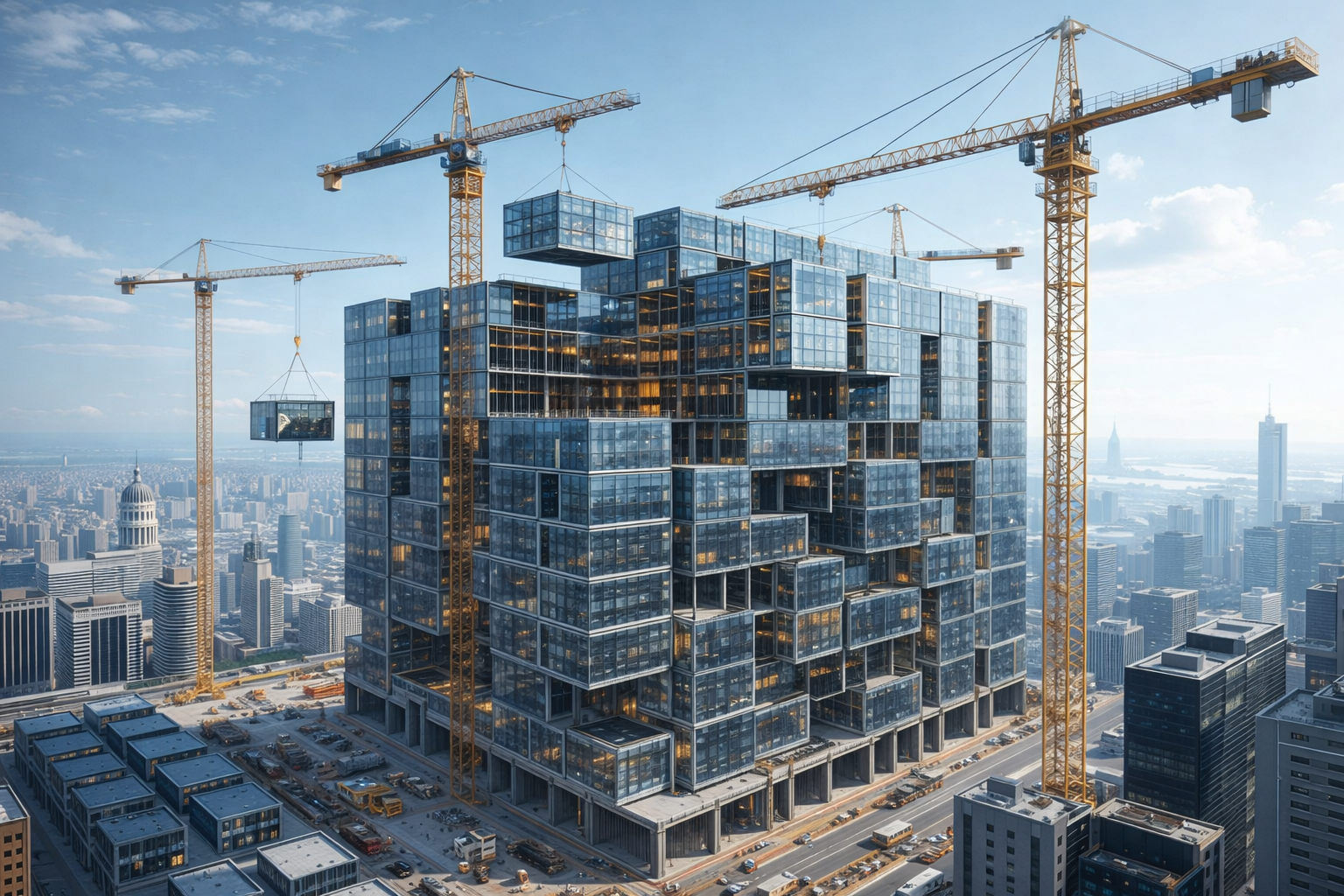
TECHNICAL ANNEX
Structural Engineering & Economic Modeling Framework
PART I — STRUCTURAL ENGINEERING FRAMEWORK
1. Structural System Overview
The M-777 supermodule is a vertically stacked modular cube composed of autonomous submodules (50m width × 20 floors height), interconnected through load-distributed docking nodes.
Each submodule operates as:
- Independent structural unit
- Independent MEP spine
- Replaceable macro-component
The macro-structure is defined as:M777=i=1∑kSMi
Where:
- SMi = autonomous structural submodule
- k = number of submodules composing the supermodule
2. Load Distribution Model
2.1 Total Vertical Load
Total vertical load:Wtotal=i=1∑k(Di+Li+Si)
Where:
- Di = dead load (self-weight)
- Li = live load
- Si = superimposed mechanical loads
2.2 Column and Core Load Transfer
Each submodule includes:
- Peripheral exoskeleton
- Central structural core
Load transfer per vertical structural element:σ=AeffWtotal
Where:
- σ = compressive stress
- Aeff = effective cross-sectional area
Design constraint:σ≤σallowable
3. Lateral Load Resistance (Wind + Seismic)
Total lateral load:Flat=Fwind+Fseismic
Wind load simplified:Fwind=21⋅ρ⋅V2⋅Cd⋅A
Where:
- ρ = air density
- V = wind velocity
- Cd = drag coefficient
- A = exposed area
Seismic base shear:Vbase=Cs⋅W
Where:
- Cs = seismic response coefficient
- W = total weight
Interlocking docking nodes distribute lateral forces between modules, reducing torsional irregularities.
4. Modular Docking Node Mechanics
Each submodule connects via:
- Mechanical shear keys
- Bolted/locked steel plates
- Reinforced tension transfer couplers
Shear resistance per node:Vnode=τallowable⋅Ashear
Safety condition:Vnode≥NnodesFlat
5. Structural Redundancy Factor
Redundancy coefficient:R=LoaddemandLoadcapacity_system
For sovereign infrastructure:R≥2.0
This ensures fault tolerance and partial module isolation capability.
6. Technical Floor Load Capacity
Raised technical floor capacity:qtech≥5–10kN/m2
Allows conversion to:
- Robotics labs
- Server clusters
- Light manufacturing
7. Material Optimization Equation
Structural mass efficiency ratio:ηm=Structural_massLoadcapacity
Higher ηm improves:
- CAPEX efficiency
- Transportation logistics
- Crane assembly time
PART II — ECONOMIC MODELING FRAMEWORK
1. Capital Expenditure Model
Total CAPEX:C0=Cstructure+CMEP+Cdigital+Cvertiport+Cland
If phased:C0=j=1∑pCphasej
2. Revenue Model
Annual total revenue:Rt=i=1∑m(Ai⋅renti⋅occi)
Where:
- Ai = surface allocated to function i
- renti = revenue per m²
- occi = occupancy rate
3. Operating Cost Model
OPEXt=Oenergy+Omaintenance+Omanagement+Odigital
Energy cost:Oenergy=KWhtotal⋅Priceenergy
4. Net Operating Income
NOIt=Rt−OPEXt
5. Payback Period
Payback=NOIavgC0
6. Net Present Value (NPV)
NPV=−C0+t=1∑n(1+r)tNOIt+(1+r)nS
7. Internal Rate of Return (IRR)
IRR satisfies:0=−C0+t=1∑n(1+r∗)tNOIt+(1+r∗)nS
8. Adaptive Square Meter Economic Uplift
Let:
- u = convertible area ratio
- Δrent = rent differential
Ruplift=u⋅Atotal⋅Δrent
Revised NOI:NOI′=NOI+Ruplift
9. Capital Replication Acceleration Model
Let:
- Cnext = cost of next M-777
- Surplust=NOIt−Debtservice
Replication condition:t=1∑xSurplust≥Cnext
Cloning acceleration factor:CAF=Timenth_unitTime1st_unit
As units increase, shared services reduce marginal CAPEX.
PART III — LASERDRON ECONOMIC–ENERGY LINK
1. Passenger Energy Demand
EnergyLD=Pax_km⋅eLD
2. Revenue Model LaserDron
RLD=Pax⋅fare
3. LaserDron ROI
ROILD=CAPEXLDRLD−OPEXLD
SYSTEM SYNTHESIS EQUATION
Full urban system:Sovereign_Urban_Value=(NOIM777+NOILD)−(Environmental_Costavoided)
Where avoided costs include:
- Health expenditure reduction
- Road maintenance savings
- Pollution mitigation cost elimination
CONCLUSION
The M-777 system integrates:
- Modular structural redundancy
- Aerospace-derived engineering
- Programmable economic adaptability
- Autonomous aerial mobility
- Capital replication mechanics
This annex provides the mathematical and structural foundation required for:
- Sovereign-level deployment
- Development bank financing
- Institutional investment review
- Infrastructure-grade engineering validation
Financial Replication Simulation Model
M-777 Modular Cloning Program (with optional LaserDron layer)
1) Model Purpose and Outputs
Core questions the simulation answers
- How many M-777 units can be built over time given phased CAPEX and operating cash flows?
- When does replication accelerate (inflection point)?
- What capital stack is required to hit a target deployment rate?
- Sensitivity to occupancy, rent, CAPEX inflation, financing rate, construction time.
Primary outputs (time series)
- Units under construction / units operational
- Monthly cash balance (program-level)
- Program-level debt, debt service coverage (DSCR)
- Cumulative CAPEX deployed
- Program NOI, FCF (free cash flow)
- Replication interval (months between unit starts)
2) Entities and Indexing
Discrete time
- t=1,2,…,T (monthly steps)
Units
- i=1,2,…,Imax
Each unit has:
- Start month si
- Completion month ci=si+Dconstr
- Ramp profile (occupancy ramp / revenue ramp)
3) Input Parameters (Program Level)
Construction & CAPEX
- Ctot: total CAPEX per M-777 (all-in)
- Dconstr: construction duration (months)
- αk: CAPEX spend curve by month k of construction, with
∑k=1Dconstrαk=1
(e.g., S-curve: low early, peak mid, taper late) - gC: CAPEX inflation (monthly or annual)
- Cvert: vertiport CAPEX (optional, may be embedded in Ctot)
- CLD: LaserDron system CAPEX per district or per node (optional)
Operations
- Stabilized annual revenues per unit:
- Rresann,Rcomann,Rdigann,Rindann
- Stabilized annual OPEX per unit: Oann
- Ramp function ϕ(m)∈[0,1] where m is months since completion
(e.g., 0.4 at month 1 → 1.0 by month 12)
Finance (capital stack)
- Equity share e, Debt share d=1−e
- Debt interest rate rd (monthly)
- Debt tenor Nd (months)
- Grace period G (months interest-only, optional)
- Program-level minimum cash reserve Bmin
Replication policy
- Start a new unit when:
- Cash balance Bt≥Θ (threshold)
- And/or DSCR program ≥ target
- And capacity to service new debt exists
4) Unit-Level Cash Flow Equations
4.1 CAPEX spend per unit during construction
For unit i, month t:
If si≤t<ci, let k=t−si+1:CAPEXi,t=Ctot⋅(1+gC)t/12⋅αk
Else:CAPEXi,t=0
4.2 Operating cash flow per unit after completion (ramped)
Monthly stabilized revenue and OPEX:Rstabmo=12Rresann+Rcomann+Rdigann+Rindann Omo=12Oann
If t≥ci, let m=t−ci+1:NOIi,t=ϕ(m)⋅Rstabmo−Omo
Else:NOIi,t=0
5) Financing Module (Debt + Equity)
5.1 Funding each unit’s CAPEX
At each month t, unit CAPEX is funded by:Equityi,t=e⋅CAPEXi,t DebtDrawi,t=d⋅CAPEXi,t
5.2 Debt balance tracking per unit (simple drawdown + amortization)
Let DebtBali,t.
During construction and grace (interest-only):
- Interest:
Inti,t=rd⋅DebtBali,t−1
- Principal payment Prini,t=0 until amortization starts.
After amortization start (month ai):
Use standard annuity payment Pi on outstanding balance at amortization start:Pi=DebtBali,ai⋅(1+rd)Nd−1rd(1+rd)Nd
Then each month:Inti,t=rd⋅DebtBali,t−1 Prini,t=Pi−Inti,t DebtBali,t=DebtBali,t−1−Prini,t
You can set:ai=ci+G
5.3 Unit Free Cash Flow (FCF)
FCFi,t=NOIi,t−Inti,t−Prini,t
6) Program-Level Cash Balance and Replication Logic
6.1 Aggregate program cash flow
NOIt=i∑NOIi,t CAPEXt=i∑CAPEXi,t DebtServicet=i∑(Inti,t+Prini,t) FCFt=i∑FCFi,t−i∑Equityi,t
If equity comes from external investors, treat it as an inflow instead; if equity is internal (retained earnings), keep as outflow. For “self-replication,” equity is internal.
6.2 Cash balance recursion
Bt=Bt−1+i∑FCFi,t−i∑Equityi,t−Overheadt
6.3 DSCR (program level)
DSCRt=DebtServicetNOIt
Replication rule might require:DSCRt≥DSCRmin
6.4 Start-next-unit condition (example policy)
Start unit j at month t if:
- Bt−Bmin≥Θ (cash available)
- and DSCRt≥DSCRmin
- and max concurrent builds not exceeded
Then set:sj=t+1
7) Optional: LaserDron as a Parallel Cash-Flow Engine
7.1 LaserDron demand
Passenger-km per month:PKMt=i∈operational∑Ni⋅T⋅L⋅pcar⋅30
7.2 LaserDron monthly revenue and cost
RtLD=PKMt⋅Farepaxkm OtLD=PKMt⋅eLD⋅PricekWh+OfixedLD NOItLD=RtLD−OtLD
Then add:NOIt←NOIt+NOItLD
This typically pulls forward the replication inflection point.
8) What Makes the Model “Accelerate” (Inflection Mechanism)
Replication accelerates when:
- Completed units accumulate and NOI grows roughly linearly with number of operational units.
- CAPEX per new unit stays constant (or declines marginally due to learning/scale).
- Internal retained cash begins covering a larger share of equity (and/or reduces need for external equity).
A simple indicator:Replication Intervalt≈Retained FCFmonthlyCequity,unit
As retained FCF rises, interval drops.
9) Implementation Template (Spreadsheet / Code Structure)
Tables you implement
A) Parameters
- CAPEX, duration, alpha curve, rent/OPEX, ramp, finance terms, policy thresholds
B) Unit schedule
- unit_id, start_month, completion_month, status
C) Monthly engine (rows = months)
- operational_units, under_construction_units
- CAPEX_t, NOI_t, debt_service_t, cash_balance_t, DSCR_t
- decision: start_new_unit? yes/no
D) Unit cashflow matrix
- for each unit x month: CAPEX, NOI, interest, principal, FCF
10) Recommended “Default” Functions (Robust and Simple)
CAPEX S-curve (example)
Define αk using a normalized distribution (e.g., [5%, 7%, 9%, 11%, 12%, 12%, 11%, 9%, 7%, 5%, 4%, 3%, 2%, 1%, 1%] for 15 months—adjust to your D).
Occupancy/ramp ϕ(m)
Example:
- Months 1–3: 0.50
- Months 4–6: 0.70
- Months 7–9: 0.85
- Months 10–12: 0.95
- Month 13+: 1.00
11) Stress Tests (must-have scenarios)
Run sensitivity toggles:
- CAPEX +10% / +20%
- Stabilized occupancy -10 points
- Rent -10%
- Construction duration +3 months
- Interest rate +200 bps
- Grid price shock (affects LaserDron OPEX if applicable)
Outputs: time-to-10-units, min cash balance, DSCR dips, equity needed.
12) Minimal KPI Set for Decision Makers
- Time to Unit #5 / #10 / #20
- Peak concurrent construction
- Lowest cash balance and month
- Average DSCR during ramp
- Equity required (if not fully self-funded)
- Replication interval trend (months between starts)
M-777 SOVEREIGN URBAN SYSTEM
Modular High-Density Habitat + Autonomous Aerial Mobility
Government Strategic Presentation (20 Slides)
Slide 1 — Executive Overview
Title:
M-777 Sovereign Urban Infrastructure Model
Core Proposition:
- Modular high-density vertical habitat system
- Kilometer-spaced ecological grid
- LaserDron autonomous aerial mobility
- Capital-amortizing, self-replicating urban model
Objective:
Deploy scalable eco-urban districts with near-zero surface traffic and strong fiscal sustainability.
Slide 2 — The Urban Challenge
Current systemic pressures:
- Urban sprawl
- Traffic congestion
- Air pollution and public health burden
- Road maintenance costs
- Rigid real estate assets
- Infrastructure financing constraints
Key Problem:
Traditional horizontal urban growth is capital-intensive and environmentally unsustainable.
Slide 3 — Strategic Response
M-777 Integrated Framework
- Vertical density
- Modular construction
- Programmable square meter
- Autonomous aerial transport
- Capital replication engine
Outcome:
Urban compression + ecological liberation + financial sustainability.
Slide 4 — Architectural Concept
M-777 Supermodule
- Stackable modular subunits (50m × 20 floors)
- Aerospace-derived docking nodes
- Autonomous structural independence
- Replaceable macro-components
Built using:
- Prefabricated high-precision systems
- Crane stacking assembly
- Dry modular integration
Slide 5 — Structural Engineering Framework
Core Systems:
- Exoskeleton load-bearing structure
- Central core vertical circulation
- Lateral resistance (wind + seismic)
- Redundant load transfer nodes
Safety design principle:
Redundancy coefficient ≥ 2.0
Engineering logic derived from orbital modular structures.
Slide 6 — Programmable Functional Units
Interior System:
- Japanese polyfunctional partition system
- Raised technical floor (industrial-capable)
- Plug-and-play infrastructure
Allows conversion between:
- Residential
- Office
- Digital labs
- Robotics production
- Light automated manufacturing
The square meter becomes adaptive.
Slide 7 — Kilometer-Spaced Ecological Urban Grid
Deployment model:
- 1 M-777 per square kilometer
- Surface reserved for green zones
- Zero ground-level car corridors
- High permeability landscape
Benefits:
- Urban heat reduction
- Air quality improvement
- Recreational space increase
- Flood resilience
Slide 8 — LaserDron Mobility System
Autonomous passenger drone network:
- AI-controlled traffic management
- Vertiports integrated into M-777
- Multi-layer altitude corridors
- Emergency redundancy protocols
Eliminates:
- Surface vehicle dependency
- Traffic congestion
- Road accidents
Slide 9 — Airspace Zoning Blueprint
Three-layer model:
Layer A: 60–120m (approach/departure)
Layer B: 120–300m (urban cruise corridors)
Layer C: 300–600m (regional mobility)
Geofenced sensitive zones
Dedicated vertical shafts per building
AI-managed corridor capacity optimization.
Slide 10 — Environmental Impact Modeling
Annual emissions reduction equation:
ΔE = Baseline ground emissions – LaserDron emissions
If powered by renewable electricity:
Passenger mobility emissions → near-zero.
Additional reductions:
- NOx
- PM2.5
- Noise pollution
- Road asphalt footprint
Slide 11 — Public Health & Social Impact
Expected systemic outcomes:
- Reduced respiratory disease burden
- Lower accident mortality
- Reduced chronic noise exposure
- Increased public green access
- Enhanced urban productivity
Quantifiable through:
- Avoided VKT metrics
- Air quality monitoring
- Hospital admission data
Slide 12 — Capital Structure
Per M-777:
Total CAPEX:
Structure + MEP + Digital + Vertiport + Site
Funding mix:
- Sovereign funding
- PPP model
- Development bank participation
- Infrastructure bonds
Phased construction reduces capital exposure.
Slide 13 — Revenue Model
Annual revenue layers:
- Residential leasing
- Commercial/retail
- Digital infrastructure hosting
- Robotics & microindustry
- LaserDron passenger mobility
Net Operating Income (NOI):
NOI = Revenue – OPEX
Slide 14 — ROI & Financial Metrics
Key indicators:
- Payback period
- NPV
- IRR
- DSCR
- Replication interval
Programmable square meter uplift improves long-term IRR resilience.
Slide 15 — Replication Simulation Model
Mechanism:
- Unit 1 operational → generates NOI
- Surplus retained → funds Unit 2
- Units accumulate → replication accelerates
Cloning acceleration factor increases over time as retained free cash flow grows.
Slide 16 — Sovereign Fiscal Advantages
Reduced public expenditure on:
- Road construction
- Road maintenance
- Traffic management
- Pollution mitigation
- Healthcare burden
Improved:
- Tax base density
- Infrastructure efficiency ratio
- Land-use productivity
Slide 17 — Risk Matrix
Technical Risks:
- Construction complexity
- Airspace regulatory integration
Financial Risks:
- CAPEX inflation
- Occupancy volatility
- Interest rate shifts
Mitigation:
- Modular phasing
- Redundant engineering
- Conservative DSCR policy
- Stress-tested simulation modeling
Slide 18 — Regulatory & Governance Requirements
Required frameworks:
- Urban air mobility regulation
- Vertiport certification
- Digital infrastructure standards
- Zoning adaptation
- Environmental compliance alignment
Compatibility with:
- ICAO guidance
- UAM standards
- National aviation authorities
Slide 19 — Pilot Deployment Roadmap
Phase 1:
- 1 M-777 + limited LaserDron corridor
- Controlled district deployment
Phase 2:
- 3–5 M-777 cluster
- Full air corridor network
Phase 3:
- City-scale replication
Timeline calibrated by fiscal capacity and financing structure.
Slide 20 — Strategic Conclusion
The M-777 Sovereign Urban System delivers:
- High-density ecological urbanism
- Near-zero ground traffic
- Autonomous mobility
- Adaptive economic real estate
- Self-amortizing replication capability
It represents a transition from static urban infrastructure
to programmable sovereign urban platforms.
M-777 SOVEREIGN URBAN SYSTEM
Modular High-Density Habitat & Autonomous Aerial Mobility Platform
Multilateral Development Bank Concept Note
1. Executive Summary
The M-777 Sovereign Urban System is a modular, high-density, space-engineered urban infrastructure platform designed to:
- Reduce urban sprawl and transport emissions
- Eliminate ground-level vehicular congestion
- Increase land-use productivity
- Deliver fiscally sustainable infrastructure replication
- Support climate mitigation and adaptation targets
The system integrates:
- Modular vertical superstructures (M-777)
- Kilometer-spaced ecological district planning
- Programmable mixed-use infrastructure
- Autonomous aerial passenger mobility (LaserDron network)
The model aligns with MDB priorities in:
- Climate resilience
- Sustainable urbanization
- Green infrastructure
- Energy transition
- Innovative financing mechanisms
2. Development Context and Problem Statement
Urban systems globally face structural stress from:
- Rapid urbanization
- Traffic congestion and economic inefficiency
- Air pollution and health burden
- Infrastructure financing gaps
- Low-density sprawl
- High lifecycle infrastructure maintenance costs
Ground-vehicle-dependent cities generate:
- Significant CO₂ emissions
- Persistent NOx and PM2.5 exposure
- Road accident mortality
- Long-term fiscal maintenance liabilities
A structural urban redesign is required.
3. Proposed Solution
The M-777 system introduces a vertically concentrated, modular district model in which:
- Population density is absorbed vertically
- Surface land is preserved as green space
- Passenger mobility is shifted to autonomous electric aerial transport
- Real estate is engineered as adaptive economic infrastructure
The solution reduces systemic urban externalities while improving fiscal efficiency.
4. Technical Overview
4.1 Modular Construction Model
Each M-777 unit:
- Is composed of autonomous 50m × 20-floor submodules
- Uses prefabricated structural systems
- Integrates redundancy and seismic resilience
- Includes convertible interior systems
Construction advantages:
- Reduced build time
- Reduced material waste
- Lower lifecycle maintenance costs
- Scalable replication
4.2 Adaptive Functional Infrastructure
Units incorporate:
- Raised technical floor systems
- Modular partition architecture
- Digital backbone integration
This enables conversion between:
- Residential
- Commercial
- Digital infrastructure
- Light manufacturing
- Innovation hubs
Result: Improved long-term asset resilience and revenue stability.
5. Mobility Component – LaserDron Network
The LaserDron system:
- Eliminates ground-based passenger vehicle dependency
- Operates via AI-controlled aerial corridors
- Uses electric propulsion
- Integrates vertiports within each M-777
Expected outcomes:
- Significant CO₂ reduction in passenger mobility
- Elimination of urban road congestion
- Reduced traffic-related fatalities
- Lower noise pollution
If powered by renewable electricity, passenger transport emissions approach near-zero levels.
6. Climate Mitigation & Environmental Impact
6.1 Emissions Reduction Model
Baseline ground transport emissions:
E_baseline = 365 × N × T × L × p_car × EF_car
Post-implementation emissions:
E_LD = 365 × N × T × L × p_car × e_LD × EF_grid
If EF_grid → low (renewable integration):
Mobility-related emissions → substantially reduced.
6.2 Additional Environmental Benefits
- Reduction in NOx and particulate matter
- Lower heat island effect
- Increased green permeable surfaces
- Reduced asphalt dependency
- Lower long-term road maintenance demand
7. Economic & Financial Model
7.1 Revenue Structure
Per M-777 unit:
Annual Revenue = Residential + Commercial + Digital + Industrial + Mobility
Net Operating Income:
NOI = Revenue – OPEX
7.2 Financial Metrics
Project evaluation includes:
- Payback period
- Net Present Value (NPV)
- Internal Rate of Return (IRR)
- Debt Service Coverage Ratio (DSCR)
- Replication interval
Programmable space increases revenue flexibility and reduces market-cycle risk.
8. Replication Mechanism
The model is designed for progressive scaling.
Mechanism:
- First unit operational → generates NOI
- Retained surplus partially funds next unit
- Portfolio grows → cash flow increases
- Replication interval shortens
This creates a controlled, fiscally sustainable expansion path.
9. Alignment with MDB Strategic Priorities
The M-777 system aligns with:
- Climate action and Paris Agreement commitments
- Sustainable Cities & Communities (SDG 11)
- Clean Energy Transition (SDG 7)
- Innovation & Infrastructure (SDG 9)
- Resilient infrastructure financing
10. Proposed Financing Structure
Potential MDB instruments:
- Sovereign lending
- Blended finance
- Green bonds
- Climate funds
- PPP frameworks
- Urban resilience financing facilities
Capital stack example:
- 30–40% equity
- 60–70% long-term concessional or blended debt
Phased modular deployment reduces upfront exposure.
11. Risk Assessment
Technical Risks
- Construction scaling challenges
- Airspace regulatory compliance
- Technology certification
Mitigation:
- Phased pilot deployment
- Redundant structural engineering
- Regulatory integration roadmap
Financial Risks
- CAPEX inflation
- Occupancy volatility
- Interest rate exposure
Mitigation:
- Conservative DSCR thresholds
- Modular phasing
- Stress-tested replication modeling
12. Regulatory and Institutional Framework
Required governance layers:
- Urban air mobility regulation
- Aviation authority integration
- Zoning adjustments
- Environmental compliance
- Infrastructure certification
MDB support may include technical advisory components.
13. Pilot Proposal
Phase 1:
- 1 M-777 unit
- Limited LaserDron corridor
- Full MRV (Monitoring, Reporting, Verification) system
Phase 2:
- 3–5 M-777 cluster
- District-scale mobility integration
Phase 3:
- City-scale expansion
14. Monitoring & Evaluation Framework
Performance indicators:
- CO₂ reduction (tCO₂e/year)
- Avoided vehicle kilometers
- Occupancy rates
- NOI performance
- Replication interval
- Public health indicators
- Green surface ratio
15. Expected Development Outcomes
- Reduced urban congestion
- Improved air quality
- Lower infrastructure maintenance costs
- Increased land productivity
- Fiscal sustainability
- Innovation ecosystem development
16. Conclusion
The M-777 Sovereign Urban System represents:
- A vertically efficient urban infrastructure model
- A climate-aligned transport alternative
- A modular construction framework
- A financially replicable development platform
The system offers MDBs a scalable, climate-resilient, infrastructure-grade investment opportunity aligned with long-term sustainable urban transformation.
WATER PROVISION CONSTRAINT ANALYSIS
High-Density Vertical Urban Deployment in Water-Scarce Regions (Case: Chad)
1. Fundamental Constraint
Water demand scales linearly with population density:Wtotal=N⋅wper_capita
Where:
- N = population
- wper_capita = daily water demand (L/person/day)
For high-density vertical cities, realistic design ranges:
| Use Type | Liters/person/day |
|---|---|
| Minimal survival | 20–30 L |
| Basic urban living | 80–120 L |
| Developed standard | 150–250 L |
For a dense M-777 (example 10,000 residents):Wdaily=10,000⋅100=1,000,000L/day=1,000m3/day
This excludes industrial/digital cooling demand.
2. Why Desalination Is Not Viable for Chad
Chad is:
- Landlocked
- Distant from ocean sources
- Energy-constrained
- Infrastructure-limited
Desalination would require:
- 1,000+ km transport pipelines
- High pumping energy (elevation dependent)
- CAPEX > feasibility threshold for inland sovereign scaling
Therefore, local atmospheric and subsurface water strategies must be prioritized.
3. Atmospheric Water Extraction (AWE) Feasibility
Water in the air exists as:
- Vapor (humidity)
- Condensable moisture (dew formation)
- Fog (rare in inland Chad except microclimates)
The maximum theoretical water content of air depends on:
- Temperature (T)
- Relative humidity (RH)
3.1 Water Vapor Density Equation
Saturation vapor pressure (Clausius–Clapeyron approximation):es(T)=6.112⋅e(T+243.517.67T)
Actual vapor pressure:e=RH⋅es
Water vapor density:ρv=T+273.15216.7⋅e[g/m3]
3.2 Example: Chad Sahel Conditions
Typical:
- Temperature: 35°C
- RH: 30% (dry season)
- RH: 60–80% (rainy season nights)
At 35°C, saturation vapor ≈ 39 g/m³
At 30% RH:ρv≈0.30⋅39≈12g/m3
So 1 m³ of air contains ≈ 12 grams of water.
To extract 1 liter (1,000 g):121000≈83m3air
For 1,000 m³/day demand:83⋅1,000,000g=83,000,000m3air/day
This is extremely high airflow volume.
4. Energy Requirements of Atmospheric Water Generation
Two primary technologies:
- Refrigeration-based condensation
- Desiccant-based adsorption (MOF, silica, salt-based systems)
4.1 Refrigeration-Based Condensation
Energy required per liter:
Typically:0.3–1.2kWh/L
Depends on:
- Temperature
- Relative humidity
- System COP
At low humidity (30% RH), efficiency drops significantly.
If 0.6 kWh/L average:
For 1,000,000 L/day:600,000kWh/day
This equals:600MWh/day
Equivalent to a medium-scale power plant.
Conclusion:
Pure refrigeration-based AWE is energy intensive and likely economically prohibitive at scale in low humidity climates.
4.2 Desiccant / MOF-Based Systems
Metal–Organic Frameworks (MOFs):
- Adsorb water at lower RH (as low as 10–20%)
- Regenerate using solar thermal heat
Water yield depends on:
- Adsorption capacity (g water/kg material)
- Cycle frequency
- Solar flux
Typical lab performance:0.2–1.5L/m2/day
Scaling to 1,000 m³/day:
Would require:>1,000,000m2
Unless high-efficiency materials with forced-air integration are used.
Still land-area intensive.
5. Hybrid Water Strategy (More Realistic)
Atmospheric water alone cannot support high-density cities in arid Sahel.
Therefore, water model must combine:
- Atmospheric capture (supplementary)
- Deep aquifer extraction (if hydrogeology permits)
- Rainwater harvesting (seasonal)
- Closed-loop water recycling (critical)
- Greywater recovery systems
- Ultra-efficient consumption design
6. Closed-Loop Urban Water Recycling
Critical for viability.
Typical urban water reuse rates:
- Conventional cities: 10–20%
- Advanced closed-loop systems: 70–90%
If M-777 reaches 85% recycling:Net demand=15%⋅Wtotal
So instead of 1,000 m³/day:150m3/day
Now AWE becomes more feasible.
7. Water Demand Reduction Variables
Key engineering levers:
- Vacuum sanitation (reduces water per flush)
- Ultra-low-flow fixtures
- Waterless industrial cooling (liquid cooling loops)
- AI water optimization
- Behavioral policy incentives
Per capita reduction to:50–60L/day
Further reduces extraction burden.
8. Groundwater Considerations in Chad
Chad contains:
- Nubian Sandstone Aquifer System (regional)
- Lake Chad basin aquifers
Risks:
- Overextraction
- Non-renewable fossil aquifers
- Salinity intrusion
- Political conflict over shared water
Hydrogeological mapping is mandatory.
9. Strategic Variables Summary
Critical variables affecting viability:
| Variable | High Impact? |
|---|---|
| Relative Humidity | Extreme |
| Energy Cost | Extreme |
| Recycling Efficiency | Critical |
| Population Density | Linear effect |
| Aquifer Access | Strategic |
| Solar Irradiance | Favorable |
| Seasonal Variability | Significant |
10. Scientific Conclusion
In Chad-type climate:
Atmospheric Water Extraction:
- Technically feasible
- Energy-intensive
- Insufficient as sole source at scale
Project viability requires:
- Aggressive water recycling (>80%)
- Hybrid atmospheric + groundwater model
- Solar-powered desiccant systems
- Reduced per capita demand
- Hydrogeological validation
Water, not energy, is the limiting variable.
Without solving water sustainability, high-density replication is constrained.
1. Climatic Baseline – Chad (Sahel Region)
Representative dry-season values:
- Day temperature: 35–42°C
- Night temperature: 20–28°C
- Relative humidity:
- Day: 15–35%
- Night: 50–85%
- Solar irradiance:
5.5–6.5 kWh/m²/day (very favorable)
Important insight:
Water vapor concentration is significantly higher at night.
Therefore, adsorption must occur primarily at night.
Desorption (regeneration) during daytime solar peak.
This matches MOF operating logic.
2. Physics of Atmospheric Water Content
At 35°C:
Saturation vapor density ≈ 39 g/m³
At 30% RH:ρv≈12g/m3
At 70% RH (night):ρv≈27g/m3
Conclusion:
Night adsorption window is critical.
3. MOF Water Uptake Capacity
State-of-the-art MOFs (e.g., MOF-801, MOF-303 class):
Water uptake at:
- 20% RH: 0.15–0.25 g water/g MOF
- 30–40% RH: 0.25–0.35 g/g
- 60–80% RH: up to 0.40 g/g
Conservative Sahel average assumption:0.25g/g per cycle
4. Regeneration via Solar Thermal
Desorption temperature required:
- 45–85°C (depending on MOF chemistry)
Chad solar irradiance is strong enough to achieve:
- 70–100°C collector output
using flat-plate or evacuated tube collectors.
Thus solar-thermal regeneration is technically viable.
5. Production per kg of MOF
Assume:
0.25 g water per gram MOF per cycle
= 0.25 kg water per kg MOF per cycle
If 1 full cycle per day:1kgMOF→0.25L/day
If optimized (2 cycles/day possible):1kg→0.5L/day
Realistically in Chad climate:
1 cycle/day reliable baseline.
6. Scaling for an M-777
Assume aggressive water conservation:
- 60 L/person/day
- 10,000 residents
Total demand:600,000L/day
Assume 85% recycling:Net new water=0.15⋅600,000 =90,000L/day
So external supply must produce:
90 m³/day
7. Required MOF Mass
If 1 kg MOF → 0.25 L/day:0.2590,000=360,000kg
360 metric tons of MOF material.
This is extremely large.
Even if optimized to 0.4 L/kg/day:0.490,000=225,000kg
Still 225 tons.
8. Surface Area Requirements
MOF must be exposed to airflow.
Assume packing density:
~100–200 kg/m³ structured modules.
Using 150 kg/m³:
For 360,000 kg:Volume=150360,000=2,400m3
If installed in 1 m thick adsorption panels:Area=2,400m2
This is manageable on:
- Rooftop
- Vertical façades
- Adjacent solar-water field
Surface area is not the bottleneck.
Material mass is.
9. Solar Thermal Requirement
Desorption energy:
Latent heat of vaporization ≈ 2.26 MJ/kg
= 0.63 kWh/kg
For 90,000 kg/day:Energythermal=90,000⋅0.63 =56,700kWh/day
Solar collection:
At 6 kWh/m²/day with 60% collector efficiency:3.6kWh/m2/dayusable
Required collector area:3.656,700≈15,750m2
≈ 1.6 hectares.
This is feasible in 1 km² spacing.
Energy is manageable.
Material scale is the constraint.
10. Capital & Material Feasibility
Critical question:
Cost per kg MOF.
Current laboratory-scale MOF cost:
$50–200/kg (not industrialized yet)
At $50/kg:360,000⋅50=$18M
At $100/kg:
$36M
For one M-777.
Material cost alone may exceed structural CAPEX.
Industrial-scale production could reduce cost significantly.
But currently:
This is borderline economically prohibitive.
11. Efficiency Sensitivity
The system becomes viable if:
Water yield improves to:
1 L/kg/day
Then:90,000kgMOFrequired
Cost drastically reduced.
Therefore:
Technology efficiency breakthrough is key variable.
12. Comparison with Groundwater Hybrid
If 50% water comes from sustainable aquifer:
Net atmospheric requirement:
45 m³/day
MOF mass halves:
180 tons → 90 tons
Much more feasible.
13. Critical Variables
| Variable | Sensitivity |
|---|---|
| Night RH | Very high |
| MOF uptake capacity | Extremely high |
| Recycling efficiency | Critical |
| Solar efficiency | Moderate |
| Population per M-777 | Linear |
| Industrial water demand | High impact |
14. Engineering Conclusion
Solar-thermal + MOF AWH in Chad:
Technically feasible
Thermodynamically sound
Energy viable
Land-area viable
But:
Material scale and cost are primary constraints.
Atmospheric water alone is unlikely to sustain a 10,000-person high-density unit unless:
- Recycling > 85%
- MOF efficiency improves
- Hybrid groundwater support exists
15. Strategic Implication
Water strategy for Chad must be:
Hybrid:
- Closed-loop recycling (priority #1)
- Limited atmospheric extraction
- Sustainable aquifer tapping
- Rain capture (seasonal storage)
- Ultra-low water consumption standards
Water defines maximum carrying capacity.