




Hybrid Human–AI Cognitive Augmentation System
Concept Overview
The Human-X Beta BioSuit is a wearable human–AI hybrid augmentation platform designed to extend human cognitive, sensory, and analytical capacities through the integration of augmented reality interfaces, distributed processing systems, and AI coprocessing networks.
The system functions as an external digital neocortex, allowing the human user to interact with a large network of specialized artificial intelligences through natural cognitive signals such as focused thought, voice commands, eye tracking, and gesture inputs.
Unlike conventional wearable technologies that provide passive data displays or limited computational assistance, the Human-X Beta system is conceived as a full cognitive amplification architecture capable of transforming a single human operator into the equivalent of a distributed multidisciplinary research team.
This architecture represents a transitional stage toward Human–AI hybrid intelligence ecosystems, where the biological brain remains the central decision-making authority while artificial intelligence systems perform large-scale analysis, modeling, and optimization.
1. Strategic Objective
The primary objective of the Human-X Beta BioSuit is to enable the creation of Hybrid Cognitive Units (HCU) capable of solving complex scientific, engineering, economic, or strategic problems through real-time human–AI coprocessing.
The system is designed to:
• Expand human analytical bandwidth
• Accelerate multidisciplinary decision-making
• Enable real-time data mining and hypothesis testing
• Reduce cognitive bottlenecks in complex systems analysis
• Allow one operator to orchestrate large distributed AI networks
From an operational standpoint, the Human-X system transforms the user into a cognitive command node connected to a global AI knowledge network.
2. Core System Architecture
The Human-X Beta BioSuit consists of five integrated technological layers:
1. Wearable Cognitive Interface Layer
2. Exoskeletal Distributed Processing Layer
3. AI Coprocessing Network Layer
4. Holographic Knowledge Visualization Layer
5. Data Mining and Logical Validation Layer
Together, these layers form a closed feedback loop between biological cognition and artificial intelligence systems.
3. Wearable Cognitive Interface Layer
This layer allows the user to communicate with the AI system using natural cognitive and sensory inputs.
Augmented Reality Lenses
Advanced AR lenses or visor systems provide immersive visualization of data, models, and AI avatars within the user’s field of vision.
Capabilities include:
• Multi-layer data visualization
• Real-time scientific simulation display
• Interactive holographic dashboards
• Spatial representation of complex systems
This interface transforms information into visual cognitive objects, enabling faster comprehension and decision-making.
Digital Iris Tracking System
The digital iris interface tracks eye movement and focus points, allowing the system to interpret:
• attention direction
• object selection
• command confirmation
• cognitive emphasis signals
The iris interface functions as a low-latency neural-behavioral input channel.
Voice and Cognitive Command Interface
The Human-X system interprets commands through:
• voice recognition
• gesture recognition
• attention-based selection
• focused thought triggers (via neural inference models)
Through continuous learning, the system adapts to the user’s cognitive patterns, creating a personalized cognitive control interface.
4. Exoskeletal Distributed Processing Layer
The Human-X BioSuit incorporates a lightweight robotic exoskeleton framework containing distributed computational modules.
This exoskeleton performs several functions:
• supports sensors and processors
• distributes heat generated by computation
• integrates power systems
• stabilizes wearable hardware
• enables high-performance edge computing
Instead of relying entirely on cloud processing, the system uses local distributed processors embedded in the suit, reducing latency and improving responsiveness.
Embedded Processing Modules
Processing nodes are located throughout the suit structure:
• chest module — central processing coordinator
• shoulder nodes — neural interface processing
• spine module — power and thermal regulation
• forearm units — gesture recognition and interface control
These processors function as edge-computing clusters, enabling real-time interaction with AI systems.
5. External Digital Neocortex Concept
The Human-X system implements a portable digital neocortex.
In biological terms, the neocortex is responsible for:
• reasoning
• pattern recognition
• abstraction
• language processing
The Human-X architecture extends this capability externally by connecting the user to a large distributed network of specialized artificial intelligences.
This creates a hybrid cognitive structure composed of:
Human intuition + AI analytical power.
6. AI Coprocessing Network
At the core of the Human-X system is an AI Coprocessing Network composed of specialized AI agents.
The baseline architecture envisions a network of at least 1,000 specialized AI avatars, each trained in a specific domain.
Examples include:
• astrophysics AI
• climate modeling AI
• economic systems AI
• biomedical AI
• engineering optimization AI
• geopolitical analysis AI
Each AI operates as an expert node within the system.
7. Holographic AI Avatar Assembly
The AI network is represented visually as a holographic assembly of avatars, forming a virtual scientific council or digital agora.
Each AI avatar represents a domain-specific intelligence capable of:
• presenting analysis
• proposing hypotheses
• evaluating data models
• detecting logical inconsistencies
This structure creates a deliberative analytical environment, where multiple specialized AI systems collaborate simultaneously.
8. Scientific Data Mining Engine
The system integrates a data mining engine that continuously scans large data sources:
• scientific databases
• engineering datasets
• economic indicators
• satellite data
• research publications
The engine performs:
• pattern detection
• anomaly detection
• predictive modeling
• cross-domain correlation
Results are filtered through logical consistency validation algorithms.
9. Contradiction Elimination Model
One of the most important functions of the system is automatic elimination of contradictions.
The AI network compares hypotheses using:
• statistical validation
• logical consistency checks
• probabilistic simulations
• historical data verification
Models that contain contradictions or weak evidence are automatically downgraded or eliminated.
This produces progressively optimized analytical outcomes.
10. Hybrid Intelligence Workflow
The Human-X workflow follows a structured process:
1️⃣ Human formulates the initial hypothesis
2️⃣ AI network decomposes the problem
3️⃣ Specialized AI nodes analyze sub-domains
4️⃣ Data mining engines collect relevant datasets
5️⃣ Simulation models are generated
6️⃣ Contradictions are detected and filtered
7️⃣ The system produces optimized conclusions
8️⃣ The human operator validates final decisions
The final authority remains with the human decision maker.
11. Comparative Positioning
| Technology | Capability | Limitations |
|---|---|---|
| Smartphones | Information access | No cognitive augmentation |
| AR Glasses | Visualization | Limited processing |
| Wearable computers | Portable computing | Limited AI integration |
| Brain-computer interfaces | Neural control | Experimental |
| Human-X BioSuit | Full hybrid intelligence | Requires advanced integration |
The Human-X architecture represents a new category of technology: Hybrid Cognitive Systems.
12. Potential Applications
The Human-X system has applications in multiple sectors:
Scientific Research
Acceleration of multidisciplinary discovery.
Climate and Planetary Systems
Large-scale environmental modeling.
Strategic Decision Making
Government and geopolitical analysis.
Advanced Engineering
Real-time design optimization.
Aerospace Exploration
Support for astronauts and mission planning.
Medical Research
Rapid analysis of complex biomedical datasets.
13. Business and Industrial Potential
The Human-X platform could become the foundation for a new industry sector:
Cognitive Augmentation Technologies
Potential markets include:
• defense research
• advanced scientific laboratories
• large engineering companies
• strategic consulting
• space exploration agencies
Long-term, the technology could evolve into consumer cognitive augmentation systems.
14. Development Roadmap
Phase 1 — Concept Prototype
AR interface + AI copilot system.
Phase 2 — Wearable Integration
Lightweight exoskeleton and distributed processors.
Phase 3 — AI Assembly Network
Integration of large-scale specialized AI systems.
Phase 4 — Neural Interface
Advanced cognitive signal detection.
Phase 5 — Hybrid Intelligence Units
Full operational human–AI teams.
15. Strategic Significance
The Human-X BioSuit represents a step toward post-industrial cognitive infrastructure, where knowledge production is dramatically accelerated through hybrid intelligence systems.
If implemented successfully, the technology could:
• increase the speed of scientific discovery
• improve complex decision-making
• enable rapid innovation cycles
• reduce systemic errors caused by limited human processing capacity
Ultimately, the Human-X architecture may become one of the foundational technologies enabling Human–AI civilizational collaboration.
Human-X Beta BioSuit
Technical Engineering Specification
DARPA-Level Concept Architecture (SpaceArch Systems Division)
1. System Definition
The Human-X Beta BioSuit is a portable hybrid cognitive augmentation platform designed to integrate biological human intelligence with distributed artificial intelligence systems through a wearable cybernetic interface.
The system combines:
• Augmented reality visualization
• Distributed edge computing embedded in an exoskeleton
• AI coprocessing cloud networks
• biometric human-machine interfaces
• holographic multi-agent collaboration environments
The objective is to create a Human–AI Hybrid Cognitive Unit (HCU) capable of solving complex multidisciplinary problems with massively parallel analysis while maintaining human decision authority.
The Human-X Beta platform functions as a portable digital neocortex, enabling real-time interaction with a network of specialized AI agents.
2. Mission Profile
The system is designed for high-complexity environments where rapid analytical synthesis across multiple domains is required.
Primary operational domains include:
Advanced scientific research
strategic systems analysis
planetary environmental monitoring
complex engineering design
space mission support
large-scale data interpretation
A single Human-X operator can coordinate a distributed AI knowledge assembly equivalent to hundreds of domain specialists.
3. System Architecture Overview
The Human-X system consists of six integrated subsystems:
- Cognitive Interface System (CIS)
- Wearable Exoskeletal Hardware Platform (WEHP)
- Distributed Edge Processing Network (DEPN)
- AI Coprocessing Cloud (AICC)
- Holographic Knowledge Visualization System (HKVS)
- Logical Validation and Data Mining Engine (LVDME)
These subsystems operate as a closed-loop hybrid intelligence architecture.
4. Cognitive Interface System (CIS)
The Cognitive Interface System enables the user to control and interact with the AI environment using natural biological signals.
Components
Augmented Reality Optical Interface
Resolution target
4K per eye
Field of view
120° immersive AR
Refresh rate
120 Hz
Optical engine
MicroLED waveguide projection
Capabilities
• multi-layer data visualization
• interactive holographic displays
• spatial model interaction
• multi-agent visualization
Digital Iris Tracking
High-precision eye-tracking sensors embedded in the visor.
Tracking resolution
<0.1° angular accuracy
Sampling frequency
1000 Hz
Functions
• target selection
• focus detection
• command confirmation
• cognitive attention inference
Voice Command Interface
AI-assisted natural language interaction.
Recognition latency
<50 ms
Languages supported
multi-language neural models
Command modes
• conversational command
• directive command
• analytical query
Gesture Interface
Integrated inertial sensors in forearm modules detect hand and arm movement.
Recognition accuracy target
98%
Functions
• object manipulation in AR space
• menu navigation
• collaborative modeling interaction
5. Wearable Exoskeletal Hardware Platform (WEHP)
The WEHP provides the mechanical structure supporting computational hardware, sensors, and power systems.
Structural Design
Material
carbon fiber reinforced polymer
titanium joint connectors
Weight target
6–9 kg
Load distribution
spine-anchored exoskeletal frame
Ventilation
active thermal channels
The exoskeleton is not designed for strength amplification, but for computational integration and ergonomic stability.
6. Distributed Edge Processing Network (DEPN)
The BioSuit integrates multiple embedded computing nodes distributed across the exoskeleton.
Purpose
• reduce latency
• perform real-time signal processing
• support AR rendering
• preprocess data for cloud transmission
Processing Architecture
Central Processing Node (CPN)
Location
chest module
Processing power target
80–120 TOPS
Functions
• AI interface coordination
• system resource management
• edge inference operations
Secondary Processing Nodes
Locations
• shoulders
• forearms
• spine module
Each node includes
• AI accelerator chip
• sensor fusion module
• local memory
Processing capacity per node
20–40 TOPS
Total Edge Processing Target
Aggregate compute capacity
200–300 TOPS
7. AI Coprocessing Cloud (AICC)
The Human-X system connects to a distributed AI cloud network composed of specialized AI agents.
Baseline architecture
minimum 1,000 domain-specific AI models
Each AI represents a knowledge specialization domain.
Examples
astrophysics
climate science
economics
materials engineering
medicine
systems engineering
machine learning research
AI Assembly Coordination System
The cloud network dynamically organizes AI agents into temporary analytical councils.
These councils perform:
• collaborative analysis
• cross-disciplinary modeling
• hypothesis generation
• scenario simulations
The structure functions as a digital research assembly or scientific agora.
8. Holographic Knowledge Visualization System (HKVS)
The HKVS presents AI analysis results as interactive holographic structures within the AR environment.
Visualization formats include:
• 3D system models
• simulation outputs
• knowledge graphs
• comparative hypothesis maps
The user can interact with these objects in real time.
9. Logical Validation and Data Mining Engine (LVDME)
A central component of Human-X is the scientific validation engine.
This system continuously evaluates hypotheses using:
• statistical analysis
• probabilistic modeling
• historical dataset comparison
• logical consistency testing
Contradictory or unsupported models are flagged or eliminated.
This process produces iteratively optimized conclusions.
10. Data Acquisition Network
The Human-X system accesses global knowledge sources.
Examples
scientific publication databases
satellite data networks
financial data streams
climate monitoring systems
engineering datasets
government open data platforms
The system continuously performs automated knowledge ingestion and indexing.
11. Communication Infrastructure
Primary communication channel
5G / future 6G networks
Backup communication
low-orbit satellite networks
Data encryption
quantum-resistant cryptographic protocols
Latency target
<30 ms for AI cloud interaction.
12. Power System
Energy source
high-density lithium solid-state batteries
Battery capacity
600–800 Wh
Operational endurance
3–4 hours continuous operation
Hot-swap battery modules supported.
13. Thermal Management
Distributed heat dissipation system.
Components
• heat pipes integrated in frame
• micro-fan cooling modules
• graphene heat spreaders
Maximum operating temperature
<45°C external surface
14. Cybersecurity Architecture
Human-X incorporates multiple layers of security.
Security layers
• encrypted communication channels
• secure hardware enclaves
• AI model authentication
• biometric identity verification
Threat model includes
• AI manipulation
• data poisoning
• command spoofing
15. Operational Workflow
Step 1
User formulates analytical objective.
Step 2
AI network decomposes the problem.
Step 3
Domain-specific AI agents analyze subcomponents.
Step 4
Data mining engine retrieves relevant datasets.
Step 5
Simulation models are generated.
Step 6
Logical validation engine filters contradictions.
Step 7
Results are presented through AR visualization.
Step 8
User performs final decision synthesis.
16. Performance Targets
| Parameter | Target |
|---|---|
| AR latency | <10 ms |
| AI response time | <2 seconds |
| Edge compute | 200–300 TOPS |
| AI agents | ≥1000 |
| Data throughput | >5 Gbps |
| Battery life | 3–4 hours |
17. Technology Readiness Level (TRL)
Current feasibility estimate
TRL 3–4
Proof-of-concept architecture possible with current technologies.
Required advances
• ultra-light edge AI chips
• improved AR optics
• distributed AI orchestration frameworks
• wearable power systems
Expected TRL progression
Prototype stage
3–5 years
Operational system
7–10 years
18. Strategic Impact
The Human-X architecture introduces a new technological category:
Hybrid Human–AI Cognitive Systems
Potential long-term impacts include
• acceleration of scientific discovery
• improved strategic decision making
• enhanced problem-solving capacity for complex global challenges
The system could redefine the human role in high-complexity knowledge environments.
Human-X Beta BioSuit
Startup Roadmap, Investment Model & Hardware Architecture
SpaceArch Advanced Hybrid Intelligence Systems
1. Strategic Vision
The Human-X Beta BioSuit represents the emergence of a new technological sector:
Human–AI Hybrid Cognitive Augmentation Systems
This sector integrates:
- wearable computing
- augmented reality
- distributed AI coprocessing
- edge AI hardware
- neuro-adaptive interfaces
The Human-X platform transforms a human operator into a Hybrid Cognitive Command Node, capable of coordinating thousands of AI systems in real time.
The long-term objective is to establish SpaceArch as a global pioneer in human-AI augmentation technologies, similar to how:
- Apple created the personal computer ecosystem
- Tesla pioneered electric mobility platforms
- NVIDIA built the AI computing infrastructure
Human-X would define the human-AI cognitive interface industry.
2. Market Opportunity
The BioSuit concept intersects several high-growth markets.
| Sector | Market Size |
|---|---|
| AR / XR systems | $300B |
| AI infrastructure | $2T |
| Wearable computing | $150B |
| Defense technology | $700B |
| Space exploration | $1T+ |
Potential addressable market:
$3–5 trillion over the next two decades.
Early adopters are expected to be:
- defense agencies
- aerospace organizations
- advanced research labs
- engineering corporations
- AI research centers
Later expansion includes enterprise and professional markets.
3. Product Roadmap
Phase 1 — Software Prototype (Year 1)
Objective
Develop the AI Copilot + AR interface without full suit hardware.
Components:
- AR headset integration
- AI orchestration software
- multi-AI collaboration interface
- holographic knowledge dashboards
Hardware platform
Existing XR headsets.
Estimated budget
$5–8M
Outcome
Proof-of-concept hybrid intelligence interface.
Phase 2 — Beta Wearable System (Years 2-3)
Development of the first BioSuit prototype.
Components:
- lightweight exoskeletal frame
- distributed edge processors
- gesture control modules
- advanced AR visor
Prototype units
10–20 suits.
Estimated budget
$30–50M
Outcome
Operational Human-AI hybrid workstation.
Phase 3 — Alpha Production Platform (Years 4-5)
Industrialization of the system.
Develop:
- custom AI chips
- optimized power systems
- full holographic AI assembly interface
- secure cloud infrastructure
Production
500–1000 units.
Estimated budget
$120–200M
Target customers
- research institutions
- aerospace agencies
- advanced engineering firms.
Phase 4 — Mass Market Expansion (Years 6-10)
Development of Human-X Lite.
Features
- simplified AR interface
- smaller AI network
- enterprise productivity tools.
Potential markets
- engineers
- scientists
- analysts
- surgeons
- architects.
Projected unit production
100,000+ systems.
4. Investment Model
Seed Round
Goal
Develop AI orchestration software.
Capital required
$10M
Use of funds
- software architecture
- AI integration
- early prototypes.
Valuation estimate
$40M pre-money.
Series A
Goal
Build full BioSuit prototype.
Capital required
$50–70M
Use of funds
- wearable hardware engineering
- distributed edge computing
- advanced AR interface.
Estimated valuation
$250–400M.
Series B
Goal
Industrial production.
Capital required
$200–300M
Use of funds
- manufacturing infrastructure
- custom AI hardware
- cloud AI platform.
Estimated valuation
$1–2B.
5. Revenue Model
Revenue streams include:
Hardware Sales
Human-X BioSuit units.
Estimated price
$50,000 – $120,000 per unit.
AI Cloud Subscription
Monthly subscription to AI coprocessing network.
Enterprise plan
$1,000 – $5,000 / month per user.
Domain AI Modules
Specialized AI packages.
Examples
- climate modeling
- engineering design
- biotech research
Subscription
$200–$1000 per module.
Data Intelligence Services
Large corporations may use the system for strategic analysis.
Consulting + licensing.
6. Competitive Landscape
No direct equivalent currently exists.
Closest technologies:
| Company | Area |
|---|---|
| Microsoft | AR systems |
| Apple | spatial computing |
| NVIDIA | AI hardware |
| Palantir | data intelligence |
| Neuralink | neural interfaces |
Human-X combines aspects of all these sectors.
7. Hardware Architecture Diagram (Conceptual)
Below is the conceptual architecture of the BioSuit system.
                   CLOUD AI NETWORK
                (1000+ Specialized AIs)
                          |
                          |
                -----------------------
                | AI ORCHESTRATION HUB |
                -----------------------
                          |
                   Secure Data Link
                          |
                   EDGE PROCESSING
                 (Distributed AI Chips)
                          |
        -----------------------------------------
        |            BIO-SUIT SYSTEM             |
        -----------------------------------------
        |                                       |
        |  AR VISOR + HOLOGRAPHIC DISPLAY       |
        |                                       |
        |  IRIS TRACKING SENSORS                |
        |                                       |
        |  VOICE / GESTURE CONTROL              |
        |                                       |
        |  EXOSKELETON FRAME                    |
        |                                       |
        |  EDGE PROCESSING MODULES              |
        |                                       |
        |  BATTERY SYSTEM                       |
        |                                       |
        -----------------------------------------
                          |
                          |
                     HUMAN OPERATOR
                     (Biological Brain)
                          |
                          |
               HYBRID COGNITIVE SYSTEM
8. Hardware Component Map
Head Module
Components
- AR optical engine
- iris tracking cameras
- audio interface
- neural inference processors
Function
Primary human-AI interaction interface.
Chest Module
Components
- central edge processor
- communication hub
- AI coprocessing controller
Function
Suit computational coordination.
Shoulder Modules
Components
- AI accelerator chips
- motion sensors
Function
Gesture detection and sensor fusion.
Forearm Modules
Components
- gesture interface
- tactile feedback actuators
Function
interaction with holographic objects.
Spine Module
Components
- power system
- cooling network
- data routing backbone.
9. System Performance Targets
| Parameter | Target |
|---|---|
| Edge AI compute | 250–300 TOPS |
| AI cloud nodes | 1000+ |
| Data bandwidth | 5–10 Gbps |
| AR latency | <10 ms |
| Battery life | 3–4 hours |
| System weight | <9 kg |
10. Strategic Significance
Human-X could become one of the first practical human-AI hybrid cognitive systems.
Potential impact:
- accelerate scientific discovery
- enable superhuman analytical capacity
- redefine professional productivity
- create a new class of AI-enhanced professionals.
Long term, systems like Human-X may become the standard interface between humans and artificial intelligence ecosystems.
11. Strategic Fit with our Vision
Your previous work around:
- AGI hybridization
- external digital neocortex
- Human-X concept
- AI neural networks
- multidisciplinary AI assemblies
aligns directly with this architecture.
Human-X is essentially the physical interface layer of the Hybrid Intelligence Civilization model we have been describing.
Human-X Beta BioSuit
Dual-Market Strategy (Startup + Defense + NASA)
Prototype Cost Model & DARPA-Style Budget Framework
SpaceArch Advanced Hybrid Intelligence Systems
1. Strategic Positioning
The Human-X Beta BioSuit should not be developed as a conventional consumer technology startup.
The optimal commercialization path is a dual-market strategy, combining:
1️⃣ Defense & strategic research sector
2️⃣ Civilian scientific and industrial sector
This approach mirrors the historical development of many foundational technologies:
| Technology | Initial Market | Civilian Expansion |
|---|---|---|
| Internet | DARPA | Global commercial internet |
| GPS | US DoD | Civil navigation |
| Drones | Military | Logistics & photography |
| Space launch | NASA/DoD | SpaceX commercial space |
The Human-X system follows the same pattern:
high-complexity strategic systems first → professional markets later → long-term mass adoption.
2. Market Segmentation
2.1 Defense / Strategic Research Market
Primary buyers:
• DARPA
• US Department of Defense
• NATO research agencies
• advanced military R&D divisions
• intelligence analysis centers
Use Cases
Strategic decision analysis
Hybrid human-AI systems capable of analyzing massive geopolitical datasets.
Mission planning
Rapid modeling of complex operational scenarios.
Scientific research acceleration
Multidisciplinary problem solving for advanced defense technologies.
Space defense operations
Integration with orbital monitoring and space situational awareness.
2.2 NASA / Space Agency Market
Potential clients:
• NASA
• ESA
• JAXA
• private space companies
Applications
Astronaut cognitive augmentation
Support for mission planning and spacecraft diagnostics.
Scientific data analysis
Processing planetary science and astrophysics datasets.
Deep space missions
Hybrid human-AI research environments for long-duration exploration.
Planetary colonization planning
Modeling life-support systems and habitat engineering.
2.3 Industrial & Research Sector
Target organizations:
• advanced engineering firms
• energy research labs
• biotech companies
• climate science institutes
• aerospace manufacturers
Applications
• complex system modeling
• industrial design optimization
• large-scale environmental analysis
• materials science research.
3. Commercial Strategy
Phase 1 — Strategic Demonstrator
Objective:
Develop a functional prototype demonstrating hybrid human-AI cognition.
Target partners:
• DARPA innovation programs
• NASA advanced systems divisions
• university research laboratories.
Revenue model:
government research grants + technology demonstration contracts.
Phase 2 — Professional Systems
Develop Human-X Research Edition.
Target clients:
• national laboratories
• aerospace companies
• scientific research institutions.
Revenue model:
hardware sales + AI cloud subscription.
Phase 3 — Enterprise Systems
Develop Human-X Professional Edition.
Target clients:
• engineers
• architects
• financial analysts
• strategic consulting firms.
Revenue model:
enterprise productivity platform.
4. Institutional Funding Opportunities
Several programs are aligned with Human-X.
DARPA
Programs related to:
• human-machine teaming
• augmented cognition
• advanced AI collaboration.
Funding range:
$5M – $50M per program.
NASA
Relevant initiatives:
• advanced astronaut tools
• deep space mission support systems
• digital astronaut research.
Funding range:
$3M – $30M.
NSF / Science Agencies
Research areas:
• human-AI collaboration
• augmented intelligence systems.
Funding range:
$2M – $15M.
5. Revenue Potential
Projected early clients:
| Client Type | Units | Price |
|---|---|---|
| Defense labs | 50 | $120k |
| NASA programs | 30 | $120k |
| Research universities | 100 | $70k |
Potential early market revenue:
$15M – $25M
Before large-scale commercialization.
6. Prototype Development Cost Model
(DARPA-Style Budget)
Phase 1 — Concept Demonstrator
Duration
12 months
Goal
AI orchestration software + AR interface.
Budget
| Category | Cost |
|---|---|
| Software engineering | $2.5M |
| AI architecture | $1.5M |
| AR interface development | $1.2M |
| Data infrastructure | $800k |
| Testing | $500k |
Total
$6.5M
Phase 2 — Hardware Prototype
Duration
24 months
Goal
first wearable BioSuit prototype.
Budget
| Category | Cost |
|---|---|
| Exoskeleton engineering | $8M |
| Edge AI computing hardware | $6M |
| AR optical system | $5M |
| Power system development | $3M |
| Sensors & biometric interface | $4M |
| Integration testing | $4M |
Total
$30M
Phase 3 — Beta Testing
Duration
12 months
Goal
operational testing.
Budget
| Category | Cost |
|---|---|
| Prototype manufacturing | $6M |
| Field testing | $4M |
| Software refinement | $5M |
| Cybersecurity architecture | $3M |
Total
$18M
Total Prototype Program Cost
| Phase | Cost |
|---|---|
| Phase 1 | $6.5M |
| Phase 2 | $30M |
| Phase 3 | $18M |
Total program
$54.5M
This is consistent with DARPA-scale advanced technology programs.
7. Manufacturing Cost Model
Estimated cost per prototype.
| Component | Cost |
|---|---|
| AR visor system | $4,000 |
| AI processors | $6,000 |
| exoskeleton frame | $3,000 |
| sensor systems | $2,500 |
| battery modules | $1,500 |
| cooling & electronics | $2,000 |
Manufacturing cost per unit
$19,000 – $25,000
Commercial Price
Expected price range
$80,000 – $120,000
High-margin early market.
8. Long-Term Market Evolution
Human-X could evolve into three product tiers.
Human-X Research
price
$120k+
Target
labs and defense agencies.
Human-X Professional
price
$30k – $50k.
Target
engineers, scientists, analysts.
Human-X Lite
price
$5k – $10k.
Target
advanced productivity tools.
9. Strategic Importance
The Human-X concept introduces a new technological category:
Hybrid Intelligence Platforms
The long-term impact may be comparable to:
• personal computers
• smartphones
• cloud computing.
It represents the first systematic interface between humans and large AI assemblies.
10. Strategic Fit with Your Work
This architecture aligns closely with the concepts you have been developing:
• Human-X
• hybrid intelligence systems
• AI neural networks
• external digital neocortex.
Human-X is effectively the physical operational interface for the hybrid intelligence model you have been exploring.
SpaceArch Human-X Program
Iron-Man-Level Exosuit Evolution Path & Scientific Framework of Human-AI Hybrid Cognition
PART I
SpaceArch Iron-Man-Level Exosuit Evolution Path
The Human-X BioSuit can be understood as the first stage of a long-term technological trajectory toward a fully integrated human-AI exosuit system combining:
• cognitive augmentation
• mobility enhancement
• environmental autonomy
• aerial capability
• distributed artificial intelligence coprocessing
This trajectory mirrors historical technological evolution:
| Technology | Stage 1 | Stage 2 | Stage 3 |
|---|---|---|---|
| Computers | Mainframes | Personal computers | Mobile devices |
| Aviation | Balloons | Airplanes | Hypersonic aircraft |
| Robotics | Industrial robots | Service robots | Autonomous humanoids |
Human-AI augmentation will follow a similar multi-stage evolution.
Stage 1 — Human-X Beta
Cognitive Augmentation Suit
Capabilities:
• external digital neocortex
• AR visualization
• AI coprocessing with 1000+ agents
• distributed edge computing
• gesture and voice interface
Primary role:
Hybrid cognitive workstation
Comparable historical analogy:
The first personal computer of hybrid intelligence systems.
Stage 2 — Human-X Gamma
Neuro-Adaptive Suit
Enhancements:
• neural interface sensors (EEG + EMG)
• cognitive intention detection
• predictive AI assistance
• brain-state monitoring
Capabilities:
• faster command execution
• partial thought-to-action control
• adaptive AI behavior
This stage introduces true human-machine cognitive coupling.
Stage 3 — Human-X Delta
Advanced Robotic Exoskeleton
Enhancements:
• powered exoskeleton actuators
• strength amplification
• enhanced endurance
• load-bearing support
Capabilities:
• carrying heavy equipment
• extreme environment mobility
• disaster response operations
Applications:
• construction
• emergency response
• space missions.
Stage 4 — Human-X AeroSuit
Personal Flight Exosuit
Integration with aerial propulsion systems.
Possible propulsion technologies:
• ducted electric fans
• micro-turbine jets
• hybrid drone propulsion
Capabilities:
• vertical takeoff and landing (VTOL)
• autonomous stabilization
• urban aerial mobility
Key systems:
• thrust-vectoring control
• AI flight stabilization
• collision avoidance sensors.
Stage 5 — Human-X OmniSuit
Full Environmental Autonomy System
Capabilities:
• atmospheric flight
• underwater operation
• extreme climate protection
• long endurance energy systems
Possible technologies:
• hydrogen fuel cells
• next-generation batteries
• graphene structural materials.
Long-Term Vision
A fully developed system could combine:
• hybrid intelligence
• robotic augmentation
• aerial mobility
• environmental protection
into a personal technological ecosystem.
This concept represents the emergence of human-machine symbiotic systems.
PART II
Scientific Framework of Human-AI Hybrid Cognition
Abstract
This paper proposes a theoretical framework describing the emergence of Hybrid Cognitive Systems (HCS) created through real-time integration between biological intelligence and artificial intelligence networks.
The framework introduces the concept of the External Digital Neocortex (EDN) and describes how distributed artificial intelligence can function as an extension of human cognitive architecture.
Hybrid cognition represents a new class of intelligence system in which biological reasoning and machine analysis operate as a unified problem-solving entity.
1. Introduction
Human intelligence evolved to process information through a biological neural network consisting of approximately 86 billion neurons.
Despite its remarkable capabilities, biological cognition has inherent limitations:
• limited working memory
• slow numerical processing
• restricted parallel analysis capacity
• bounded access to global information
Artificial intelligence systems, by contrast, exhibit strengths in:
• large-scale data processing
• pattern recognition across massive datasets
• rapid simulation and modeling.
The integration of these two systems creates the possibility of Hybrid Intelligence, where biological cognition and artificial computation complement each other.
2. The External Digital Neocortex
The External Digital Neocortex (EDN) is defined as a distributed artificial cognitive layer connected to a human user through real-time interfaces.
This architecture mirrors the functional role of the biological neocortex:
| Biological Neocortex | External Digital Neocortex |
|---|---|
| Pattern recognition | AI machine learning |
| Abstract reasoning | simulation engines |
| Language processing | natural language models |
| Knowledge integration | global data networks |
The EDN extends human cognition beyond biological limitations.
3. Human-AI Coprocessing Model
Hybrid cognition operates through cognitive coprocessing.
Workflow:
1 Human formulates problem or hypothesis
2 AI network decomposes problem structure
3 specialized AI agents analyze subdomains
4 results are synthesized into coherent models
5 human evaluates final conclusions.
This process creates a distributed cognitive system.
4. AI Knowledge Assembly Model
In the Human-X architecture, the AI network operates as a virtual scientific council composed of domain-specific intelligence agents.
This structure resembles historical models of collective reasoning:
• scientific peer review
• academic conferences
• expert panels
However, AI agents operate orders of magnitude faster.
5. Contradiction Elimination and Logical Filtering
A key function of hybrid cognition is logical contradiction filtering.
The AI network performs:
• cross-model comparison
• probabilistic validation
• data-consistency checks
Models that violate scientific constraints are eliminated.
This process produces progressively optimized analytical outcomes.
6. Hybrid Intelligence Equation
The conceptual structure of hybrid cognition can be represented as:
Hybrid Intelligence =
Human intuition
+
AI computational analysis
+
distributed data mining
+
logical validation systems.
This combination creates an intelligence architecture capable of solving problems beyond the capacity of either system independently.
7. Cognitive Bandwidth Expansion
Human cognitive bandwidth is limited by:
• working memory capacity
• attention constraints
• serial reasoning processes.
Hybrid cognition expands bandwidth by delegating large analytical tasks to AI systems while preserving human strategic judgment.
8. Human Role in Hybrid Systems
The human component remains essential for:
• ethical judgment
• creative insight
• strategic decision making
• hypothesis generation.
Artificial intelligence performs analytical tasks but does not replace human agency.
9. Applications
Hybrid cognition systems may transform multiple fields:
Scientific research
Acceleration of discovery.
Climate science
Complex planetary modeling.
Medicine
Large-scale biomedical data analysis.
Engineering
Design optimization.
Strategic governance
Complex decision support systems.
10. Civilizational Implications
The emergence of hybrid intelligence may represent a major evolutionary transition in human technological development.
Potential consequences include:
• exponential acceleration of knowledge production
• new forms of collaborative intelligence
• transformation of professional roles.
Hybrid intelligence may eventually become a standard interface between humans and advanced computational systems.
11. Conclusion
The Human-X architecture represents an early prototype of Hybrid Cognitive Systems.
By integrating biological intelligence with distributed artificial intelligence networks, it becomes possible to create a new class of cognitive entities capable of addressing complex global challenges.
The development of such systems will likely define a new technological frontier in the relationship between humans and machines.
SpaceArch AeroSuit X-1
Unified Architecture: Human-X BioSuit + Drone Exosuit Personal Flight System
1. System Concept
The SpaceArch AeroSuit X-1 is a next-generation hybrid human-AI aerial exosuit system that integrates:
- Human-X cognitive augmentation architecture
- AI copiloted flight stabilization systems
- Drone-class electric propulsion modules
- augmented reality flight interface
The objective is to create a portable personal flight platform in which a human operator acts as the strategic controller, while an AI copilot performs real-time stabilization, navigation, and safety management.
Unlike early jet suits or experimental personal flight systems, AeroSuit X-1 is designed around the principle of hybrid cognition-assisted flight.
This means the human pilot does not manually control thrust in real time; instead, the system uses AI stabilization and autopilot logic, similar to modern drones and fighter aircraft fly-by-wire systems.
2. Core System Philosophy
The AeroSuit concept relies on three complementary intelligence layers:
1. Human Pilot
Strategic decision making.
2. AI Copilot
Flight stabilization, obstacle detection, thrust balancing.
3. Distributed AI Knowledge Network
Weather analysis, route optimization, mission planning.
This architecture transforms the pilot into a hybrid human-AI flight unit.
3. System Architecture Overview
The AeroSuit X-1 integrates five primary subsystems:
- Human-X Cognitive Interface
- Drone Propulsion Platform
- Flight Stabilization AI
- Environmental Awareness Sensors
- Energy and Power System
These operate through a unified AI flight control architecture.
4. Human-X Cognitive Interface
The pilot interacts with the system through the Human-X BioSuit interface.
AR Flight Visor
Provides real-time visualization of:
- flight altitude
- speed
- thrust balance
- navigation map
- hazard detection alerts
The interface functions similarly to fighter jet helmet displays.
Digital Iris Control
Eye tracking allows the pilot to select commands.
Examples:
Look at a waypoint → confirm navigation target.
Look at landing zone → initiate landing sequence.
Voice Command Interface
Examples:
“Ascend 30 meters”
“Return to base”
“Hover mode”
Commands are interpreted by the AI copilot.
5. Drone Propulsion Architecture
The propulsion system uses high-efficiency electric ducted fan modules.
Possible configurations:
Quad Rotor System
4 propulsion units mounted:
- two shoulder mounts
- two backpack mounts
Advantages:
- simplicity
- stable control
- redundancy.
Hexa Rotor System
6 propulsion units distributed around the body.
Advantages:
- greater stability
- improved thrust distribution.
Thrust Requirements
Estimated total thrust required:
| Parameter | Value |
|---|---|
| Pilot + suit mass | 100 kg |
| Safety margin | 1.5× |
| Required thrust | 150 kgf |
Each rotor must generate approximately:
25–40 kgf thrust depending on configuration.
6. Flight Stabilization AI
Manual control of personal flight systems is extremely difficult.
Therefore AeroSuit uses AI stabilization algorithms derived from drone flight systems.
The AI performs:
- thrust balancing
- automatic attitude correction
- turbulence compensation
- obstacle avoidance.
This allows the pilot to focus on navigation and mission objectives.
7. Environmental Sensor Suite
The suit includes multiple sensors for situational awareness.
Sensors
- LiDAR scanners
- stereo cameras
- radar proximity sensors
- GPS + inertial navigation
- atmospheric sensors.
These sensors feed data to the AI flight controller.
8. Energy System
Energy density is the primary limitation of personal flight systems.
Battery System
High-density lithium battery packs.
Estimated capacity:
6–8 kWh
Estimated endurance:
| Flight Mode | Duration |
|---|---|
| Hover | 15–20 min |
| Cruise | 20–30 min |
| Energy-efficient glide | 30–40 min |
Future technologies could extend endurance:
- hydrogen fuel cells
- hybrid turbine generators.
9. Structural Design
The AeroSuit structure includes:
- carbon fiber exoskeleton
- reinforced propulsion mounts
- vibration dampers
- aerodynamic control surfaces.
The design must balance strength, weight, and thermal management.
10. Safety Systems
Safety is the most critical requirement.
Emergency Parachute
Automatic deployment if altitude >30 meters.
Rotor Redundancy
The system can remain airborne even if one rotor fails.
AI Safety Mode
If the pilot becomes incapacitated, the AI initiates:
- automatic landing
- return-to-base protocol.
11. Performance Targets
| Parameter | Target |
|---|---|
| Maximum speed | 120 km/h |
| Operational altitude | 300–1000 m |
| Endurance | 20–30 min |
| Total system weight | <40 kg |
| Maximum payload | 120 kg pilot mass |
12. Potential Applications
Emergency Response
Rapid access to disaster areas.
Urban Mobility
Short-distance aerial transportation.
Military Reconnaissance
Stealth mobility.
Industrial Inspection
Inspection of infrastructure and energy systems.
Extreme Sports
Personal aerial mobility experiences.
13. Development Roadmap
Phase 1 — AI Flight System Prototype
Develop stabilization software.
Duration
12 months.
Phase 2 — Ground Test Platform
Test propulsion and control systems.
Duration
18 months.
Phase 3 — First Flight Prototype
Human test flights.
Duration
2–3 years.
14. Estimated Development Cost
| Development Stage | Budget |
|---|---|
| AI flight control software | $5M |
| Propulsion R&D | $15M |
| Structural engineering | $8M |
| Prototyping | $10M |
| Testing | $7M |
Total development budget
$45M
15. Strategic Significance
The AeroSuit X-1 concept represents a convergence of multiple technological revolutions:
- human-AI hybrid cognition
- drone propulsion systems
- wearable robotics
- augmented reality interfaces.
Together these systems create the possibility of AI-assisted personal aerial mobility.
The long-term impact could be comparable to the introduction of:
- automobiles
- helicopters
- personal computers.
16. Strategic Fit with SpaceArch
The AeroSuit platform integrates multiple technologies already present in the SpaceArch innovation ecosystem:
• Human-X hybrid intelligence architecture
• drone propulsion research
• AI distributed systems
• augmented reality interfaces.
This convergence creates a potential flagship project capable of positioning SpaceArch as a pioneer in human-AI mobility technologies.
AeroSuit X-1 with magnetic solar-energy satellite charging corridors (LaserSat integration).

Human-X BioSuit
Realistic Technology Logistics Plan (2026–2036)
The Human-X BioSuit concept does not require speculative science fiction technology. The core idea is to assemble and integrate technologies that already exist, combined with several components currently under rapid development.
The system evolves progressively from a cognitive augmentation suit toward a full hybrid human-AI mobility platform.
This roadmap describes a credible development timeline from 2026 to 2036.
Phase 0 — System Pre-Assembly
Year: 2026
Goal:
Create the first functional Human-X BioSuit prototype (non-flight version).
Architecture:
Human operator
+
BioSuit wearable interface
+
AI copilot system
+
biometric sensors
+
AR interface
The first version focuses on cognitive augmentation rather than mobility.
Technologies Already Available
Smart Textile BioSuit
Wearable computational fabrics already exist.
Capabilities include:
• heart-rate monitoring
• respiration monitoring
• posture tracking
• muscle activity sensing (EMG)
• temperature and hydration tracking
Companies working on this:
• Hexoskin
• Sensoria
• Myant
• MIT Media Lab
Technology readiness level:
TRL 7–8
Meaning: close to commercial deployment.
Haptic Gloves
Haptic gloves are already commercially available.
Example:
SenseGlove Nova
Capabilities:
• finger tracking
• tactile feedback
• force feedback
• gesture control
These devices allow precise interaction with virtual interfaces and AI systems.
TRL:
7–8
AR / XR Glasses
Mixed-reality systems are already operational.
Examples:
• Apple Vision ecosystem
• Meta AR prototypes
• Magic Leap
• Microsoft HoloLens
Capabilities:
• real-time spatial mapping
• digital overlays on the physical world
• gesture interaction
• AI assistant integration
TRL:
7–9
AI Copilot System
Already widely available.
Components include:
• large language models
• multimodal AI
• navigation and data analysis copilots
• engineering and research assistants
This becomes the cognitive engine of the BioSuit.
TRL:
7–9
Result of Phase 0 (2026)
The first Human-X prototype becomes a wearable cognitive augmentation platform.
Use cases include:
• engineering analysis
• scientific research
• drone operation
• robotics tele-control
• decision support
• AI-assisted knowledge processing
No flight capability yet.
Phase I — Cognitive Augmentation Suit
2027–2029
Goal:
Create a true external digital neuro-cortex.
Architecture:
Human brain
→ bioelectrical signals
→ AI coprocessor
→ distributed AI cloud
The system converts human intention into machine-readable commands.
Neural Intent Detection
Currently under development.
Examples:
• Neuralink
• OpenBCI
• NextMind
Capabilities:
• detect neural signals
• interpret cognitive intention
• translate brain signals into digital commands
Estimated maturity:
2028
TRL:
5–6 today.
Gesture Neural Interface
EMG-based control systems are advancing rapidly.
Components include:
• muscle sensors
• motion tracking
• machine-learning interpretation
Accuracy levels already exceed 99% gesture recognition in controlled environments.
TRL:
6–7
Distributed AI Cognitive Network
Human-X connects to a large distributed network of specialized AI systems.
Concept:
AI Assembly
or
Cognitive Agora
Example configuration:
1000 specialized AI agents with post-doctoral level knowledge.
Functions:
• scientific analysis
• data mining
• logical contradiction filtering
• optimization modeling
This transforms the suit into a hybrid human-AI reasoning platform.
Result of Phase I
Human-X becomes a portable digital exocortex.
Capabilities include:
• complex scientific reasoning
• real-time data synthesis
• multi-disciplinary problem solving
• collaborative AI analysis
Phase II — Soft Exoskeleton Mobility
2028–2031
Goal:
Add physical augmentation.
Existing technologies include:
• HAL exoskeleton
• Ekso Bionics
• Sarcos robotics systems
These systems already allow:
• assisted walking
• load carrying
• rehabilitation mobility
TRL:
6–7
Soft Exoskeleton Concept
Instead of heavy robotic armor, the Human-X system uses:
textile-based exoskeletons
Components:
• artificial muscle fibers
• cable-driven actuators
• lightweight motors
Target weight:
5–10 kg
Functions
• strength amplification (2x)
• fatigue reduction
• posture stabilization
• extended mobility endurance
Phase III — Drone Exosuit Flight System
2030–2033
Goal:
Enable assisted personal flight.
Architecture:
Human-X BioSuit
+
Drone Exosuit frame
Configuration options:
• quadcopter
• hexacopter
• octocopter
Similar systems already exist experimentally:
• Jetson ONE
• multicopter personal vehicles
Main Limitation
Energy density.
Current battery technology remains the primary bottleneck.
Expected Flight Autonomy
2030 estimates:
15–25 minutes of flight.
Phase IV — Autonomous Stability AI
2032–2034
AI manages flight stabilization.
The system controls:
• balance
• wind compensation
• navigation
• energy optimization
The human operator provides high-level commands only.
Phase V — LaserSat Energy Corridors
2034–2036
This stage integrates the SpaceArch LaserSat concept.
Energy infrastructure includes:
• orbital solar satellites
• directed energy transmission
• airborne recharge corridors
Architecture:
LaserSat
↓
energy corridor
↓
AeroSuit charging system
This dramatically extends operational range.
Development Timeline Summary
| Year | Phase | Outcome |
|---|---|---|
| 2026 | Phase 0 | Cognitive BioSuit |
| 2027 | XR + AI | Digital exocortex |
| 2028 | Neural interface | intent-based control |
| 2029 | Soft exoskeleton | physical augmentation |
| 2031 | Drone exosuit | experimental flight |
| 2033 | AI stabilization | safe aerial mobility |
| 2036 | LaserSat corridors | large-scale mobility |
Estimated Prototype Budget (Phase I)
| Component | Cost |
|---|---|
| AI architecture | $2M |
| XR interface | $1M |
| smart textiles | $800k |
| haptic gloves | $300k |
| control software | $2M |
Estimated prototype cost:
$6–8 million
Technical Conclusion
The Human-X BioSuit concept does not require unknown physics or speculative technology.
Most components already exist:
• XR systems
• AI copilots
• smart fabrics
• haptic interfaces
• exoskeleton systems
The real challenge is system integration.
That integration layer is precisely the opportunity for a deep-tech startup architecture such as SpaceArch.
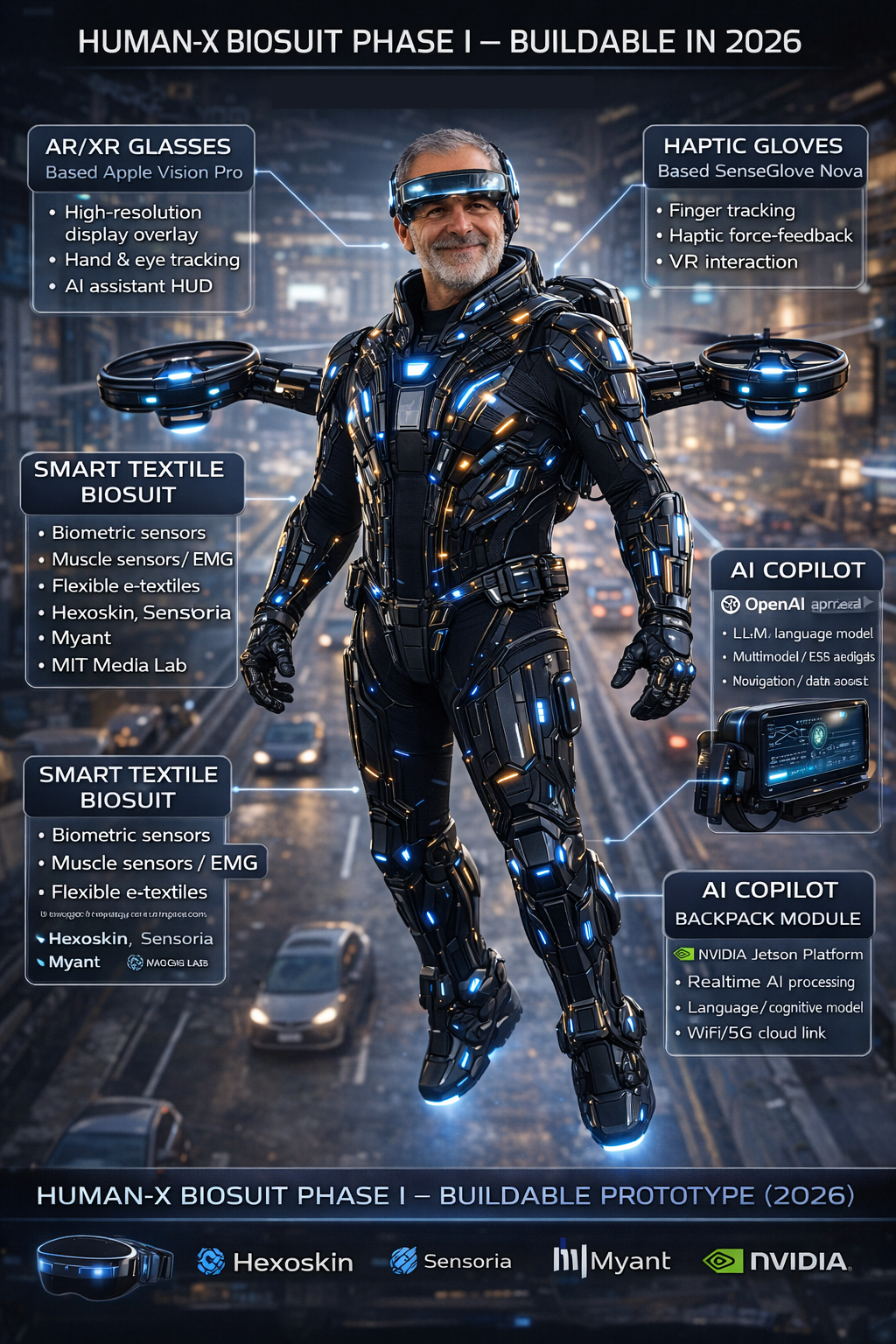
Human-X BioSuit Phase I – Buildable in 2026” architecture, showing exact commercial components that could already assemble the first prototype.