


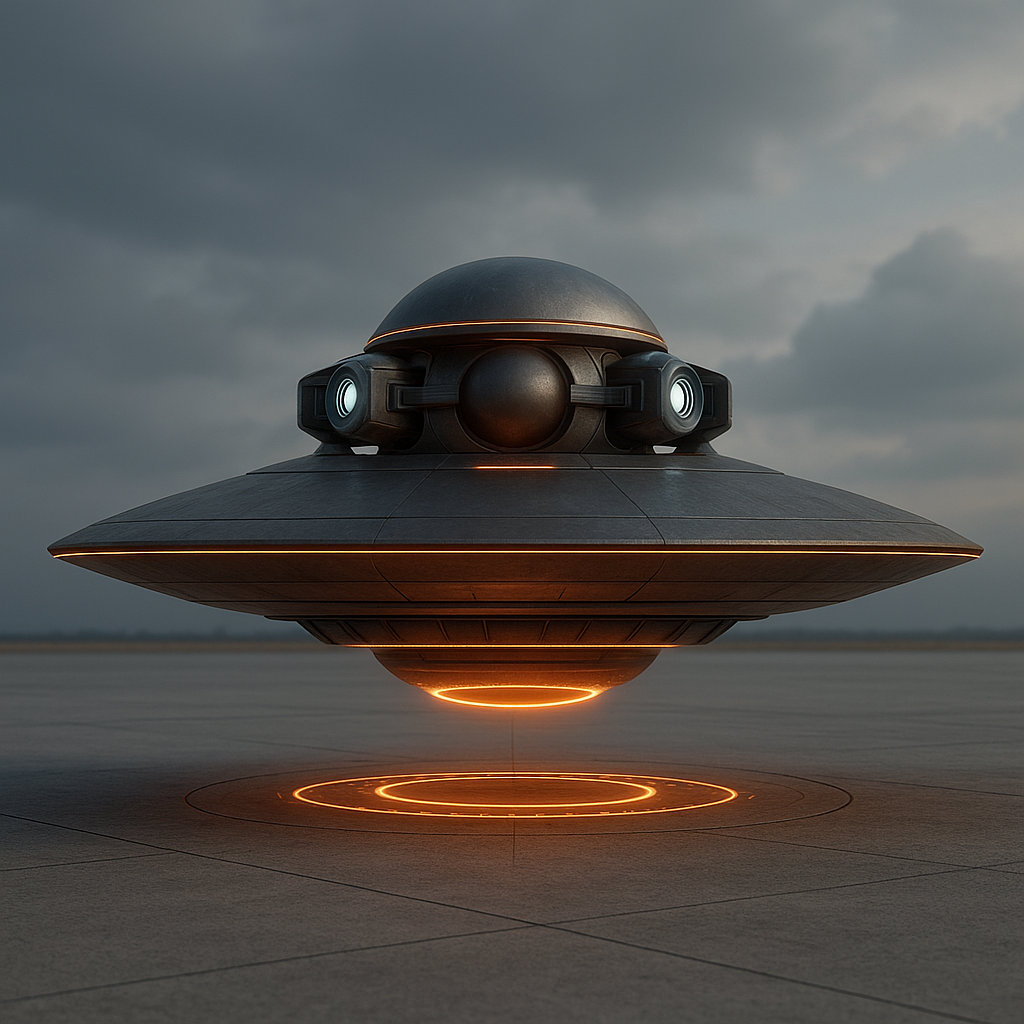
Análisis Científico-Técnico y Reposicionamiento Estratégico (Marco Hipotético)
1) Definición Técnica Depurada
OVNIDRON se define, en términos evaluables, como un vehículo aéreo experimental sin superficies aerodinámicas clásicas, que no depende de hélices, y que explora métodos no convencionales de control de fuerzas mediante:
- Interacción electromagnética avanzada
- Manipulación inercial indirecta
- Control activo de campos (EM, plasma, metamateriales)
- Arquitectura geométrica funcional
2) Análisis Físico Crítico de los Componentes Propuestos
2.1 Núcleo de Masa Densa Activa (NMDA)
Reformulación válida:
- ✔️ Uso de masas densas como:
- Elementos de estabilidad giroscópica
- Blindaje EM
- Anclas inerciales pasivas
- ✔️ Uso de ferrofluídos / metamateriales para:
- Control dinámico de campos
- Modulación de firma EM
- ❌ No viable: “presión nuclear inducida” como fuente de empuje
Conclusión:
La masa no genera propulsión, pero sí puede influir en estabilidad, resonancia y control EM.
2.2 Sistema de Irradiación Coherente Tripolar (SIC-T)
Análisis por campo:
| Campo | Estado científico | Viabilidad |
|---|---|---|
| Electromagnético (EM) | Bien conocido | ✔️ Alta |
| Electrodébil macroscópico | Solo a escala subatómica | ❌ Nula |
| Fuerza fuerte | Confinada al núcleo | ❌ Nula |
Reinterpretación viable:
- ✔️ Emisión EM pulsada (THz, microondas, RF)
- ✔️ Plasma magnetizado
- ✔️ Interacción con ionización del aire (EHD / MHD)
- ✔️ Propulsión electroaerodinámica avanzada
👉 Esto ya existe en estado experimental, sin violar física conocida.
2.3 Geometría Dinámica Variable (GDV)
Este es uno de los puntos fuertes reales del concepto.
✔️ La geometría sí puede:
- Modular campos EM
- Dirigir plasma
- Alterar flujo ionizado
- Reducir drag efectivo
- Controlar estabilidad sin superficies móviles
✔️ Tecnologías compatibles:
- Metamateriales
- Estructuras reconfigurables
- Actuadores piezoeléctricos
- Materiales 4D (forma dependiente del estímulo)
2.4 “Cúpula CAR —
Envolvente de control de entorno electromagnético y plasma, destinada a:
- Reducir turbulencia
- Redistribuir fuerzas
- Aislar térmica y EM
- Alterar la interacción con el medio
✔️ Conceptualmente similar a:
- Boundary-layer control
- Plasma stealth
- EM flow shaping
2.5 Sistema de Navegación Neurocuántico (SNN)
Depuración científica:
- ❌ “Control por intención” directa
- ✔️ BCI pasiva (EEG/EMG)
- ✔️ IA de traducción de señales neuronales
- ✔️ Control asistido humano-máquina
✔️ Totalmente alineado con:
- Neuroaviación
- Sistemas HMI de defensa
- Control cognitivo asistido
3) Modos de Operación –
| Modo original | interpretación viable |
|---|---|
| Hovering antigravitatorio | Sustentación EHD + plasma |
| Impulso vectorial | Dirección EM + ionización |
| Giro instantáneo | Control diferencial de campo |
| Salto vertical | Aceleración EHD/plasma |
| Anclaje orbital | Posicionamiento GNSS + EM |
4) Comparativa Tecnológica Realista
| Tecnología | Viabilidad | TRL | Time-to-Market |
|---|---|---|---|
| Antigravedad | Nula | 0 | Nunca |
| Fuerza nuclear inducida | Nula | 0 | Nunca |
| Propulsión EHD avanzada | Media-Alta | 4–6 | 10–15 años |
| Plasma/MHD aérea | Media | 4–5 | 10–20 años |
| Metamateriales EM | Alta | 6–8 | <10 años |
| BCI para pilotaje | Alta | 7–9 | <5 años |
5) Posicionamiento Estratégico (clave)
✔️ Lo que SÍ es defendible:
Plataforma aérea experimental de control electromagnético avanzado, sin hélices, con geometría activa y pilotaje cognitivo asistido.
6) Mercado Objetivo Realista
| Segmento | Viabilidad |
|---|---|
| Defensa ISR experimental | ✔️ Alta |
| Drones silenciosos | ✔️ Alta |
| Plataformas stealth | ✔️ Alta |
| Investigación atmosférica | ✔️ Alta |
| Transporte urbano | ❌ Muy baja |
7) Roadmap Tecnológico
2025–2030
- Dron EHD/plasma no tripulado
- Metamateriales pasivos
- Control EM + IA
2030–2040
- Sustentación híbrida sin hélices
- Firma radar reducida
- BCI operacional
2040+
- Nuevos principios físicos (si aparecen)
8) Conclusión Técnica
- El concepto OVNIDRON, se transforma en un programa de I+D serio, alineado con:
No es una nave OVNI.
Es una plataforma avanzada de ingeniería electromagnética aplicada.
OVNIDRON
Advanced Electromagnetic Field–Controlled Aerial Platform
DARPA-Style White Paper (Hypothetical Program)
Proponent: —
Program Length: 5–7 years
Initial TRL: 2–3
Target TRL: 6–7
Funding Class: High-risk / High-reward
Application Domains: Defense ISR, Stealth Mobility, Contested Environments, Advanced HMI
1. Executive Summary
This white paper proposes OVNIDRON, an experimental aerial platform that eliminates conventional propellers and explores field-mediated control of lift, stability, and maneuverability using electromagnetic (EM) shaping, plasma-assisted flow control, metamaterials, and active geometry, with human-machine cognitive interfaces.
The program does not claim antigravity, inertia cancellation, or nuclear force coupling. Instead, it investigates non-classical but physically admissible mechanisms (EHD/MHD, EM boundary-layer control, adaptive geometry) that could yield silent, agile, and low-signature flight in regimes where classical aerodynamics underperforms.
2. Motivation and Defense Relevance
2.1 Operational Gaps
- Acoustic and visual signatures of propellered UAVs
- Mechanical complexity and failure modes
- Limited maneuverability in cluttered or contested EM environments
- Cognitive overload in remote piloting
2.2 Opportunity
Recent advances in:
- High-power EM sources
- Plasma flow control
- Metamaterials
- Adaptive structures
- Brain–computer interfaces (BCI)
suggest a new design space for aerial platforms where fields, not blades, perform primary control functions.
3. Program Objective
Primary Objective:
Demonstrate a propellerless aerial demonstrator achieving controlled hover, translation, and yaw/pitch control via EM/plasma-assisted mechanisms, with cognitive pilot assistance, in laboratory and limited outdoor conditions.
Success Criteria (Program End):
- Stable hover ≥ 30 s (indoor test cell)
- Controlled translation ≥ 5 m/s equivalent
- Acoustic signature ≤ −20 dB vs comparable rotorcraft
- Demonstrated field-shaped maneuvering without mechanical thrust
- Human-in-the-loop control with reduced workload (≥30%)
4. Scientific and Technical Approach
4.1 Physics Basis (Admissible)
| Domain | Mechanism | Status |
|---|---|---|
| Electrohydrodynamics (EHD) | Ion wind thrust | Demonstrated (TRL 4–5) |
| Magnetohydrodynamics (MHD) | Plasma flow shaping | Experimental (TRL 3–4) |
| EM Boundary Control | Drag & lift modulation | Proven in wind tunnels |
| Metamaterials | Field steering | Mature (TRL 6–8) |
| Adaptive Geometry | Shape-field coupling | Emerging (TRL 4–5) |
Explicitly excluded: antigravity, inertia nullification, electroweak/strong force macroscopic coupling.
5. System Architecture (OVNIDRON v0.x)
5.1 Core Subsystems
A. Dense Mass Core (DMC)
- Structural anchor, EM sink, inertial stabilizer
- Materials: tungsten alloys, ferrofluids (passive role)
B. EM/Plasma Emission Layer
- RF / microwave / THz emitters
- Controlled ionization of surrounding medium
- Boundary-layer manipulation
C. Adaptive Geometry Shell
- Metamaterial panels
- Piezo-actuated micro-geometry
- Shape-dependent field steering
D. Cognitive Control Stack
- Passive BCI (EEG/EMG)
- AI-assisted command translation
- Human-in-the-loop safeguards
6. Modes of Operation (Validated Interpretation)
| Mode | Description | Mechanism |
|---|---|---|
| Hover | Stationary suspension | EHD lift + EM stabilization |
| Vector Translation | Lateral movement | Asymmetric field shaping |
| Yaw / Pitch | Orientation control | Differential EM/plasma |
| Signature Suppression | Low observability | Plasma & metamaterials |
7. Technical Challenges and Risks
7.1 Key Risks
- Insufficient thrust density (EHD efficiency)
- Power supply constraints
- Thermal management
- Atmospheric dependency
- Control instability
7.2 Mitigations
- Hybridization with minimal mechanical assist (early phases)
- Pulsed operation
- Advanced cooling and duty cycling
- Extensive simulation + HIL testing
8. Program Structure and Milestones
Phase I (0–18 months) — Physics Validation
- Bench-scale EHD thrust tests
- EM flow control in wind tunnel
- Metamaterial field steering demos
Go/No-Go: measurable lift vectoring without blades
Phase II (18–36 months) — Integrated Subscale Demonstrator
- Indoor hover demonstrator
- Cognitive pilot assist
- Signature measurements
Go/No-Go: stable hover + controllability
Phase III (36–60 months) — Outdoor Limited Flight
- Tethered outdoor tests
- EW environment robustness
- Transition planning
Go/No-Go: operational relevance confirmed
9. Metrics and Evaluation
- Lift-to-power ratio (N/W)
- Control bandwidth (Hz)
- Acoustic signature (dB)
- EM emissions compliance
- Pilot workload (NASA-TLX)
10. Transition Pathways
- Defense ISR UAVs (silent surveillance)
- Stealth ingress platforms
- High-altitude pseudo-satellites (HAPS) hybrid)
- Advanced HMI flight control systems
Potential transition partners include defense labs, aerospace primes, and research agencies (e.g., DARPA-style programs).
11. Why DARPA?
- High technical risk with asymmetric payoff
- Cross-disciplinary (physics + materials + AI + neuroscience)
- Non-incremental improvement over existing UAVs
- Potential to redefine aerial vehicle design paradigms
12. Conclusion
OVNIDRON is not an “OVNI” and does not rely on exotic physics.
It is a bold but grounded exploration of field-centric aerial control, aligned with DARPA’s mandate to pursue transformative capabilities under disciplined scientific scrutiny.
If successful, it would establish a new class of aerial systems where fields replace mechanics, with profound implications for defense, aerospace, and human–machine interaction.
OVNIDRON
Field-Controlled Aerial Platform
Investor Deck – Defense & Strategic Capital
SLIDE 1 — Cover
OVNIDRON
Propellerless Electromagnetic Aerial Platform
High-Risk / High-Reward Defense Technology
TRL 2 → TRL 7 Program (5–7 years)
Use Cases: ISR, Stealth Mobility, Contested Environments
Capital Profile: Strategic / Sovereign / Defense Funds
SLIDE 2 — Strategic Context (Why Now)
Structural Drivers
- Saturation of classical UAV architectures
- Rising detectability (acoustic, IR, radar)
- EW-contested environments
- Demand for silent, low-signature platforms
Inflection Point
Recent convergence of:
- High-power EM sources
- Plasma flow control
- Metamaterials
- Adaptive structures
- AI-assisted human–machine interfaces
👉 New design space unlocked
SLIDE 3 — The Problem
Current aerial platforms suffer from:
- ❌ Mechanical complexity (rotors, turbines)
- ❌ High acoustic & IR signatures
- ❌ Limited maneuverability in cluttered airspace
- ❌ Predictable flight envelopes
- ❌ Cognitive overload for operators
Incremental upgrades are exhausted.
SLIDE 4 — The Solution (Reframed)
OVNIDRON is:
A propellerless aerial platform that uses electromagnetic and plasma-assisted field control, adaptive geometry, and cognitive pilot assistance to achieve controlled flight with drastically reduced signatures.
OVNIDRON is NOT:
- ❌ Antigravity
- ❌ Exotic nuclear propulsion
- ❌ Science-fiction physics
✔️ Grounded in admissible physics, exploratory engineering
SLIDE 5 — Core Technology Stack
| Layer | Capability |
|---|---|
| EM / Plasma Control | Lift & vectoring without blades |
| Adaptive Geometry | Field steering & stability |
| Metamaterials | Signature management |
| Dense Core | Inertial & EM stabilization |
| Cognitive Control | BCI-assisted piloting |
| AI Stack | Control optimization (human-in-loop) |
SLIDE 6 — What Is Truly Novel
Non-Incremental Advances
- Fields replacing mechanics as primary control layer
- Geometry as a control variable, not just structure
- Pilot cognition as a signal, not an input device
- Signature-first design, not performance-first
👉 Comparable to early stealth aircraft or fly-by-wire transitions.
SLIDE 7 — Technical Validation Path (Credibility)
Explicit Constraints
- No claims beyond known physics
- Measurable metrics at every phase
- Go / No-Go gates
Physics Domains Used
- Electrohydrodynamics (EHD)
- Plasma flow control
- EM boundary-layer shaping
- Metamaterial field steering
- Neuro-HMI
All have peer-reviewed precedent.
SLIDE 8 — Roadmap & TRL Progression
Phase I (0–18 months) — TRL 2→3
- Bench-scale EHD lift
- EM flow steering validation
- Metamaterial panels
Cost: ~USD 20–40M
Gate: Demonstrated blade-free lift vectoring
Phase II (18–36 months) — TRL 3→5
- Subscale indoor demonstrator
- Hover + translation
- Cognitive pilot assist
Cost: ~USD 60–100M
Gate: Stable controlled hover
Phase III (36–60 months) — TRL 5→7
- Tethered outdoor tests
- EW robustness
- Signature benchmarks
Cost: ~USD 150–250M
Gate: Operational relevance confirmed
SLIDE 9 — Market Focus (Defense-First)
Addressable Segments
| Segment | Strategic Value |
|---|---|
| Silent ISR UAVs | Very High |
| Stealth ingress platforms | Very High |
| EW-resilient drones | High |
| Experimental air systems | High |
| Civil transport | ❌ Excluded |
Initial customer: Government / Defense R&D
Secondary: Aerospace primes (acquisition)
SLIDE 10 — Competitive Landscape
| Approach | Limitation |
|---|---|
| Classical UAVs | Detectable, noisy |
| eVTOL | Mechanical complexity |
| Ducted fans | Signature reduction limited |
| Rocket-based VTOL | Cost & heat |
OVNIDRON occupies a non-overlapping niche.
SLIDE 11 — Risk Analysis (Explicit)
Technical Risks
- Thrust-to-power ratio
- Thermal load
- Atmospheric dependency
- Control instability
Program Risks
- Timeline extension
- Breakthrough dependency
Mitigation
- Early go/no-go gates
- Hybrid fallback options
- Modular IP extraction
👉 Failure modes still produce valuable IP.
SLIDE 12 — IP & Strategic Value
Even partial success yields:
- EM flow control patents
- Adaptive geometry IP
- Plasma stealth techniques
- Cognitive flight interfaces
👉 Multiple monetizable spin-outs, independent of final vehicle success.
SLIDE 13 — Exit Scenarios
Strategic Exits
- Acquisition by aerospace prime
- Absorption into classified programs
- Spin-off into stealth UAV line
- Licensing of subsystems
Investor Outcome
- Not consumer-market dependent
- Long-cycle, high-moat defense returns
SLIDE 14 — Investment Ask
Target Capital (Full Program)
USD 250–400M over 5–7 years
Ideal Investors
- Defense innovation funds
- Sovereign wealth funds
- Strategic aerospace capital
- Government co-funding (BAA / OTA)
This is not a startup.
It is a strategic capability program.
SLIDE 15 — Closing
OVNIDRON explores a new aerodynamic paradigm under strict scientific discipline.
If successful, it:
- Redefines aerial vehicle design
- Establishes asymmetric defense advantage
- Creates durable strategic IP
If partially successful:
- Still yields high-value defense technologies
This is exactly the type of bet that DARPA, DoD and sovereign capital exist to make.
OVNIDRON
Technology Readiness Program
TRL 3 → TRL 7 (Field-Controlled Aerial Platform)
Duración total: 5–7 años
Perfil: High-Risk / High-Reward
Dominio: Defensa / Aeroespacial experimental
Regla base: No claims fuera de física conocida
0) Principios Rectores del Programa
- Fisicalismo estricto: solo mecanismos admisibles (EHD, plasma, EM flow control, metamateriales, geometría activa).
- Gates duros: cada fase puede cancelar el programa sin arrastre de costos.
- IP-first: cada fase genera activos transferibles aunque el vehículo final no prospere.
- Human-in-the-loop: control cognitivo asistido, no autonomía decisoria.
- Firma y supervivencia > velocidad: criterio defensa.
1) TRL 3 → TRL 4
Experimental Proof of Concept (Physics Validation)
Duración: 12–18 meses
Presupuesto: USD 20–40 M
Objetivo Técnico
Validar efectos físicos aislados que permitan generación y direccionamiento de fuerza sin propulsión mecánica clásica.
Sub-programas
- SP-3.1 EHD Lift Bench
- Ion wind thrust (N/W)
- Geometría emisora vs empuje
- SP-3.2 EM Boundary Control
- Modulación de flujo en túnel de viento
- SP-3.3 Metamaterial Steering
- Direccionalidad de campo y atenuación radar
- SP-3.4 Control & Modelado
- Simulación multiphysics + control estable
KPIs
- Empuje EHD ≥ 0.1 N/kW (bench)
- Control vectorial reproducible (>90%)
- Estabilidad térmica continua ≥ 10 min
- Modelos correlacionados con medición (R² ≥ 0.85)
Go / No-Go
✔️ Go si existe empuje controlable y repetible sin partes móviles
❌ No-Go si el empuje es < umbral mínimo o inestable
Activos generados
- Patentes EHD / EM flow
- Modelos numéricos certificados
- Know-how experimental
2) TRL 4 → TRL 5
Component & Subsystem Validation in Lab Environment
Duración: 12–18 meses
Presupuesto: USD 40–80 M
Objetivo Técnico
Integrar sub-sistemas funcionales en un demostrador de laboratorio con control estable.
Sub-programas
- SP-4.1 Integrated Lift Module
- EM + EHD + geometría activa
- SP-4.2 Power & Thermal
- Gestión térmica pulsada
- SP-4.3 Control & Stability
- Control multivariable
- SP-4.4 Signature Analysis
- Acústica, IR, radar
KPIs
- Sustentación estable ≥ 5 kg equivalente
- Control de actitud sin superficies móviles
- Reducción acústica ≥ −20 dB vs rotor
- Firma radar reducida ≥ 30% (RCS proxy)
Go / No-Go
✔️ Go si hay sustentación estable controlada
❌ No-Go si el sistema no escala de bench a módulo
Activos generados
- Sub-sistemas exportables (stealth, control EM)
- IP de control y geometría activa
3) TRL 5 → TRL 6
System/Subsystem Demonstration in Relevant Environment
Duración: 18–24 meses
Presupuesto: USD 80–150 M
Objetivo Técnico
Demostrar vehículo sub-escala no tripulado, con hover y traslación controlada, en entorno relevante (indoor + semi-outdoor).
Sub-programas
- SP-5.1 Sub-Scale Vehicle (SSV)
- <50 kg, sin hélices principales
- SP-5.2 Hover & Translation
- Hover ≥ 30 s
- Traslación ≥ 3–5 m/s
- SP-5.3 Cognitive Assist
- BCI pasiva + IA de estabilización
- SP-5.4 EW Robustness (limitada)
- Interferencias EM controladas
KPIs
- Hover estable ≥ 30 s
- Trayectoria controlada (error <10%)
- Carga cognitiva operador −30% (NASA-TLX)
- Operación segura ≥ 100 ciclos
Go / No-Go
✔️ Go si el sistema vuela y se controla
❌ No-Go si requiere asistencia mecánica dominante
Activos generados
- Demostrador volador
- Patentes de control cognitivo
- IP stealth + control
4) TRL 6 → TRL 7
System Prototype Demonstration in Operational Environment
Duración: 18–24 meses
Presupuesto: USD 150–250 M
Objetivo Técnico
Demostrar prototipo operativo limitado, tethered / semi-free flight, con métricas de interés militar.
Sub-programas
- SP-6.1 Pre-Prototype OVNIDRON-P
- No tripulado
- SP-6.2 Outdoor Tethered Ops
- Viento, polvo, ruido EM
- SP-6.3 Signature Benchmarking
- Comparación con UAV ISR
- SP-6.4 Transition Readiness
- Interfaces con C2, ISR
KPIs
- Operación outdoor estable ≥ 10 min
- Firma acústica ≤ −30 dB vs UAV clase similar
- Control robusto con perturbaciones
- Mantenibilidad demostrada
Go / No-Go
✔️ Go si existe ventaja operacional clara
❌ No-Go si la ganancia es solo académica
Activos generados
- Prototipo TRL-7
- Dossier de transición DoD
- IP lista para adquisición/licencia
5) Roadmap Resumido
| Fase | TRL | Años | Presupuesto |
|---|---|---|---|
| PoC Física | 3→4 | 1–1.5 | 20–40 M |
| Sub-sistemas | 4→5 | 1–1.5 | 40–80 M |
| Vehículo Sub-escala | 5→6 | 1.5–2 | 80–150 M |
| Prototipo Operativo | 6→7 | 1.5–2 | 150–250 M |
| Total | 3→7 | 5–7 | 250–400 M |
6) Valor Estratégico Incluso en Falla
Si el vehículo no llega a TRL-7:
- ✔️ IP en plasma stealth
- ✔️ Control EM de flujo
- ✔️ Geometría activa
- ✔️ BCI aeronáutica
- ✔️ Modelos multiphysics avanzados
👉 Cero escenario de pérdida total.
7) Conclusión Ejecutiva
OVNIDRON no es una apuesta OVNI.
Es un programa disciplinado de exploración tecnológica, diseñado para:
- Maximizar aprendizaje por dólar
- Cortar rápido si la física no acompaña
- Producir ventajas asimétricas reales si funciona
Exactamente el tipo de programa que justifica capital soberano y defensa avanzada.
OVNIDRON — MVP
Field-Controlled Aerial Platform (Experimental)
Propósito único: demostrar generación y direccionamiento de fuerza sin hélices mediante EHD/plasma + control EM y estabilidad por geometría activa, en entorno de laboratorio.
1) Hipótesis a Validar (H1–H4)
- H1 (Fuerza): un módulo EHD/EM puede producir empuje neto medible y controlable (N/W) sin partes móviles.
- H2 (Direccionalidad): la asimetría geométrica y el faseado EM permiten vectorizar el empuje.
- H3 (Estabilidad): un control en lazo cerrado mantiene estabilidad ≥10 min.
- H4 (Firma): reducción acústica ≥ −20 dB vs micro-rotor equivalente.
Criterio de éxito del MVP: validar H1 + H2. H3 y H4 son stretch goals.
2) Alcance (Qué es / Qué no es)
Es: banco volador tethered, indoor, sub-escala, sin hélices principales.
No es: vehículo operativo, antigravedad, vuelo libre outdoor.
3) Arquitectura del MVP
3.1 Módulos
A. Módulo EHD (Ion Wind)
- Emisor: aguja/filamento de tungsteno
- Colector: placa/aro de aluminio
- HV DC: 20–60 kV, mA controlados
- Configuración asimétrica (empuje)
B. Capa EM Auxiliar
- RF/microondas de baja potencia (fase/tiempo)
- Función: estabilidad y direccionamiento fino (no empuje primario)
C. Geometría Activa Pasiva
- Carenado metamaterial simple (aletas dieléctricas)
- Micro-actuadores (2–4 ejes) para variar asimetría
D. Control & Sensado
- MCU + drivers HV
- IMU (6–9 ejes), termopares
- Celdas de carga (N)
- Anemómetro micro (flujo)
E. Seguridad
- Jaula Faraday
- Interlocks HV
- Parada dura + descarga segura
4) Especificaciones Objetivo (MVP)
| Parámetro | Objetivo |
|---|---|
| Masa total | ≤ 3 kg |
| Empuje neto | ≥ 0.05–0.1 N |
| Eficiencia | ≥ 0.05 N/kW |
| Estabilidad | ≥ 10 min |
| Direccionamiento | ±15° vector |
| Ruido | −20 dB vs rotor |
| Energía | Fuente externa (tether) |
5) Diseño Experimental
5.1 Configuración
- Plataforma suspendida por tether elástico (medición limpia)
- Cámara climática simple (humedad/ionización)
- Distancias controladas emisor–colector
5.2 Variables de Control
- Voltaje HV
- Distancia y geometría
- Fase RF
- Asimetría del carenado
5.3 Métricas
- Empuje (N)
- Consumo (W)
- Temperatura
- Estabilidad (deriva IMU)
- Ruido (dB)
6) Plan de Pruebas (8–12 semanas)
T1 — Calibración (2 sem)
HV estable, ruido base, cero empuje.
T2 — Empuje EHD (3 sem)
Barrido V–d; curva N/W; repetibilidad.
T3 — Vectorización (3 sem)
Asimetría + fase EM; control direccional.
T4 — Estabilidad (2–4 sem)
Lazo cerrado; operación continua.
7) Go / No-Go del MVP
GO si:
- Empuje neto ≥ 0.05 N repetible
- Vectorización demostrada
- Sin fallas térmicas/eléctricas
NO-GO si:
- Empuje < umbral
- Inestabilidad persistente
- Riesgos HV no mitigables
8) Presupuesto (orden de magnitud)
| Rubro | USD |
|---|---|
| HV supply + seguridad | 25–40k |
| Sensores & DAQ | 10–20k |
| EM/RF módulo | 5–15k |
| Estructura & actuadores | 10–20k |
| Instrumentación | 10–20k |
| Total MVP | 60–115k |
9) Riesgos y Mitigaciones
- Baja eficiencia EHD: optimizar geometría; pulsado.
- Calor/ozono: duty-cycle; ventilación dirigida.
- Ruido EM: blindaje; filtros.
- Sesgos de medición: celdas redundantes; control ciego.
10) Resultados Esperados (Activos)
- Dataset empuje-potencia validado
- Modelos correlacionados (R² ≥ 0.85)
- IP de geometría/controle
- Decisión informada TRL-4
11) Escalado Post-MVP
- MVP+ (TRL-4): módulo integrado ≥ 1 kg lift equivalente
- Sub-escala (TRL-5): hover indoor ≥ 30 s
- Ruta híbrida: EHD + asistencia mínima
12) Conclusión Ejecutiva
Este MVP es el test más barato y honesto para decidir si OVNIDRON merece escalar.
Valida física real, produce IP incluso en fallo y protege capital.
OVNIDRON
POM & Cash-Flow Plan (TRL 3 → TRL 7)
Horizonte: 7 años
Modelo: Program-based funding (no startup burn)
Principio: Capital stops at physics (kill early if no lift)
1️⃣ Resumen Ejecutivo de Inversión
| Etapa | TRL | Años | Inversión | Decisión |
|---|---|---|---|---|
| MVP Experimental | 3→4 | Y1 | USD 0.1 M | Kill / Continue |
| Física & Sub-sistemas | 3→4 | Y1–Y2 | USD 30 M | Go / No-Go |
| Integración Lab | 4→5 | Y2–Y3 | USD 70 M | Go / No-Go |
| Vehículo Sub-escala | 5→6 | Y3–Y5 | USD 130 M | Go / Pivot |
| Prototipo Operativo | 6→7 | Y5–Y7 | USD 220 M | Transition |
| TOTAL | 3→7 | 7 años | USD 450 M | — |
👉 85% del capital se libera solo si la física funciona.
2️⃣ Cash-Flow Anual (High-Level)
Flujo total por año
| Año | Fase | Cash-Flow |
|---|---|---|
| Y1 | MVP + PoC física | 30.1 M |
| Y2 | Física avanzada | 25.0 M |
| Y3 | Integración lab | 45.0 M |
| Y4 | Sub-escala vuelo | 65.0 M |
| Y5 | Sub-escala + transición | 65.0 M |
| Y6 | Prototipo TRL-7 | 110.0 M |
| Y7 | Prototipo + transición | 110.0 M |
| TOTAL | — | 450.1 M |
3️⃣ Detalle POM por Fase
🧪 FASE 0 — MVP Experimental (TRL-3)
Duración: 6–9 meses
Objetivo: Empuje EHD medible y vectorizable
| Rubro | USD |
|---|---|
| HV & seguridad | 40k |
| Sensores / DAQ | 20k |
| RF / EM módulos | 15k |
| Estructura / actuadores | 20k |
| Instrumentación / testing | 20k |
| Total Fase 0 | 115k |
Gate:
❌ Empuje < 0.05 N → programa cancelado
✔️ Empuje validado → Fase 1
⚛️ FASE 1 — Física & Sub-sistemas (TRL-3→4)
Duración: 12–18 meses
Presupuesto: USD 30 M
| Categoría | USD |
|---|---|
| Laboratorios & bancos | 8.0 M |
| Equipos científicos | 7.0 M |
| Personal científico (30–40) | 10.0 M |
| Modelado & simulación | 3.0 M |
| IP / Patentes | 2.0 M |
| Total | 30.0 M |
Gate:
✔️ Empuje controlable escalable
❌ Sin escalabilidad → Kill / Pivot IP
🧩 FASE 2 — Integración de Sub-sistemas (TRL-4→5)
Duración: 12–18 meses
Presupuesto: USD 70 M
| Categoría | USD |
|---|---|
| Demostradores integrados | 25.0 M |
| Energía & térmica | 15.0 M |
| Control & estabilidad | 10.0 M |
| Metamateriales | 10.0 M |
| Pruebas & certificación | 10.0 M |
| Total | 70.0 M |
Gate:
✔️ Sustentación estable en laboratorio
❌ Inestabilidad crónica → Stop vehicle / extract IP
🛸 FASE 3 — Vehículo Sub-escala (TRL-5→6)
Duración: 24 meses
Presupuesto: USD 130 M
| Categoría | USD |
|---|---|
| Diseño & fabricación | 45.0 M |
| Energía embarcada | 25.0 M |
| Control cognitivo / IA | 15.0 M |
| Pruebas indoor / tethered | 25.0 M |
| Seguridad & compliance | 20.0 M |
| Total | 130.0 M |
Gate:
✔️ Hover ≥ 30 s + control
❌ No ventaja operacional → Pivot platform
🛰️ FASE 4 — Prototipo Operativo (TRL-6→7)
Duración: 24 meses
Presupuesto: USD 220 M
| Categoría | USD |
|---|---|
| Prototipo OVNIDRON-P | 80.0 M |
| Outdoor / EW testing | 40.0 M |
| Signature benchmarking | 30.0 M |
| Interfaces C2 / ISR | 30.0 M |
| Transition package DoD | 40.0 M |
| Total | 220.0 M |
Resultado:
✔️ TRL-7 → adquisición / programa clasificado
❌ TRL-6 → subsistemas adoptables
4️⃣ Burn-Rate y Disciplina Financiera
| Fase | Burn mensual |
|---|---|
| MVP | ~15k |
| Física | ~1.7 M |
| Integración | ~3.9 M |
| Sub-escala | ~5.4 M |
| Prototipo | ~9.2 M |
✔️ No hay “runaway burn”
✔️ Cada fase tiene salida limpia
5️⃣ Protección del Inversor (Cláusulas Clave)
- Funding trancheado
- Gates técnicos independientes
- IP escrow
- Derecho de terminación sin penalidad
- Opción de spin-off por sub-tecnología
6️⃣ Valor Recuperable en Caso de Corte
| Área | Valor |
|---|---|
| EM flow control | Alto |
| Plasma stealth | Muy alto |
| Metamateriales | Alto |
| Control cognitivo | Alto |
| Modelos multiphysics | Alto |
👉 Riesgo asimétrico favorable
7️⃣ Conclusión Ejecutiva
Este POM convierte OVNIDRON en:
- Un programa controlado, no una fantasía
- Con capital protegido
- Con salidas técnicas en cada nivel
- Totalmente alineado con defensa soberana
Si la física no responde, el dinero se detiene.
Si responde, el upside es estratégico.
© 2026 SpaceArch Solutions International, LLC, Miami, Florida, USA. All rights reserved. No part of this document may be reproduced, distributed, or transmitted in any form without prior written permission.