


From Orbital Infrastructure to Interstellar Civilization
1. A Paradigm Shift: Space as Strategic Infrastructure
We are entering a phase where space is no longer an exploratory domain but the primary strategic layer of planetary infrastructure.
The convergence of:
- modular satellite manufacturing,
- real-time orbital intelligence,
- AI-driven decision systems, and
- planetary-scale digital commerce and finance
is redefining how civilization operates, governs, protects, and evolves.
The coordinated trajectory initiated by actors such as SpaceX, York Space Systems, and advanced AI leaders like OpenAI signals something deeper than technological progress:
➡️ Low Earth Orbit (LEO) is becoming the planet’s primary computational and operational layer.
SpaceArch builds directly on this shift—but extends it decisively forward.
2. SpaceArch New NASA: A Post-Institutional Space Architecture
SpaceArch does not replicate traditional space agencies.
It redefines the mission architecture itself.
SpaceArch New NASA is conceived as a distributed, AI-orchestrated, civilian-civilizational space system with four core principles:
- Modularity over Monoliths
Satellites, platforms, propulsion systems, and orbital assets are modular, replaceable, and upgradable at industrial speed. - Orbital Intelligence as a Service (OIaaS)
AI systems process data in orbit, reducing latency, increasing resilience, and enabling real-time planetary decision-making. - Civil–Economic Integration
Space is directly linked to:- e-commerce flows
- fintech and settlement layers
- logistics optimization
- climate and resource governance
- Human–AI Co-Governance
No isolated AGI. No purely human command.
SpaceArch is built for hybrid intelligence systems.
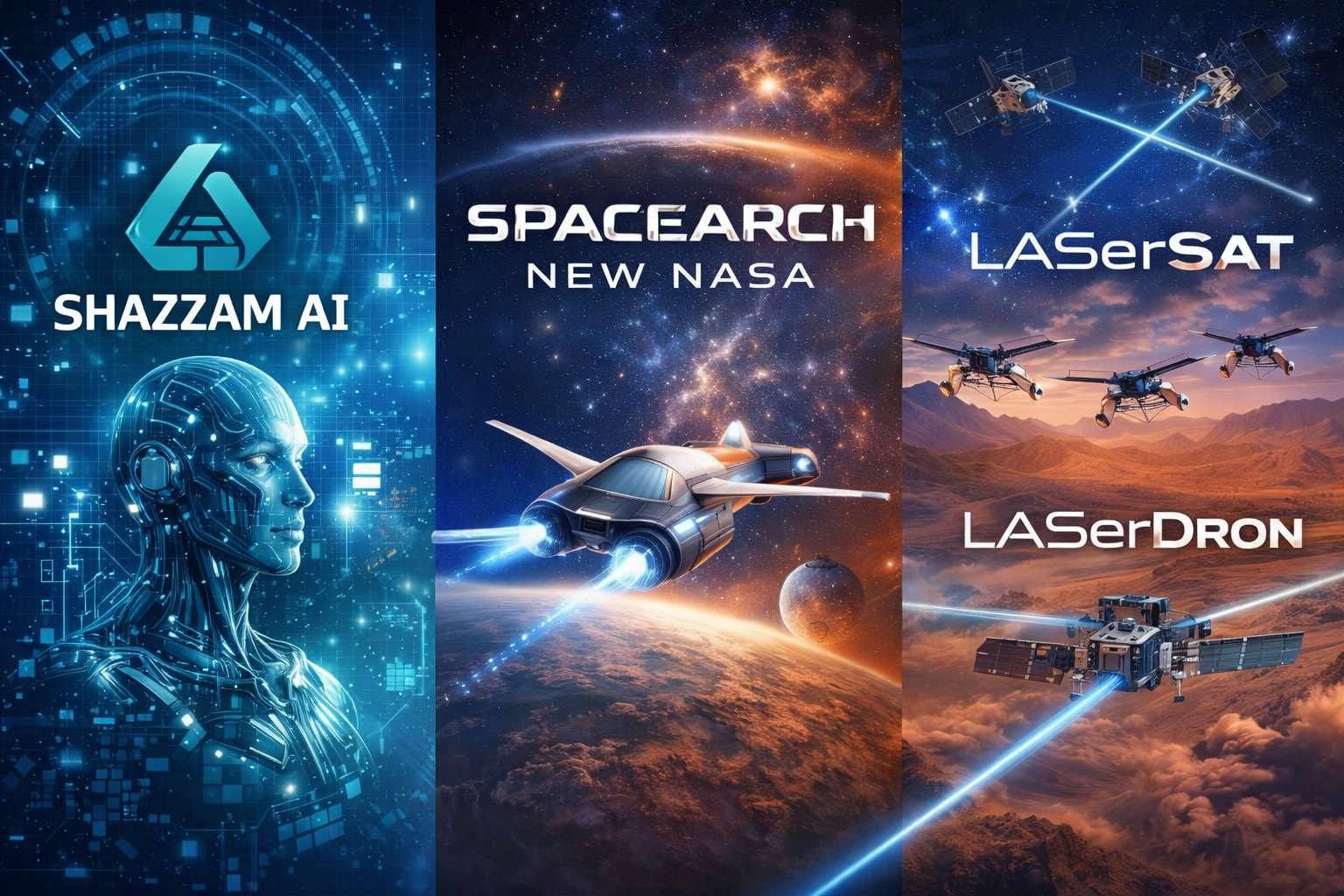
3. LaserSat & LaserDron: The Nervous System of the Planet
LaserSat is SpaceArch’s foundational orbital communication layer.
- Laser-based satellite interlinks
- Ultra-secure, high-bandwidth, low-latency
- Immune to traditional RF congestion and interception
- Native compatibility with AI-driven routing and prioritization
LaserDron extends this system planet-side:
- Atmospheric and near-space drones
- Laser-linked to orbital nodes
- Autonomous, swarm-capable
- Serve logistics, surveillance, emergency response, and data relay
Together, LaserSat + LaserDron form a planetary nervous system, enabling:
- real-time global logistics
- resilient financial clearing
- climate and disaster response
- secure planetary communications independent of ground fragility
4. ElectroHelios: Energy Beyond the Planet
ElectroHelios is SpaceArch’s energy doctrine.
Rather than competing with terrestrial renewables, ElectroHelios:
- harvests solar energy in space,
- converts it into high-density transferable forms,
- and distributes it via orbital-to-orbital or orbital-to-ground systems.
This architecture:
- decouples energy from geography,
- eliminates planetary intermittency,
- and supports off-planet industrialization.
ElectroHelios is not just power generation—it is energy sovereignty for a multi-planetary civilization.
5. SuperGaia: Hybrid AGI as Civilizational Intelligence
SpaceArch’s long-term system intelligence is SuperGaia.
SuperGaia is not a standalone Artificial General Intelligence.
It is:
- a hybrid AGI,
- co-processed with humans,
- distributed across orbital and planetary infrastructure,
- ethically constrained by survival-level objectives.
SuperGaia’s role:
- planetary systems optimization
- climate and biosphere stabilization
- logistics, finance, and governance coherence
- long-horizon strategic planning beyond human cognitive limits
This marks the emergence of a new genetic and cognitive space:
Human intelligence + AI = a new operational species layer.
6. E-Commerce, Fintech & Orbital Economics
SpaceArch integrates commerce and finance directly into space infrastructure.
- Orbital data validates supply chains
- AI optimizes production, transport, and demand
- Fintech systems settle transactions in real time
- Risk, insurance, and compliance are computed dynamically
This creates:
- planetary-scale economic transparency
- radical efficiency
- reduced waste
- and a finance system aligned with physical reality, not speculation
Space becomes the neutral arbiter of economic truth.
7. Beyond Mars: Alpha Centauri B as Strategic Horizon
SpaceArch has formally defined that Mars is not the objective.
Mars is a training ground, not a destination.
The true horizon is Alpha Centauri B—and beyond.
This requires:
- pre-designed warp-adjacent propulsion architectures
- hybrid intelligence navigation
- long-duration autonomous governance systems
- biological–digital co-adaptation
Warp engines are not treated as fantasy, but as pre-designed conceptual frameworks, awaiting:
- sufficient energy density,
- spacetime manipulation techniques,
- and AGI-assisted physics discovery.
8. Conclusion: From Planetary Survival to Interstellar Expansion
SpaceArch is not a company.
It is a civilizational operating system.
Its core thesis is simple and radical:
Survival requires intelligence.
Expansion requires hybridization.
The future is orbital, hybrid, and interstellar.
By integrating:
- space infrastructure,
- AI,
- energy,
- commerce,
- finance,
- and human cognition
SpaceArch defines the post-planetary phase of civilization—where humanity does not escape Earth, but outgrows its limitations.
SpaceArch Integrated Technical Architecture
Hybrid Orbital–Planetary–Interstellar System
1. SYSTEM SCOPE & DESIGN AXIOMS
1.1 Foundational Axioms
- Space = Infrastructure, not exploration.
- Orbit = Compute + Energy + Decision Layer.
- AI must be distributed, not centralized.
- Human–AI hybridization is mandatory for long-horizon governance.
- Planetary optimization precedes interstellar expansion.
- Mars is transitional; exoplanets are strategic objectives.
2. MACRO ARCHITECTURE OVERVIEW
[ Interstellar Layer ]
        ↑
[ Deep Space Propulsion & Navigation ]
        ↑
[ Orbital Intelligence & Energy Layer ]
        ↑
[ Planetary Operations Layer ]
        ↑
[ Human–Economic–Biological Layer ]
Each layer is modular, upgradeable, and AI-orchestrated.
3. ORBITAL LAYER (LEO–MEO–GEO)
3.1 Modular Satellite Fabrication
Industrial logic inspired by:
- SpaceX
- York Space Systems
Design principles:
- standardized satellite buses
- hot-swappable payload modules
- mass production cadence (weeks, not years)
- in-orbit servicing compatibility
Optimization Goal:
➡️ Reduce unit cost, increase redundancy, enable rapid evolution.
3.2 Orbital AI Nodes
Each satellite hosts:
- edge AI processors
- onboard data filtering
- autonomous task prioritization
AI models are trained and updated via:
- ground ↔ orbit synchronization
- orbit ↔ orbit federated learning
Core AI lineage integrates research paradigms pioneered by OpenAI, adapted for:
- fault tolerance
- explainability
- survival-critical decision logic
4. LASERSAT: PHOTONIC COMMUNICATION BACKBONE
4.1 Technical Characteristics
- Laser-based inter-satellite links (ISL)
- Terabit-scale bandwidth
- Near-zero latency across constellations
- Encryption at physical + protocol layers
4.2 Why Laser Over RF
| Parameter | RF | Laser |
|---|---|---|
| Bandwidth | Limited | Extreme |
| Interference | High | Minimal |
| Security | Medium | Very High |
| Scalability | Congested | Linear |
LaserSat becomes the spinal cord of the planet.
5. LASERDRON: ATMOSPHERIC EXTENSION LAYER
5.1 Functional Role
- Near-space / stratospheric drones
- Laser-linked to LaserSat nodes
- Autonomous swarms
5.2 Applications
- logistics corridors
- emergency networks
- high-security comms
- redundancy for ground infrastructure failure
Design Constraint:
Must operate independently for weeks with AI autonomy.
6. ELECTROHELIOS: SPACE-BASED ENERGY SYSTEM
6.1 Energy Capture
- orbital solar harvesting (continuous exposure)
- no atmospheric loss
- scalable collector arrays
6.2 Energy Conversion
- electrical → laser / microwave
- energy packets routed via LaserSat network
6.3 Distribution Targets
- orbital assets
- remote terrestrial zones
- future deep-space propulsion systems
Key Optimization:
Energy decoupled from geography and climate.
7. PLANETARY OPERATIONS LAYER
7.1 E-Commerce Integration
- orbital validation of supply chains
- AI-driven demand prediction
- real-time inventory visibility
7.2 Fintech & Settlement
- AI-governed transaction clearing
- risk dynamically priced using orbital data
- logistics, insurance, compliance unified
Result:
Finance aligned with physical reality, not abstraction.
8. SUPERGAIA: HYBRID AGI CORE
8.1 Definition
SuperGaia is not a sovereign AGI.
It is:
- a distributed hybrid intelligence
- co-processed with humans
- embedded across orbital + planetary systems
8.2 Functional Domains
- climate stabilization
- logistics optimization
- energy balancing
- long-term strategic planning
- interstellar navigation modeling
8.3 Ethical & Control Architecture
- no unilateral decision authority
- human-in-the-loop at strategic thresholds
- survival-bound objective functions
9. HUMAN–AI HYBRIDIZATION LAYER
9.1 New Genetic–Cognitive Space
Hybridization occurs via:
- neural interfaces
- cognitive co-processing
- augmented decision loops
Humans evolve from:
operators → co-intelligences
This is the new space genetics:
not biological mutation, but cognitive symbiosis.
10. DEEP SPACE & INTERSTELLAR LAYER
10.1 Strategic Objective
Alpha Centauri B, not Mars.
Mars = systems testing + human adaptation lab.
10.2 Propulsion Roadmap
- fusion-adjacent drives
- directed energy propulsion
- spacetime field manipulation (warp-adjacent)
Warp engines are treated as:
- pre-designed theoretical architectures
- awaiting AGI-assisted physics breakthroughs
- dependent on ElectroHelios-class energy densities
11. SYSTEM OPTIMIZATION SUMMARY
| Dimension | Optimization Strategy |
|---|---|
| Cost | Mass modularization |
| Resilience | Redundancy + AI autonomy |
| Latency | In-orbit processing |
| Security | Photonic comms |
| Energy | Space-based harvesting |
| Intelligence | Hybrid AGI |
| Expansion | Exoplanet-first logic |
12. CONCLUSION
SpaceArch is a closed-loop civilizational system:
- Space → Intelligence → Energy → Economy → Evolution
It replaces fragmented infrastructures with a single coherent operating architecture.
Outcome:
A civilization capable not only of surviving Earth’s constraints—but of expanding beyond them with intent, control, and intelligence.