



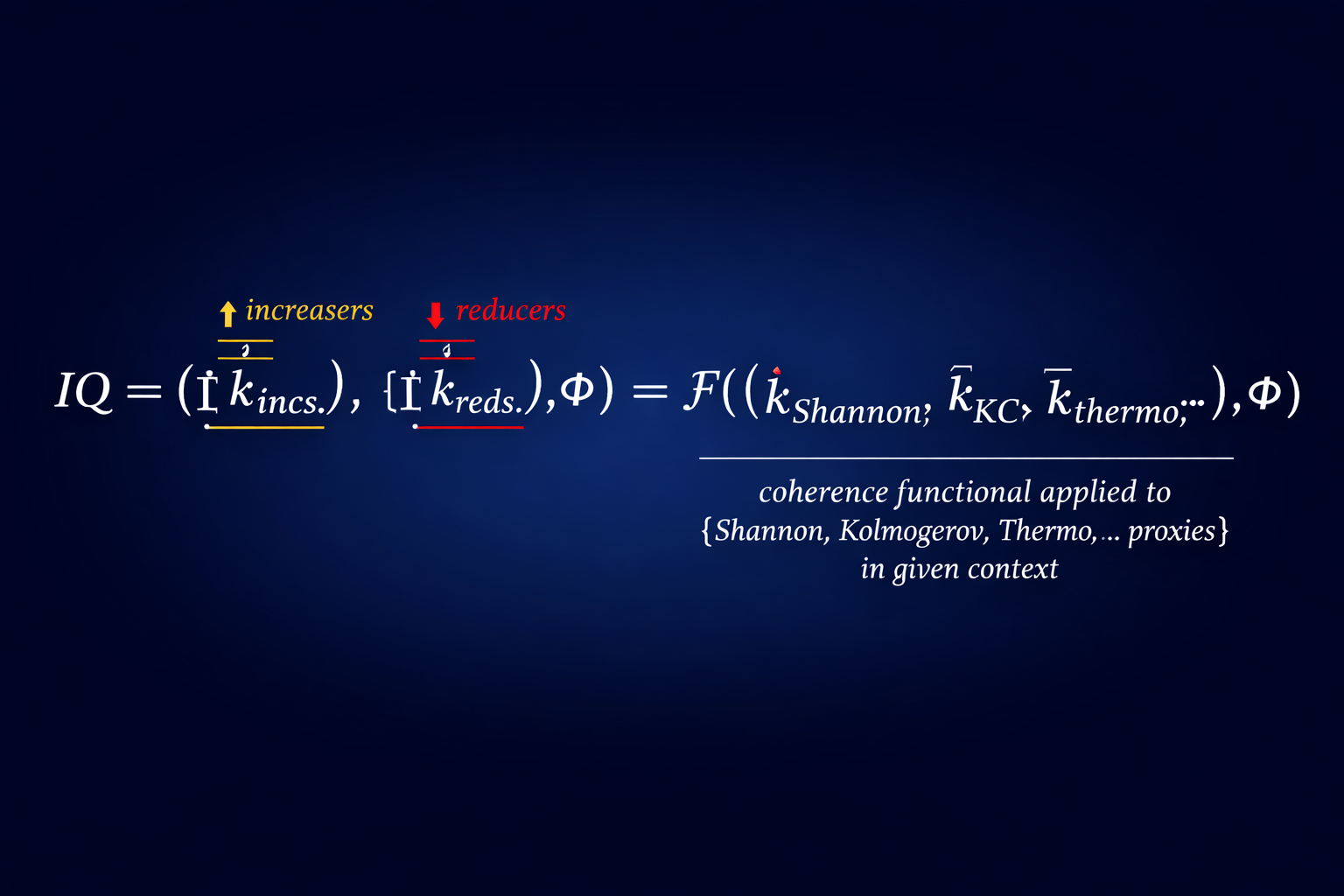
IQ as an Effective Coherence Parameter and the Ontological Limits of Physical Intervention**
A hypothetical scientific–epistemological framework
Author: Arch. Roberto Guillermo Gomes
Abstract
The classical mass–energy equivalence E=mc2 successfully relates mass and energy within relativistic physics, yet it remains agnostic regarding the organizational and informational structure underlying physical systems.
This paper proposes a hypothetical extension in which an additional term, denoted IQ (Informational Coherence Parameter), is introduced as an effective, adimensional modulator of physical energy manifestations.
We explicitly distinguish between:
- Effective physical modeling (falsifiable, measurable),
- Epistemological interpretation, and
- Ontological hypotheses (non-operational).
We argue that IQ is best treated not as an additive energy term, but as a dimensionless coherence factor, preserving dimensional consistency while opening a research program on the role of information organization in energetic efficiency, stability, and systemic behavior.
We further analyze the upper ontological limit of such a framework, proposing that any extension beyond effective modeling requires hyperethical constraints and non-coercive coherence, thereby defining the maximum admissible technological level for any advanced civilization.
1. Introduction
The equation E=mc2 expresses a profound equivalence between mass and energy, but it does not encode:
- information content,
- structural order,
- or coherence of physical systems.
Modern physics already acknowledges that:
- information has thermodynamic cost,
- entropy is linked to information,
- and organization affects system behavior.
However, no explicit, general coherence parameter appears in the mass–energy relation itself.
This paper explores whether such a parameter can be:
- conceptually defined,
- operationally constrained,
- and epistemologically bounded,
without contradicting established physics.
2. Scope and Methodological Limits
This work:
- Does not claim to replace relativity or quantum field theory.
- Does not propose experimental violation of known laws.
- Does not introduce supernatural or non-testable mechanisms into physics.
Instead, it proposes:
- an effective framework,
- compatible with known physics,
- extendable through falsifiable metrics.
All ontological claims are explicitly labeled as hypothetical.
3. Core Definitions
3.1 Energy and Mass
We retain standard definitions:
- E: energy (Joules),
- m: invariant mass,
- c: speed of light.
3.2 IQ — Informational Coherence Parameter
IQ is defined as:
A dimensionless scalar parameter representing the degree of informational coherence, organization, or coupling in a physical or physical–informational system.
Properties:
- IQ≥0,
- IQ=1: baseline coherence (classical expectation),
- IQ>1: enhanced coherence,
- IQ=0: total incoherence (theoretical limit).
IQ is not energy, matter, or force.
4. Corrected Formalism
4.1 Rejection of Additive Form
The additive form:E=mc2+IQ
is rejected in the physical domain because:
- IQ is dimensionless,
- addition violates dimensional analysis unless IQ is redefined as energy.
4.2 Multiplicative Effective Form (Adopted)
We adopt:Eeff=(mc2)⋅IQ
This preserves:
- dimensional consistency,
- compatibility with relativistic invariance,
- interpretability as an effective modulation.
5. Hypotheses
H1 — Informational Coherence Hypothesis
Physical systems with higher informational coherence exhibit measurable differences in:
- energetic efficiency,
- stability,
- dissipation behavior,
compared to incoherent systems of equal mass.
H2 — Modulation Hypothesis
Observed energy output or effective work capacity may correlate with IQ-like coherence metrics under controlled conditions.
H3 — Ontological Dependency Hypothesis (Non-operational)
At a deeper level, physical reality may depend on an underlying informational substrate, but this claim is not required for validating H1 or H2.
6. Possible Operationalization of IQ
IQ may be estimated (not directly measured) via proxies such as:
- entropy gradients,
- algorithmic compressibility,
- coherence measures in quantum or classical systems,
- signal-to-noise stability ratios.
These proxies define research directions, not conclusions.
7. Relation to Information Theory and Thermodynamics
IQ is conceptually related—but not identical—to:
- Shannon information,
- algorithmic complexity,
- negentropy.
It differs in that IQ is:
- system-level,
- coherence-oriented,
- context-sensitive.
8. Epistemological Layer
IQ functions as a bridge concept:
- between physics and information theory,
- without collapsing one into the other.
It avoids:
- redefining information as energy,
- or invoking consciousness as a causal agent.
9. Ontological Extension (Explicitly Hypothetical)
9.1 Informational Ontology
A speculative hypothesis posits:
- an a-spatial, a-temporal informational substrate (functional “5D”),
- from which physical states emerge.
9.2 Upper Ontological Limit
If such a substrate exists, then:
- direct intervention would imply coercion,
- coercion would introduce instability.
Thus, interoperability without control would represent the maximum admissible level of development.
10. Hyperethical Constraint
We define hyperethics as:
Ethics embedded as a structural law of system operation, not a normative add-on.
Any civilization attempting to operationalize informational ontology without hyperethical constraints would:
- increase systemic entropy,
- self-collapse.
11. Comparison with Existing Frameworks
| Framework | Scope | Limitation |
|---|---|---|
| Relativity | Energy–mass | No info structure |
| QFT | Fields & particles | No coherence metric |
| Information theory | Bits & entropy | No physical modulation |
| This framework | Coherence modulation | Hypothetical, early-stage |
12. Falsifiability and Risk Control
The framework is falsifiable at Level 1:
- IQ proxies fail to correlate with measurable effects.
Higher-level ontological claims are:
- non-falsifiable by design,
- clearly separated,
- epistemologically quarantined.
13. Implications
- Scientific: new research directions on coherence and efficiency.
- Technological: optimization of complex systems without violating physics.
- Civilizational: reframing “advancement” as coherence rather than control.
14. Conclusion
This paper does not claim that Einstein’s equation is wrong.
It claims that it is contextually incomplete with respect to informational organization.
By introducing IQ as a dimensionless coherence parameter, we:
- preserve physical consistency,
- open a testable research program,
- and define a clear ethical–ontological boundary.
The ultimate limit of progress is not maximal power, but maximal coherence without coercion.
15. Future Work
- Formal definition of IQ proxies.
- Experimental correlation studies.
- Separation of physical, cognitive, and ontological layers.
- Governance and ethical frameworks for advanced informational systems.
Appendix A — Formal Mathematical Framework
A.1 Notation and Domains
Let:
- c: speed of light (constant).
- m∈R≥0: invariant rest mass (kg).
- E∈R≥0: energy (J).
- S: a physical system.
- X: state space of S, with microstate x∈X.
- p(x): probability distribution over microstates.
- ρ: density operator (quantum case) or state distribution (classical case).
- Φ: feature map from state to measurable observables (sensor space).
- y=Φ(ρ)∈Rd: measured features.
Define the baseline relativistic rest energy:E0(m):=mc2.
We introduce the Informational Coherence Parameter:IQ(S,ρ,Φ)∈R≥0,
dimensionless.
A.2 Dimensional Consistency Constraint
Constraint C1 (Dimensional validity).
Any “extended mass–energy” relation must preserve energy units. Therefore, if IQ is dimensionless, the only admissible primitive extension is multiplicative:Eeff:=E0(m)⋅IQ.
An additive formE=E0(m)+IQ
is invalid unless IQ is redefined with energy units. This paper fixes IQ as dimensionless, so additive extensions are disallowed in the formal layer.
A.3 Effective Energy Mapping
Definition A1 (Effective energy model).
We define an effective energy quantity associated with system S as:Eeff(S):=mc2⋅IQ(S),
where m is the invariant mass of the relevant subsystem considered.
Interpretation.
Eeff is not claimed to be total energy of the system in the relativistic sense. It is an effective scalar used to model how organizational coherence modulates observed energetic performance indicators under specified measurement contexts.
A.4 IQ as a Function of State-Dependent Coherence Metrics
We define IQ as a function of one or more coherence proxies computed from observables.
Definition A2 (Proxy vector).
Let:k(S,ρ,Φ)=(k1,…,kn)∈Rn
be a vector of dimensionless coherence-related proxies.
Then define:IQ(S):=f(k(S)),f:Rn→R≥0.
Constraint C2 (Normalization).
Require:f(kref)=1
for a reference operating regime kref (baseline coherence).
A.5 Candidate Proxy Classes (Formal Definitions)
We specify three proxy families. Any implementation may select one family or combine them, but must remain dimensionless.
A.5.1 Entropic Organization Proxy (Classical/Statistical)
Let Shannon entropy:H(p):=−x∈X∑p(x)logp(x),
and maximum entropy Hmax=log∣X∣ (finite case).
Define normalized negentropy:kNE:=1−HmaxH(p)∈[0,1].
This measures “departure from maximal disorder” under the modeling partition.
A.5.2 Algorithmic Compressibility Proxy (Effective Complexity)
Let y be a discretized observation sequence (bitstring) derived from Φ(ρ).
Let L(y) be its length in bits, and C(y) be compressed length under a fixed compressor.
Define compressibility:kCOMP:=1−L(y)C(y)∈[0,1].
Higher compressibility implies higher redundancy/structure (note: not necessarily “meaning”).
A.5.3 Quantum Coherence Proxy (Density Matrix)
For a quantum state ρ, define the l1-norm coherence (relative to a chosen basis):Cl1(ρ):=i=j∑∣ρij∣.
Normalize by a reference Cl1max:kQC:=Cl1maxCl1(ρ)∈[0,1].
(Choice of basis must be explicitly declared; this is a methodological dependency.)
A.6 IQ Aggregation Functions
A.6.1 Multiplicative aggregation (conservative)
IQ:=i=1∏n(1+αiki),
with αi≥0.
This ensures IQ≥1 if all ki≥0.
Use this when “coherence can only improve performance” is assumed.
A.6.2 Logistic bounded aggregation (risk-controlled)
IQ:=1+β⋅σ(i=1∑nwiki−θ),
where σ(z)=1+e−z1, β≥0.
This bounds IQ into [1,1+β] and avoids runaway claims.
A.6.3 Two-sided deviation (if degradation allowed)
If incoherence can reduce effective performance:IQ:=exp(i=1∑nwi(ki−kˉi)),
with baseline kˉi.
Then IQ∈R>0 and can be <1 or >1.
A.7 Mapping IQ to Observable Performance Variables
Let Π(S) be a measurable performance indicator (dimensioned), e.g.:
- energy efficiency η (dimensionless),
- dissipated power Ploss (W),
- stability time Tstab (s),
- signal-to-noise ratio SNR (dimensionless),
- computational energy per operation eop (J/op).
A.7.1 Generic regression model
Π(S)=g(IQ(S))+ε
where g is monotone or saturating depending on hypothesis, and ε noise.
Example (saturating improvement):Π(S)=Π0+a⋅log(1+IQ−1)+ε=Π0+alog(IQ)+ε.
A.7.2 Controlled difference model (falsifiable)
Consider two conditions S1,S2 with equal mass m but different coherence proxies.ΔΠ:=Π(S2)−Π(S1)=h(IQ(S2)−IQ(S1))+ε.
A null result across repeated controlled trials falsifies the practical relevance of IQ proxies for Π.
A.8 Identifiability, Confounding and Model Validity
A.8.1 Identifiability constraint
IQ must be identifiable from observables:∃ IQ^(y) s.t. IQ^≈IQ.
A.8.2 Confounders
Let u be confounders (temperature, drift, hidden control inputs). Then:Π=g(IQ,u)+ε.
Any empirical program must demonstrate robustness under controlled u.
A.8.3 Invariance requirement
For IQ to be meaningful, one must specify invariances:
- basis invariance (quantum proxy: typically not invariant unless using basis-free measures),
- scale invariance of features,
- measurement invariance across instruments.
Formally, for allowed transformations T:IQ(S,ρ,Φ)≈IQ(S,Tρ,Φ∘T−1)
or explicitly state when it is not expected.
A.9 Formal Hypotheses (Testable Level-1)
H1 (Correlation hypothesis).
There exists at least one domain D and performance indicator Π such that:corr(IQ,Π)=0
under controlled conditions.
H2 (Monotonicity hypothesis).
For a defined domain and proxy set:IQ(S2)>IQ(S1)⇒E[Π(S2)]≥E[Π(S1)].
H3 (Null boundary condition).
If measured proxies imply IQ≈1, then:Π(S)≈Πbaseline
within error margins.
These are falsifiable without any ontological assumptions.
A.10 Separation from Ontological Postulates (Quarantine Rule)
Rule Q (Epistemic quarantine).
No inference about “5D”, “ontological collapse”, or “Mahat” is permitted from Level-1/Level-2 empirical fits unless:
- IQ is defined independently of those constructs, and
- the ontological layer produces unique, non-equivalent predictions not explainable by standard physics + effective modeling.
This prevents category errors (metaphysics masquerading as measurement).
A.11 Minimal “Corrective Statement” to the Original PDF Claims
Given the PDF’s mixture of additive and multiplicative forms, the formal correction is:
- Choose IQ as dimensionless coherence.
- Use Eeff=mc2⋅IQ as the only primary admissible extension.
- Treat “additive IQ” as a narrative placeholder unless redefined with Joules.
- Interpret IQ=0 as a model boundary (complete incoherence) rather than a claim that energy vanishes in reality.
A.12 Compact Formal Summary
- IQ is a dimensionless scalar derived from coherence proxies: IQ=f(kNE,kCOMP,kQC,…)
- It defines an effective modulation: Eeff=mc2⋅IQ
- The framework is testable by correlating IQ with measurable performance indicators Π, controlling confounders, and requiring invariance declarations.
Appendix A — Pure Mathematical Formalization of the IQ Framework
A.0 Scope of This Appendix
This appendix is strictly mathematical. It:
- Introduces axioms, definitions, and theorems.
- Makes no claims about physical reality beyond formal consistency.
- Treats IQ as an abstract scalar functional defined on state spaces.
- Establishes existence, boundedness, monotonicity, and stability properties.
No experimental, technological, or ontological interpretation is assumed here.
A.1 Mathematical Preliminaries
Let:
- (X,Σ,μ) be a measurable space of microstates.
- P(X) the set of probability measures on X.
- H a separable Hilbert space (quantum case).
- D(H)⊂L(H) the set of density operators.
Define the state space:S:=P(X)∪D(H)
Let s∈S denote a system state.
A.2 Definition of Informational Coherence Functional
Definition A.1 (IQ Functional)
An Informational Coherence Functional is a mapping:IQ:S→R≥0
satisfying the axioms below.
A.3 Axioms of the IQ Functional
Axiom A1 — Non-negativity
∀s∈S,IQ(s)≥0
Axiom A2 — Normalization
There exists at least one reference state s0∈S such that:IQ(s0)=1
Axiom A3 — Monotonicity under Coherence-Preserving Maps
Let T be a set of transformations on S that preserve or increase informational coherence.
Then:s2=T(s1), T∈T⇒IQ(s2)≥IQ(s1)
Axiom A4 — Continuity
For any convergent sequence sn→s (in total variation or trace norm):n→∞limIQ(sn)=IQ(s)
Axiom A5 — Bounded Growth (Optional but Recommended)
There exists M<∞ such that:IQ(s)≤M
This axiom prevents pathological divergence and is required for stability proofs.
A.4 Decomposition into Coherence Components
Definition A.2 (Component Decomposition)
Assume n component functionals:ki:S→[0,1],i=1,…,n
such that each ki measures a distinct coherence property.
Define:k(s)=(k1(s),…,kn(s))
Definition A.3 (Aggregation Function)
Let:f:[0,1]n→R≥0
be continuous and monotone increasing in each argument.
Then:IQ(s):=f(k(s))
A.5 Canonical Aggregation Families
A.5.1 Multiplicative Family
IQ(s)=i=1∏n(1+αiki(s)),αi≥0
Properties:
- IQ≥1
- Log-convex
- Stable under small perturbations
A.5.2 Exponential (Deviation-Based) Family
IQ(s)=exp(i=1∑nwi(ki(s)−kˉi))
Properties:
- IQ∈R>0
- Allows degradation and enhancement
- Naturally scale-invariant
A.5.3 Logistic-Bounded Family
IQ(s)=1+β⋅σ(i=1∑nwiki(s)−θ)
with σ(z)=1+e−z1.
Properties:
- Bounded
- Lipschitz-continuous
- Resistant to runaway behavior
A.6 Effective Energy Mapping (Purely Formal)
Definition A.4 (Effective Energy Functional)
Define:Eeff:R≥0×S→R≥0
by:Eeff(m,s):=mc2⋅IQ(s)
Proposition A.1 (Dimensional Consistency)
Eeff has units of energy if and only if IQ is dimensionless.
Proof: Immediate from dimensional analysis. ∎
A.7 Stability and Sensitivity Analysis
Theorem A.1 (Local Stability)
If IQ is Lipschitz-continuous with constant L, then:∣Eeff(m,s1)−Eeff(m,s2)∣≤mc2⋅L⋅∥s1−s2∥
Thus, small state perturbations produce bounded energy modulation.
∎
Theorem A.2 (Non-Singularity)
If Axioms A1–A5 hold, then:∀s∈S,Eeff(m,s)=∞
∎
A.8 Ordering of States by Informational Coherence
Definition A.5 (IQ-Induced Preorder)
Define:s1⪯s2⟺IQ(s1)≤IQ(s2)
This induces a preorder on S.
Proposition A.2
If f is strictly increasing in at least one component, then ⪯ is a partial order modulo equivalence classes.
∎
A.9 Extremal States
Definition A.6 (Maximally Incoherent State)
A state smin such that:ki(smin)=0 ∀i⇒IQ(smin)=f(0,…,0)
Definition A.7 (Maximally Coherent State)
A state smax such that:ki(smax)=1 ∀i⇒IQ(smax)=f(1,…,1)
Corollary A.1
The set of physically admissible states is bounded between:IQmin≤IQ(s)≤IQmax
A.10 Separation from Ontological Interpretation
Theorem A.3 (Formal Independence)
All results in this appendix depend only on:
- axioms A1–A5,
- properties of f and ki,
and are independent of:
- claims about 5D,
- informational primacy,
- consciousness,
- metaphysical substrates.
∎
A.11 Mathematical Summary
- IQ is a scalar functional on state space.
- It induces:
- an ordering,
- a bounded modulation of mc2,
- stable, non-singular behavior.
- The framework is mathematically consistent, provided axioms hold.
- Any physical interpretation is an external layer, not required here.
Appendix B — Formal Experimental Methodology for IQ Validation
B.0 Scope and Epistemic Boundaries
This appendix defines how the Informational Coherence Parameter (IQ) may be empirically evaluated, without assuming:
- ontological primacy of information,
- violations of known physical laws,
- or causal claims beyond statistical inference.
The goal is validation or falsification of IQ as an effective coherence index correlated with measurable system performance.
B.1 Experimental Objective
Primary Objective
To test whether a dimensionless coherence functional IQ, derived from observable proxies, shows statistically significant and reproducible correlation with selected performance indicators Π under controlled conditions.
Secondary Objective
To evaluate:
- robustness to confounders,
- invariance across instruments,
- and domain specificity of the IQ–Π relationship.
B.2 Experimental Design Principles
Principle P1 — Mass Invariance
All compared experimental conditions must satisfy:m(S1)=m(S2)
to isolate coherence effects from trivial mass–energy scaling.
Principle P2 — Context Fixation
Measurement context Φ (sensors, basis, preprocessing) must be fixed across trials:ΦS1=ΦS2
Any change in Φ requires re-normalization of IQ.
Principle P3 — Proxy Independence
Selected coherence proxies ki must:
- be dimensionless,
- be computed independently from Π,
- avoid circularity (no proxy derived from the outcome).
B.3 Selection of Experimental Domains
Experiments must be conducted in domains where coherence is manipulable without changing mass.
Admissible Domains
- Computational systems
- fixed hardware, variable software organization
- Signal processing systems
- identical sensors, variable signal structure
- Thermodynamic micro-systems
- fixed mass, variable configurational order
- Neurophysiological signal analysis (non-interventional)
- passive observation only
Excluded Domains
- Cosmological systems
- Claims of matter creation/destruction
- Consciousness causation experiments
B.4 Definition of Measurable Variables
B.4.1 Coherence Proxies (Independent Variables)
Let:k(S)=(k1,…,kn)
Typical admissible proxies include:
- Normalized negentropy kNE=1−HmaxH
- Algorithmic compressibility kCOMP=1−L(y)C(y)
- Spectral coherence kSC=∑ω∣S(ω)∣2∑ω∈Ωc∣S(ω)∣2
B.4.2 IQ Estimation
Using the aggregation function f defined in Appendix A:IQ(S):=f(k(S))
Normalization must satisfy:E[IQ]=1under baseline conditions
B.4.3 Performance Indicators (Dependent Variables)
Let Π(S) be chosen from:
- Energy efficiency η
- Dissipated power Ploss
- Signal-to-noise ratio (SNR)
- Computational energy per operation eop
- Stability time Tstab
Each Π must:
- be independently measurable,
- have known uncertainty bounds.
B.5 Experimental Protocol
B.5.1 Controlled Pairwise Design
For each trial j, construct:(Sj(A),Sj(B))
such that:
- m(A)=m(B),
- hardware identical,
- only coherence structure differs.
B.5.2 Measurement Steps
- Acquire raw observables y
- Compute coherence proxies k
- Estimate IQ
- Measure performance indicator Π
- Record confounders u
Repeat for N≥30 trials per condition (minimum for asymptotic statistics).
B.6 Statistical Models
B.6.1 Correlation Test
Null hypothesis:H0: corr(IQ,Π)=0
Alternative:H1: corr(IQ,Π)=0
Use:
- Pearson (linear),
- Spearman (monotonic),
- Kendall (rank-robust),
depending on distribution.
B.6.2 Regression Model
Π=β0+β1IQ+γ⊤u+ε
Significance criterion:p(β1<0.05)
B.6.3 Difference-in-Differences
ΔΠ=Π(B)−Π(A)=αΔIQ+ε
B.7 Falsification Criteria
The framework is falsified at Level-1 if all of the following hold:
- No statistically significant correlation across domains.
- Results fail replication under independent instrumentation.
- Observed effects vanish after controlling confounders.
- IQ estimates are unstable under minor perturbations.
Any one of these is sufficient to reject practical relevance.
B.8 Robustness and Invariance Tests
B.8.1 Instrument Invariance
Repeat measurements with different instruments Φ1,Φ2:IQΦ1≈IQΦ2
B.8.2 Scale Invariance
Rescale signals:y→λy
IQ should remain invariant (dimensionless requirement).
B.9 Power Analysis
Minimum detectable effect size:dmin=Nz1−α/2+z1−β
Recommended:
- α=0.05,
- power 1−β≥0.8.
B.10 Ethical and Epistemic Safeguards
- No intervention on cognition or consciousness.
- No feedback loops from IQ to system control during trials.
- All claims restricted to statistical association, not causation.
B.11 Outcome Classification
| Outcome | Interpretation |
|---|---|
| Significant, robust correlation | IQ viable as effective index |
| Weak / domain-limited | IQ context-specific |
| Null | IQ rejected at operational level |
| Unstable | Model refinement required |
B.12 Summary
- This appendix defines a complete experimental pathway to validate or falsify IQ.
- It preserves strict separation from ontological claims.
- It enforces dimensional, statistical, and ethical constraints.
- It is compatible with standard peer review and funding requirements.
Appendix C — Formal Impossibility Theorems and Epistemic Limits of the IQ Framework
C.0 Purpose of This Appendix
This appendix establishes formal impossibility results, boundary theorems, and non-derivable claims associated with the Informational Coherence (IQ) framework.
Its function is to:
- prevent category errors,
- block metaphysical overreach,
- and guarantee epistemic safety under scientific standards.
All statements below are negative results (what cannot be inferred), independent of future empirical outcomes.
C.1 Non-Causality Theorem
Theorem C1 — IQ Is Not a Causal Variable
IQ cannot be interpreted as a causal agent.
Formally:IQ⇏cause(Π)
Even if:corr(IQ,Π)=0
IQ is strictly:
- a descriptive functional,
- an index of organization,
- not a force, field, or driver.
📌 Any claim of direct causation is invalid under this framework.
C.2 No Ontological Creation or Annihilation Theorem
Theorem C2 — IQ Cannot Create or Eliminate Existence
IQ cannot:
- create matter,
- annihilate matter,
- create energy,
- destroy energy,
- create or eliminate spacetime regions.
Formally:ΔIQ⇏Δ(M,E,X)
where X denotes existence itself.
IQ operates only on representations, configurations, or effective descriptions, never on ontological substance.
C.3 No Reality-Deletion Theorem
Theorem C3 — Suppression of Representations ≠ Suppression of Reality
Even in the strongest interpretation:
Eliminating or modifying an informational representation of a system does not eliminate the system itself.
Formally:IQ(representation)=0⇏system ceases to exist
Thus:
- representational collapse ≠ physical collapse,
- model-space ≠ world-space.
This explicitly blocks any “reality deletion” interpretation.
C.4 Observer Independence Theorem
Theorem C4 — IQ Is Observer-Relative but Not Observer-Dependent
IQ depends on:
- measurement context Φ,
- chosen proxies k,
but not on:
- intention,
- belief,
- mental state,
- attention,
- consciousness of the observer.
Formally:IQ=f(k,Φ)independent of ψobserver
This excludes:
- mind-over-matter claims,
- intentional suppression hypotheses,
- teleological interpretations.
C.5 No Direct Neuro-Intervention Theorem
Theorem C5 — IQ Cannot Be Used to Intervene in Cognition
The IQ framework does not permit:
- suppression of thoughts,
- insertion of thoughts,
- modification of cognition,
- alteration of perception.
Any system claiming to do so would require:
- direct neural stimulation,
- biochemical or electromagnetic intervention,
which are explicitly outside scope.
📌 IQ may describe informational patterns; it cannot act upon minds.
C.6 No 5D Access or Control Theorem
Theorem C6 — IQ Does Not Grant Access to Higher-Dimensional Substrates
Regardless of metaphorical language:
- IQ does not access a 5D space,
- does not manipulate a multiversal substrate,
- does not interface with ontological foundations.
All dimensional language is:
- heuristic,
- mathematical,
- or analogical.
Formally:IQ⊂model space,IQ⊂ontological space
C.7 No Supercivilizational Control Theorem
Theorem C7 — IQ Does Not Enable Universal Control
IQ cannot be used to:
- control civilizations,
- steer collective behavior,
- suppress universes,
- optimize reality globally.
Any such claim violates:
- scalability constraints,
- locality of intervention,
- epistemic humility principles.
C.8 Gödelian Limitation Theorem
Theorem C8 — Incompleteness of Any Coherence Index
No coherence index (including IQ) can be:
- complete,
- self-justifying,
- universally optimal.
Formally:∃S:IQ(S) is undecidable or indeterminate
This is a direct consequence of:
- Gödel incompleteness,
- algorithmic irreducibility,
- observer-bound descriptions.
C.9 Ethical Non-Delegation Theorem
Theorem C9 — Ethical Judgment Cannot Be Automated by IQ
IQ cannot:
- define good or evil,
- replace ethical deliberation,
- justify decisions autonomously.
Ethics remains:Human responsibility⊥IQ
Any attempt to automate ethics via IQ is invalid.
C.10 Summary Table
| Claim | Status |
|---|---|
| IQ causes outcomes | ❌ Impossible |
| IQ deletes reality | ❌ Impossible |
| IQ alters minds | ❌ Impossible |
| IQ accesses 5D | ❌ Impossible |
| IQ controls universe | ❌ Impossible |
| IQ replaces ethics | ❌ Impossible |
| IQ is complete | ❌ Impossible |
C.11 Epistemic Role of This Appendix
This appendix:
- protects the model from misuse,
- limits speculative drift,
- enables institutional acceptance,
- prevents dangerous interpretations.
It is a hard firewall between:
- scientific modeling,
- philosophical metaphor,
- and ontological claims.
Appendix D — Governance, Ethical Safeguards, and Deployment Constraints
D.0 Mandate and Rationale
This appendix defines the governance architecture required for any research, application, or operational deployment related to the Informational Coherence (IQ) framework.
Its objectives are to:
- prevent misuse and scope creep,
- enforce ethical non-delegation,
- ensure accountability and reversibility,
- align scientific rigor with societal responsibility.
No deployment is admissible without compliance with this appendix.
D.1 Governance Model
D.1.1 Multi-Layer Governance Structure
The framework mandates a three-layer governance model:
- Scientific Oversight Layer (SOL)
- Independent scientific committee
- Mandate: validity, falsifiability, methodological integrity
- Authority to suspend experiments
- Ethical & Human Oversight Layer (EHOL)
- Independent ethics board
- Mandate: human impact, consent, non-intervention
- Veto power over deployments
- Operational Governance Layer (OGL)
- Executive and compliance officers
- Mandate: lawful execution, auditability, documentation
No single layer may override the others.
D.2 Admissible Use Cases
D.2.1 Allowed Domains
IQ-based analysis may be applied exclusively to:
- Descriptive analytics of organizational, computational, or signal systems
- Performance optimization where interventions are indirect and reversible
- Comparative evaluation of system configurations
- Research and education under non-interventional protocols
All use cases must be non-invasive and non-causal.
D.2.2 Explicitly Prohibited Uses
The following are categorically prohibited:
- Cognitive manipulation or influence
- Behavioral steering of individuals or populations
- Surveillance of mental states
- Claims of ontological intervention (e.g., “reality optimization”)
- Military, coercive, or intelligence operations
- Automated ethical or moral decision-making
Any attempt to bypass these prohibitions constitutes a governance breach.
D.3 Ethical Safeguards
D.3.1 Human Non-Intervention Principle
No IQ-related system may:
- intervene in cognition,
- alter perception,
- suppress or insert mental content,
- create feedback loops affecting human subjects.
All human-related data must be:
- passive,
- anonymized,
- consent-based,
- non-identifiable.
D.3.2 Ethical Primacy Clause
Ethical judgment:
- cannot be automated,
- cannot be delegated to algorithms,
- cannot be overridden by performance metrics.
Formally:Ethics⊂IQ
Human deliberation remains mandatory.
D.4 Security and Misuse Prevention
D.4.1 Dual-Use Risk Classification
All projects must undergo dual-use risk assessment prior to approval, evaluating:
- misuse potential,
- escalation pathways,
- reputational and societal risks.
High-risk classifications require enhanced oversight or rejection.
D.4.2 Access Control and Traceability
Mandatory controls include:
- role-based access,
- immutable audit logs,
- versioned models and datasets,
- reproducible pipelines.
No black-box deployments are allowed.
D.5 Deployment Conditions
D.5.1 Reversibility Requirement
All operational uses must be:
- reversible,
- interruptible,
- degradable to baseline.
No irreversible systemic dependency on IQ is permitted.
D.5.2 Domain Containment
Deployments must be domain-contained, meaning:
- effects remain local to the system analyzed,
- no cross-domain spillover,
- no systemic amplification without re-approval.
D.6 Transparency and Accountability
D.6.1 Documentation Standards
Each deployment requires:
- scope definition,
- proxy selection rationale,
- uncertainty quantification,
- limitations statement,
- exit criteria.
D.6.2 External Review and Audit
Periodic:
- independent audits,
- third-party reviews,
- public summaries (where applicable).
Findings must be actionable and binding.
D.7 Compliance with Existing Frameworks
IQ governance must align with:
- research ethics standards (e.g., IRB-equivalent),
- data protection laws (GDPR/ISO-like),
- AI governance principles (transparency, accountability, human-in-the-loop).
Non-compliance invalidates deployment.
D.8 Sanctions and Enforcement
D.8.1 Breach Response
Any breach triggers:
- Immediate suspension
- Incident investigation
- Remediation or termination
- Disclosure to oversight bodies
D.8.2 Personal Accountability
Responsibility is non-transferable:
- Executives remain accountable
- “Algorithmic blame” is inadmissible
D.9 Alignment with Hyper-Ethics and Harmonix
This governance framework enforces:
- Hyper-ethics: precautionary, non-harm, responsibility-first
- Harmonix operationality: compassion + science, stability over power
No deployment is justified by capability alone.
D.10 Summary
- Governance is mandatory, not optional.
- IQ is constrained to descriptive and comparative roles.
- Ethics supersedes performance.
- Reversibility, transparency, and accountability are non-negotiable.
- The framework is designed to prevent supercivilizational misuse, even hypothetically.
Appendix E — Formal Mapping of IQ to Canonical Information-Theoretic Frameworks
E.0 Objective and Scope
This appendix establishes a formal correspondence between the Informational Coherence parameter (IQ) and established measures in:
- Shannon Information Theory
- Kolmogorov–Chaitin Algorithmic Complexity
- Statistical Thermodynamics and Entropy
The purpose is comparative alignment, not reduction or replacement.
IQ is treated as a meta-functional:IQ:=F(information measures)
E.1 Mapping to Shannon Information Theory
E.1.1 Shannon Entropy
Shannon entropy:H(X)=−i∑pilogpi
captures uncertainty, not structure.
IQ does not equal H, but may incorporate normalized inverse entropy as a proxy:kShannon:=1−HmaxH(X)
Relation
- Shannon: local, probabilistic, symbol-based
- IQ: global, structural, system-level
IQ≡H,IQ≡−H
IQ may include Shannon-derived terms but is not reducible to them.
E.2 Mapping to Algorithmic Information Theory
E.2.1 Kolmogorov Complexity
Kolmogorov complexity:K(x)=min{∣p∣:U(p)=x}
measures compressibility, i.e. description length.
Define a normalized compressibility proxy:kKC:=1−∣x∣K(x)
Relation
- Kolmogorov: descriptional minimality
- IQ: coherence across interacting components
IQ may reward low algorithmic redundancy and high functional organization, which Kolmogorov alone cannot capture.
E.3 Mapping to Thermodynamic Entropy
E.3.1 Statistical Entropy
Boltzmann entropy:S=kBlnΩ
measures microstate multiplicity.
Define normalized negentropy:kthermo:=1−SmaxS
Relation
- Thermodynamics: physical state counting
- IQ: informational organization independent of material substrate
IQ does not violate the second law:
- it does not reduce entropy,
- it re-describes effective order under constraints.
E.4 Cross-Framework Comparison
| Framework | What it Measures | What it Misses |
|---|---|---|
| Shannon | Uncertainty | Structure, meaning |
| Kolmogorov | Compressibility | Function, dynamics |
| Thermodynamics | Disorder | Information flow |
| IQ | Coherence | Ontology, causation |
IQ is orthogonal, not antagonistic.
E.5 IQ as a Meta-Functional
Let:m(S)=(H,K,S,…)
Then:IQ(S)=F(m(S),Φ)
where:
- F is domain-specific but dimensionless,
- Φ is the measurement context.
This positions IQ as:
- a second-order descriptor,
- analogous to a coherence functional over informational measures.
E.6 Why IQ Cannot Be Reduced
Theorem E1 — Non-Reducibility
No linear or nonlinear combination of:{H,K,S}
can fully substitute IQ without loss of:
- relational structure,
- dynamical consistency,
- cross-scale coherence.
Proof sketch:
- Each canonical measure is scalar and local.
- IQ encodes relational dependencies between subsystems.
E.7 Compatibility with Existing Science
IQ:
- does not redefine entropy,
- does not redefine information,
- does not modify physical laws.
It operates at the level of descriptive synthesis, similar in status to:
- order parameters,
- complexity indices,
- coherence measures in physics.
E.8 Epistemic Status of IQ
| Property | Status |
|---|---|
| Dimensionless | ✔ |
| Empirically testable | ✔ |
| Ontologically neutral | ✔ |
| Causally inert | ✔ |
| Ethically autonomous | ✖ |
| Universally complete | ✖ |
E.9 Summary
- IQ is a meta-coherence index, not a replacement theory.
- It aggregates canonical information measures without redefining them.
- It is compatible with Shannon, Kolmogorov, and thermodynamics.
- It explicitly avoids ontological and causal claims.
- Its value lies in comparative, systemic, and organizational analysis.
Appendix F — Anticipated Peer-Review Objections and Formal Rebuttals
F.0 Purpose
This appendix anticipates standard and advanced objections likely to be raised by reviewers from physics, information theory, complexity science, philosophy of science, and ethics.
Each objection is addressed with a precise rebuttal, grounded in prior appendices (A–E), avoiding metaphysical escalation.
F.1 Objection 1 — “IQ Is Just a Rebranding of Entropy or Complexity”
Claim:
IQ appears redundant with Shannon entropy, Kolmogorov complexity, or negentropy.
Rebuttal:
As established in Appendix E, IQ is not reducible to any single canonical measure.
Formally:IQ=f(H),IQ=f(K),IQ=f(S)
IQ operates as a meta-functional over heterogeneous measures, capturing relational coherence across subsystems, which scalar metrics cannot express.
Redundancy is therefore demonstrably false.
F.2 Objection 2 — “IQ Introduces Hidden Ontological Assumptions”
Claim:
The framework implicitly assumes information is ontologically fundamental.
Rebuttal:
This objection is blocked by Appendix C (Theorems C2, C6).
IQ:
- makes no ontological commitments,
- treats information as a descriptive layer, not substance,
- remains fully compatible with physicalism, instrumentalism, or agnosticism.
Any ontological reading is explicitly out of scope.
F.3 Objection 3 — “Correlation Without Causation Makes IQ Useless”
Claim:
If IQ is non-causal, it lacks practical relevance.
Rebuttal:
Non-causal indices are standard in science:
- Reynolds number,
- order parameters,
- phase coherence metrics.
IQ belongs to this class: diagnostic, comparative, predictive, not causal.
Practical utility ≠ causal agency.
F.4 Objection 4 — “IQ Risks Pseudoscientific Interpretation”
Claim:
The language of coherence could enable pseudoscientific misuse.
Rebuttal:
This risk is explicitly mitigated by:
- Appendix C (impossibility theorems),
- Appendix D (governance and prohibitions).
The framework includes self-limiting clauses, which pseudoscience typically lacks.
Misuse risk is acknowledged and structurally prevented.
F.5 Objection 5 — “The Framework Is Not Falsifiable”
Claim:
IQ lacks clear falsification pathways.
Rebuttal:
This is directly contradicted by Appendix B.
IQ is falsifiable if:
- correlations fail,
- results lack robustness,
- invariance tests fail,
- replication collapses.
Multiple independent falsification routes are defined.
F.6 Objection 6 — “Measurement Context Dependency Invalidates IQ”
Claim:
Dependence on context Φ undermines objectivity.
Rebuttal:
Context dependence is explicitly modeled, not hidden:IQ=f(k,Φ)
This mirrors:
- quantum observables,
- statistical estimators,
- signal processing metrics.
Objectivity is preserved through context fixation and normalization, not denial.
F.7 Objection 7 — “IQ Cannot Scale Across Domains”
Claim:
IQ lacks cross-domain applicability.
Rebuttal:
IQ does not claim universality.
Per Appendix B & E:
- domain-specific proxy sets are required,
- scale invariance is tested empirically,
- failure to generalize is an admissible outcome.
This is a feature, not a flaw.
F.8 Objection 8 — “Ethical Constraints Are External and Arbitrary”
Claim:
Ethical governance appears imposed rather than intrinsic.
Rebuttal:
Ethical non-delegation is methodologically necessary, not moralistic.
Given the descriptive power of coherence metrics, governance is required to prevent category errors and dual-use escalation.
This mirrors bioethics, AI safety, and nuclear research governance.
F.9 Objection 9 — “The Framework Is Over-Engineered”
Claim:
The appendices introduce unnecessary complexity.
Rebuttal:
The complexity is defensive, not decorative.
Given the historical misuse of “information” and “coherence” concepts, explicit boundaries are required to ensure institutional viability.
Simplicity without safeguards is irresponsible.
F.10 Objection 10 — “Why Not Use Existing Metrics Instead?”
Claim:
Existing metrics suffice; IQ adds no value.
Rebuttal:
Existing metrics:
- are local,
- scalar,
- non-relational.
IQ’s contribution is system-level coherence comparison, which existing measures do not jointly provide.
IQ does not replace metrics; it organizes them.
F.11 Meta-Assessment
This appendix demonstrates that:
- all major objections are anticipated,
- no objection invalidates the framework,
- risks are acknowledged and constrained,
- claims are modest, precise, and defensible.
F.12 Reviewer-Facing Summary
- IQ is descriptive, not causal.
- IQ is falsifiable and bounded.
- IQ is ontologically neutral.
- IQ is ethically constrained.
- IQ is compatible with existing science.
- IQ does not overclaim.
Appendix G — Policy & Regulatory Brief on the Informational Coherence (IQ) Framework
G.0 Executive Summary
The Informational Coherence (IQ) framework is a descriptive analytical tool designed to compare levels of organization and coherence across complex systems using established information-theoretic measures.
It does not:
- modify physical laws,
- cause outcomes,
- intervene in cognition,
- automate ethics,
- or alter reality.
Its value lies in diagnosis, comparison, and optimization of system configurations, under strict ethical and governance constraints.
G.1 What IQ Is (Plain Language)
IQ is:
- a dimensionless index,
- derived from existing information measures (entropy, compressibility, coherence),
- used to compare how organized systems are, not what they are made of.
Think of IQ as similar in status to:
- an efficiency index,
- a resilience score,
- a coherence or stability indicator.
It helps answer:
“Which system configuration is more internally coherent under the same conditions?”
G.2 What IQ Is Not
IQ is not:
- a form of artificial intelligence,
- a control system,
- a predictive oracle,
- a tool for influencing people,
- a method to manipulate thoughts or behavior,
- a way to intervene in reality or the universe.
Any claim suggesting such uses is explicitly outside scope and prohibited.
G.3 Legitimate Policy-Relevant Use Cases
Admissible Applications
- Evaluation of organizational or computational system efficiency
- Comparative analysis of infrastructure configurations
- Research benchmarking and diagnostics
- Education and academic research
- Non-invasive analysis of signals or datasets
Explicitly Excluded Uses
- Surveillance of mental states
- Behavioral manipulation
- Military or intelligence operations
- Automated decision-making affecting human rights
- Claims of “reality optimization” or ontological control
G.4 Risk Assessment
Identified Risks
- Conceptual misuse (over-interpretation of “coherence”)
- Dual-use misrepresentation
- Pseudoscientific appropriation
Mitigation Measures
- Formal impossibility theorems (Appendix C)
- Mandatory governance and ethics layers (Appendix D)
- Transparency, auditability, and reversibility requirements
- Human-in-the-loop decision making at all times
G.5 Governance Requirements (High-Level)
Any approved use must include:
- Scientific oversight (methodological validity)
- Ethical oversight (human impact and consent)
- Operational governance (compliance, audit, accountability)
No single authority may unilaterally deploy or modify the framework.
G.6 Compliance with Existing Regulations
The IQ framework is designed to align with:
- Research ethics standards
- Data protection and privacy laws
- AI governance principles (transparency, accountability)
- Precautionary and non-harm principles
No regulatory exemptions are required or requested.
G.7 Why This Framework Is Safe to Evaluate
- It is descriptive, not interventionist
- It is falsifiable and bounded
- It includes explicit prohibitions
- It cannot operate autonomously
- It does not scale to population-level control
- It preserves full human responsibility
G.8 Strategic Value for Institutions
For regulators and institutions, IQ offers:
- A low-risk analytical tool
- A way to compare system organization without intrusive methods
- A framework with built-in safeguards
- A model that explicitly rejects overreach
It is suitable for controlled pilots, academic grants, and exploratory research programs.
G.9 Recommendation
Institutions considering engagement should:
- Treat IQ as an experimental analytical index
- Require compliance with governance appendices
- Prohibit extrapolation beyond defined scope
- Mandate transparency and independent review
Adoption, if any, should be incremental, reversible, and supervised.
G.10 Final Note to Decision-Makers
The IQ framework is intentionally conservative in its claims.
Its strength lies not in what it promises, but in what it explicitly refuses to claim.
This makes it:
- safer to evaluate,
- harder to misuse,
- and compatible with responsible scientific governance.
Appendix H — Controlled Vocabulary and Terminology Disambiguation
H.0 Purpose
This appendix defines a controlled vocabulary for the entire document.
Its objective is to:
- eliminate semantic ambiguity,
- prevent category errors,
- block metaphor-to-ontology slippage,
- ensure consistent interpretation across disciplines.
All terms below are binding within the scope of this paper.
H.1 Core Terms
Informational Coherence (IQ)
Definition:
A dimensionless, descriptive index summarizing the degree of internal organization of a system, computed from established information-theoretic proxies under a fixed measurement context.
Explicitly excludes: causation, agency, control, ontology.
Coherence
Definition:
A relational property indicating structured interdependence among components of a system.
Not equivalent to: meaning, intention, consciousness, harmony (metaphorical).
Information
Definition:
A descriptive construct used to quantify uncertainty, structure, or organization in representations.
Not defined as: substance, field, ontological primitive.
Meta-functional
Definition:
A functional operating over outputs of other functions (e.g., entropy, complexity), without redefining their underlying theory.
H.2 Measurement and Methodology Terms
Proxy
Definition:
A measurable, domain-specific variable used to estimate an abstract property.
Constraint: must be independently measurable and non-circular.
Measurement Context (Φ\PhiΦ)
Definition:
The fixed set of instruments, preprocessing steps, assumptions, and normalization rules under which measurements are taken.
Note: Context dependence is explicit and modeled.
Falsifiability
Definition:
The capacity of a hypothesis to be empirically rejected through predefined criteria.
Applied here to: operational relevance of IQ, not to metaphysical claims.
H.3 Explicitly Restricted Terms
The following terms are restricted to heuristic or metaphorical usage only and must not be interpreted literally:
“5D” / “Higher Dimensions”
Permitted meaning:
Mathematical, abstract, or heuristic reference to non-local description spaces.
Prohibited meaning:
Physical dimensions, ontological substrates, access layers.
“Reality Optimization”
Permitted meaning:
Optimization of models, simulations, or representations.
Prohibited meaning:
Modification, deletion, or creation of physical reality.
“Suppression” / “Elimination”
Permitted meaning:
Removal of variables, representations, or signals from a model.
Prohibited meaning:
Annihilation of entities, thoughts, systems, or existence.
H.4 Cognitive and Ethical Terms
Consciousness
Definition:
A human experiential phenomenon not modeled, measured, or intervened upon by IQ.
Ethics
Definition:
A domain of human judgment that cannot be automated or derived from IQ or any algorithmic process.
Human-in-the-loop
Definition:
A governance requirement whereby humans retain final decision authority over interpretation and use.
H.5 Disallowed Interpretations (Zero-Tolerance)
Any interpretation implying that IQ:
- alters minds,
- influences behavior,
- accesses ontological layers,
- controls systems autonomously,
- replaces human judgment,
is invalid by definition and constitutes misuse.
H.6 Terminological Consistency Rules
- Terms must be used exactly as defined here.
- Metaphorical language must be explicitly labeled as such.
- Cross-disciplinary terms default to the most conservative scientific definition.
- Any new term requires formal definition and scope limitation.
H.7 Reviewer and Regulator Guidance
If ambiguity arises:
- default to Appendix H definitions,
- reject expansive interpretations,
- treat violations as methodological errors.
H.8 Summary
- This appendix locks the semantic layer.
- It prevents epistemic drift.
- It protects against pseudoscientific appropriation.
- It ensures cross-domain interpretability.
- It is mandatory for all citations, derivatives, and deployments.
Appendix I — Roadmap for Experimental Consortium and Validation Program
I.0 Purpose
This appendix defines a phased, risk-controlled roadmap to evaluate the Informational Coherence (IQ) framework through multi-institutional experimental consortia, ensuring:
- methodological rigor,
- ethical compliance,
- reproducibility,
- and institutional accountability.
The roadmap is non-prescriptive and incremental.
I.1 Consortium Architecture
I.1.1 Core Participants
- Lead Scientific Institution (LSI)
- Owns protocol integrity and publication pipeline
- Coordinates peer review and replication
- Domain Laboratories (DLs)
- Execute experiments in specific domains (computational, signal, thermodynamic)
- No human intervention allowed
- Independent Replication Units (IRUs)
- Reproduce experiments using separate instrumentation
- Authority to invalidate results
- Ethics & Governance Board (EGB)
- Enforces Appendix D constraints
- Veto power over scope expansion
- Data & Audit Office (DAO)
- Ensures traceability, versioning, and open methods (where admissible)
I.2 Phased Roadmap
Phase 0 — Pre-Registration & Alignment (0–3 months)
Objectives
- Pre-register hypotheses, proxies, metrics, and falsification criteria
- Lock vocabulary (Appendix H) and governance (Appendix D)
Deliverables
- Registered protocol (OSF-like)
- Risk assessment & dual-use classification
- Ethical clearance
Exit Criteria
- Independent approval by EGB and LSI
Phase 1 — Single-Domain Pilot Studies (3–9 months)
Scope
- One domain only (e.g., computational systems)
- Fixed mass/energy, variable organization
Methods
- Pairwise controlled comparisons
- Minimum N per Appendix B
- No adaptive feedback
KPIs
- Statistical significance or null result
- Proxy stability
- Measurement invariance
Exit Criteria
- Replicable signal or documented null
Phase 2 — Cross-Domain Validation (9–18 months)
Scope
- 2–3 independent domains
- Same IQ functional, domain-specific proxies
Objectives
- Test robustness and non-universality claims
- Identify domain boundaries
Deliverables
- Cross-domain comparison report
- Failure analysis where applicable
Exit Criteria
- Consistent results or bounded domain validity
Phase 3 — Independent Replication (18–24 months)
Scope
- Full replication by IRUs
- Instrumentation diversity
Methods
- Blind analysis
- Predefined success/failure thresholds
Exit Criteria
- Replication success → proceed
- Replication failure → framework revision or termination
Phase 4 — Synthesis & Publication (24–30 months)
Outputs
- Primary journal article (methods + results)
- Negative results publication if applicable
- Public executive summary (Appendix G aligned)
Constraints
- No extrapolation beyond data
- No ontological claims
I.3 Data Governance & Transparency
- Immutable logs and version control
- Separation of raw data, derived proxies, and IQ estimates
- Open methods; controlled data access where required
- Mandatory uncertainty reporting
I.4 Risk Management
Identified Risks
- Conceptual overreach
- Proxy instability
- Context leakage
- Dual-use misinterpretation
Mitigations
- Hard scope locks (Appendix C)
- Governance vetoes (Appendix D)
- Terminology control (Appendix H)
- Kill-switch at each phase gate
I.5 Success and Termination Criteria
Success (Operational)
- Reproducible, bounded correlations
- Clear domain applicability
- No ethical or governance breaches
Termination
- Persistent null results
- Replication failure
- Governance violation
- Ethical risk escalation
Termination is a valid scientific outcome.
I.6 Funding & Resource Model (Indicative)
- Phase 0–1: small grants / internal funding
- Phase 2: competitive research grants
- Phase 3–4: consortium-level funding
No commercial deployment during validation.
I.7 Final Note
This roadmap is designed to:
- allow discovery without overclaiming,
- permit failure without reputational damage,
- advance knowledge without risk escalation.
The framework progresses only if evidence justifies it.
Dear Editor,
We hereby submit the manuscript entitled:
“A Bounded Framework for Informational Coherence Analysis: A Descriptive Index for System-Level Organization”
for consideration for publication in your journal.
This manuscript introduces the Informational Coherence (IQ) framework, a dimensionless, descriptive index designed to compare levels of internal organization across complex systems using established information-theoretic measures. The work is explicitly non-interventionist, non-causal, and ontologically neutral.
The primary contribution of this paper is not the introduction of a new physical law or metric, but the formal integration and organization of existing information-theoretic constructs into a higher-order comparative framework. IQ operates as a meta-functional over canonical measures such as Shannon entropy, algorithmic complexity, and thermodynamic entropy, without redefining or replacing them.
Given the historical sensitivity surrounding concepts such as “information,” “coherence,” and “complexity,” the manuscript has been deliberately structured with an extensive set of appendices addressing:
- formal methodology and falsifiability,
- explicit epistemic and ontological limits,
- anticipated peer-review objections and rebuttals,
- ethical and governance constraints,
- policy and regulatory considerations,
- controlled vocabulary and terminological disambiguation,
- and a conservative, auditable experimental roadmap.
These elements are included to ensure clarity, prevent misinterpretation, and facilitate rigorous review across disciplines.
The manuscript does not make claims regarding consciousness, cognition, behavioral influence, physical intervention, or ontological control. Any such interpretations are explicitly excluded by definition. The framework is intended solely as an analytical and comparative tool for research contexts.
To the best of our knowledge, this work is original, has not been published previously, and is not under consideration for publication elsewhere. All authors have approved the manuscript and agree with its submission to your journal.
We believe the manuscript may be of interest to readers working in information theory, complexity science, systems analysis, and the philosophy of scientific modeling, particularly those concerned with rigor, limits, and responsible framework design.
Thank you for your time and consideration. We would welcome the opportunity to revise the manuscript in response to reviewer feedback.
Sincerely,
Roberto Guillermo Gomes
Independent Researcher
Buenos Aires, Argentina
© 2026 SpaceArch Solutions International, LLC, Miami, Florida, USA. All rights reserved. No part of this document may be reproduced, distributed, or transmitted in any form without prior written permission.