







Lifecycle Governance for Intelligent Automation Systems
I. Conceptual Definition
Automation Maintenance within AIEarth is the structured supervision, validation, and evolution of AI-enabled workflows, CRM automation, lifecycle sequences, API integrations, and rule-based execution systems.
Automation is not static.
It degrades without governance.
Automation Maintenance ensures:
• Stability
• Accuracy
• Logical integrity
• Execution reliability
• Data consistency
• Performance sustainability
It protects the automation layer as infrastructure.
II. The Automation Risk Problem
Organizations invest in:
• CRM automation
• Lead lifecycle flows
• AI workflow systems
• Trigger-based sequences
• API-connected processes
But over time:
• Triggers break
• APIs change
• Data structures evolve
• Rules conflict
• AI outputs drift
• Performance slows
• Integration errors compound
Without maintenance, automation becomes fragile.
Automation fragility increases operational risk.
III. Core Functional Scope
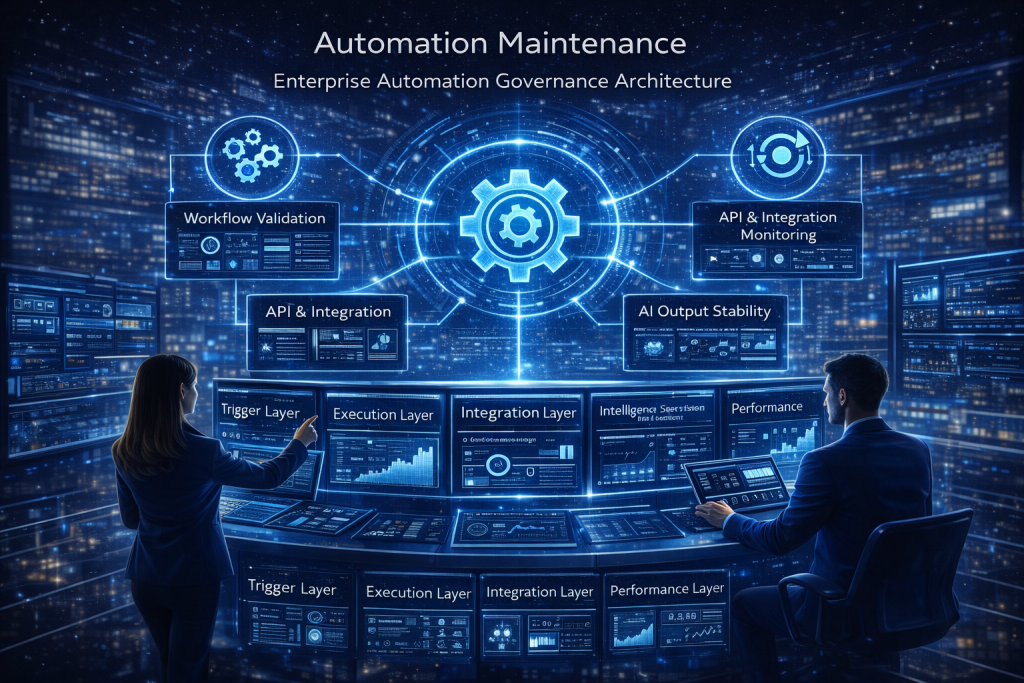
Automation Maintenance covers five structural layers:
1️⃣ Workflow Integrity Validation
• Trigger condition testing
• Execution path verification
• Error log review
• Conditional logic audit
• Dependency mapping
Ensures flows execute as designed.
2️⃣ CRM & Lifecycle System Supervision
• Contact routing validation
• Lead stage transition auditing
• Follow-up sequence accuracy
• Email/SMS automation verification
• Task assignment logic monitoring
Prevents lifecycle breakdown.
3️⃣ API & Integration Monitoring
• API connection health checks
• Authentication token rotation
• Integration error handling review
• Data transfer integrity validation
• Webhook verification
Prevents silent failure across platforms.
4️⃣ AI Logic Stability Oversight
• AI output consistency review
• Model parameter monitoring
• Prompt refinement validation
• Automation AI drift detection
• Exception handling testing
Prevents unpredictable automation behavior.
5️⃣ Performance & Scalability Supervision
• Execution time monitoring
• Automation queue stability
• Throughput analysis
• Scaling stress validation
• Latency monitoring
Ensures automation remains efficient under load.
IV. Scientific & Systems Framework
Automation Maintenance operates under:
• Scheduled audit cycles
• Real-time monitoring dashboards
• Error threshold alerts
• KPI validation checkpoints
• Regression testing protocols
• Update compatibility checks
Automation is treated as:
A living system requiring lifecycle management.
V. Commercial Consequences of Neglect
Without maintenance:
• Leads are lost
• Clients are not followed up
• Orders fail silently
• AI responses become inconsistent
• Internal task allocation collapses
• Revenue leakage occurs
Automation failure is invisible revenue loss.
VI. Strategic Outcomes of Structured Maintenance
With Automation Maintenance:
• Conversion flows remain stable
• Sales pipelines remain predictable
• Operational load remains reduced
• AI remains aligned
• Error probability declines
• Revenue consistency improves
Automation becomes:
Operational leverage — not operational risk.
VII. Differentiation vs Basic Support
| Basic Automation Support | AIEarth Automation Maintenance |
|---|---|
| Fix when broken | Continuous integrity supervision |
| Manual troubleshooting | Structured validation cycles |
| No performance tracking | Execution efficiency monitoring |
| Reactive approach | Preventive governance |
| No AI oversight | AI drift monitoring |
We do not “fix automation.”
We govern automated ecosystems.
VIII. Integration Within AIEarth Stack
Automation Maintenance protects:
• AI Workflow Systems
• Lifecycle Automation
• CRM Structuring
• Process Optimization Architecture
• IoT-triggered systems
• Enterprise Infrastructure flows
It stabilizes intelligent operations.
IX. Enterprise Positioning
At Enterprise level, Automation Maintenance becomes:
• Mission-critical
• Contractually structured
• SLA-defined
• Audit-driven
• KPI-monitored
It supports:
Multi-location operations
Trade networks
Franchise systems
High-volume CRM pipelines
X. Business & Financial Impact
Proper automation maintenance results in:
• Higher lead retention
• Lower human supervision cost
• Reduced rework
• Improved operational velocity
• Lower system failure probability
• Improved ROI on automation investment
Automation without maintenance:
Degrades.
Automation with governance:
Compounds value.
XI. Website-Ready Summary Version
Automation Maintenance
Lifecycle Governance for Intelligent Systems.
We continuously supervise, validate, and optimize automated workflows, CRM systems, and AI-enabled processes to ensure execution stability, performance consistency, and scalable operational reliability.
Automation is not a one-time setup.
It is an evolving infrastructure layer.
XII. Strategic Conclusion
In scalable digital environments:
Automation reduces operational load.
But only if:
It remains structurally governed.
Automation Maintenance transforms intelligent workflows into durable operational assets.
AUTOMATION MAINTENANCE
Enterprise Automation Governance Architecture
I. Structural Definition
Automation Maintenance is the continuous governance, validation, recalibration, and performance supervision of rule-based systems, AI-driven workflows, CRM lifecycle automation, API integrations, and intelligent process orchestration layers.
Automation is not static code execution.
It is a dynamic operational network composed of:
• Conditional triggers
• Data pipelines
• AI logic nodes
• External integrations
• Execution queues
• Feedback loops
Without lifecycle governance, automation entropy increases.
Automation Maintenance prevents entropy.
II. System Architecture Model
Automation ecosystems consist of five interdependent structural layers:
1. Trigger Layer
Defines event initiation logic:
• Form submission
• CRM status change
• API webhook
• Time-based scheduler
• IoT signal
• Behavioral event
Risk:
Trigger misfires or duplicates cause cascade effects.
Governance:
• Trigger validation tests
• Frequency anomaly detection
• Duplicate prevention rules
2. Execution Layer
Processes defined rules:
• Conditional branching
• Task routing
• Data transformation
• API calls
• AI prompt execution
Risk:
Execution failure silently blocks business processes.
Governance:
• Log auditing
• Error threshold monitoring
• Queue stability validation
• Retry logic optimization
3. Integration Layer
Connects external systems:
• Payment gateways
• CRM platforms
• Email/SMS tools
• ERP systems
• Logistics systems
• AI models
Risk:
API changes or expired credentials break automation invisibly.
Governance:
• Token rotation monitoring
• API response validation
• Data mapping verification
• Integration uptime tracking
4. Intelligence Layer (AI Systems)
Includes:
• Prompt-driven logic
• Model inference
• Classification systems
• Predictive routing
Risk:
AI drift, output inconsistency, or bias amplification.
Governance:
• Output sampling validation
• Drift detection review
• Parameter recalibration
• Exception boundary modeling
5. Performance Layer
Measures:
• Execution time
• System load
• Throughput
• Latency impact
• Resource utilization
Risk:
Automation slows under scale.
Governance:
• Load stress testing
• Queue monitoring
• Throughput benchmarking
• Infrastructure resource alignment
III. Scientific Governance Model
Automation Maintenance operates on:
• Audit cycles
• KPI-driven supervision
• Structured validation checkpoints
• Regression testing
• Controlled update deployments
• Risk scoring matrix
This transforms automation from reactive IT dependency into a governed operational asset.
IV. Automation Risk Modeling
Unmaintained automation creates:
• Revenue leakage
• Missed lead follow-ups
• Incorrect client routing
• Payment processing errors
• Operational misalignment
• Data corruption
• AI hallucination propagation
These failures are often silent.
Silent failures are financially dangerous.
Automation Maintenance reduces silent failure probability.
V. Quantifiable KPIs
Governance requires measurable metrics:
• Execution success rate
• Automation failure ratio
• Lead routing accuracy
• Trigger reliability score
• API health consistency
• AI output variance
• Average workflow execution time
• Operational dependency exposure index
Automation becomes auditable.
VI. Cost-of-Neglect Analysis
Without governance:
Automation reliability degrades over time.
Consequences include:
• Increased manual intervention
• Sales leakage
• Customer dissatisfaction
• Brand instability
• Higher support overhead
• Escalating troubleshooting cost
The cost of reactive repair exceeds preventive governance.
VII. Performance & Financial Impact
Automation Maintenance generates:
• Higher lead retention
• Stable lifecycle conversion
• Reduced human supervision hours
• Lower error correction cost
• Improved infrastructure ROI
• Stable AI output consistency
Automation becomes scalable leverage.
VIII. Integration Within AIEarth Infrastructure Stack
Automation Maintenance stabilizes:
• AI Workflow Systems
• CRM Structuring
• Lifecycle Automation
• Process Optimization Architecture
• IoT-triggered actions
• Enterprise Smart Retail Systems
• Intelligent Workspaces
It is a horizontal protection layer.
IX. Enterprise Positioning
At Enterprise level, Automation Maintenance becomes:
• SLA-defined
• Audit-documented
• Risk-scored
• Performance-indexed
• Compliance-ready
It supports:
Multi-node networks
Franchise systems
Trade infrastructure
Cross-border operations
AI-assisted decision engines
Automation governance becomes mission-critical.
X. Comparative Positioning
| Basic Automation Setup | Automation Governance Architecture |
|---|---|
| One-time configuration | Continuous lifecycle oversight |
| Manual error fixing | Structured anomaly detection |
| Limited logs | KPI-driven supervision |
| Reactive troubleshooting | Predictive risk modeling |
| No AI drift control | AI output stability governance |
We do not install automation.
We govern intelligent systems.
XI. Strategic Commercial Reframing
Automation is marketed as:
“Operational efficiency.”
But efficiency without maintenance degrades.
Automation Maintenance reframes automation as:
A long-term operational asset class.
XII. Lifecycle Evolution Logic
Automation systems evolve due to:
• Business model changes
• CRM stage modifications
• API updates
• AI model upgrades
• Regulatory shifts
• Workflow redesign
Maintenance ensures system adaptation remains controlled and predictable.
XIII. Financial Architecture Alignment
Automation Maintenance supports:
• Recurring revenue model
• Client retention
• Enterprise positioning
• Reduced churn
• Long-term contract stability
• Infrastructure valuation logic
It converts projects into governance contracts.
XIV. Strategic Conclusion
Automation reduces operational load only if:
It remains structurally governed.
Unmaintained automation amplifies risk.
Maintained automation compounds value.
Automation Maintenance transforms intelligent workflows into durable infrastructure assets.