







Data-Driven Physical Environments Integrated with AI Infrastructure
I. Strategic Definition
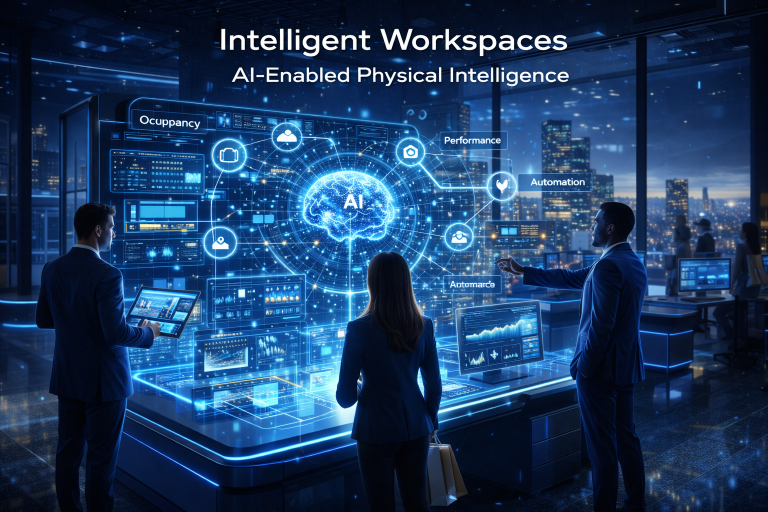
Intelligent Workspaces are AI-enabled, sensor-integred, digitally synchronized physical environments designed to optimize productivity, operational flow, energy efficiency, and decision intelligence.
They are not “smart offices.”
They are:
Integrated Physical–Digital Operating Layers
where infrastructure, data, people, and automation converge into a measurable performance system.
This module connects architecture, IoT, AI analytics, workflow automation, and cloud infrastructure into a unified operational ecosystem.
II. Conceptual Architecture
An Intelligent Workspace is composed of five interlocking layers:
1️⃣ Physical Layer
• Smart access control
• Environmental sensors (temperature, CO₂, occupancy)
• Energy monitoring
• Space utilization mapping
• Digital kiosks / collaboration interfaces
2️⃣ Connectivity Layer
• Secure managed network
• IoT gateways
• Cloud synchronization
• Edge computing capability
3️⃣ Data Intelligence Layer
• Real-time analytics dashboards
• Occupancy behavior modeling
• Energy optimization modeling
• Performance heatmaps
• Resource allocation insights
4️⃣ Automation Layer
• Smart scheduling systems
• Dynamic room allocation
• Energy auto-adjustment
• Predictive maintenance alerts
• AI-enhanced workflow routing
5️⃣ Strategic Oversight Layer
• Executive-level performance dashboards
• ROI modeling on space utilization
• Cost-per-employee metrics
• Efficiency benchmarking
III. Business Purpose
Intelligent Workspaces exist to:
• Reduce wasted square meters
• Optimize employee throughput
• Improve meeting efficiency
• Lower energy costs
• Enhance hybrid collaboration
• Provide measurable operational metrics
• Convert office infrastructure into strategic capital
In mid-size enterprises, physical inefficiencies typically cost between 8% and 22% of operational expenditure.
This module converts infrastructure into a measurable performance asset.
IV. Differentiation vs Traditional Smart Office Vendors
| Traditional Smart Office | AIEarth Intelligent Workspace |
|---|---|
| Device-based solutions | Systems architecture integration |
| Isolated automation | AI-coordinated operational layer |
| Focus on gadgets | Focus on ROI & performance metrics |
| No CRM integration | Full workflow & CRM linkage |
| No strategic reporting | Executive-level decision dashboards |
We do not install devices.
We design systems.
V. Target Clients
• Corporate offices (50–500 employees)
• Real estate developers
• Co-working operators
• Retail headquarters
• Innovation labs
• Hybrid workforce organizations
• Government or semi-public agencies
VI. Operational Impact Model
Measured KPIs include:
• Space utilization ratio
• Energy cost reduction %
• Meeting productivity efficiency
• Employee flow optimization
• Asset utilization rate
• Operational cost per square meter
The objective is not technological sophistication.
The objective is measurable optimization.
VII. Integration within AIEarth Ecosystem
Intelligent Workspaces integrate with:
• Digital Foundations (web + cloud layer)
• AI Workflow Systems
• CRM & Lifecycle Automation
• Smart Commercial Nodes (OmniStand)
• Process Optimization Architecture
This module becomes a physical extension of digital intelligence.
VIII. Positioning Statement (Website-Ready Version)
Intelligent Workspaces
AI-Integrated Physical Environments for Measurable Operational Performance
We transform offices, commercial spaces, and hybrid environments into intelligent operational ecosystems — where infrastructure, data, automation, and executive analytics converge into measurable ROI.
Intelligent Workspaces
Structured Pricing Framework
Pricing is based on:
• Square meters
• Number of employees
• IoT density
• Automation complexity
• Integration depth (CRM, AI, workflow)
• Energy optimization modeling
• Dashboard intelligence level
• Multi-location orchestration
We price architecture + system design + integration.
Hardware is budgeted separately or via partner procurement.
Tier 1 — WORKSPACE FOUNDATION
Operational Visibility Layer
Ideal for:
Small–mid offices, coworking spaces, single-location teams.
Includes:
✔ Space utilization mapping
✔ Basic IoT integration (occupancy + environmental sensors)
✔ Smart scheduling system
✔ Cloud data synchronization
✔ Executive dashboard (utilization + basic energy metrics)
✔ Process mapping session
✔ 1 optimization advisory session
Focus:
Make space measurable.
Timeline
4–6 weeks
Investment
$12,000 – $18,000 implementation
Ongoing monitoring:
$800 – $1,500 / month
Tier 2 — WORKSPACE ADVANCED
Intelligent Operational Coordination
Ideal for:
Scaling organizations, hybrid workforce offices, multi-department operations.
Includes everything in Foundation, plus:
✔ Advanced energy optimization logic
✔ AI-based occupancy modeling
✔ Automated room allocation
✔ Workflow integration (CRM + task systems)
✔ Predictive maintenance alerts
✔ Performance heatmaps
✔ KPI reporting structure
✔ 3 strategic optimization sessions
Focus:
Reduce inefficiencies and automate coordination.
Timeline
6–8 weeks
Investment
$25,000 – $40,000 implementation
Ongoing optimization:
$1,500 – $3,000 / month
Tier 3 — WORKSPACE ENTERPRISE
Multi-Node Intelligent Infrastructure
Ideal for:
Corporate HQ, multi-office enterprises, real estate groups, hybrid networks.
Includes everything in Advanced, plus:
✔ Multi-location orchestration
✔ Cross-office performance dashboards
✔ AI predictive space modeling
✔ Energy cost forecasting
✔ Executive-level ROI modeling
✔ 20+ automation workflows
✔ Cross-entity data integration
✔ Process Optimization Architecture integration
✔ Quarterly strategic review
Focus:
Convert physical infrastructure into strategic decision layer.
Timeline
8–12 weeks
Investment
$50,000 – $95,000 implementation
Strategic evolution plan:
$3,000 – $7,000 / month
Integration into Enterprise Infrastructure Bundle
Now we integrate this properly.
Intelligent Workspaces becomes:
The physical intelligence layer of Enterprise Infrastructure.
Enterprise Infrastructure Bundle
Full Digital–Physical Operational Architecture
Includes:
✔ Digital Foundations (Web + Cloud)
✔ Scalable Cloud Environment
✔ AI Workflow Systems
✔ Lifecycle Automation
✔ Process Optimization Architecture
✔ Smart Retail / OmniStand (if applicable)
✔ Intelligent Workspaces (Foundation / Advanced / Enterprise tier)
Enterprise Infrastructure — Tier E1
Digital + Operational Intelligence
✔ Enterprise Digital Infrastructure
✔ AI Workflow Systems (Advanced)
✔ Intelligent Workspace Foundation
Investment:
$60,000 – $90,000 setup
$3,000 – $5,000 / month
Enterprise Infrastructure — Tier E2
Hybrid Commercial & Workspace Intelligence
✔ Enterprise Digital Infrastructure
✔ AI Workflow Systems (Advanced)
✔ Process Optimization Architecture
✔ Smart Retail Advanced
✔ Intelligent Workspace Advanced
Investment:
$90,000 – $150,000 setup
$5,000 – $9,000 / month
Enterprise Infrastructure — Tier E3
Full Commercial + Multi-Node Intelligence Architecture
✔ Enterprise Infrastructure (complete stack)
✔ AI Workflow Enterprise
✔ Lifecycle Automation Enterprise
✔ Process Optimization Enterprise
✔ Smart Retail Enterprise
✔ Intelligent Workspace Enterprise
✔ Executive Intelligence Dashboards
Investment:
$150,000 – $300,000+ setup
$8,000 – $15,000 / month
Strategic Positioning Narrative
Enterprise Infrastructure is not a package.
It is:
A structured operating system for companies.
It integrates:
Digital presence
Cloud computing
AI workflows
Automation
Process engineering
Retail intelligence
Workspace intelligence
Into one coherent performance architecture.
Differentiation vs IT Integrators
| Traditional IT Integrator | AIEarth Enterprise Infrastructure |
|---|---|
| Hardware-focused | System architecture-driven |
| Device installation | Operational intelligence engineering |
| Fragmented tools | Unified AI-enabled ecosystem |
| Cost center mentality | ROI-structured capital optimization |
Strategic Outcome
When Intelligent Workspaces integrate into Enterprise Infrastructure:
Physical space becomes measurable capital.
AI becomes embedded into daily operations.
Decision-making becomes data-driven.
Operational friction decreases.
Enterprise valuation logic improves.