


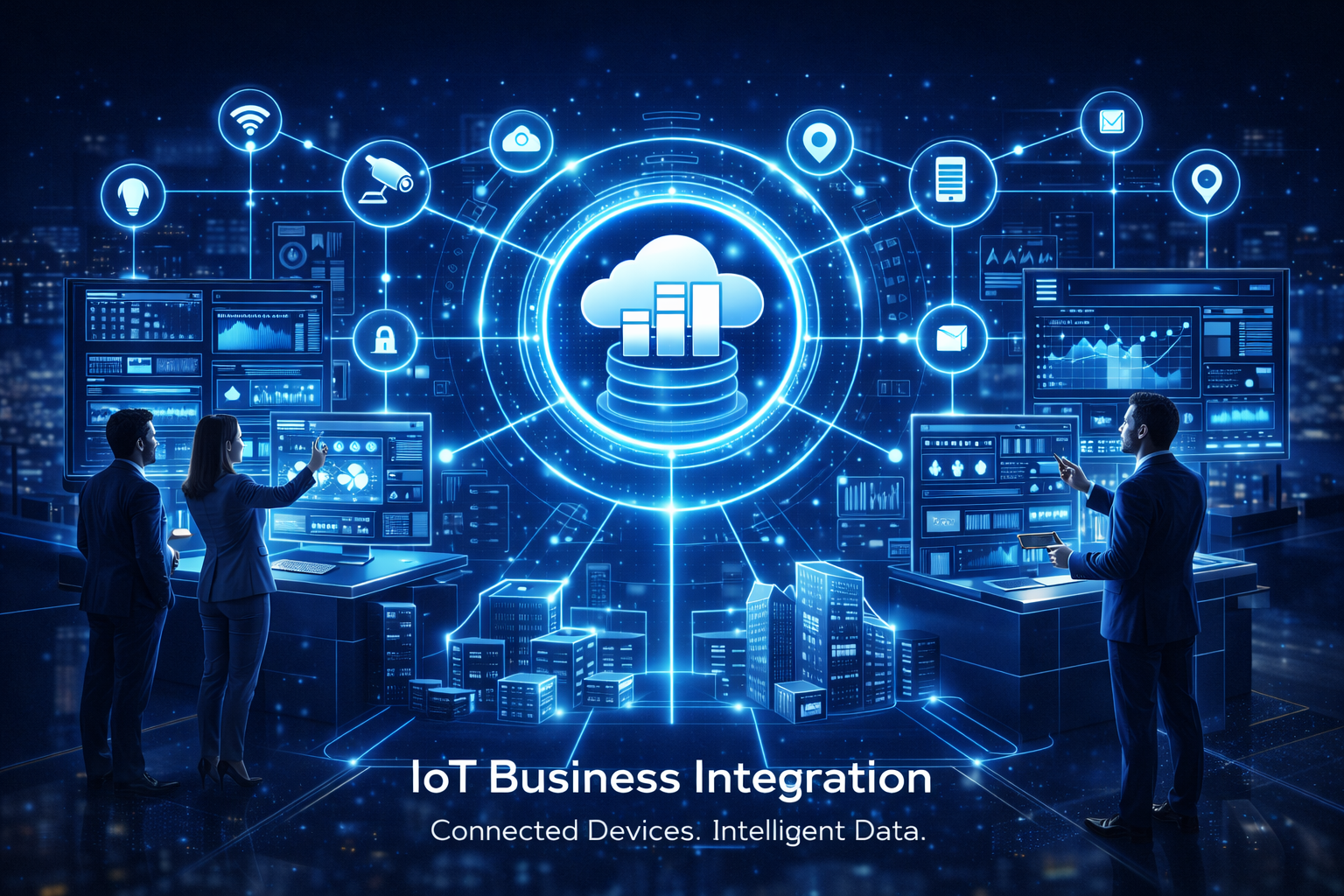
Intelligent Device-to-Data Operational Architecture
I. Strategic Definition
IoT Business Integration is the structured incorporation of physical devices, sensors, and connected systems into a unified cloud-based intelligence architecture that enables real-time monitoring, automation, and predictive decision-making.
It is not about connecting devices.
It is about:
Converting physical signals into actionable business intelligence.
IoT becomes valuable only when integrated into:
• Cloud environments
• CRM systems
• AI workflows
• Automation logic
• Executive dashboards
• Process optimization models
II. The Structural Problem in Most IoT Deployments
Typical IoT implementations fail because they are:
• Device-centric
• Fragmented
• Vendor-isolated
• Non-integrated with CRM
• Non-integrated with workflow systems
• Not aligned with ROI metrics
• Operationally underutilized
This results in:
High hardware cost.
Low intelligence value.
AIEarth addresses this by designing IoT as a business architecture layer.
III. Architectural Framework
IoT Business Integration is structured across six layers:
1️⃣ Device Layer
Includes:
• Environmental sensors
• Occupancy sensors
• Inventory sensors
• Energy meters
• Equipment monitors
• Smart access systems
• Smart POS integrations
Devices are selected based on operational objectives — not trends.
2️⃣ Connectivity Layer
• Secure network segmentation
• Encrypted data transmission
• Edge computing nodes
• API-based integration bridges
• Cloud gateway architecture
Security and scalability are mandatory design constraints.
3️⃣ Data Aggregation Layer
• Real-time telemetry capture
• Data normalization
• Structured database storage
• Event logging
• Historical data indexing
Raw signals are converted into structured datasets.
4️⃣ Intelligence Layer
• AI anomaly detection
• Predictive maintenance modeling
• Usage pattern recognition
• Energy optimization logic
• Behavioral segmentation
Data becomes insight.
5️⃣ Automation Layer
• Automated alerts
• Conditional triggers
• Workflow activation
• Inventory restock automation
• Maintenance scheduling
• Performance threshold notifications
Insight becomes action.
6️⃣ Executive Intelligence Layer
• KPI dashboards
• Energy cost analysis
• Operational risk mapping
• Asset performance reporting
• Multi-location comparison
• ROI tracking
Action becomes measurable business value.
IV. Business Applications
IoT Business Integration supports:
• Smart retail
• Intelligent workspaces
• Commercial nodes
• Warehouses & logistics hubs
• Trade network facilities
• Franchise systems
• Energy optimization in real estate
• Industrial monitoring
V. Differentiation vs Hardware Vendors
| Hardware Vendor | AIEarth IoT Business Integration |
|---|---|
| Device installation | Business architecture integration |
| Single system dashboards | Unified intelligence platform |
| Limited analytics | AI predictive modeling |
| No CRM linkage | Full CRM & workflow integration |
| No ROI tracking | Executive KPI infrastructure |
We do not sell devices.
We design operational intelligence systems.
VI. Measurable KPIs
IoT integration must produce measurable improvements:
• Energy reduction %
• Downtime reduction %
• Maintenance cost savings
• Inventory shrinkage reduction
• Response time improvement
• Operational transparency increase
• Revenue-per-asset ratio
If it cannot be measured, it is not integrated.
VII. Integration within AIEarth Stack
IoT Business Integration connects directly with:
• Scalable Cloud Environments
• AI Workflow Systems
• Lifecycle Automation
• Process Optimization Architecture
• Intelligent Workspaces
• Smart Retail Systems
It becomes the physical sensor layer of the enterprise operating system.
VIII. Risk Management Framework
Proper IoT integration must address:
• Cybersecurity hardening
• Network segmentation
• Data encryption
• Redundancy design
• Device lifecycle management
• Vendor neutrality
Security architecture is not optional.
It is structural.
IX. Ideal Client Profiles
• Commercial real estate operators
• Retail networks
• Distribution centers
• Industrial facilities
• Corporate campuses
• Hybrid office networks
• Smart city pilot environments
X. Strategic Positioning Statement (Website-Ready)
IoT Business Integration
Physical Signals. Digital Intelligence. Measurable Results.
We engineer secure IoT architectures that transform real-world operations into AI-driven, cloud-synchronized intelligence systems — delivering measurable performance optimization across commercial, retail, and enterprise environments.
XI. Strategic Outcome
When IoT Business Integration is properly executed:
Devices stop being isolated hardware.
They become:
Operational sensors of enterprise intelligence.
This converts infrastructure from:
Cost center
→
Performance multiplier.
IoT Business Integration
Structured Pricing Framework
Pricing is based on:
• Number of IoT endpoints
• Facility size (sqm / sq ft)
• Data density requirements
• Integration complexity (CRM / ERP / AI)
• Automation logic layers
• Security architecture level
• Multi-location orchestration
• Predictive modeling requirements
We price architecture + integration + intelligence layer.
Hardware procurement is separate or pass-through.
Tier 1 — IoT FOUNDATION
Operational Visibility Layer
Ideal for:
Single facility, retail space, workspace, warehouse.
Includes:
✔ Up to 25 IoT endpoints integration
✔ Secure cloud gateway architecture
✔ Data aggregation layer
✔ Basic dashboard (real-time metrics)
✔ Threshold alert system
✔ CRM integration (if applicable)
✔ One optimization advisory session
Focus:
Make operations measurable.
Timeline
4–6 weeks
Investment
$15,000 – $25,000 implementation
Ongoing monitoring:
$1,000 – $2,000 / month
Tier 2 — IoT ADVANCED
Intelligent Operational Automation
Ideal for:
Multi-department facilities, logistics hubs, commercial nodes.
Includes everything in Foundation, plus:
✔ Up to 75 IoT endpoints
✔ AI anomaly detection
✔ Predictive maintenance modeling
✔ Automated workflow triggers
✔ Inventory sensor integration
✔ Energy optimization modeling
✔ Multi-dashboard reporting
✔ Security architecture hardening
✔ 3 optimization strategy sessions
Focus:
Convert sensor data into automation.
Timeline
6–8 weeks
Investment
$30,000 – $60,000 implementation
Ongoing intelligence management:
$2,000 – $4,000 / month
Tier 3 — IoT ENTERPRISE
Multi-Node Predictive Intelligence Infrastructure
Ideal for:
Corporate campuses, franchise networks, industrial facilities, multi-location enterprises.
Includes everything in Advanced, plus:
✔ 100+ IoT endpoints
✔ Cross-location orchestration
✔ AI predictive modeling layer
✔ Risk detection analytics
✔ Executive intelligence dashboards
✔ ERP integration (if applicable)
✔ Process Optimization Architecture alignment
✔ Cybersecurity architecture integration
✔ Quarterly executive review
Focus:
Transform physical infrastructure into predictive operational system.
Timeline
8–12 weeks
Investment
$65,000 – $150,000+ implementation
Strategic intelligence governance:
$3,000 – $8,000 / month
Integration into Enterprise Infrastructure Bundle
Now we position this correctly.
IoT Business Integration becomes:
The sensor intelligence layer of Enterprise Infrastructure.
Enterprise Infrastructure — Updated Architecture Stack
Enterprise Infrastructure now includes:
✔ Digital Foundations
✔ Scalable Cloud Environment
✔ AI Workflow Systems
✔ Lifecycle Automation
✔ Process Optimization Architecture
✔ Smart Retail Systems
✔ Intelligent Workspaces
✔ IoT Business Integration
This completes the physical-to-digital intelligence loop.
Enterprise Infrastructure — Tier E2 (Enhanced)
✔ Enterprise Digital Infrastructure
✔ AI Workflow Advanced
✔ Process Optimization Architecture
✔ Intelligent Workspace Advanced
✔ IoT Foundation
Investment:
$120,000 – $180,000 setup
$6,000 – $10,000 / month
Enterprise Infrastructure — Tier E3 (Full Intelligence Stack)
✔ Full Enterprise Infrastructure
✔ AI Workflow Enterprise
✔ Lifecycle Automation Enterprise
✔ Process Optimization Enterprise
✔ Smart Retail Enterprise
✔ Intelligent Workspace Enterprise
✔ IoT Enterprise Integration
✔ Executive Intelligence Layer
Investment:
$200,000 – $400,000+ setup
$10,000 – $20,000 / month
Strategic Positioning Narrative
Enterprise Infrastructure is:
Not IT.
Not automation.
Not IoT.
It is:
A structured enterprise operating system.
IoT becomes the physical sensory input of that operating system.
Without IoT:
You optimize digital workflows.
With IoT:
You optimize physical operations.
Differentiation vs System Integrators
| System Integrator | AIEarth Enterprise Infrastructure |
|---|---|
| Device connectivity | Sensor-to-AI architecture |
| Hardware resale | Business intelligence engineering |
| Operational tools | Unified enterprise operating system |
| Limited automation | Full workflow + lifecycle + process stack |
| No ROI modeling | Executive intelligence dashboards |
Strategic Outcome
When IoT is integrated into Enterprise Infrastructure:
Physical infrastructure becomes:
Measurable
Automated
Predictive
Scalable
AI-augmented
This increases:
Operational resilience
Cost efficiency
Data transparency
Enterprise valuation