







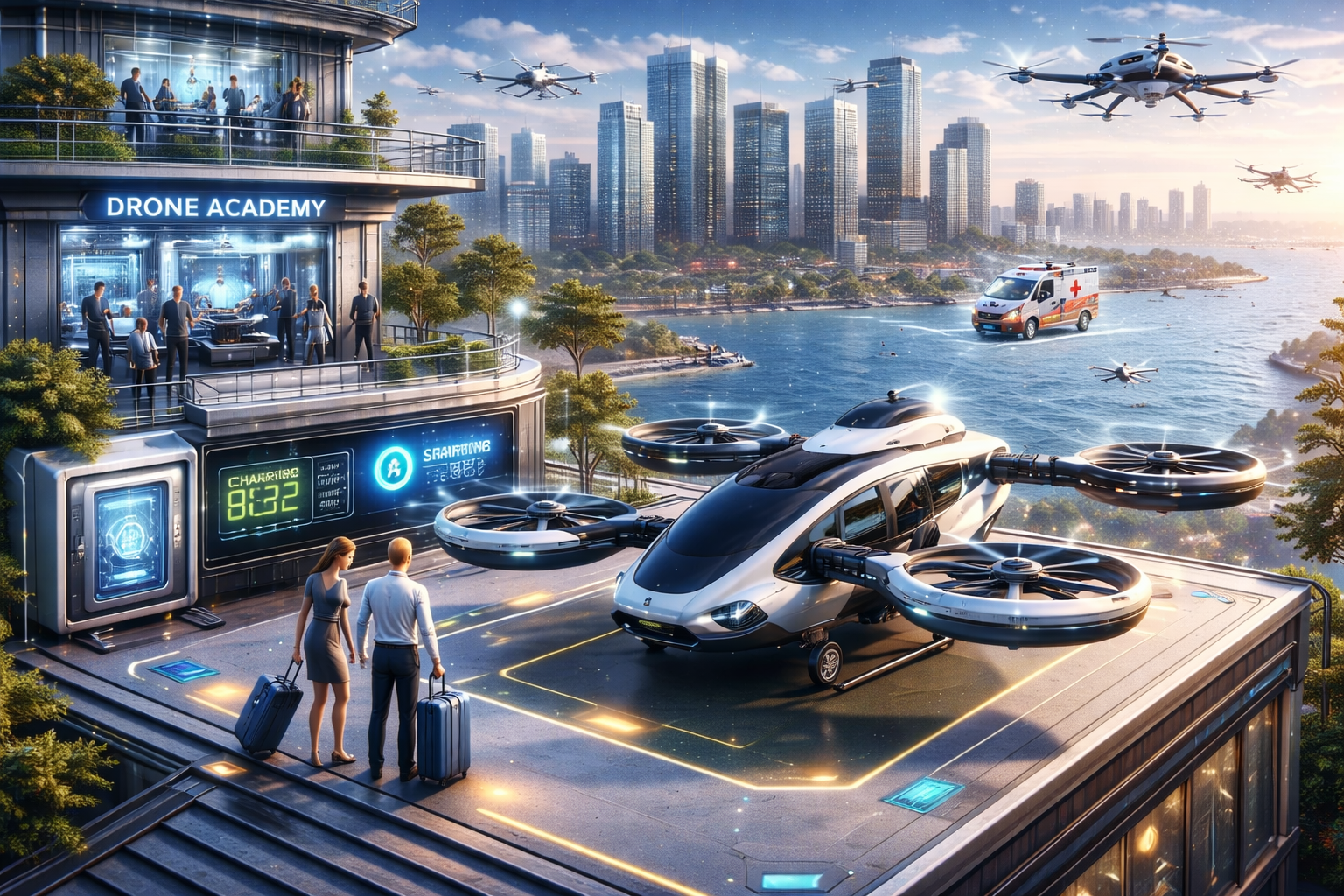
AI Airlines Drons
Reimagining Urban and Interurban Mobility
SpaceArch Solutions International is developing Airlines Drones AI Studio: a future mobility division designed to progressively replace heavy, expensive and inefficient transportation systems with networks of intelligent electric drones.
The first focus is interurban routes of 400 to 1,000 kilometers, where traditional cars and many short-haul flights are slower, more expensive and environmentally inefficient.
Instead of moving millions of people in large airports and highways, the future moves people through distributed aerial networks.
The initial concept proposes premium electric passenger drones capable of connecting cities in 1 to 2 hours.
Examples:
- Mar del Plata ↔ Buenos Aires
- Mar del Plata ↔ Bahía Blanca
- Córdoba ↔ Rosario
- Dubai ↔ Abu Dhabi
🚁 First MVP – Argentina
The first pilot route proposed by SpaceArch is:
- 📍 Galería Central, Mar del Plata
- 📍 Puerto Madero, Buenos Aires
Estimated travel time:
- ⏱️ Approximately 2 hours door-to-door
Instead of large airports, the system uses compact “VertiDron” stations integrated into urban buildings.
The first prototype “Vertidronómetro” would include:
- Folding landing and takeoff platform
- Battery recharge system
- Passenger waiting area
- Digital control and AI traffic coordination
- Direct integration with apps and reservations
The idea is to demonstrate that small, premium drone mobility can become faster and more practical than traditional transport.
🔋 One-Hour Battery Recharge System
A key part of the project is the development of a proprietary fast-charging system capable of recharging batteries in approximately one hour.
The future recharge stations would be integrated into:
- VertiDron stations
- Parking garages
- Buildings
- Residential homes
- Commercial centers
This would make continuous drone operation viable.
🏠 Drones Instead of Cars
The long-term vision is not only interurban transport.
SpaceArch proposes a gradual replacement of automobiles with smaller personal drones.
The concept includes:
- Compact drones with foldable arms
- Designs small enough to fit in a normal home garage
- Electric propulsion
- Autonomous or assisted flight
- Reduced urban congestion
Future homes and buildings could include:
- Folding landing platforms
- Rooftop or balcony takeoff areas
- Common drone garages
- Recharge stations
New buildings designed by SpaceArch Solutions International through its smart-city and DMA divisions could integrate these systems from the beginning.
🏙️ Smart Cities and Air Traffic Synchronization
For the system to work safely, SpaceArch proposes a synchronized aerial traffic network.
This includes:
- 🚦 Smart aerial traffic lights
- 📡 AI-coordinated takeoff and landing systems
- 🛰️ Real-time digital navigation
- 🌐 Integration with city infrastructure
- Automatic separation of routes and altitudes
Intersections and key corners could eventually incorporate small synchronized takeoff and landing points connected to the city’s digital infrastructure.
This concept would be integrated with the future DMA Smart Buildings system and the broader SpaceArch smart-city ecosystem.
🚑 Drone Ambulances
One of the most powerful applications is the replacement or complement of traditional ambulances with medical drones.
Drone ambulances could:
- Reach emergencies much faster
- Avoid traffic
- Transport doctors, medicine or small emergency units
- Connect directly with the future SpaceArch XR Ecosystem health system
- Send patient data in real time
In some cases, a drone ambulance could arrive in minutes where a traditional ambulance may take 20–40 minutes.
🎓 Private Drone Pilot Academy
To support the system, SpaceArch also proposes the creation of a private drone pilot and operator academy.
Integrated with Gen Academy, the academy could train:
- Passenger drone pilots
- Drone maintenance technicians
- Air traffic coordinators
- Drone ambulance operators
- Autonomous navigation supervisors
This creates a new generation of jobs and supports the future expansion of the network.
💡 Why It Matters
The current transport model is:
- Expensive
- Slow
- Polluting
- Congested
- Dependent on large infrastructure
The SpaceArch drone mobility model is designed to be:
- Faster
- Cleaner
- Distributed
- Lower-cost
- Easier to expand
The future of transport is not bigger airports and more traffic.
The future is a network of intelligent electric drones connecting people, cities and buildings directly.