




From Digital Exhibitions to a Decentralized Urban Commercial Network
ExpoPlanet.digital will incorporate a new category of associated businesses into its international exhibition infrastructure: commercial establishments equipped with Smart TVs, digital screens, or Internet-connected audiovisual systems installed in storefront windows, customer areas, reception spaces, or public-facing venues.
These businesses will be able to display scheduled videos from the different expos developed through ExpoPlanet.digital, including company presentations, products, services, technologies, innovations, projects, cultural content, and selected audiovisual materials.
In exchange for their participation, each venue will receive:
- free positioning across ExpoPlanet.digital exhibition websites and directories;
- recognition as an official partner venue;
- visibility within the ExpoPlanet digital ecosystem;
- access to e-commerce development at cost;
- progressive integration with payment, sales, logistics, and digital promotion systems;
- the opportunity to incorporate its own products and services into the commercial ecosystem.
The proposal expands the model developed through the AICine International Partner Venue Network, which enables cafés, restaurants, hotels, coworking spaces, universities, cultural centers, commercial venues, and other locations equipped with Smart TVs, projectors, or digital screens to become local exhibition nodes connected to a shared international platform.
The next stage extends this principle beyond audiovisual and cultural exhibition into business promotion, e-commerce, commercial intermediation, and product and service distribution.
1. From Traditional Storefront to Smart Window
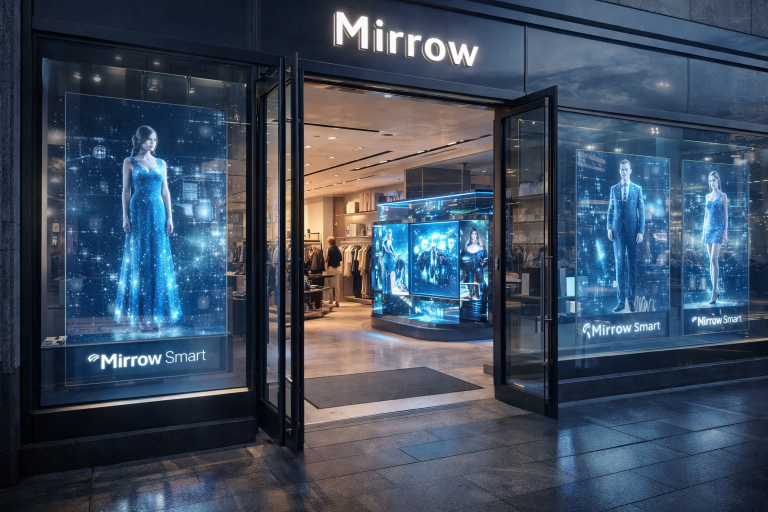
A traditional storefront is usually limited to physical products displayed inside the premises, static advertising, posters, or short-term promotional campaigns.
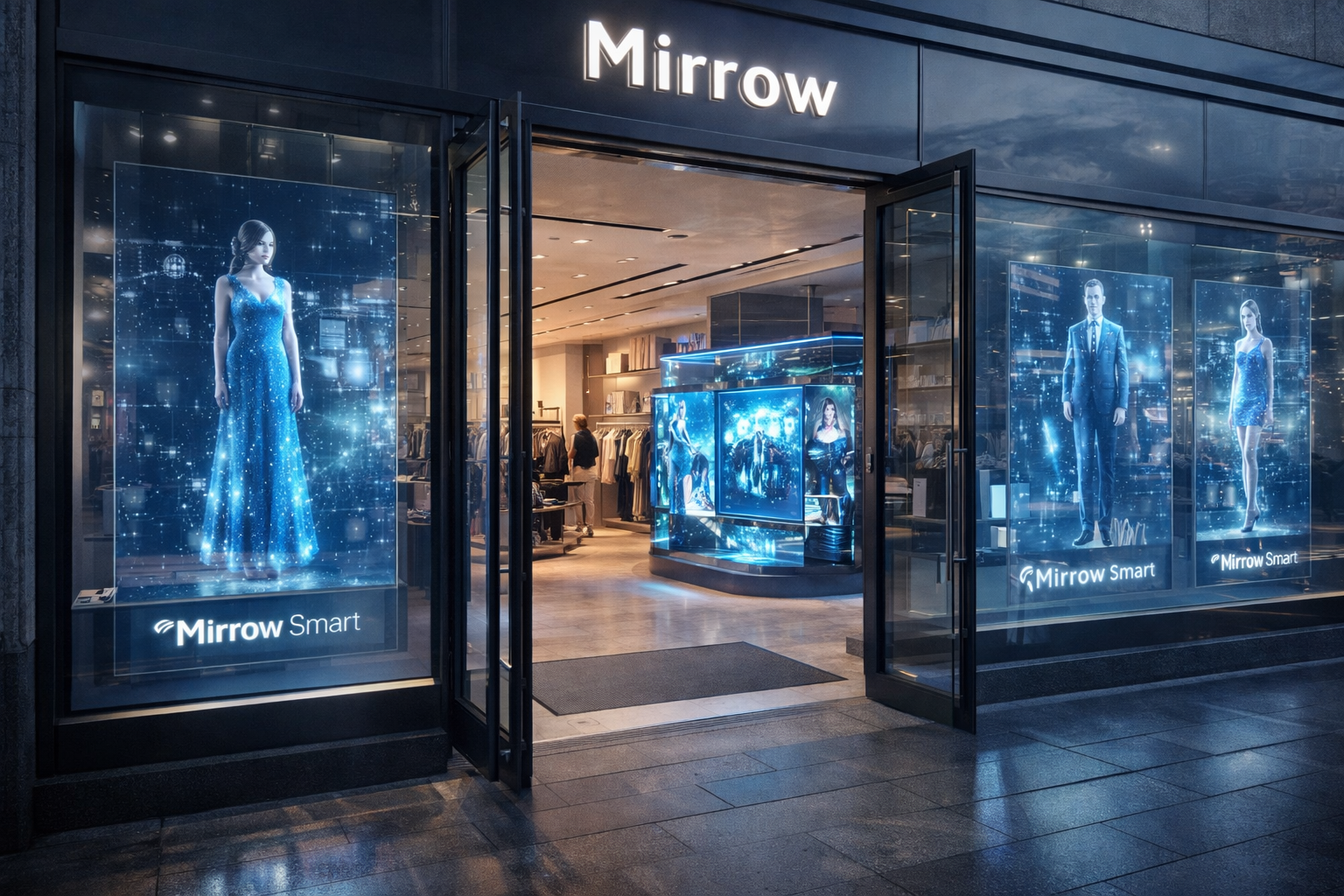
When a Smart TV is connected to the ExpoPlanet network, the same storefront becomes a dynamic digital surface capable of displaying, on a rotating basis:
- participating companies;
- physical products;
- professional services;
- technological solutions;
- artificial intelligence applications;
- industrial developments;
- cultural and audiovisual content;
- investment opportunities;
- local and international businesses;
- sector-specific exhibitions;
- educational and institutional programs.
Each participating business therefore becomes more than an individual point of sale. It becomes part of an international communication, exhibition, promotion, and commercial network.
The screen is not merely an advertising display.
It becomes an entry point into a complete digital and transactional system.
Each video or presentation may include a QR code or identifiable digital link. A passerby can scan it, access the relevant ExpoPlanet page, learn more about the company or product, request information, contact a representative, or complete a purchase.
2. A Mutual Exchange of Value
The economic foundation of the system is based on an exchange of existing capabilities.
The participating business provides:
- physical visibility;
- an Internet-connected screen;
- space in its storefront or premises;
- customer and pedestrian traffic;
- territorial presence;
- potential capacity for product collection or delivery.
ExpoPlanet.digital provides:
- audiovisual content;
- digital programming;
- online positioning;
- inclusion in directories and exhibition portals;
- web infrastructure;
- e-commerce tools;
- commercial lead-generation channels;
- payment-system integration;
- access to an international business ecosystem.
This relationship makes it possible to achieve broad physical presence with a very low marginal cost.
Instead of relying exclusively on paid billboards, urban advertising screens, or isolated promotional campaigns, ExpoPlanet uses infrastructure that already exists: commercial storefronts, screens, public-facing premises, and customer circulation.
In return, businesses receive services that they would otherwise need to acquire separately, including online visibility, e-commerce, automated sales tools, digital positioning, and access to broader markets.
This is not simply an exchange of advertising space.
It is a partnership in which local businesses exchange attention and physical presence for technology, positioning, infrastructure, and transactional capacity.
3. From Viewer to Customer
One of the central limitations of traditional advertising is the distance between seeing an advertisement and completing a purchase.
A person may notice a product, remember it, and search for it later. However, a significant number of commercial opportunities are lost during that interval.
The ExpoPlanet Smart Window Network is designed to reduce that distance.
The process may work as follows:
- A person sees a video in a storefront promoting a company, product, service, or exhibition.
- The screen displays a QR code connected directly to the relevant ExpoPlanet page.
- The person scans the code with a mobile device.
- The person accesses the exhibitor, company, product, or service page.
- The person reviews information, pricing, availability, and commercial conditions.
- The purchase is completed through the enabled payment methods.
- The customer selects local delivery, store collection, domestic shipping, or international shipping.
- The product or service is delivered through the corresponding logistics solution.
The screen therefore performs four functions simultaneously:
- exhibition;
- promotion;
- lead generation;
- commercial conversion.
The gap between visual marketing and real transactions is reduced to a few digital steps.
4. E-Commerce Infrastructure
Participating businesses will be able to access e-commerce development at cost, adapted to their size, location, commercial model, and operational requirements.
Depending on each case, the solution may include:
- digital catalogs;
- product pages;
- audiovisual presentations;
- purchase buttons;
- commercial forms;
- QR codes;
- shopping carts;
- basic order management;
- payment-system integration;
- shipping calculations;
- collection at the business premises;
- delivery coordination;
- courier integration;
- WhatsApp support;
- sales-team referrals;
- publication within ExpoPlanet exhibitions;
- positioning within Digital Cities portals;
- future integration with TaskSales.
Not every business will require the same architecture.
A café may use the network mainly to attract visitors and display cultural or commercial content.
A retail store may use it to sell physical products.
A professional firm may use it to generate inquiries, bookings, or consultations.
A manufacturer may use it as an international catalog and distribution channel.
A chamber of commerce or professional association may use it to promote its members.
The infrastructure will therefore be modular and adaptable.
5. Payment Systems
In Argentina, participating businesses may integrate payment systems such as Mercado Pago, credit cards, debit cards, bank transfers, and other available digital payment methods.
In other countries, the most suitable alternatives will be selected according to:
- local regulations;
- currency;
- banking infrastructure;
- available payment gateways;
- processing costs;
- ease of use;
- international settlement capacity.
The architecture will not be permanently tied to a single payment provider.
Each implementation will select the most efficient combination of local and international systems, according to the type of business and its target market.
For international operations, the system may incorporate multi-currency gateways, international transfers, fintech services, and payment solutions compatible with each jurisdiction.
6. Delivery and Logistics
The platform may integrate different delivery methods according to location, product type, distance, and seller capacity.
In Argentina, available options may include:
- urban courier services;
- last-mile delivery operators;
- platform-based delivery services;
- postal services;
- private parcel companies;
- pickup at the participating business;
- collection points;
- deliveries coordinated directly by the seller.
For national and international operations, the system may incorporate:
- national postal operators;
- private logistics companies;
- courier services;
- fulfillment centers;
- door-to-door delivery;
- specialized freight operators;
- pickup-point networks;
- international parcel services.
Each logistics integration must be adapted to the country, city, type of product, and available service providers.
The system must also consider:
- shipping costs;
- delivery coverage;
- estimated delivery times;
- product weight and dimensions;
- order tracking;
- return policies;
- insurance;
- customs requirements;
- restricted goods;
- tax documentation;
- seller responsibilities.
The objective is not to impose a single logistics provider.
The objective is to build a flexible connection layer between buyers, sellers, participating venues, and delivery operators.
7. Each Business as a Micro-Distribution Center
Every participating business may progressively perform three simultaneous functions.
Visibility Point
The screen displays ExpoPlanet content and creates physical presence for participating companies and exhibitors.
Commercial Access Point
Customers can scan QR codes, review offers, request information, or complete purchases.
Logistics Point
The business may operate as a collection point, delivery point, temporary storage point, demonstration venue, or local coordination center.
This transforms local businesses into decentralized micro-centers for promotion, access, sales, and distribution.
During the first stage, a business may simply display content.
During the second stage, it may sell its own products.
During the third stage, it may incorporate products from other companies within the ecosystem.
At a more advanced stage, it may operate as a local collection, representation, demonstration, or distribution point.
This evolution can occur gradually, without requiring a complete operational transformation from the beginning.
8. A Networked Urban Infrastructure
When multiple businesses in the same city participate, a distributed territorial network is formed.
A commercial street, gallery, downtown district, tourism corridor, or gastronomic area may incorporate dozens of connected screens.
Each screen retains its local identity while receiving content from a shared programming infrastructure.
In a city such as Mar del Plata, the network could expand across:
- Güemes Street;
- San Martín Street;
- commercial galleries;
- cafés;
- restaurants;
- hotels;
- coworking spaces;
- cultural centers;
- universities;
- real estate offices;
- technology retailers;
- tourism establishments;
- professional offices.
The city progressively becomes a distributed exhibition environment.
ExpoPlanet exhibitions no longer exist only inside websites. They become physically visible through multiple urban locations.
Every storefront becomes a window into an international ecosystem.
9. Content Programming
Programming must be organized to avoid excessive repetition, saturation, or loss of public interest.
Content may be classified according to:
- industry;
- category;
- language;
- city;
- country;
- audience profile;
- time of day;
- duration;
- campaign;
- exhibition;
- season;
- special event.
A screen located in a coworking space may prioritize startups, artificial intelligence, training, innovation, and professional services.
A hotel may display tourism, culture, hospitality, gastronomy, local experiences, and entertainment.
A technology retailer may present software, robotics, hardware, digital tools, and business solutions.
A screen inside a commercial gallery may combine retail products, fashion, food, entertainment, cultural programming, and AICine content.
Programming may be general or specifically adapted to the profile and location of each participating venue.
10. Short, Clear, and Transactional Content
Videos designed for storefronts must be understandable without audio or with limited sound.
They should therefore include:
- clearly visible branding;
- a concise main message;
- subtitles;
- strong visual content;
- a clearly identifiable product or service;
- a direct call to action;
- a QR code;
- a web address;
- short duration;
- essential information only.
The purpose is not to reproduce long corporate presentations.
The purpose is to create content capable of attracting attention within a few seconds.
Each video should answer four essential questions:
- What is being offered?
- What problem does it solve?
- Why is it relevant?
- How can the viewer purchase it or establish contact?
11. Benefits for Participating Businesses
Partner businesses may receive:
- free positioning within ExpoPlanet exhibitions;
- inclusion in international directories;
- recognition as an official partner venue;
- increased visibility;
- technological differentiation;
- access to audiovisual content;
- connection with new audiences;
- increased potential foot traffic;
- e-commerce tools at cost;
- automated payment and inquiry systems;
- access to commercial campaigns;
- integration with Digital Cities;
- potential participation in TaskSales;
- opportunities to market their own products and third-party products.
For many businesses, the main value will not be the screen itself.
The principal value will be their incorporation into a broader digital and commercial infrastructure.
12. Benefits for Exhibitors
Companies participating in ExpoPlanet exhibitions will be able to move from an exclusively online presence to a hybrid physical and digital presence.
Their content may circulate simultaneously through:
- websites;
- directories;
- social media;
- videos;
- streaming channels;
- international portals;
- commercial screens;
- cultural venues;
- coworking spaces;
- hotels;
- cafés;
- urban storefronts.
This increases exhibition frequency and multiplies the number of contact points with potential customers.
A company located in one country may gain audiovisual presence in a storefront in Mar del Plata, Buenos Aires, Miami, Dakar, Rio de Janeiro, Dubai, or any other city integrated into the network.
13. Benefits for the Public
Members of the public will be able to discover companies, products, services, and solutions while moving through the city.
They will not need to enter a traditional exhibition, search for a specific platform, or attend a scheduled event.
Content will appear within accessible everyday spaces.
Users will be able to:
- observe;
- discover;
- compare;
- scan;
- request information;
- purchase;
- request a demonstration;
- contact a company;
- receive a product;
- collect a purchase from a nearby location.
The city becomes an interactive commercial interface.
14. Integration with AICine
The same venue network may combine cultural and commercial programming.
At selected times, screens may display:
- film trailers;
- short films;
- festival announcements;
- filmmaker interviews;
- director presentations;
- AICine content.
At other times, the same screens may display:
- products;
- companies;
- services;
- sector-specific exhibitions;
- commercial opportunities;
- institutional presentations;
- educational programs.
The AICine model already proposes a decentralized international network of venues that brings AI-generated cinema to local audiences through connected screens and QR codes.
The ExpoPlanet Smart Window Network adds a commercial layer to this infrastructure without eliminating its cultural function.
The same screen can operate as:
- a distributed cinema;
- an advertising channel;
- a digital catalog;
- a sales point;
- a networking space;
- an e-commerce interface.
15. Integration with TaskSales
At a later stage, participating businesses may join TaskSales, the decentralized commercial network of the ecosystem.
This would allow a business not only to sell its own products and services, but also to act as a sales or referral channel for products and services offered by other companies integrated into the system.
When a sale can be attributed to a participating business, promoter, institution, association, or commercial node, the corresponding fee or commission may be applied according to the rules of the system.
The storefront therefore stops being a passive advertising surface and becomes a potential revenue-generating unit.
Every screen may attract customers.
Every QR code may identify the origin of a commercial inquiry.
Every transaction may record which venue or partner generated the opportunity.
Every node may participate in a transparent commercial revenue-sharing model.
16. Traceability and Performance Measurement
For the system to be commercially sustainable, the performance of each venue must be measurable.
Relevant indicators may include:
- number of active screens;
- hours of content displayed;
- videos played;
- QR-code scans;
- visits generated;
- inquiries;
- completed forms;
- sales;
- average transaction value;
- most-viewed products;
- most effective time periods;
- cities with the highest activity;
- performance by venue;
- performance by campaign;
- conversion rate;
- operating cost per transaction.
Each business may receive a specific QR code, link, campaign code, or identification system.
This will make it possible to determine which storefront, city, venue, campaign, or video generated each interaction.
17. System Governance
The participation of businesses must be regulated through clear and practical terms.
These may define:
- minimum technical requirements;
- authorized use of content;
- display schedules;
- campaign duration;
- visual identity standards;
- trademark protection;
- sales responsibilities;
- logistics responsibilities;
- data protection;
- payment conditions;
- return policies;
- commercial attribution rules;
- conditions for free positioning;
- conditions for e-commerce development at cost;
- continuation or suspension of participation.
Participation should remain flexible while maintaining consistent operational standards.
The business will preserve its commercial independence.
ExpoPlanet will manage the shared infrastructure, exhibition programming, digital positioning, and technological integrations.
18. Progressive Implementation
The network may be launched through four stages.
Stage One: Pilot Network
A limited group of businesses with visible Smart TVs or digital screens is selected.
The objectives will be to:
- verify reproduction quality;
- test QR codes;
- measure interactions;
- validate public interest;
- adjust video duration;
- evaluate business participation.
Stage Two: Digital Integration
Commercial pages for participating venues are created or adapted.
This stage may include:
- business profiles;
- digital catalogs;
- contact buttons;
- payment systems;
- tracking codes;
- product links.
Stage Three: Transactional Integration
Payments, orders, and logistics are connected.
Each business may determine whether it operates as:
- a seller;
- a pickup point;
- an exhibition venue;
- a promoter;
- a distributor;
- a TaskSales node.
Stage Four: International Scalability
The model is replicated in other cities and countries, adapting:
- language;
- currency;
- payment systems;
- logistics providers;
- commercial regulations;
- taxation;
- delivery methods;
- consumer behavior.
19. Three Central Tactical Objectives
Physical Omnipresence with Low Marginal Cost
The system uses advertising inventory that already exists within local businesses: storefronts, screens, physical venues, and pedestrian traffic.
In exchange, ExpoPlanet provides positioning, technology, e-commerce development, and access to a global ecosystem.
Direct Conversion at the Point of Contact
The viewer can immediately become a visitor, commercial lead, or buyer through a QR code and a simplified sales process.
Advertising stops being merely informative and becomes transactional.
Decentralized Logistics and Distribution
Participating businesses can progressively become exhibition, pickup, sales, and distribution points.
The commercial network no longer depends on a single central location and becomes distributed across the city.
20. A New Physical-Digital Infrastructure
The ExpoPlanet Smart Window Network should not be understood as a campaign of isolated screens.
It is a hybrid infrastructure connecting:
- digital content;
- physical spaces;
- local businesses;
- international companies;
- payment systems;
- logistics;
- e-commerce;
- advertising;
- culture;
- networking;
- distribution.
Its main innovation is the integration of elements that usually operate separately.
Advertising is connected to sales.
Sales are connected to logistics.
Logistics are connected to local businesses.
Local businesses are connected to an international platform.
The screen is connected to the website.
The website is connected to the city.
The city is connected to the global market.
Strategic Summary
The incorporation of businesses with Smart TVs in their storefronts transforms the ExpoPlanet network into a distributed, visible, and transactional commercial infrastructure.
Businesses provide urban presence.
ExpoPlanet provides content, positioning, and technology.
Exhibitors obtain physical visibility.
The public gains direct access to products and services.
Payment systems enable transactions.
Logistics operators complete delivery.
Every participating venue may become a node of visibility, sales, collection, and distribution.
When the system is replicated across multiple businesses, neighborhoods, cities, and countries, it forms a network capable of integrating promotion, e-commerce, and logistics within a single architecture.
ExpoPlanet exhibitions therefore cease to be exclusively digital events.
They become a permanent omnichannel commercial infrastructure distributed throughout the everyday physical spaces of cities.