


Global Solidarity is not just another NGO, charity project or “good intentions” platform. It is a new type of global system designed to connect business, technology, education, trade and humanitarian action inside the same network.
The traditional model is simple: companies make money first, and maybe later donate a small part. Global Solidarity changes that logic completely.
Instead of waiting for donations, the system generates its own cash flow through business, e-commerce, AI services, education, automation, exports, digital marketplaces and international partnerships. Then, a fixed part of the profits is automatically redirected to humanitarian aid, sustainable development and global transformation projects.
In other words:
💡 First generate. Then redistribute. Then scale.
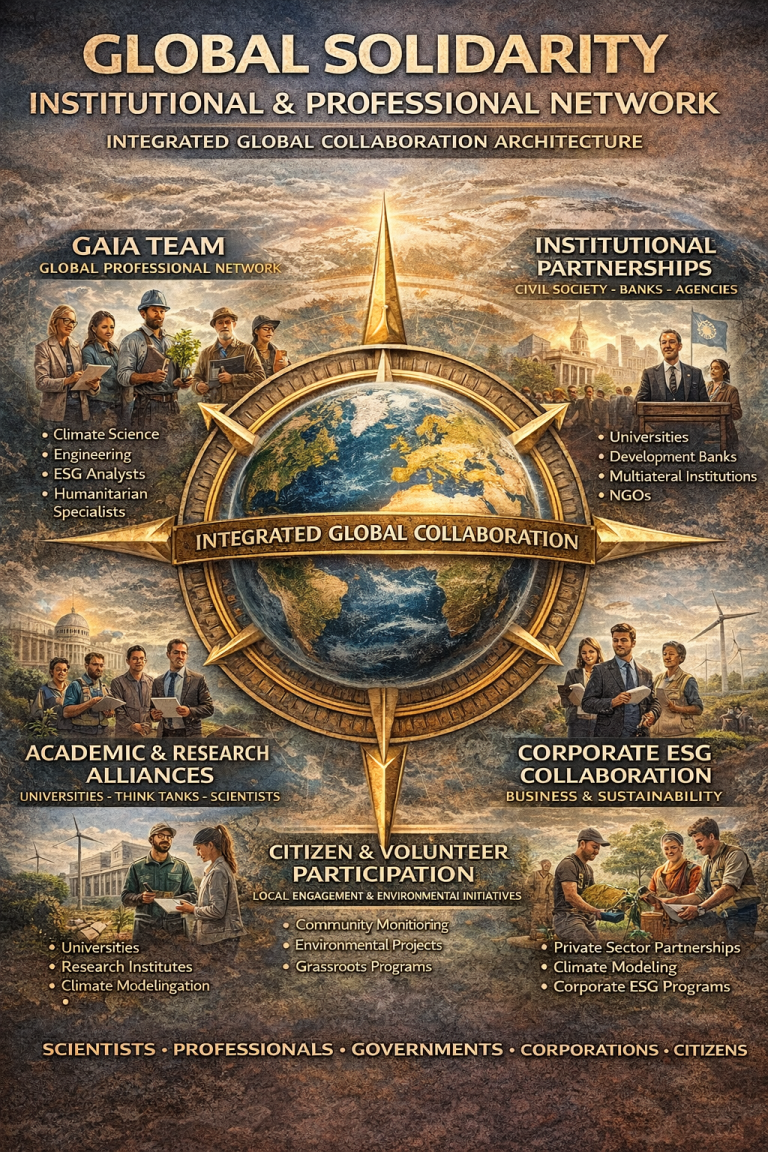
Global Solidarity works like an interconnected ecosystem made of several divisions:
• Gen Academy → trains people, gives them skills and connects them to remote work and international markets.
• AIUCIP → helps companies, stores and professionals sell more, automate, export and grow.
• MegaStore → humanitarian e-commerce: people buy products and part of the profits help feed children, support NGOs or finance sustainable projects.
• Mayday → applies the funds directly to urgent humanitarian and environmental needs.
• SpaceArch Solutions → creates the technology, infrastructure, AI systems and business architecture behind the network.
• YoungSoftPower → brings young talent into the system and turns them into operators, freelancers, creators and future entrepreneurs.
• Digital Labs → develops new products, solutions and business models.
The interesting part is that every area feeds the others.
A student learns in Gen Academy, then starts working through AIUCIP or MegaStore. Those activities create sales and revenue. Part of that money goes to Mayday and sustainable projects. Those projects create new jobs, more training, more business and more growth.
So the system becomes self-financing.
That is the real difference between Global Solidarity and traditional charity. Charity usually depends on donations, governments or external support. Global Solidarity creates its own economic engine.
The key idea is that solidarity can also be profitable.
Not “profitable” in the selfish sense, but because a stronger and bigger system can help more people.
The formula is very simple:
More business → more revenue → more humanitarian funds → more stability → more development → more business.
A virtuous circle.
Technology is central to this idea because today it is possible to coordinate thousands or millions of people through AI, automation, online platforms, digital payments, CRM systems, dashboards and global marketplaces.
With this kind of structure:
• A small business in Mar del Plata can sell to Dubai.
• A student in Argentina can learn, work remotely and earn in dollars.
• A company can automatically donate part of its sales.
• Investors can see exactly where the money goes.
• Every project can be tracked with total transparency.
That last point is extremely important.
One of the biggest problems with traditional NGOs is that people do not trust them. They often think the money disappears into bureaucracy. Global Solidarity solves that by using radical transparency: open reports, public dashboards, traceable projects and clear results.
“Every dollar generated, every dollar invested and every dollar donated can be tracked.”
Global Solidarity also introduces another important idea: technological equality.
Today, the new form of inequality is not only about money. It is also about access to technology, AI, education, internet, remote work and global markets.
People without those tools are left behind.
That is why the system does not only give help. It gives people the tools to create their own future:
• affordable education;
• AI tools;
• remote work;
• international sales;
• automation;
• global visibility.
The goal is not only to transfer money.
The goal is to transfer capacity.
Mar del Plata plays a very special role inside this model. It becomes the pilot city, the first operational node, where the system is tested and developed before expanding to Argentina, Latin America, Dubai and the rest of the world.
From there, the network can grow through new nodes in other cities and countries.
At the end, Global Solidarity can be summarized in one sentence:
🚀 Global Solidarity turns solidarity from an occasional emotional act into a permanent, scalable and technology-driven economic system.