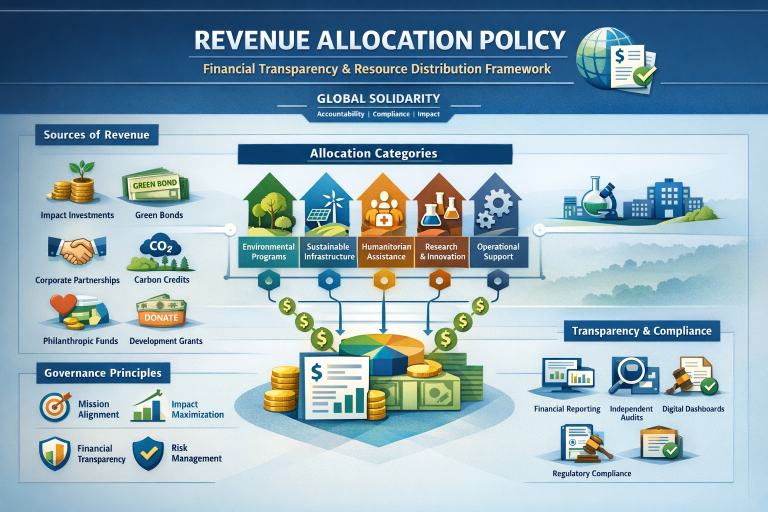






Institutional Governance & Financial Architecture
Global Solidarity Platform
The Legal & SPIV Structure defines the legal and financial framework through which Global Solidarity organizes, governs, and finances its large-scale environmental, humanitarian, and sustainable infrastructure initiatives.
Given the complexity and scale of the programs envisioned—spanning climate mitigation, ecosystem restoration, humanitarian assistance, and sustainable economic development—the platform requires a robust legal architecture capable of supporting international capital flows, institutional partnerships, and multi-jurisdictional project deployment.
The framework integrates corporate governance, project financing structures, and international legal compliance mechanisms to ensure transparency, accountability, and operational scalability.
1. Conceptual Definition
The Legal & SPIV (Special Purpose Investment Vehicle) Structure refers to the system of legally defined entities through which Global Solidarity organizes investment capital, manages project financing, and allocates financial resources to sustainability initiatives.
SPIV entities are structured legal vehicles created for the purpose of financing and managing specific projects or investment portfolios.
These entities provide a transparent and controlled financial environment that separates project financing from the core organizational structure.
Through this structure, Global Solidarity enables:
• institutional participation in sustainability financing
• efficient capital allocation to specific projects
• financial risk compartmentalization
• regulatory compliance across jurisdictions
2. Strategic Hypothesis
The Legal & SPIV Structure is based on several principles of international project finance and institutional governance.
- Large-scale sustainability initiatives require specialized financial vehicles.
- Project-specific legal entities improve transparency and accountability.
- Structured investment vehicles reduce financial and operational risk.
- Institutional investors require legally defined financing structures.
- Segregation of project assets protects the financial stability of the broader organization.
- Legal clarity improves cross-border collaboration and regulatory compliance.
- Structured project financing facilitates capital mobilization at scale.
- Legal governance frameworks support long-term institutional credibility.
Under this model, SPIV entities function as modular financial structures enabling scalable investment in sustainability projects.
3. Legal Governance Architecture
The Global Solidarity legal architecture is designed as a multi-layered governance structure.
This structure may include:
• a central coordinating entity responsible for strategic governance
• regional operational entities managing program deployment
• project-specific SPIV entities responsible for financing and execution
• regulatory compliance and oversight mechanisms
This modular legal framework allows the platform to operate across multiple jurisdictions while maintaining consistent governance standards.
4. Special Purpose Investment Vehicles (SPIV)
SPIV entities are independent legal structures created to finance and manage individual projects or portfolios of sustainability initiatives.
Each SPIV is typically established for a specific purpose, such as:
• financing reforestation programs
• funding renewable energy infrastructure
• supporting climate resilience projects
• developing humanitarian logistics systems
By isolating project financing within dedicated entities, SPIV structures enhance financial transparency and operational accountability.
5. Risk Segregation
One of the primary advantages of SPIV structures is the segregation of financial risk.
By separating project assets and liabilities from the core organizational structure, SPIV entities limit the exposure of the broader platform to project-specific risks.
This risk segregation:
• protects the financial integrity of the central organization
• allows independent evaluation of project performance
• facilitates structured financing arrangements with institutional investors
Risk segregation is a standard mechanism in international infrastructure financing.
6. Capital Structuring
SPIV entities enable the structuring of different layers of investment capital.
These capital layers may include:
• equity investment from institutional partners
• debt financing from financial institutions
• green bonds or sustainability-linked financial instruments
• philanthropic or impact investment contributions
Structured capital stacks allow diverse investors to participate according to their risk tolerance and investment objectives.
7. Regulatory Compliance
The Legal & SPIV Structure is designed to operate in compliance with international regulatory frameworks governing financial transactions, investment vehicles, and sustainability financing.
Compliance considerations may include:
• corporate governance standards
• financial reporting requirements
• environmental and social impact regulations
• anti-money laundering and financial transparency regulations
Regulatory alignment ensures that the platform operates within recognized legal frameworks.
8. Governance of SPIV Entities
Each SPIV may operate under a defined governance structure that ensures accountability and transparency.
Typical governance mechanisms may include:
• board oversight structures
• financial reporting requirements
• independent auditing procedures
• compliance and regulatory monitoring
These governance mechanisms ensure that project financing is managed responsibly.
9. Financial Transparency
SPIV entities enable transparent tracking of financial flows associated with individual projects.
This transparency facilitates:
• investor oversight
• performance monitoring
• impact evaluation
• regulatory compliance
Transparent financial reporting improves institutional credibility and stakeholder trust.
10. Investor Participation
The Legal & SPIV Structure allows participation by multiple categories of investors.
These may include:
• institutional investors
• development banks
• sovereign wealth funds
• impact investment funds
• private sector partners
Structured investment vehicles allow capital to be deployed in a controlled and transparent manner.
11. International Project Financing
Many Global Solidarity initiatives involve cross-border projects requiring coordination between multiple jurisdictions.
SPIV structures provide a legal framework capable of managing:
• international investment flows
• cross-border project contracts
• regulatory compliance across jurisdictions
• currency and financial settlement mechanisms
This legal flexibility is essential for large-scale global sustainability initiatives.
12. Project Governance
Each project financed through an SPIV may operate under defined governance and management protocols.
These protocols may include:
• project management structures
• financial oversight mechanisms
• environmental and social impact monitoring
• compliance and reporting procedures
Structured governance ensures responsible project implementation.
13. Legal Risk Management
Legal risks associated with international project financing may include regulatory uncertainty, contractual disputes, or jurisdictional complexities.
The Legal & SPIV Structure incorporates mechanisms designed to mitigate such risks, including:
• standardized contractual frameworks
• legal due diligence procedures
• regulatory compliance monitoring
• dispute resolution mechanisms
These safeguards protect both the organization and participating investors.
14. Comparative Institutional Perspective
Traditional charitable organizations often rely on centralized funding structures that limit financial scalability.
The Legal & SPIV Structure differs by adopting financial mechanisms commonly used in international infrastructure financing and institutional investment management.
This approach allows sustainability initiatives to access larger pools of capital while maintaining financial transparency and accountability.
15. Scalability of the Legal Structure
The modular nature of SPIV entities enables the platform to scale its operations as new projects and programs are developed.
New SPIV entities may be created to finance additional initiatives without affecting existing project structures.
This modular approach supports the expansion of Global Solidarity programs across different geographic regions and sectors.
16. Institutional Credibility
Institutional investors and development banks typically require clear legal frameworks before participating in sustainability financing.
The Legal & SPIV Structure enhances credibility by providing:
• defined governance mechanisms
• transparent financial reporting
• structured project financing frameworks
• clear legal accountability
These features improve the platform’s capacity to attract institutional capital.
17. Long-Term Strategic Objective
The long-term objective of the Legal & SPIV Structure is to establish a legal and financial architecture capable of supporting the mobilization of large-scale capital for sustainability initiatives while maintaining full regulatory compliance and governance transparency.
By combining project-specific investment vehicles with strong legal governance frameworks, Global Solidarity aims to create a stable and scalable financial infrastructure for environmental and humanitarian programs.
18. Strategic Conclusion
The Legal & SPIV Structure represents a central component of the financial and governance architecture of the Global Solidarity platform.
Through modular investment vehicles, transparent financial governance, and strong regulatory compliance mechanisms, the framework enables efficient capital mobilization and responsible management of sustainability investments.
This legal architecture supports the long-term operational stability and institutional credibility of Global Solidarity’s global initiatives.