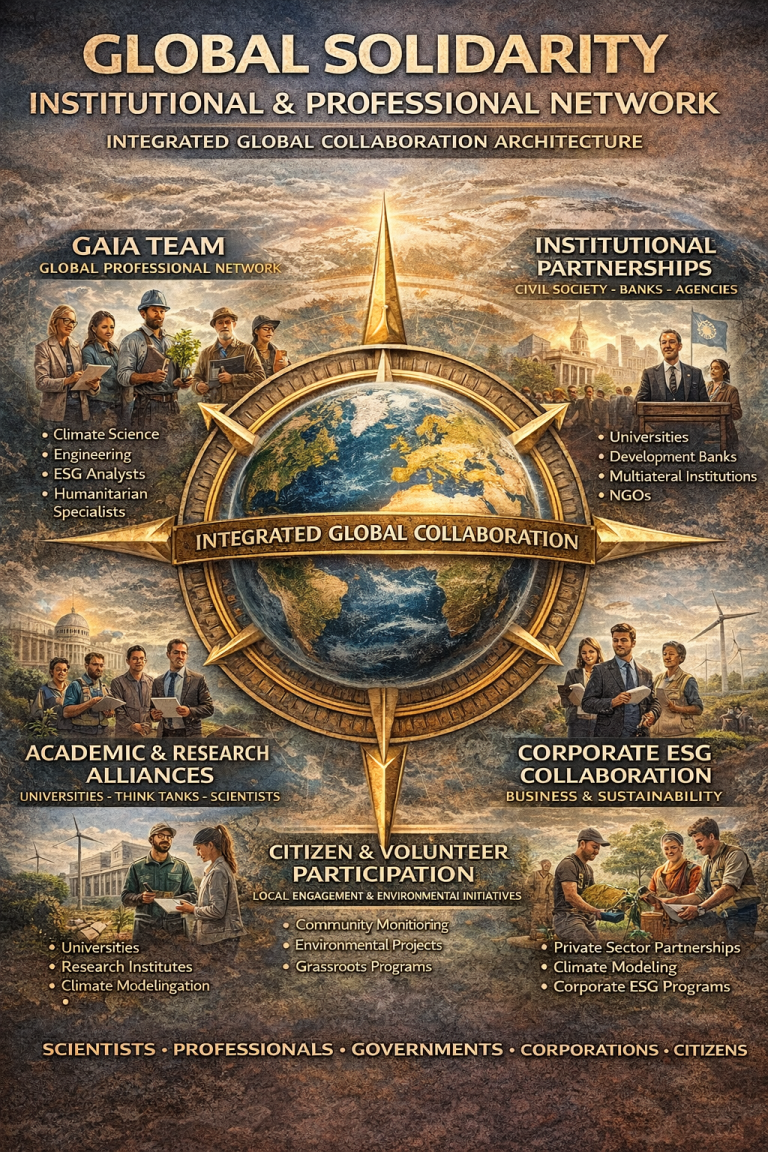






Scientific Collaboration Framework for Global Sustainability
1. Conceptual Definition
The Academic & Research Alliances Program is the institutional framework through which Global Solidarity collaborates with universities, research centers, scientific institutions, and academic networks worldwide.
Its purpose is to integrate scientific knowledge, technological innovation, and interdisciplinary research into the design, implementation, and evaluation of sustainability initiatives.
The program recognizes that complex global challenges—such as climate change, ecosystem degradation, water scarcity, and humanitarian crises—require rigorous scientific research and evidence-based policy development.
Academic partnerships allow Global Solidarity to combine operational capabilities with the analytical power of the global scientific community.
2. Strategic Hypothesis
The Academic & Research Alliances framework is based on several structural assumptions regarding the role of scientific knowledge in addressing global challenges.
- Scientific research is essential for understanding complex environmental and social systems.
- Evidence-based decision-making improves the effectiveness of sustainability initiatives.
- Universities and research institutions represent critical sources of innovation and technical expertise.
- Interdisciplinary collaboration accelerates problem-solving.
- Data-driven research enhances the credibility of sustainability initiatives.
- Academic partnerships strengthen institutional legitimacy.
- Long-term sustainability strategies require continuous research and monitoring.
- Global scientific networks facilitate international cooperation and knowledge sharing.
Under this framework, academic institutions become strategic partners in the development of sustainable solutions.
3. Areas of Academic Collaboration
Academic and research institutions may collaborate with Global Solidarity across several key domains.
Climate Science and Environmental Systems
Research partnerships may focus on:
• climate modeling and forecasting
• ecosystem resilience studies
• biodiversity conservation strategies
• carbon cycle analysis
• environmental monitoring technologies
These research activities support the design of climate mitigation and adaptation initiatives.
Sustainable Infrastructure and Engineering
Universities with engineering and urban planning expertise may contribute to:
• renewable energy system design
• sustainable water infrastructure
• climate-resilient urban development
• environmental engineering innovations
Academic research helps improve the technical feasibility of sustainability projects.
Environmental Economics and Sustainable Finance
Research institutions specializing in economics and finance may contribute to:
• impact investment models
• carbon market analysis
• environmental cost-benefit evaluation
• sustainable financial instruments
This research supports the development of the Global Financing Architecture.
Humanitarian Systems and Social Resilience
Social science departments may collaborate on research related to:
• climate migration dynamics
• community resilience strategies
• disaster response systems
• humanitarian logistics
Understanding social dynamics improves the effectiveness of humanitarian programs.
4. Research Integration Model
The Academic & Research Alliances Program integrates research outputs into the operational structure of Global Solidarity.
Research contributions may be incorporated through:
• technical reports supporting project design
• data analysis for environmental monitoring
• policy recommendations for sustainability governance
• evaluation frameworks for measuring program impact
Scientific knowledge becomes directly integrated into operational decision-making.
5. Collaborative Research Programs
Global Solidarity may establish collaborative research initiatives with academic partners.
Examples include:
• climate risk assessment programs
• environmental monitoring networks
• sustainable infrastructure innovation labs
• environmental data analysis platforms
• interdisciplinary sustainability research centers
These programs enable long-term collaboration between researchers and practitioners.
6. Student and Academic Engagement
The Academic & Research Alliances Program also supports participation by students and early-career researchers.
Opportunities may include:
• research internships
• field research participation
• collaborative research projects
• graduate thesis partnerships
• sustainability innovation competitions
Such programs strengthen the connection between academic education and real-world sustainability initiatives.
7. Data and Knowledge Exchange
Academic partnerships facilitate the exchange of data and knowledge between institutions and Global Solidarity.
This may include:
• open research datasets
• collaborative publications
• joint research reports
• scientific conferences and workshops
Knowledge exchange promotes interdisciplinary learning and innovation.
8. Scientific Advisory Role
Academic partners may also contribute to Global Solidarity through participation in scientific advisory structures.
Researchers may provide expertise in areas such as:
• environmental science
• climate modeling
• sustainable engineering
• public policy
• humanitarian systems
Scientific advisors contribute to the strategic and technical quality of sustainability initiatives.
9. Research Impact and Policy Development
Academic research contributes not only to project design but also to broader policy discussions.
Research findings may inform:
• national sustainability strategies
• international environmental agreements
• climate policy development
• environmental regulation frameworks
Through research collaboration, Global Solidarity initiatives contribute to knowledge generation at the global level.
10. Comparative Perspective
Traditional sustainability initiatives often rely on operational implementation without sufficient integration of scientific research.
The Academic & Research Alliances model differs by embedding scientific research within operational frameworks.
This approach enables:
• more accurate environmental analysis
• improved project design
• stronger policy alignment
• higher institutional credibility
Scientific integration strengthens the long-term effectiveness of sustainability programs.
11. Institutional Benefits
Academic collaboration generates several strategic advantages for the Global Solidarity platform.
These include:
• access to advanced research expertise
• improved scientific credibility
• data-driven project evaluation
• expanded international cooperation networks
• accelerated technological innovation
Such benefits enhance the institutional capacity of Global Solidarity.
12. Long-Term Strategic Objective
The long-term objective of the Academic & Research Alliances Program is to create a global knowledge network dedicated to sustainability innovation.
By connecting academic institutions with operational sustainability initiatives, the program seeks to accelerate the development of solutions addressing environmental and humanitarian challenges.
13. Strategic Conclusion
The Academic & Research Alliances framework represents a critical pillar of the Global Solidarity platform.
Through structured collaboration with universities and research institutions, the platform integrates scientific knowledge into sustainability initiatives, ensuring that environmental restoration, climate resilience, and humanitarian programs are guided by rigorous research and evidence-based methodologies.
In doing so, the program strengthens the capacity of Global Solidarity to operate as a scientifically informed and institutionally credible global platform for sustainable development.
Technology & Data Infrastructure
Digital Backbone for Global Sustainability Systems
1. Conceptual Definition
The Technology & Data Infrastructure (TDI) represents the digital and technological backbone of the Global Solidarity platform.
It integrates advanced information systems, data analytics tools, environmental monitoring technologies, and digital collaboration platforms to support the design, coordination, implementation, and evaluation of sustainability initiatives.
The infrastructure connects multiple operational layers, including:
• environmental monitoring networks
• financial tracking systems
• project management platforms
• impact measurement frameworks
• global data repositories
Through this integrated digital architecture, Global Solidarity transforms complex sustainability operations into data-driven systems capable of operating at global scale.
2. Strategic Hypothesis
The Technology & Data Infrastructure framework is based on several fundamental assumptions regarding the role of technology in large-scale sustainability initiatives.
- Complex environmental systems require advanced data analysis for effective management.
- Digital infrastructure enables coordination across geographically distributed institutions.
- Real-time monitoring improves environmental risk detection.
- Data-driven decision-making enhances project effectiveness.
- Artificial intelligence can accelerate environmental modeling and forecasting.
- Digital transparency systems strengthen institutional accountability.
- Global data networks enable collaborative research and innovation.
- Technology platforms improve operational scalability and efficiency.
Under this framework, technological systems function as core operational infrastructure for global sustainability governance.
3. Core Technology Pillars
The Technology & Data Infrastructure architecture is structured around five key technological pillars:
1️⃣ Environmental Monitoring Systems
2️⃣ Data Analytics & Modeling Platforms
3️⃣ Digital Collaboration Infrastructure
4️⃣ Financial & Impact Tracking Systems
5️⃣ Transparency & Open Data Platforms
These components work together to create an integrated digital ecosystem supporting Global Solidarity initiatives.
4. Environmental Monitoring Systems
Environmental monitoring systems collect real-time data regarding environmental conditions and ecosystem health.
These systems may integrate data from:
• satellite observation networks
• climate monitoring stations
• ocean and atmospheric sensors
• remote sensing technologies
• biodiversity monitoring platforms
Environmental data provides the scientific foundation for evaluating ecological trends and guiding sustainability strategies.
5. Data Analytics & Modeling Platforms
Advanced data analytics platforms process large datasets related to environmental conditions, climate patterns, and sustainability projects.
These platforms may incorporate:
• climate simulation models
• carbon cycle analysis tools
• geographic information systems (GIS)
• predictive analytics systems
• artificial intelligence algorithms
Such analytical capabilities enable the identification of environmental risks and opportunities.
6. Geographic Intelligence Systems
Geographic intelligence systems provide spatial analysis capabilities that support environmental planning and project implementation.
These systems integrate:
• satellite imagery
• geographic information systems
• environmental mapping tools
• spatial data analytics
Geographic intelligence supports the identification of priority regions for environmental restoration and sustainability initiatives.
7. Digital Collaboration Infrastructure
Global sustainability initiatives require collaboration among numerous institutions and professionals.
Digital collaboration systems support coordination through:
• project management platforms
• research collaboration tools
• communication networks for institutional partners
• knowledge-sharing databases
These tools enable effective collaboration across international networks.
8. Financial & Impact Tracking Systems
Technology platforms also support financial transparency and project impact monitoring.
Key components include:
• financial transaction tracking systems
• project expenditure monitoring
• environmental impact measurement tools
• sustainability performance dashboards
These systems ensure that financial resources and project outcomes are accurately monitored.
9. Artificial Intelligence Integration
Artificial intelligence technologies can enhance sustainability initiatives by supporting:
• climate prediction models
• environmental risk analysis
• optimization of resource allocation
• large-scale data analysis
AI-based systems can identify patterns and insights that would be difficult to detect through conventional analysis.
10. Transparency & Open Data Platforms
The Technology & Data Infrastructure includes digital platforms designed to provide transparency regarding Global Solidarity operations.
These platforms may offer public access to:
• project data
• environmental impact metrics
• financial allocation summaries
• geographic project distribution
Open data systems increase accountability and enable independent research.
11. Cybersecurity & Data Integrity
Given the importance of digital infrastructure, robust cybersecurity measures are necessary to protect data integrity.
Cybersecurity frameworks may include:
• secure data storage systems
• encrypted communication channels
• identity verification protocols
• data integrity monitoring systems
Strong cybersecurity protects institutional and operational information.
12. Comparative Perspective
Many sustainability initiatives rely on fragmented information systems that limit operational efficiency.
The Technology & Data Infrastructure differs by integrating:
• environmental monitoring
• financial tracking
• project management
• transparency reporting
into a unified digital architecture.
This integration improves coordination, efficiency, and accountability.
13. System-Level Benefits
The Technology & Data Infrastructure generates several operational advantages.
These include:
• improved environmental monitoring capabilities
• enhanced decision-making through data analysis
• increased operational transparency
• improved collaboration across institutions
• scalable digital infrastructure for global operations
Technology becomes an enabling factor for large-scale sustainability initiatives.
14. Long-Term Strategic Objective
The long-term objective of the Technology & Data Infrastructure is to create a global digital ecosystem supporting environmental intelligence, sustainability governance, and collaborative research.
Through advanced technological systems, Global Solidarity aims to improve the coordination and effectiveness of sustainability initiatives worldwide.
15. Strategic Conclusion
The Technology & Data Infrastructure represents a fundamental pillar of the Global Solidarity platform.
By integrating environmental monitoring systems, advanced data analytics, digital collaboration tools, and transparency platforms, the infrastructure provides the technological foundation necessary for coordinated global action addressing environmental and humanitarian challenges.
In doing so, technology becomes a key driver enabling the transformation toward a more sustainable and resilient global system.